
AS June 2019 Paper 1 Q8
8. A gas company maintains a straight pipeline that passes under a mountain.
The pipeline is modelled as a straight line and one side of the mountain is modelled as a plane.
There are accessways from a control centre to two access points on the pipeline.
Modelling the control centre as the origin \(O\), the two access points on the pipeline have coordinates \(P(-300, 400, -150)\) and \(Q(300, 300, -50)\), where the units are metres.
The equation of the plane modelling the side of the mountain is \(2x + 3y - 5z = 300\)
The company wants to create a new accessway from this side of the mountain to the pipeline.
The accessway will consist of a tunnel of shortest possible length between the pipeline and the point \(M(100, k, 100)\) on this side of the mountain, where \(k\) is a constant.
It is only practical to construct the new accessway if it will be significantly shorter than both of the existing accessways, \(OP\) and \(OQ\).
| Scheme | Marks | AO |
|---|---|---|
| Note: Allow alternative vector forms throughout, e.g. row vectors, \(\mathbf{i}\), \(\mathbf{j}\), \(\mathbf{k}\) notation \(\mathbf{b} = \pm\left[\begin{pmatrix}300\\ 300\\ -50\end{pmatrix} - \begin{pmatrix}-300\\ 400\\ -150\end{pmatrix}\right] = \pm\begin{pmatrix}600\\ -100\\ 100\end{pmatrix}\) | M1 | 1.1b |
| So \(\mathbf{r} = \begin{pmatrix}-300\\ 400\\ -150\end{pmatrix} + \lambda\begin{pmatrix}600\\ -100\\ 100\end{pmatrix}\) oe \(\left(\text{e.g. } \mathbf{r} = \begin{pmatrix}300\\ 300\\ -50\end{pmatrix} + \lambda\begin{pmatrix}6\\ -1\\ 1\end{pmatrix}\right)\) | A1 | 2.5 |
| (2) |
Notes
M1: Attempts the direction between positions \(P\) and \(Q\). If no method shown, two correct entries imply the method.
A1: A correct equation in the correct form. Any point on the line may be used, and any non-zero multiple of the direction. Must begin \(\mathbf{r} = \ldots\)
(b)(i)
| Scheme | Marks | AO |
|---|---|---|
| \(k = 200\) | B1 | 2.2a |
| If \(M\) is the point on mountain, and \(X\) a general point on the line then e.g.\[\overrightarrow{MX} = \begin{pmatrix}-300\\ 400\\ -150\end{pmatrix} + \lambda\begin{pmatrix}600\\ -100\\ 100\end{pmatrix} - \begin{pmatrix}100\\ k\\ 100\end{pmatrix} = \begin{pmatrix}-400 + 600\lambda\\ 400 - k - 100\lambda\\ -250 + 100\lambda\end{pmatrix} = \begin{pmatrix}-400 + 600\lambda\\ 200 - 100\lambda\\ -250 + 100\lambda\end{pmatrix}\]May be in terms of \(k\) or with \(k = 200\) used. | M1 | 3.1b |
| e.g. \(\begin{pmatrix}-400 + 600\lambda\\ 200 - 100\lambda\\ -250 + 100\lambda\end{pmatrix}\bullet\begin{pmatrix}600\\ -100\\ 100\end{pmatrix} = 0 \Rightarrow \lambda = \ldots\) | dM1 | 1.1b |
| So e.g. \(\overrightarrow{OX} = \begin{pmatrix}-300\\ 400\\ -150\end{pmatrix} + \dfrac{3}{4}\begin{pmatrix}600\\ -100\\ 100\end{pmatrix} = \ldots\) | M1 | 3.4 |
| So coordinates of \(X\) are \((150, 325, -75)\) Accept as \(\begin{pmatrix}150\\ 325\\ -75\end{pmatrix}\) | A1 | 1.1b |
| (5) |
(b)(ii)
| Scheme | Marks | AO |
|---|---|---|
| Length of tunnel is \(\sqrt{(150 - 100)^2 + (325 - 200)^2 + (-75 - 100)^2} = \ldots\) | M1 | 1.1b |
| Awrt 221 m from correct working, so \(\lambda\) must have been correct. (Must include units) | A1 | 1.1b |
| (2) |
Notes
Note: mark part (b) as a whole.
(i) B1: Correct value of \(k\) deduced.
M1: Realises the need to find the distance from the point on the mountain to a general point on the line.
dM1: Takes the dot product with the direction vector of line and sets to zero and proceeds to find a value of \(\lambda\). If working with \(k\) as well, allow for finding either \(\lambda\) in terms of \(k\) or \(k\) in terms of \(\lambda\).
M1: Substitutes their \(\lambda\) into their line equation. (This may not have come from correct work, but the method is for using the line equation here.) May be implied by two out of three correct coordinates for their \(\lambda\)
Note: May omit this step and substitute \(\lambda\) into \(\overrightarrow{MX}\). This gains M0 here, but can gain M1A1 in (ii) for finding the length of \(\overrightarrow{MX}\).
A1: Correct point.
(ii) M1: Uses the distance formula with their point and \(M\), or with their \(\overrightarrow{MX}\) from (i). (May be implied by two out of three correct coordinates for their \(\lambda\))
A1: Correct distance, including units. Accept awrt 221 m or \(25\sqrt{78}\) m
For reference Some of the other common equations/values of \(\lambda\) in (b)(i) are:\[\overrightarrow{MX} = \begin{pmatrix}-300\\ 400\\ -150\end{pmatrix} + \lambda\begin{pmatrix}6\\ -1\\ 1\end{pmatrix} - \begin{pmatrix}100\\ 200\\ 100\end{pmatrix} = \begin{pmatrix}-400 + 6\lambda\\ 200 - \lambda\\ -250 + \lambda\end{pmatrix} \Rightarrow \lambda = 75\]\[\overrightarrow{MX} = \begin{pmatrix}300\\ 300\\ -50\end{pmatrix} + \lambda\begin{pmatrix}600\\ -100\\ 100\end{pmatrix} - \begin{pmatrix}100\\ 200\\ 100\end{pmatrix} = \begin{pmatrix}200 + 600\lambda\\ 100 - 100\lambda\\ -150 + 100\lambda\end{pmatrix} \Rightarrow \lambda = -\frac{1}{4}\]\[\overrightarrow{MX} = \begin{pmatrix}300\\ 300\\ -50\end{pmatrix} + \lambda\begin{pmatrix}6\\ -1\\ 1\end{pmatrix} - \begin{pmatrix}100\\ 200\\ 100\end{pmatrix} = \begin{pmatrix}200 + 6\lambda\\ 100 - \lambda\\ -150 + \lambda\end{pmatrix} \Rightarrow \lambda = -25\](If the negative direction vectors are used in any case, the value of \(\lambda\) is just the negative of the above.)
Alternatives to part (b)
Note that variations may occur with the line equation chosen in part (a), but mark as follows:
Alternative (Alt 1)
(b)(i)
| Scheme | Marks | AO |
|---|---|---|
| As per main scheme. | B1 M1 | 2.2a 3.1b |
| \(d^2 = (-400 + 600\lambda)^2 + (200 - 100\lambda)^2 + (-250 + 100\lambda)^2\) \(\quad = 380000\lambda^2 - 570000\lambda + 262500\) \(\quad = 380000\left(\lambda - \dfrac{3}{4}\right)^2 + 48750 \Rightarrow \lambda = \ldots\) | dM1 | 1.1b |
| As per main scheme. | M1 A1 | 3.4 1.1b |
| (5) |
(b)(ii)
| Scheme | Marks | AO |
|---|---|---|
| Length of tunnel is \(\sqrt{\text{“}48750\text{”}} = \ldots\) | M1 | 1.1b |
| Awrt 221 m from correct working, so completion of square must have been correct. (Must include units) | A1 | 1.1b |
| (2) |
(i) B1M1: As per main scheme.
M1: Realises the need to find the distance from the point on the mountain to a general point on the line.
dM1: Attempts the distance or distance squared of \(\overrightarrow{MX}\), expands and completes the square to find the value of \(\lambda\) for which distance is minimum. May obtain other forms for the completed square. Look for \(A(B\lambda - C)^2 - D + \text{“}262500\text{”}\) where \(A, B, C, D \ne 0\) but \(B\) may be 1.
M1A1: As per main scheme.
(ii) M1: Correct method for the distance. May be as per main scheme, or via extracting from the completed square constant term.
A1: Correct distance, including units. Accept awrt 221 m or \(25\sqrt{78}\) m
Alternative (Alt 2)
(b)(i)
| Scheme | Marks | AO |
|---|---|---|
| As per main scheme. | B1 M1 | 2.2a 3.1b |
| \(d^2 = (-400 + 600\lambda)^2 + (200 - 100\lambda)^2 + (-250 + 100\lambda)^2\) \(\quad = 380000\lambda^2 - 570000\lambda + 262500\) \(\dfrac{\mathrm{d}}{\mathrm{d}\lambda}(d^2) = 0 \Rightarrow 760000\lambda - 570000 = 0 \Rightarrow \lambda = \ldots\) | dM1 | 1.1b |
| As per main scheme. | M1 A1 | 3.4 1.1b |
| (5) |
(Corrected from the printed mark scheme: the derivative is printed as \(\dfrac{\mathrm{d}}{\mathrm{d}x}(d^2)\); it is with respect to \(\lambda\).)
(b)(ii)
| Scheme | Marks | AO |
|---|---|---|
| Length of tunnel is \(\sqrt{(150 - 100)^2 + (325 - 200)^2 + (-75 - 100)^2} = \ldots\) | M1 | 1.1b |
| Awrt 221 m from correct working, differentiation etc must have been correct. (Must include units) | A1 | 1.1b |
| (2) |
As per main scheme except for:
(i) dM1: Attempts the distance or distance squared of \(\overrightarrow{MX}\), differentiates and sets to zero to find \(\lambda\) for minimum distance.
(ii) M1: May substitute \(\lambda\) into the distance squared formula to find distance.
Alternative (Alt 3)
(b)(i)
| Scheme | Marks | AO |
|---|---|---|
| \(k = 200\) | B1 | 2.2a |
| If \(M\) is the point on mountain, then e.g. (may use \(Q\) rather than \(P\))\[\overrightarrow{MP} = \begin{pmatrix}-400\\ 200\\ -250\end{pmatrix} \Rightarrow \cos\theta = \frac{\begin{pmatrix}-400\\ 200\\ -250\end{pmatrix}\cdot\begin{pmatrix}600\\ -100\\ 100\end{pmatrix}}{\sqrt{(-400)^2 + 200^2 + (-250)^2}\sqrt{600^2 + (-100)^2 + 100^2}}\]\(\Rightarrow \cos\theta = \ldots\) or \(\theta = \ldots\) (where \(\theta\) is the angle between the line and \(\overrightarrow{MP}\)) | M1 | 3.1b |
| \(\Rightarrow \left|\overrightarrow{PX}\right| = \left|\overrightarrow{MP}\right|\cos\theta = \ldots\) | dM1 | 1.1b |
| So e.g.\[\overrightarrow{OX} = \begin{pmatrix}-300\\ 400\\ -150\end{pmatrix} + \frac{\left|\overrightarrow{PX}\right|}{\left|\begin{pmatrix}600\\ -100\\ 100\end{pmatrix}\right|}\begin{pmatrix}600\\ -100\\ 100\end{pmatrix} = \begin{pmatrix}-300\\ 400\\ -150\end{pmatrix} + \frac{\text{“}75\sqrt{38}\text{”}}{100\sqrt{38}}\begin{pmatrix}600\\ -100\\ 100\end{pmatrix} = \ldots\] | M1 | 3.4 |
| So coordinates of \(X\) are \((150, 325, -75)\) Accept as \(\begin{pmatrix}150\\ 325\\ -75\end{pmatrix}\) | A1 | 1.1b |
| (5) |
(Corrected from the printed mark scheme: the numerator is printed as “\(75\sqrt{8}\)”; \(\left|\overrightarrow{PX}\right| = 75\sqrt{38}\).)
(b)(ii)
| Scheme | Marks | AO |
|---|---|---|
| Length of tunnel is \(\left|\overrightarrow{MP}\right|\sin\theta = \ldots\) (oe) | M1 | 1.1b |
| Awrt 221 m from correct working. (Must include units) | A1 | 1.1b |
| (2) |
(i) B1: Correct value of \(k\) deduced.
M1: Finds \(\overrightarrow{MP}\) (or \(\overrightarrow{MQ}\)) and attempts scalar product formula with this and the direction of the line to find the angle or cosine of the angle between line and \(\overrightarrow{MP}\) (or \(\overrightarrow{MQ}\))
dM1: Uses their angle with the cosine to find the length of \(\overrightarrow{PX}\) (or \(\overrightarrow{QX}\)). Accept equivalent trigonometric methods (e.g. finding opposite side first and using tangent or Pythagoras).
M1: Uses the length of \(\overrightarrow{PX}\) (or \(\overrightarrow{QX}\)) to find the coordinates of the point on the line at shortest distance from \(M\).
A1: Correct point.
(ii) M1: Correct method for the distance. May be as per main scheme, or use of sine ratio with their angle between the line and \(\overrightarrow{MP}\) (or \(\overrightarrow{MQ}\)). Accept equivalent trigonometric methods.
A1: Correct distance, including units. Accept awrt 221 m or \(25\sqrt{78}\) m
Useful diagram:
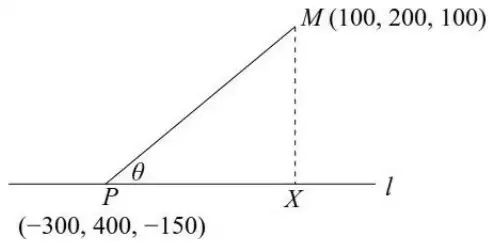
Note for \(P\), \(\cos\theta = \pm\dfrac{57}{\sqrt{38}\sqrt{105}}\), \(\theta = 25.5\ldots°\) and \(\left|\overrightarrow{PX}\right| = 75\sqrt{38}\)
For \(Q\), \(\cos\theta = \pm\dfrac{19}{\sqrt{38}\sqrt{29}}\), \(\theta = 55.08\ldots°\), \(\left|\overrightarrow{QX}\right| = 25\sqrt{38}\)
| Scheme | Marks | AO |
|---|---|---|
| \(\left|\overrightarrow{OP}\right| = \sqrt{(-300)^2 + 400^2 + (-150)^2} \approx 522\) \(\left|\overrightarrow{OQ}\right| = \sqrt{300^2 + 300^2 + 50^2} \approx 427\) | M1 | 1.1b |
| New tunnel length is significantly shorter than these values so it is likely that the company will decide to build the accessway. Reason and conclusion needed. | A1ft | 2.2b |
| (2) |
Notes
M1: Calculates the two distances \(OP\) and \(OQ\).
A1ft: Makes an appropriate conclusion for their tunnel length, but distances \(OP\) and \(OQ\) must be correct. A reason and a conclusion is needed.
Accept for reason e.g. “significantly shorter” or “tunnel is more than 100 m less than either existing accessway”, as these act as a comparative judgement. But do not accept just “shorter” or just inequalities given with no comparative evidence.
| Scheme | Marks | AO |
|---|---|---|
| E.g. The mountainside is not likely to be flat so a plane may not be a good model. The tunnel and/or pipeline will not have negligible thickness so modelling as lines may not be appropriate. A shortest length tunnel may not be possible, or most practical, as the strata of the rock in the mountain have not been considered by the model. | B1 | 3.5b |
| (1) | ||
| (12 marks) |
Notes
B1: Any appropriate criticism of the model given. The model must be referred to in some way – e.g. criticise the straightness/thickness of line, flatness of plane or lack of taking strata etc of mountain into account (as e.g. this means line may not be straight).
Note: reference to measurements not being correct is NOT a limitation of the model.