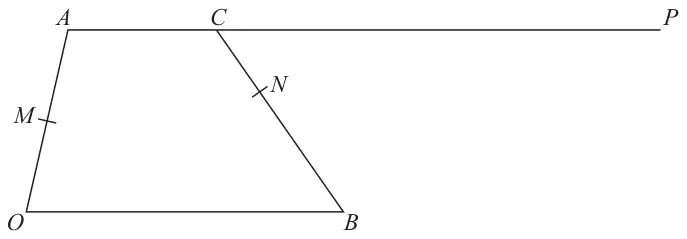
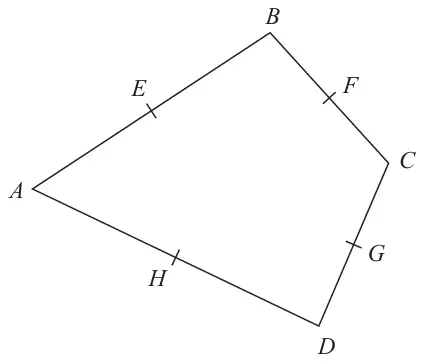
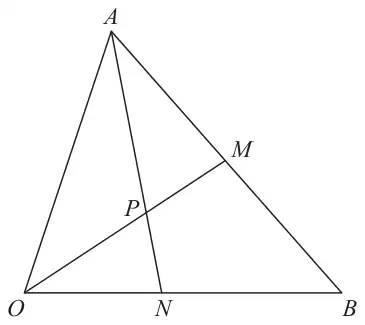
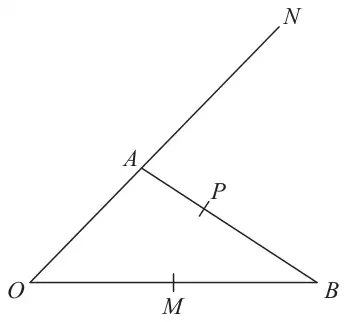
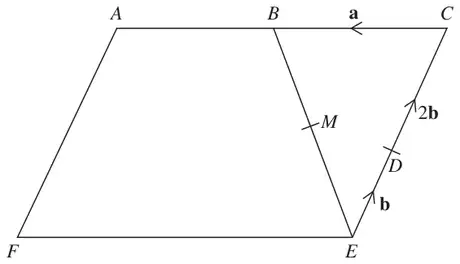
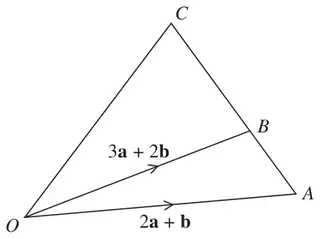
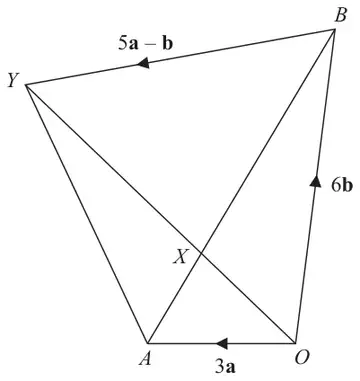
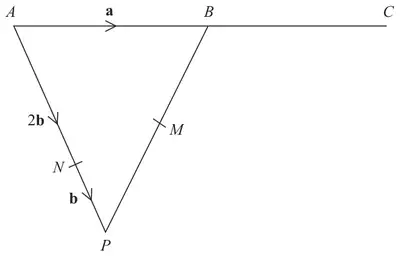
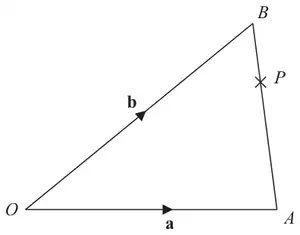
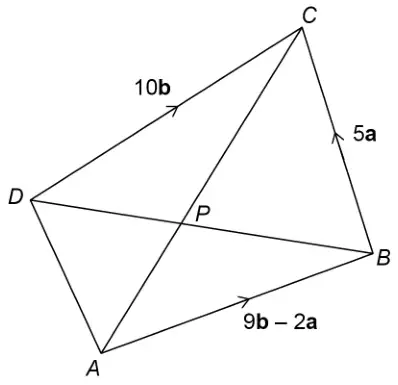
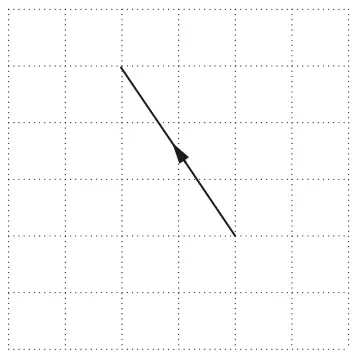
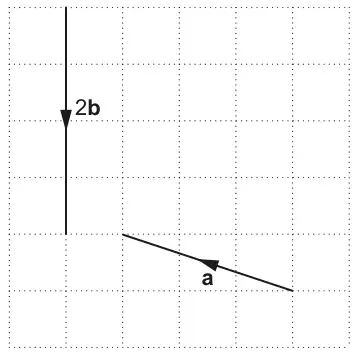
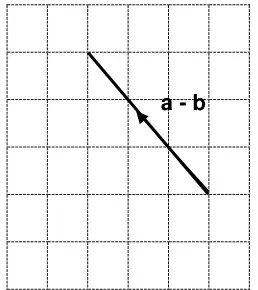
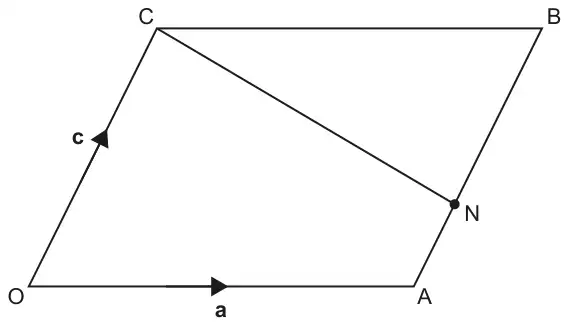
\(\overrightarrow{CP} = k \times \overrightarrow{AC}\) where \(k\) is a scalar.
Given that \(MNP\) is a straight line, find the value of \(k\). You must show all your working. (5)
Mark scheme
Answer
Mark
Mark scheme
\(\dfrac{15}{4}\)
P1
for process to find \(\overrightarrow{BC}\) or \(\overrightarrow{CB}\), eg \(\overrightarrow{BC} = -3\mathbf{b} + \mathbf{a} + 2\mathbf{b}\) oe (\(= \mathbf{a} - \mathbf{b}\)) or \(\overrightarrow{CB} = -2\mathbf{b} - \mathbf{a} + 3\mathbf{b}\) oe (\(= -\mathbf{a} + \mathbf{b}\))
P1
for process that uses the ratio 5 : 3, eg \(\overrightarrow{BN} = \dfrac{5}{8}(-3\mathbf{b} + \mathbf{a} + 2\mathbf{b})\ \left(= \dfrac{5}{8}\mathbf{a} - \dfrac{5}{8}\mathbf{b}\right)\) or \(\overrightarrow{NB} = -\dfrac{5}{8}\mathbf{a} + \dfrac{5}{8}\mathbf{b}\) oe or \(\overrightarrow{CN} = \dfrac{3}{8}(-2\mathbf{b} - \mathbf{a} + 3\mathbf{b})\ \left(= -\dfrac{3}{8}\mathbf{a} + \dfrac{3}{8}\mathbf{b}\right)\) or \(\overrightarrow{NC} = \dfrac{3}{8}\mathbf{a} - \dfrac{3}{8}\mathbf{b}\) oe
P1
for a process to find an expression, in terms of \(\mathbf{a}\) and \(\mathbf{b}\), for \(\overrightarrow{MN}\) or \(\overrightarrow{MP}\) or \(\overrightarrow{NP}\) eg \(\overrightarrow{MN} = -\dfrac{1}{2}\mathbf{a} + 3\mathbf{b} + \dfrac{5}{8}(\mathbf{a} - \mathbf{b})\) oe \(\left(= \dfrac{1}{8}\mathbf{a} + \dfrac{19}{8}\mathbf{b}\right)\) or \(\overrightarrow{MN} = \dfrac{1}{2}\mathbf{a} + 2\mathbf{b} + \dfrac{3}{8}(-\mathbf{a} + \mathbf{b})\) oe \(\left(= \dfrac{1}{8}\mathbf{a} + \dfrac{19}{8}\mathbf{b}\right)\) or \(\overrightarrow{MP} = \dfrac{1}{2}\mathbf{a} + 2\mathbf{b} + k(2\mathbf{b})\) oe or \(\overrightarrow{NP} = \dfrac{3}{8}\mathbf{a} - \dfrac{3}{8}\mathbf{b} + k(2\mathbf{b})\) oe
P1
for a process to find a correct expression, in terms of \(\mathbf{a}\) and \(\mathbf{b}\) for the same vector eg \(\overrightarrow{MP}\) or \(\overrightarrow{NP}\) or parallel vectors eg \(\overrightarrow{MP}\) and \(\overrightarrow{MN}\) or \(\overrightarrow{NP}\) and \(\overrightarrow{MN}\) eg \(\overrightarrow{MP} = \dfrac{1}{2}\mathbf{a} + 2\mathbf{b} + k(2\mathbf{b})\) oe and \(\overrightarrow{MP} = \lambda\left(\dfrac{1}{8}\mathbf{a} + \dfrac{19}{8}\mathbf{b}\right)\) oe or \(\overrightarrow{NP} = \dfrac{3}{8}\mathbf{a} - \dfrac{3}{8}\mathbf{b} + k(2\mathbf{b})\) oe and \(\overrightarrow{NP} = \lambda\left(\dfrac{1}{8}\mathbf{a} + \dfrac{19}{8}\mathbf{b}\right)\) oe or \(\overrightarrow{MP} = \dfrac{1}{2}\mathbf{a} + 2\mathbf{b} + k(2\mathbf{b})\) oe and \(\overrightarrow{MN} = \dfrac{1}{8}\mathbf{a} + \dfrac{19}{8}\mathbf{b}\) oe or \(\overrightarrow{NP} = \dfrac{3}{8}\mathbf{a} - \dfrac{3}{8}\mathbf{b} + k(2\mathbf{b})\) oe and \(\overrightarrow{MN} = \dfrac{1}{8}\mathbf{a} + \dfrac{19}{8}\mathbf{b}\) oe
OR for a process to find a correct expression in terms of \(\mathbf{a}\) and \(\mathbf{b}\), for \(\overrightarrow{AP}\) or \(\overrightarrow{CP}\) using \(\overrightarrow{MN}\) \(\overrightarrow{AP} = -\dfrac{1}{2}\mathbf{a} + \mu\left(\dfrac{1}{8}\mathbf{a} + \dfrac{19}{8}\mathbf{b}\right)\) oe or \(\overrightarrow{CP} = -\dfrac{3}{8}\mathbf{a} + \dfrac{3}{8}\mathbf{b} + \mu\left(\dfrac{1}{8}\mathbf{a} + \dfrac{19}{8}\mathbf{b}\right)\) oe OR for a process to find a correct expression in terms of \(\mathbf{a}\) and \(\mathbf{b}\) for the same vector \(\overrightarrow{BP}\) or \(\overrightarrow{OP}\) \(\overrightarrow{BP} = \mathbf{a} - \mathbf{b} + k(2\mathbf{b})\) oe and \(\overrightarrow{BP} = \dfrac{5}{8}\mathbf{a} - \dfrac{5}{8}\mathbf{b} + \mu\left(\dfrac{1}{8}\mathbf{a} + \dfrac{19}{8}\mathbf{b}\right)\) oe \(\overrightarrow{OP} = \mathbf{a} + 2\mathbf{b} + k(2\mathbf{b})\) oe and \(\overrightarrow{OP} = \dfrac{1}{2}\mathbf{a} + \mu\left(\dfrac{1}{8}\mathbf{a} + \dfrac{19}{8}\mathbf{b}\right)\) oe
A1
for \(\dfrac{15}{4}\) oe
Additional guidance
Vectors must be unambiguously identified Accept \(BC\) for \(\overrightarrow{BC}\) etc throughout Allow a for \(\mathbf{a}\) and b for \(\mathbf{b}\) throughout Vectors could be written on the diagram and may be in either direction. Throughout, do not condone missing brackets unless recovered Follow through candidates \(\overrightarrow{BC}\) or \(\overrightarrow{CB}\) provided full method to find subsequent vectors is clearly shown A correct expression for \(\overrightarrow{BN}\) or \(\overrightarrow{NB}\) or \(\overrightarrow{CN}\) or \(\overrightarrow{NC}\) implies the previous P mark
Follow through candidates \(\overrightarrow{BN}\) or \(\overrightarrow{NB}\) or \(\overrightarrow{CN}\) or \(\overrightarrow{NC}\) provided full method to find subsequent vectors is clearly shown May use \(\overrightarrow{NM}\) or \(\overrightarrow{PM}\) or \(\overrightarrow{PN}\) Allow equivalent vectors throughout eg \(\overrightarrow{MP} = \dfrac{1}{2}\mathbf{a} + 2\mathbf{b} + \mu(\mathbf{b})\) This mark may be awarded without the previous mark being awarded
Vectors do not have to be simplified May use \(\overrightarrow{NM}\) or \(\overrightarrow{PM}\) or \(\overrightarrow{PN}\) Condone use of same variable for equivalent vector journeys Condone lack of labelling if vector journeys are correctly equated
May use \(\overrightarrow{PA}\) or \(\overrightarrow{PC}\) NB: \(\overrightarrow{CP} = -\dfrac{1}{2}\mathbf{a} - 2\mathbf{b} + \mu\left(\dfrac{1}{8}\mathbf{a} + \dfrac{19}{8}\mathbf{b}\right)\)
May use \(\overrightarrow{PB}\) or \(\overrightarrow{PO}\)
Award 0 marks for a correct answer with no supportive working
for a correct expression for \(\overrightarrow{CB}\) or \(\overrightarrow{BC}\) eg, \(\overrightarrow{CB} = -k\mathbf{b} - \mathbf{a} + \mathbf{b}\) or \(\overrightarrow{BC} = -\mathbf{b} + \mathbf{a} + k\mathbf{b}\)
P1
for a correct expression for \(\overrightarrow{CN}\) or \(\overrightarrow{BN}\) or \(\overrightarrow{NC}\) or \(\overrightarrow{NB}\) eg, \(\overrightarrow{CN} = \dfrac{5}{9}(-k\mathbf{b} - \mathbf{a} + \mathbf{b})\) or \(\overrightarrow{BN} = \dfrac{4}{9}(-\mathbf{b} + \mathbf{a} + k\mathbf{b})\) or \(\overrightarrow{NC} = \dfrac{5}{9}(-\mathbf{b} + \mathbf{a} + k\mathbf{b})\) or \(\overrightarrow{NB} = \dfrac{4}{9}(-k\mathbf{b} - \mathbf{a} + \mathbf{b})\)
P1
for a correct unsimplified expression for \(\overrightarrow{MN}\) eg \(\dfrac{1}{2}\mathbf{a} + k\mathbf{b} + \dfrac{5}{9}(-k\mathbf{b} - \mathbf{a} + \mathbf{b})\) oe or \(-\dfrac{1}{2}\mathbf{a} + \mathbf{b} + \dfrac{4}{9}(-\mathbf{b} + \mathbf{a} + k\mathbf{b})\) oe
Must have a maximum of 3 vector terms, \(\mathbf{a}\), \(\mathbf{b}\), and \(k\mathbf{b}\)
Mark scheme (b)
Answer
Mark
Mark scheme
No, with explanation
C1
No with supporting reason ft (a) Acceptable reasons: No, since \(\dfrac{1}{18}(8k\mathbf{b} + 10\mathbf{b} - \mathbf{a})\) is not a multiple of \(\mathbf{b}\) No, as \(N\) is not the midpoint of \(BC\) No, they are not multiples of each other No, does not factorise to \(\mathbf{b}\) Not a multiple of \(OB\) \(OB\) doesn’t have an \(\mathbf{a}\)
Not acceptable reasons: Yes… No, they don’t share the same multiples \(OB\) doesn’t go into \(MN\)
for \(2 \times 3 + {-1}\ (= 5)\) or \(2 \times 2 + 4\ (= 8)\) seen as a calculation or for \(\begin{pmatrix} 2 \times 3 \\ 2 \times 2 \end{pmatrix}\) + \(\begin{pmatrix} -1 \\ 4 \end{pmatrix}\) or for \(\begin{pmatrix} 5 \\ b \end{pmatrix}\) or \(\begin{pmatrix} a \\ 8 \end{pmatrix}\) or for \(\begin{pmatrix} 3 \\ 2 \end{pmatrix}\) drawn or \(\begin{pmatrix} 6 \\ 4 \end{pmatrix}\) drawn or \(\begin{pmatrix} -1 \\ 4 \end{pmatrix}\) drawn
M1
for \(\begin{pmatrix} 5 \\ 8 \end{pmatrix}\) or for \(\begin{pmatrix} 5 \\ 8 \end{pmatrix}\) drawn with no arrow or incorrect arrow or for \(\begin{pmatrix} 5 \\ b \end{pmatrix}\) drawn with arrow or \(\begin{pmatrix} a \\ 8 \end{pmatrix}\) drawn with arrow, where \(b \neq 8\) and \(a \neq 5\)
A1
cao
Additional guidance
May be in the correct position in a column vector or coordinate.
Condone missing arrows
For this mark the drawn vector must include an arrow showing direction. Need not be labelled but do not award if there is any ambiguity
22 Given that the vector \(a\begin{pmatrix} 2 \\ 6 \end{pmatrix} + b\begin{pmatrix} 8 \\ 2 \end{pmatrix}\) is parallel to the vector \(\begin{pmatrix} 13 \\ 6 \end{pmatrix}\)
find an expression for \(b\) in terms of \(a\). (3)
Mark scheme
Answer
Mark
Mark scheme
\(b = 3a\)
P1
for \(a\begin{pmatrix} 2 \\ 6 \end{pmatrix} + b\begin{pmatrix} 8 \\ 2 \end{pmatrix} = k\begin{pmatrix} 13 \\ 6 \end{pmatrix}\) oe or for setting up a linear equation in \(a\) or \(b\) eg \(2a + 8b = 13k\) or \(6a + 2b = 6k\), \(k \neq 0, 1\) or for \(2a + 8b = 13\) and \(6a + 2b = 6\) or for \(\dfrac{2a + 8b}{6a + 2b} = \dfrac{13}{6}\) oe
P1
for process to solve the simultaneous equations to get \(b = \dfrac{3k}{2}\) and \(a = \dfrac{k}{2}\) or \(b = \dfrac{3}{2}\) and \(a = \dfrac{1}{2}\) or both \(2a + 8b = 13k\) and \(6a + 2b = 6k\) with process to eliminate \(k\)
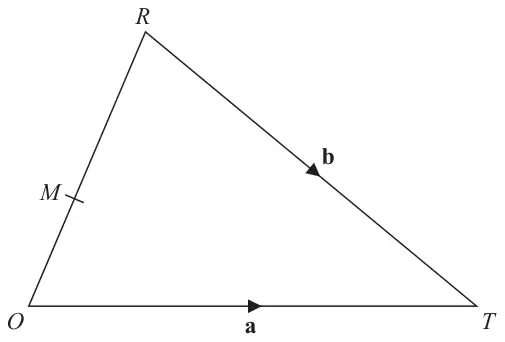
for process to find \(\overrightarrow{OR} = \mathbf{a} - \mathbf{b}\) or \(\overrightarrow{RO} = \mathbf{b} - \mathbf{a}\)
P1
for process to find \(\overrightarrow{MR} = \dfrac{3}{5}(\mathbf{a} - \mathbf{b})\) or \(\overrightarrow{MO} = \dfrac{2}{5}(\mathbf{b} - \mathbf{a})\) or \(\overrightarrow{RM} = \dfrac{3}{5}(\mathbf{b} - \mathbf{a})\) or \(\overrightarrow{OM} = \dfrac{2}{5}(\mathbf{a} - \mathbf{b})\)
P1
for complete process to find \(\overrightarrow{MT}\) in terms of \(\mathbf{a}\) and \(\mathbf{b}\), eg \(\dfrac{3}{5}(\mathbf{a} - \mathbf{b}) + \mathbf{b}\) oe or \(\dfrac{2}{5}(\mathbf{b} - \mathbf{a}) + \mathbf{a}\) oe
A1
for \(\dfrac{3}{5}\mathbf{a} + \dfrac{2}{5}\mathbf{b}\) or \(\dfrac{1}{5}(3\mathbf{a} + 2\mathbf{b})\) or \(\dfrac{3\mathbf{a} + 2\mathbf{b}}{5}\)
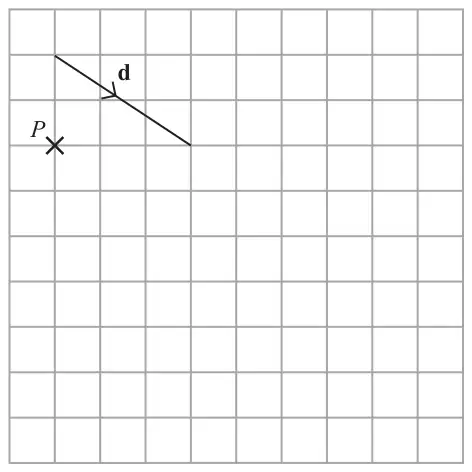
(b) From the point \(P\), draw the vector \(2\mathbf{d}\) (1)
Mark scheme (a)
Answer
Mark
Mark scheme
(i) \(\begin{pmatrix} 1 \\ 5 \end{pmatrix}\)
B1
for \(\begin{pmatrix} 1 \\ 5 \end{pmatrix}\)
(ii) \(\begin{pmatrix} 0 \\ 5 \end{pmatrix}\)
M1
for substitution of values eg \(\begin{pmatrix} 2 \times 2 - 4 \\ 3 \times 2 - 1 \end{pmatrix}\) oe OR for \(\begin{pmatrix} 0 \\ b \end{pmatrix}\) or \(\begin{pmatrix} a \\ 5 \end{pmatrix}\) where \(a\), \(b\) are integer values.
A1
for \(\begin{pmatrix} 0 \\ 5 \end{pmatrix}\)
Additional guidance
(ii) M1: Need not be shown in brackets at this stage
Mark scheme (b)
Answer
Mark
Mark scheme
correct vector drawn
C1
for a correct vector drawn from point \(P\)
Additional guidance
Need not be labelled but do not award if there is any ambiguity.
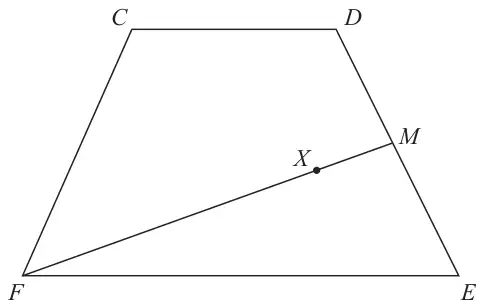
(b) Find the ratio length of \(DF\) : length of \(DE\) (3)
Mark scheme (a)
Answer
Mark
Mark scheme
\(\overrightarrow{AC} = 5\overrightarrow{AB}\) and reason
M1
for \(\overrightarrow{AC} = 5(3\mathbf{a} + 4\mathbf{b})\) or \(\overrightarrow{BC} = 4(3\mathbf{a} + 4\mathbf{b})\) or indicates that \(15\mathbf{a} + 20\mathbf{b} = 5 \times (3\mathbf{a} + 4\mathbf{b})\)
C1
for \(\overrightarrow{AC} = 5\overrightarrow{AB}\) or \(\overrightarrow{AC} = 5(3\mathbf{a} + 4\mathbf{b})\) or \(15\mathbf{a} + 20\mathbf{b} = 5(3\mathbf{a} + 4\mathbf{b})\) and a correct reason, eg \(AC\) is a multiple of \(AB\) / multiples of each other / \(AB\) is a factor of \(AC\) or they have the same gradient / are parallel / go in the same direction or they have a point in common / both start at \(A\) or \(AC\) is an enlargement of \(AB\)
Additional guidance
Do not award this mark if any incorrect working seen Could use \(AB\) and \(BC\) or \(AC\) and \(BC\)
Mark scheme (b)
Answer
Mark
Mark scheme
5 : 2
P1
for \((\overrightarrow{DF} =)\ 3\mathbf{e} + 6\mathbf{f} + (-10.5\mathbf{e} - 21\mathbf{f})\ \ (= -7.5\mathbf{e} - 15\mathbf{f})\) or for a multiplicative relationship for \(\overrightarrow{DE}\) and \(\overrightarrow{EF}\) eg \(\overrightarrow{EF} = -3.5\,\overrightarrow{DE}\) or for \((DE : EF =)\ 1 : -3.5\) oe
P1
for a multiplicative relationship for \(\overrightarrow{DF}\) and \(\overrightarrow{DE}\) eg \(\overrightarrow{DF} = -2.5\,\overrightarrow{DE}\) or for \((DF : DE =)\ -5 : 2\) oe eg \(-2.5 : 1\) or \(-7.5 : 3\) or for answer of 2 : 5 oe
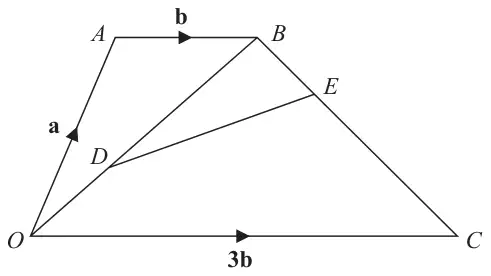
\(D\) is the point on \(OB\) such that \(OD : DB = 2 : 3\) \(E\) is the point on \(BC\) such that \(BE : EC = 1 : 4\)
Work out the vector \(\overrightarrow{DE}\) in terms of \(\mathbf{a}\) and \(\mathbf{b}\). Give your answer in its simplest form. (4)
Mark scheme
Answer
Mark
Mark scheme
\(\dfrac{2}{5}\mathbf{a} + \mathbf{b}\)
P1
for relationship involving \(D\) eg \(\overrightarrow{OD} = \dfrac{2}{5}\overrightarrow{OB}\) or \(\overrightarrow{DB} = \dfrac{3}{5}\overrightarrow{OB}\) or for relationship involving \(E\) eg \(\overrightarrow{BE} = \dfrac{1}{5}\overrightarrow{BC}\) or \(\overrightarrow{EC} = \dfrac{4}{5}\overrightarrow{BC}\)
P1
for relationship involving \(D\) in terms of \(\mathbf{a}\) and \(\mathbf{b}\) eg \(\overrightarrow{OD} = \dfrac{2}{5}(\mathbf{a} + \mathbf{b})\) or \(\overrightarrow{DB} = \dfrac{3}{5}(\mathbf{a} + \mathbf{b})\) or for relationship involving \(E\) in terms of \(\mathbf{a}\) and \(\mathbf{b}\) eg \(\overrightarrow{BE} = \dfrac{1}{5}(-\mathbf{b} - \mathbf{a} + 3\mathbf{b})\) oe or \(\overrightarrow{EC} = \dfrac{4}{5}(-\mathbf{b} - \mathbf{a} + 3\mathbf{b})\) oe or \(\overrightarrow{BC} = 2\mathbf{b} - \mathbf{a}\) oe or \(\overrightarrow{CB} = \mathbf{a} - 2\mathbf{b}\) oe
P1
(dep P2) for expression for \(\overrightarrow{DE}\) in terms of \(\mathbf{a}\) and \(\mathbf{b}\) eg \(\overrightarrow{DE} = \dfrac{3}{5}(\mathbf{a} + \mathbf{b}) + \dfrac{1}{5}(-\mathbf{b} - \mathbf{a} + 3\mathbf{b})\)
A1
for \(\dfrac{2}{5}\mathbf{a} + (1)\mathbf{b}\) or \(\dfrac{1}{5}(2\mathbf{a} + 5\mathbf{b})\)
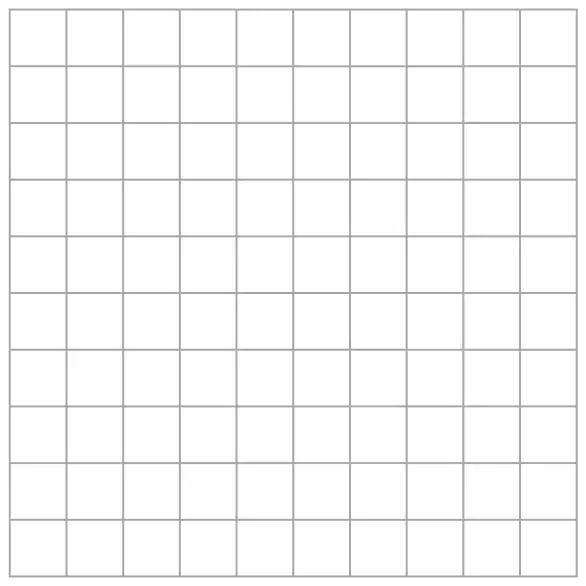
On the grid below, draw and label the vector \(\mathbf{a} - 2\mathbf{b}\) (3)
Mark scheme
Answer
Mark
Mark scheme
Vector drawn
M1
for \(5 - 2 \times 3\ (= -1)\) or \(2 - 2 \times -1\ (= 4)\) seen as a calculation OR for \(\begin{pmatrix} 5 \\ 2 \end{pmatrix} - \begin{pmatrix} 2 \times 3 \\ 2 \times -1 \end{pmatrix}\) OR for \(\begin{pmatrix} -1 \\ b \end{pmatrix}\) or \(\begin{pmatrix} a \\ 4 \end{pmatrix}\) OR for \(\begin{pmatrix} 5 \\ 2 \end{pmatrix}\) or \(\begin{pmatrix} -3 \\ 1 \end{pmatrix}\) or \(\begin{pmatrix} -6 \\ 2 \end{pmatrix}\) drawn
M1
for \(\begin{pmatrix} -1 \\ 4 \end{pmatrix}\) OR for \(\begin{pmatrix} -1 \\ 4 \end{pmatrix}\) drawn with no arrow or incorrect arrow OR for \(\begin{pmatrix} -1 \\ b \end{pmatrix}\) or \(\begin{pmatrix} a \\ 4 \end{pmatrix}\) drawn with arrow, where \(b \neq 4\) and \(a \neq -1\)
A1
cao
Additional guidance
May be in a column vector
Condone missing arrows
For this mark (A1) the drawn vector must include an arrow showing direction.
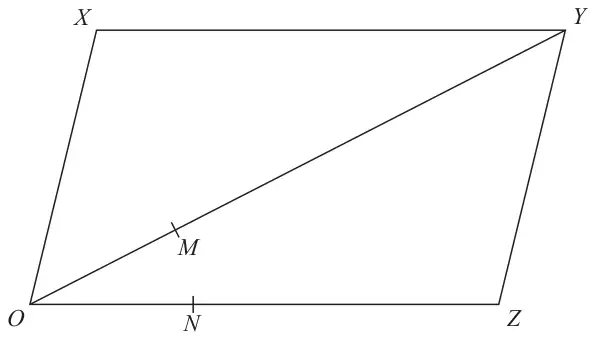
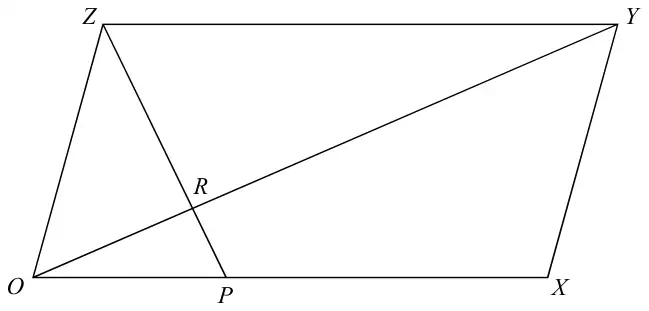
\(P\) is the point on \(OX\) such that \(OP : PX = 1 : 2\) \(R\) is the point on \(OY\) such that \(OR : RY = 1 : 3\)
Work out, in its simplest form, the ratio \(ZP : ZR\) You must show all your working. (5)
Mark scheme
Answer
Mark
Mark scheme
4 : 3
P1
Process to find a missing vector using the given ratios as fractions, eg \(\dfrac{1}{3}\) of \(\overrightarrow{OX}\ \left(= \dfrac{1}{3}\mathbf{a}\right)\) or \(\dfrac{1}{4}\) of \(\overrightarrow{OY}\ \left(= \dfrac{1}{4}\mathbf{b}\right)\)
P1
for a process to use \(\overrightarrow{ZO} = \overrightarrow{YX} = \mathbf{a} - \mathbf{b}\) oe
P1
for a process to find either \(\overrightarrow{ZP}\) or \(\overrightarrow{ZR}\) in terms of \(\mathbf{a}\) and \(\mathbf{b}\), eg either \(\overrightarrow{ZP} = \mathbf{a} - \mathbf{b} + \dfrac{1}{3}\mathbf{a}\) or \(\overrightarrow{ZR} = \mathbf{a} - \mathbf{b} + \dfrac{1}{4}\mathbf{b}\)
P1
for a process to write \(\overrightarrow{ZP}\) and \(\overrightarrow{ZR}\) as multiples of the same vector, eg multiplying both by 12 to get the ratio, \(\dfrac{4}{3}(\mathbf{a} - 0.75\mathbf{b})\) and \(\mathbf{a} - 0.75\mathbf{b}\) respectively
A1
oe
Additional guidance
Might be embedded in their answer for \(ZP\)
The award of this mark implies the first two process marks.
Work out \(\mathbf{a} - 2\mathbf{b}\) as a column vector. (2)
Mark scheme
Answer
Mark
Mark scheme
\(\begin{pmatrix} -2 \\ 1 \end{pmatrix}\)
M1
for \(4 - 2 \times 3\ (= -2)\) or \(5 - 2 \times 2\ (=1)\) seen as a calculation OR for \(\begin{pmatrix} 4 \\ 5 \end{pmatrix} - \begin{pmatrix} 2 \times 3 \\ 2 \times 2 \end{pmatrix}\) OR for \(\begin{pmatrix} -2 \\ b \end{pmatrix}\) where \(b \ne 1\) or \(\begin{pmatrix} a \\ 1 \end{pmatrix}\) where \(a \ne -2\)
starts process eg \(\overrightarrow{AB} = \mathbf{b} - \mathbf{a}\) oe
P1
for process to find \(\overrightarrow{OM} = \mathbf{a} + \dfrac{1}{2}\text{``}(\mathbf{b} - \mathbf{a})\text{''}\) oe \(\left(= \dfrac{1}{2}(\mathbf{a} + \mathbf{b})\right)\)
P1
for process to find \(\overrightarrow{AP} = -\mathbf{a} + \dfrac{3}{5}\text{``}\left(\dfrac{1}{2}\mathbf{a} + \dfrac{1}{2}\mathbf{b}\right)\text{''}\) oe or (indep) for \(\overrightarrow{AN} = -\mathbf{a} + \text{``}k\text{''}\mathbf{b}\)
P1
process to find “\(k\)” using \(\overrightarrow{AN} = -\mathbf{a} + \text{``}k\text{''}\mathbf{b}\) as a multiple of \(\overrightarrow{AP}\)
A1
cao
Alternative
Answer
Mark
Mark scheme
3 : 4
P1
for producing \(OM\) to \(C\) such that \(AC\) is parallel to \(OB\)
P1
for process to show that \(MC = OM\), using congruent triangles \(ACM\) and \(BOM\)
P1
for process to find \(PC\) as a multiple of \(OM/5\ (= 7OM/5)\)
P1
for process to find \(ON\) as a multiple of \(AC(OB)\ (= 3OB/7)\) using similar triangles \(ACP\) and \(NOP\)
A1
cao
Formal geometric reasoning relating to congruent and similar triangles is not required
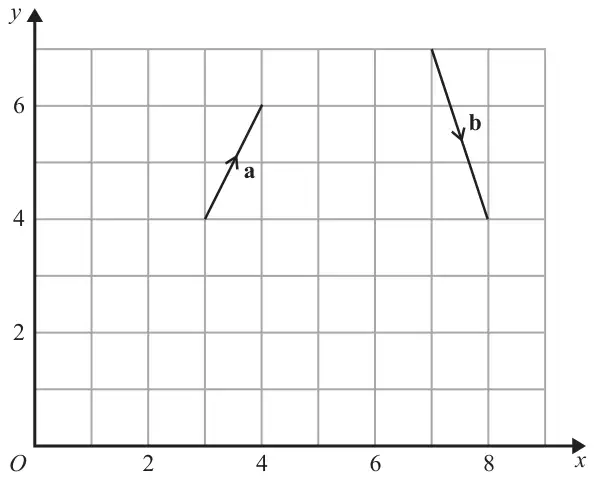
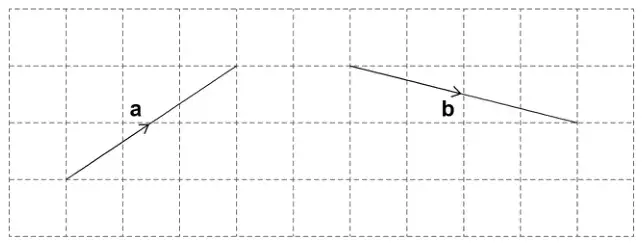
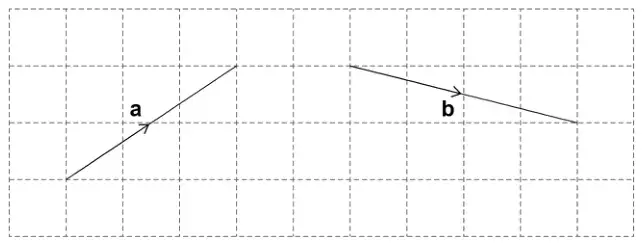
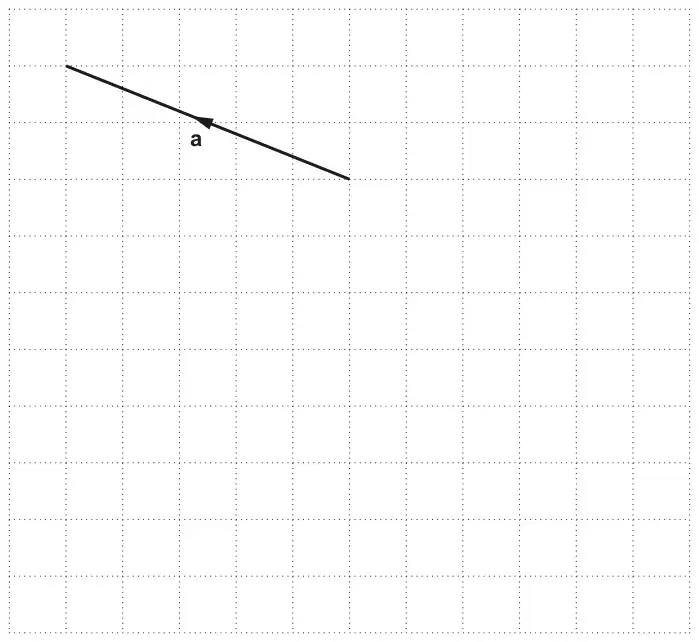
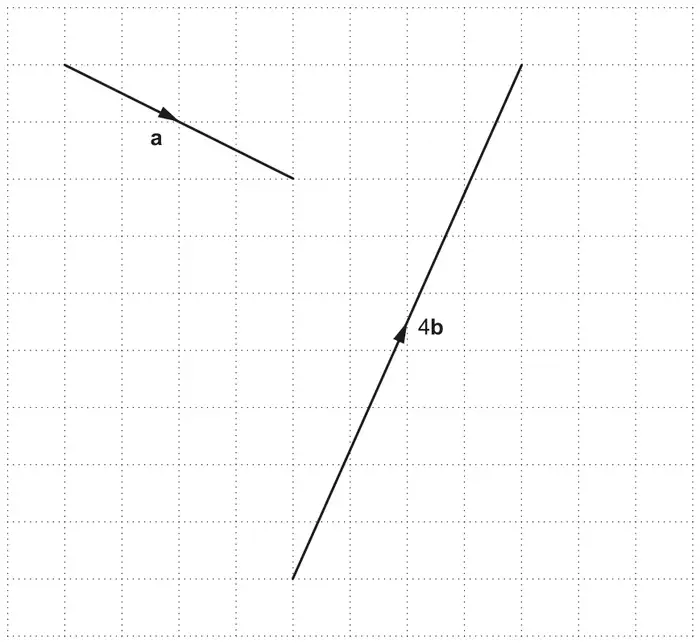
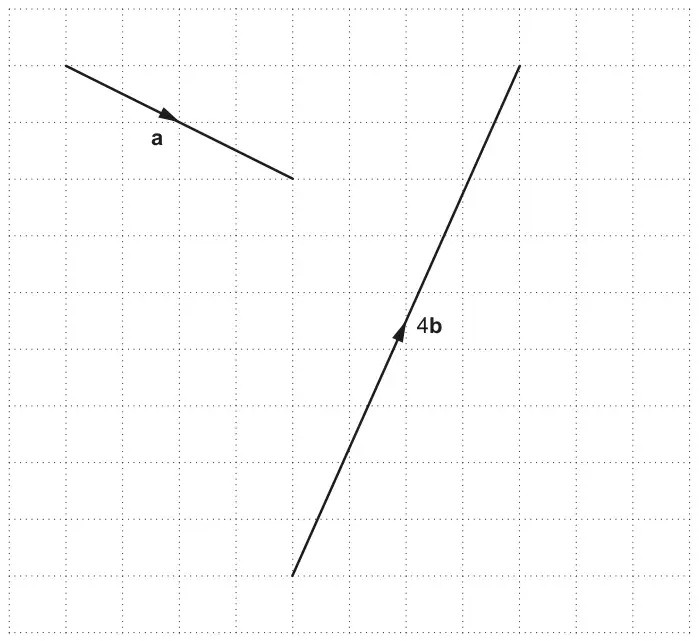
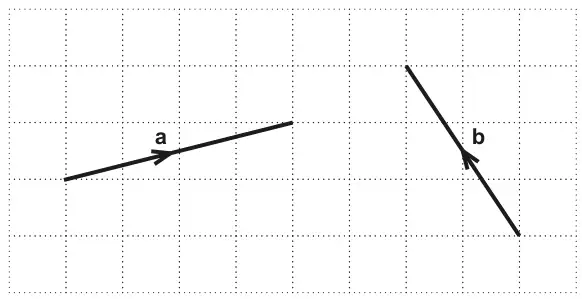
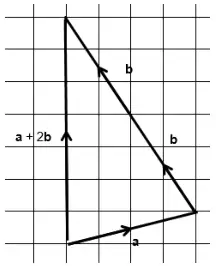
10 The vector a and the vector b are shown on the grid.
(a) On the grid, draw and label vector \(-2\mathbf{a}\) (1)
(b) Work out \(\mathbf{a} + 2\mathbf{b}\) as a column vector. (2)
Mark scheme (a)
Answer
Mark
Mark scheme
Diagram
B1
for correct vector drawn including arrow
Additional guidance
May be drawn anywhere on the grid. Condone missing label
Mark scheme (b)
Answer
Mark
Mark scheme
\(\begin{pmatrix} 3 \\ -4 \end{pmatrix}\)
M1
for \(\mathbf{a} + 2\mathbf{b}\) drawn with resultant vector or for writing a and b as column vectors and attempt to add \(\mathbf{a} + 2\mathbf{b}\), eg \(\begin{pmatrix} 1 \\ 2 \end{pmatrix} + 2 \times \begin{pmatrix} 1 \\ -3 \end{pmatrix}\) or \(\begin{pmatrix} 1 + 2 \\ c \end{pmatrix}\) or \(\begin{pmatrix} d \\ 2 + -6 \end{pmatrix}\) or \(\begin{pmatrix} -4 \\ 3 \end{pmatrix}\)
\(\overrightarrow{AP} = k\overrightarrow{AB}\) where \(k\) is a scalar quantity.
Given that \(MPN\) is a straight line, find the value of \(k\). (5)
Mark scheme
Answer
Mark
Notes
\(\dfrac{2}{5}\)
P1
for process to find \(\overrightarrow{AB}\ (= \mathbf{b} - \mathbf{a})\) or \(\overrightarrow{BA}\ (= \mathbf{a} - \mathbf{b})\)
P1
for process to find \(\overrightarrow{MN}\ \left(= -\tfrac{1}{2}\mathbf{b} + \mathbf{a} + 2\mathbf{a}\right)\) or \(\overrightarrow{PN}\ (= -k(\mathbf{b} - \mathbf{a}) + 2\mathbf{a})\) or \(\overrightarrow{MP}\) (= \(-\tfrac{1}{2}\mathbf{b} + \mathbf{a} + k(\mathbf{b} - \mathbf{a})\) or \(\tfrac{1}{2}\mathbf{b} + (1 - k)(\mathbf{a} - \mathbf{b})\))
P1
for process to find two of \(\overrightarrow{MN}\), \(\overrightarrow{PN}\) and \(\overrightarrow{MP}\)
P1
for process to find \(k\), using \(\overrightarrow{MN}\) as a multiple of \(\overrightarrow{PN}\) or using \(\overrightarrow{MN}\) as a multiple of \(\overrightarrow{MP}\) or using \(\overrightarrow{PN}\) as a multiple of \(\overrightarrow{MP}\)
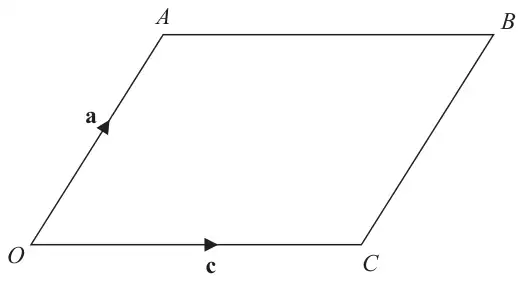
\(\overrightarrow{OA} = \mathbf{a}\) and \(\overrightarrow{OC} = \mathbf{c}\)
\(X\) is the midpoint of the line \(AC\). \(OCD\) is a straight line so that \(OC : CD = k : 1\)
Given that \(\overrightarrow{XD} = 3\mathbf{c} - \dfrac{1}{2}\mathbf{a}\)
find the value of \(k\). (4)
Mark scheme
Answer
Mark
Notes
\(\dfrac{2}{5}\)
P1
for first step to solve the problem e.g. \(\overrightarrow{AC} = -\mathbf{a} + \mathbf{c}\) or \(\overrightarrow{OX} = \dfrac{1}{2}\mathbf{a} + \dfrac{1}{2}\mathbf{c}\) or demonstrates the location of \(D\) and \(X\) on the diagram
P1
for a correct vector statement using \(\overrightarrow{CD}\) eg \(\overrightarrow{CD} = \overrightarrow{CX} + \overrightarrow{XD}\) or \(\overrightarrow{CD} = \overrightarrow{OD} - \overrightarrow{OC}\) or \(\overrightarrow{OD} = \dfrac{7}{2}\mathbf{c}\) or \(\overrightarrow{CD} = 2.5\mathbf{c}\) oe
P1
for a correct equation or ratio using \(k\) eg equating \(\overrightarrow{XD} = 3\mathbf{c} - \dfrac{1}{2}\mathbf{a} = \dfrac{1}{2}(-\mathbf{a} + \mathbf{c}) + \dfrac{1}{k}\mathbf{c}\) or \(\dfrac{\overrightarrow{OD}}{\overrightarrow{OC}} = \dfrac{k + 1}{k}\) or \(k = \dfrac{1}{2.5}\) or using a ratio approach eg \((\overrightarrow{OC} : \overrightarrow{CD}) = k : 1 = 1 : 2.5\)
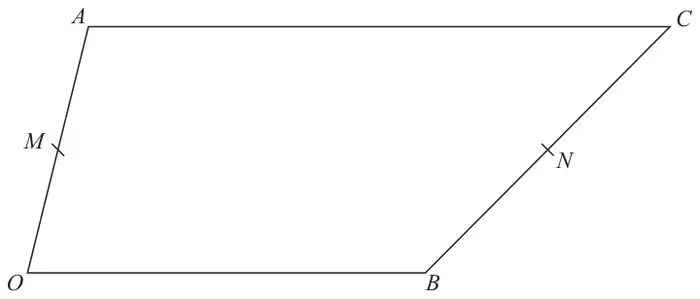
\(\overrightarrow{OA} = 6\mathbf{a}\) and \(\overrightarrow{OB} = 6\mathbf{b}\) \(M\) is the midpoint of \(AB\).
(a) Write \(\overrightarrow{OM}\) in terms of \(\mathbf{a}\) and \(\mathbf{b}\). Give your answer in its simplest form. (2)
\(N\) is the midpoint of \(OB\). \(G\) is the point on \(OM\) such that \(OG : GM = 2 : 1\)
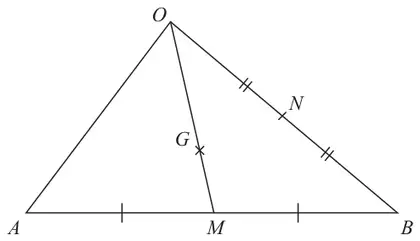
*(b) Show that \(AGN\) is a straight line. (4)
Mark scheme (a)
Answer
Mark
Notes
\(3\mathbf{a} + 3\mathbf{b}\)
2
M1 for \(\overrightarrow{AB} = 6\mathbf{b} - 6\mathbf{a}\) oe or \(\overrightarrow{BA} = 6\mathbf{a} - 6\mathbf{b}\) oe or \((\overrightarrow{OM}) = \dfrac{1}{2}(6\mathbf{a} + 6\mathbf{b})\) oe A1 cao
Mark scheme (b)
Working
Answer
Mark
Notes
Method 1 Show that \(\overrightarrow{AG}\) is parallel to \(\overrightarrow{AN}\)
Shown
4
M1 for a method to find \(\overrightarrow{OG}\) or \(\overrightarrow{GM}\) in terms of \(\mathbf{a}\) and \(\mathbf{b}\) eg \(\overrightarrow{OG} = \dfrac{2}{3}\text{``}(3\mathbf{a} + 3\mathbf{b})\text{''}\) (\(= 2\mathbf{a} + 2\mathbf{b}\)) eg \(\overrightarrow{GM} = \dfrac{1}{3}\text{``}(3\mathbf{a} + 3\mathbf{b})\text{''}\) (\(= \mathbf{a} + \mathbf{b}\)) M1 for a method to find \(\overrightarrow{AN}\) in terms of \(\mathbf{a}\) and \(\mathbf{b}\) eg \(-6\mathbf{a} + 6\mathbf{b} \div 2\) (\(= 3\mathbf{b} - 6\mathbf{a}\)) M1 for a method to find \(\overrightarrow{AG}\) in terms of \(\mathbf{a}\) and \(\mathbf{b}\) eg \(-6\mathbf{a} + \text{``}2\mathbf{a} + 2\mathbf{b}\text{''}\) (\(= 2\mathbf{b} - 4\mathbf{a}\)) C1 for correct simplified expressions in terms of \(\mathbf{a}\) and \(\mathbf{b}\) for \(\overrightarrow{AG}\) and \(\overrightarrow{AN}\) followed by conclusion
Method 2 Show that \(\overrightarrow{AG}\) is parallel to \(\overrightarrow{GN}\)
OR M1 for a method to find \(\overrightarrow{OG}\) in terms of \(\mathbf{a}\) and \(\mathbf{b}\) eg \(\dfrac{2}{3}\text{``}(3\mathbf{a} + 3\mathbf{b})\text{''}\) (\(= 2\mathbf{a} + 2\mathbf{b}\)) M1 for a method to find \(\overrightarrow{GN}\) in terms of \(\mathbf{a}\) and \(\mathbf{b}\) eg \(-\text{``}(2\mathbf{a} + 2\mathbf{b})\text{''} + 6\mathbf{b} \div 2\) (\(= \mathbf{b} - 2\mathbf{a}\)) M1 for a method to find \(\overrightarrow{AG}\) in terms of \(\mathbf{a}\) and \(\mathbf{b}\) eg \(\dfrac{1}{2}(6\mathbf{b} - 6\mathbf{a}) - \dfrac{1}{3}\text{``}(3\mathbf{a} + 3\mathbf{b})\text{''}\) (\(= 2\mathbf{b} - 4\mathbf{a}\)) C1 for correct simplified expressions in terms of \(\mathbf{a}\) and \(\mathbf{b}\) for \(\overrightarrow{AG}\) and \(\overrightarrow{GN}\) followed by conclusion
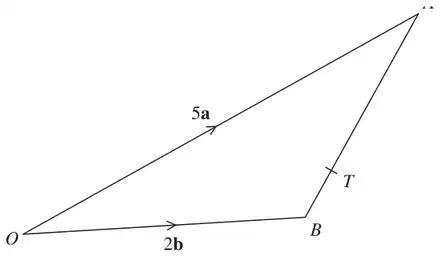
\(T\) is the point on \(AB\) such that \(AT : TB = 5 : 1\)
Show that \(OT\) is parallel to the vector \(\mathbf{a} + 2\mathbf{b}\) (4)
Mark scheme
Answer
Mark
Notes
Correct conclusion from correct working
4
B1 for \(\overrightarrow{AB} = -5\mathbf{a} + 2\mathbf{b}\) or \(\overrightarrow{BA} = 5\mathbf{a} - 2\mathbf{b}\) M1 for a correct vector statement for \(\overrightarrow{OT}\) eg \(\overrightarrow{OA} + \overrightarrow{AT}\) or \(\overrightarrow{OB} + \overrightarrow{BT}\) or \(\overrightarrow{OA} + \dfrac{5}{6}\overrightarrow{AB}\) or \(\overrightarrow{OB} + \dfrac{1}{6}\overrightarrow{BA}\), may be written partially or fully in terms of \(\mathbf{a}\) and \(\mathbf{b}\) M1 for \(5\mathbf{a} + \dfrac{5}{6}(-5\mathbf{a} + 2\mathbf{b})\) oe or \(2\mathbf{b} + \dfrac{1}{6}(5\mathbf{a} - 2\mathbf{b})\) oe A1 for \(\dfrac{5}{6}(\mathbf{a} + 2\mathbf{b})\) is parallel to \(\mathbf{a} + 2\mathbf{b}\)
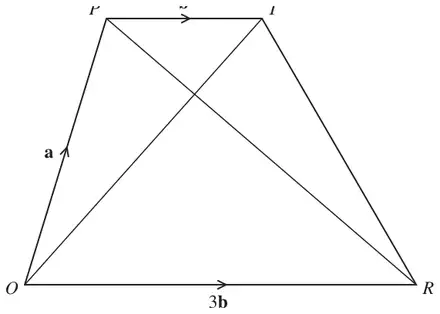
M1 for \(\overrightarrow{OP} + \tfrac{1}{4}\overrightarrow{PR}\) or \(\overrightarrow{OR} + \tfrac{3}{4}\overrightarrow{RP}\) (may be in terms of \(\mathbf{a}\) and \(\mathbf{b}\)) A1 for \(\tfrac{3}{4}\mathbf{a} + \tfrac{3}{4}\mathbf{b}\) or \(\tfrac{3}{4}(\mathbf{a} + \mathbf{b})\)
Mark scheme (c)
Answer
Mark
Notes
\(OS = \tfrac{3}{4}OT\)
2
C2 (dep A1) for \(S\) divides \(OT\) in the ratio 3:1 oe or \(OS = \tfrac{3}{4}OT\) oe (C1 (dep A1) for \(S\) lies on \(OT\) or that \(OT\) and \(PR\) intersect at \(S\) oe)
M1 for finding one other vector expressed as \(\mathbf{a}\) and/or \(\mathbf{b}\) M1 for method to find one of \(\overrightarrow{DM}\), \(\overrightarrow{MA}\) or \(\overrightarrow{DA}\) eg \(\overrightarrow{DM} = -\mathbf{b} + \tfrac{1}{2}(3\mathbf{b} + \mathbf{a})\) oe, \(\overrightarrow{MA} = \tfrac{1}{2}(3\mathbf{b} + \mathbf{a}) + \mathbf{a}\) oe or \(\overrightarrow{DA} = 2\mathbf{b} + 2\mathbf{a}\) oe M1 for method to find two of \(\overrightarrow{DM}\), \(\overrightarrow{MA}\) or \(\overrightarrow{DA}\) A1 for two of \(\overrightarrow{DM} = \tfrac{1}{2}(\mathbf{a} + \mathbf{b})\), \(\overrightarrow{MA} = 1.5(\mathbf{a} + \mathbf{b})\), \(\overrightarrow{DA} = 2(\mathbf{a} + \mathbf{b})\) ie simplified but oe C1 (dep on working shown) for conclusion relating to correct working
M1 for \(\overrightarrow{AB} = \overrightarrow{AO} + \overrightarrow{OB}\) \((= -(2\mathbf{a} + \mathbf{b}) + (3\mathbf{a} + 2\mathbf{b}))\) or \(\mathbf{a} + \mathbf{b}\) M1 for \(\overrightarrow{AC} = \tfrac{7}{2}\overrightarrow{AB}\) or \(\overrightarrow{BC} = \tfrac{5}{2}\overrightarrow{AB}\), may be in terms of \(\mathbf{a}\) and \(\mathbf{b}\) M1 (dep M2) for complete method to find \(\overrightarrow{OC}\) in terms of \(\mathbf{a}\) and \(\mathbf{b}\) A1 for \(\tfrac{11}{2}\mathbf{a} + \tfrac{9}{2}\mathbf{b}\) or equivalent simplest form (SC B2 for \(\tfrac{11}{2}\mathbf{a} + \tfrac{23}{2}\mathbf{b}\) or \(\tfrac{11}{2}\mathbf{a} + \tfrac{19}{2}\mathbf{b}\))
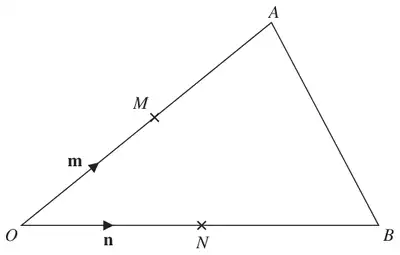
M1 for \(\overrightarrow{MN} = \overrightarrow{MO} + \overrightarrow{ON}\) \((= \mathbf{n} - \mathbf{m})\) or \(\overrightarrow{NM} = \overrightarrow{OM} + \overrightarrow{NO}\) \((= \mathbf{m} - \mathbf{n})\) or \(\overrightarrow{AB} = \overrightarrow{AO} + \overrightarrow{OB}\) \((= 2\mathbf{n} - 2\mathbf{m})\) or \(\overrightarrow{BA} = \overrightarrow{OA} + \overrightarrow{BO}\) \((= 2\mathbf{m} - 2\mathbf{n})\) M1 for \(\overrightarrow{MN} = \mathbf{n} - \mathbf{m}\) and \(\overrightarrow{AB} = 2\mathbf{n} - 2\mathbf{m}\) oe C1 (dep on M1, M1) for fully correct proof, with \(\overrightarrow{AB} = 2\overrightarrow{MN}\) or \(AB\) is a multiple of \(\overrightarrow{MN}\) [SC M1 for \(\overrightarrow{MN} = 0.5\mathbf{n} - 0.5\mathbf{m}\) and \(\overrightarrow{AB} = \mathbf{n} - \mathbf{m}\) C1 (dep on M1) for fully correct proof, with \(\overrightarrow{AB} = 2\overrightarrow{MN}\) or \(AB\) is a multiple of of \(\overrightarrow{MN}\)]
M1 for correct vector equation involving \(\overrightarrow{ON}\), eg. \(\overrightarrow{ON} = \overrightarrow{OA} + \overrightarrow{AN}\), may be written, partially or fully, in terms of \(\mathbf{a}\) and \(\mathbf{b}\), e.g. (\(\overrightarrow{ON} =\)) \(\mathbf{a} + \frac{2}{3}\overrightarrow{AB}\) M1 for showing answer requires \(\overrightarrow{AN} = \frac{2}{3}\overrightarrow{AB}\) or \(\overrightarrow{BN} = \frac{1}{3}\overrightarrow{BA}\) A1 \(\frac{1}{3}\mathbf{a} + \frac{2}{3}\mathbf{b}\) oe
M1 for a correct vector statement for \(\overrightarrow{OD}\) or \(\overrightarrow{ND}\) in terms of \(\mathbf{a}\) and \(\mathbf{b}\), e.g. \(\overrightarrow{OD} = \mathbf{a} + \mathbf{b} + \mathbf{b}\) oe or \(\overrightarrow{ND} = \frac{2}{3}(-\mathbf{b} + \mathbf{a}) + \mathbf{b} + \mathbf{b}\) oe A1 for correct and fully simplified vectors for \(\overrightarrow{ON}\) (may be seen in (a)) and for \(\overrightarrow{OD}\) (\(= \mathbf{a} + 2\mathbf{b}\)) or \(\overrightarrow{ND}\) (\(= \frac{2}{3}\mathbf{a} + \frac{4}{3}\mathbf{b}\)) C1 (dep on A1) for statement that \(\overrightarrow{OD}\) or \(\overrightarrow{ND}\) is a multiple of \(\overrightarrow{ON}\) (+ common point)
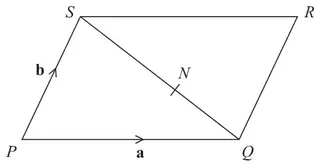
(a) Write down, in terms of \(\mathbf{a}\) and \(\mathbf{b}\), an expression for \(\overrightarrow{SQ}\). (1)
(b) Express \(\overrightarrow{NR}\) in terms of \(\mathbf{a}\) and \(\mathbf{b}\). (3)
Mark scheme (a)
Answer
Mark
Notes
\(\mathbf{a} - \mathbf{b}\)
1
B1 for \(\mathbf{a} - \mathbf{b}\) oe
Mark scheme (b)
Answer
Mark
Notes
\(\frac{2}{5}\mathbf{a} + \frac{3}{5}\mathbf{b}\)
3
M1 for a correct vector statement for \(\overrightarrow{NR}\) eg. (\(\overrightarrow{NR} =\)) \(\overrightarrow{NQ} + \overrightarrow{QR}\) or (\(\overrightarrow{NR} =\)) \(\overrightarrow{NS} + \overrightarrow{SR}\) M1 for \(\frac{2}{5}SQ\) (+ \(QR\)) or \(\frac{3}{5}QS\) (+ \(SR\)) (\(SQ\), \(QR\), \(QS\), \(SR\) may be written in terms of \(\mathbf{a}\) and \(\mathbf{b}\)) A1 for \(\frac{2}{5}(\mathbf{a} - \mathbf{b}) + \mathbf{b}\) oe or \(\frac{3}{5}(\mathbf{b} - \mathbf{a}) + \mathbf{a}\) oe
(a) Find the vector \(\overrightarrow{PB}\), in terms of a and b. (1)
\(B\) is the midpoint of \(AC\). \(M\) is the midpoint of \(PB\).
*(b) Show that \(NMC\) is a straight line. (4)
Mark scheme (a)
Answer
Mark
Notes
\(\mathbf{a} - 3\mathbf{b}\)
1
B1 for \(\mathbf{a} - 3\mathbf{b}\) oe
Mark scheme (b)
Answer
Mark
Notes
4
M1 for (NC =) \(2\mathbf{a} - 2\mathbf{b}\) oe M1 for (NM =) \(\mathbf{b} + \frac{1}{2}\)“\(\mathbf{a} - 3\mathbf{b}\)” A1 for \(\frac{1}{2}(\mathbf{a} - \mathbf{b})\) oe and \(2\mathbf{a} - 2\mathbf{b}\) oe C1 for NC is a multiple of NM (+ common point) OR M1 for (NC =) \(2\mathbf{a} - 2\mathbf{b}\) oe M1 for (MC =) \(\frac{1}{2}\)“\(\mathbf{a} - 3\mathbf{b}\)”\(+\, \mathbf{a}\) A1 for \(\frac{3}{2}(\mathbf{a} - \mathbf{b})\) oe and \(2\mathbf{a} - 2\mathbf{b}\) oe C1 for NC is a multiple of MC (+ common point) OR M1 for (NM =) \(\mathbf{b} + \frac{1}{2}\)“\(\mathbf{a} - 3\mathbf{b}\)” M1 for (MC =) \(\frac{1}{2}\)“\(\mathbf{a} - 3\mathbf{b}\)”\(+\, \mathbf{a}\) A1 for \(\frac{1}{2}(\mathbf{a} - \mathbf{b})\) oe and \(\frac{3}{2}(\mathbf{a} - \mathbf{b})\) oe C1 for NM is a multiple to MC (+ common point)
Accept eg \(9\mathbf{b} + 3\mathbf{a}\) or \(3(\mathbf{a} + 3\mathbf{b})\) for \(3\mathbf{a} + 9\mathbf{b}\) but do not accept \(9\mathbf{b} - 2\mathbf{a} + 5\mathbf{a}\)
Accept eg \(AC\) or \(A \to C\) or \(ABC\) or \(A \to B \to C\) for \(\overrightarrow{AC}\)
Condone upper case letters for lower case letters and vice-versa
Ignore incorrect vectors and award marks for any correct vectors
Vectors may be seen on the diagram
Correct vectors may be seen in ratios and/or divisions eg \(\mathbf{a} + 3\mathbf{b} : 2\mathbf{a} + 6\mathbf{b}\) Answer \(\dfrac{1}{2}\)
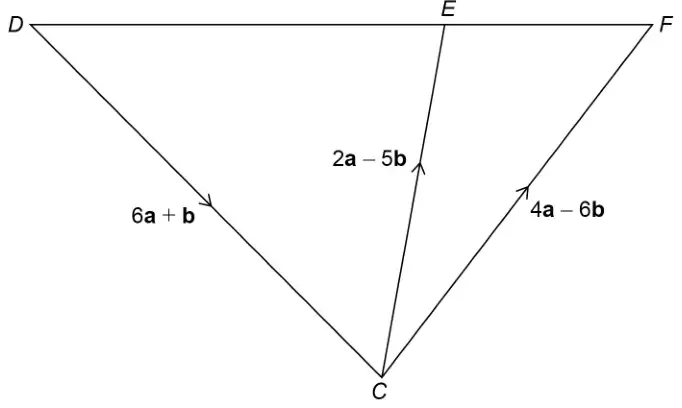
Two fully simplified expressions from \((\overrightarrow{DE} =)\ 8\mathbf{a} - 4\mathbf{b}\) \((\overrightarrow{DF} =)\ 10\mathbf{a} - 5\mathbf{b}\) \((\overrightarrow{EF} =)\ 2\mathbf{a} - \mathbf{b}\) and valid indication that the vectors are parallel
A1
eg \((\overrightarrow{DE} =)\ 8\mathbf{a} - 4\mathbf{b}\) and \((\overrightarrow{FE} =)\ -2\mathbf{a} + \mathbf{b}\) and \(8\mathbf{a} - 4\mathbf{b} = -4(-2\mathbf{a} + \mathbf{b})\) or \((\overrightarrow{DF} =)\ 10\mathbf{a} - 5\mathbf{b}\) and \((\overrightarrow{EF} =)\ 2\mathbf{a} - \mathbf{b}\) and \(\overrightarrow{DF} = 5\overrightarrow{EF}\)
Additional guidance
Condone absence of vector notation
Condone eg \(\overrightarrow{DCE}\) or \(D\) to \(E\) for \(\overrightarrow{DE}\)
If the only two correct expressions are eg \(\overrightarrow{DE}\) and \(\overrightarrow{ED}\) the maximum possible mark is M1
Only combining the three given vectors
Zero
\(\overrightarrow{DF} = \overrightarrow{DE} + \overrightarrow{EF}\) is not a valid indication
Stating eg \(\overrightarrow{DF}\) is a (scalar) multiple of \(\overrightarrow{EF}\) is not enough for the final A1
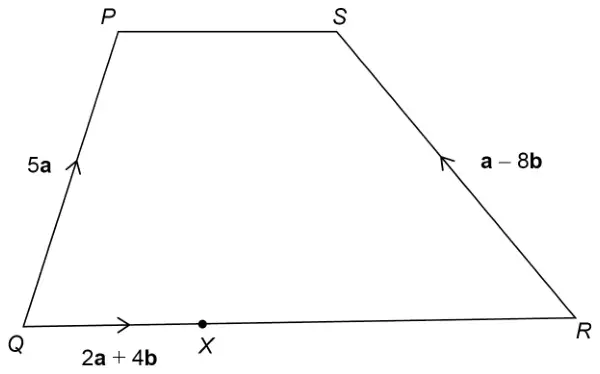
\((\overrightarrow{PS} =)\ \mathbf{a} + 2\mathbf{b}\) and indication why \(PS\) is parallel to \(QR\)
A1
eg \(2(\mathbf{a} + 2\mathbf{b}) = 2\mathbf{a} + 4\mathbf{b}\) or \(5\mathbf{a} + 10\mathbf{b} = 5(\mathbf{a} + 2\mathbf{b})\) or \(\mathbf{a} + 2\mathbf{b}\) and \(\overrightarrow{QR}\) is a multiple of \(\overrightarrow{PS}\)
Additional guidance
Some or all vectors may be reversed and the final mark can be from using a negative constant eg \(\overrightarrow{RX} = -3\mathbf{a} - 6\mathbf{b}\) \(\overrightarrow{PS} = \mathbf{a} + 2\mathbf{b}\) \(-3(\mathbf{a} + 2\mathbf{b}) = -3\mathbf{a} - 6\mathbf{b}\)
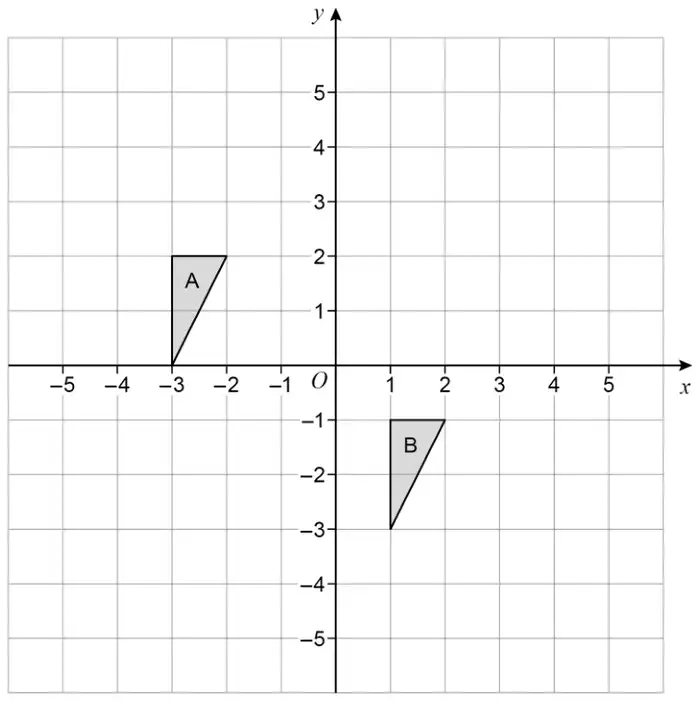
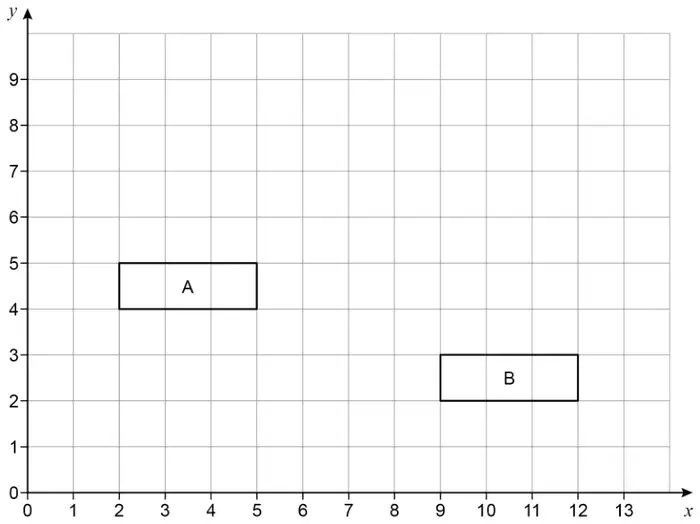
20 Write down the translation vector that maps shape A onto shape B. [2 marks]
Mark scheme
Answer
Mark
Comments
\(\begin{pmatrix}4\\-3\end{pmatrix}\)
B2
B1 \(\begin{pmatrix}4\\\ldots\end{pmatrix}\) or \(\begin{pmatrix}\ldots\\-3\end{pmatrix}\) SC1 \(\begin{pmatrix}-4\\3\end{pmatrix}\)
Additional guidance
\((4, -3)\) or \(\begin{pmatrix}-3\\4\end{pmatrix}\)
B0
Ignore words if a vector is also seen eg1 Reflection \(\begin{pmatrix}4\\-3\end{pmatrix}\) eg2 4 right 3 up and \(\begin{pmatrix}4\\3\end{pmatrix}\) eg3 4 right 3 down eg4 Rotate 4 left and 3 up and \(\begin{pmatrix}-4\\3\end{pmatrix}\)
B2 B1 B0 SC1
Condone any type of brackets
Condone missing brackets for B2 or B1 or SC1 but must have two numbers in a column
Condone ‘fraction line’ for B2 or B1 or SC1 but must have two numbers in a column
\(\begin{pmatrix}4x\\-3y\end{pmatrix}\) or \(\begin{pmatrix}x4\\-y3\end{pmatrix}\) or \(\begin{pmatrix}x + 4\\y - 3\end{pmatrix}\) or \(\begin{pmatrix}\text{4 right}\\\text{3 down}\end{pmatrix}\) or \(\begin{pmatrix}\text{4 r}\\\text{3 d}\end{pmatrix}\) or \(\begin{pmatrix}4 \rightarrow\\3 \downarrow\end{pmatrix}\)
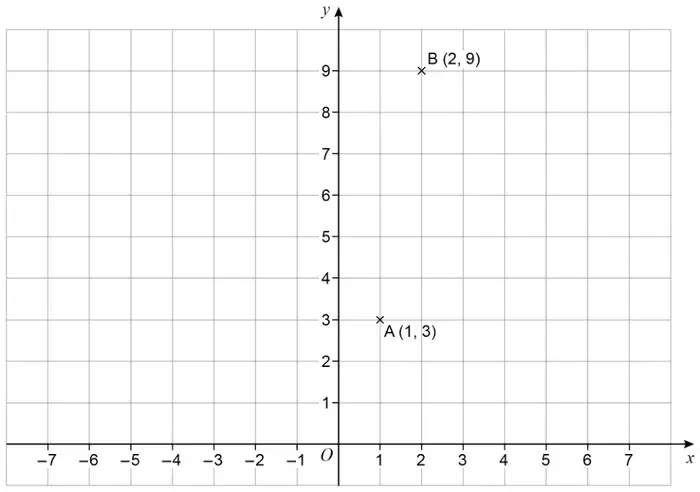
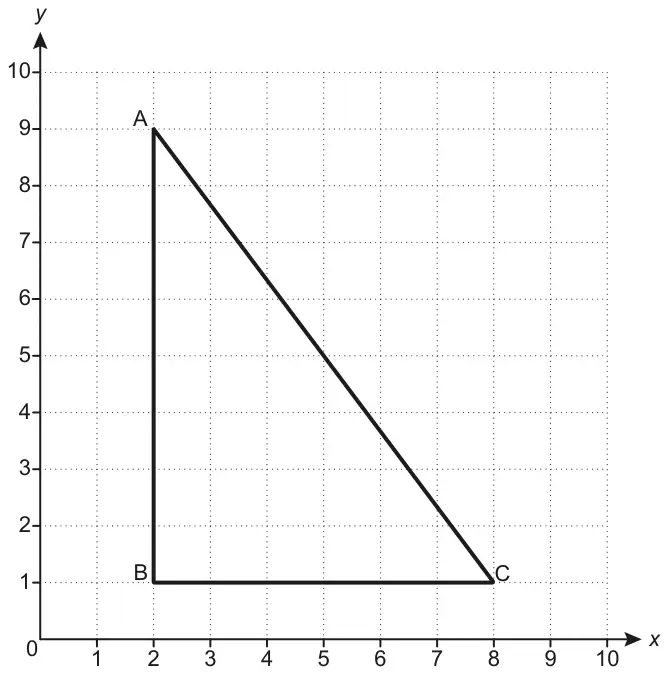
9 A (1, 3) and B (2, 9) are points on a centimetre grid.
ABCD is a parallelogram.
AD and BC are horizontal and each has length 5 cm
The diagonals of ABCD cross at E.
Work out the two possible pairs of coordinates of E. [4 marks]
Mark scheme
Answer
Mark
Comments
Identifies (6, 3) or (7, 9) or \((-4, 3)\) or \((-3, 9)\)
M1
may be seen on the grid mark intention on diagram eg parallelogram drawn with one of the vertices at (6, 3) or (6, 3) plotted
Identifies (6, 3) and (7, 9) or identifies \((-4, 3)\) and \((-3, 9)\)
M1dep
may be seen on the grid mark intention on diagram eg parallelogram drawn with two of the vertices at (6, 3) and (7, 9) or (6, 3) and (7, 9) plotted
Both diagonals drawn for one of the correct parallelograms or centre of one of the correct parallelograms identified or (4, 6) or \((-1, 6)\)
M1dep
mark intention on diagram M3 may be implied eg \(\left(\dfrac{1 + 7}{2}, \dfrac{9 + 3}{2}\right)\) or \(\left(\dfrac{-4 + 2}{2}, \dfrac{9 + 3}{2}\right)\)
(4, 6) and \((-1, 6)\)
A1
Additional guidance
Up to M3 may be awarded for correct work with no answer or incorrect answer, even if this is seen amongst multiple attempts
Both answers correct (ignore working)
M3A1
One answer correct (ignore working)
M3A0
For first 2 marks condone correct points plotted even if labelled incorrectly
Up to M2 can be awarded for coordinates given as answers
Arc centre \(A\) radius 5 cm passing through (6, 3) and/or \((-4, 3)\) is not sufficient to award M1 etc
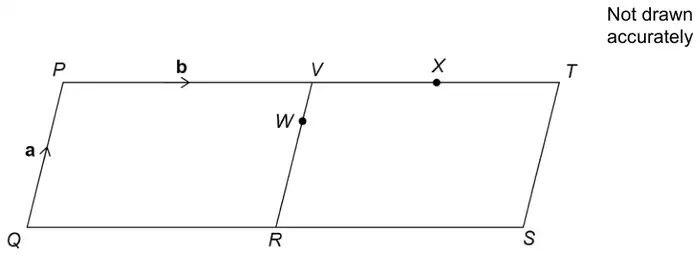
Prove that Q, W and X lie on a straight line. [3 marks]
Mark scheme
Answer
Mark
Comments
Any one of \((\overrightarrow{QW} =)\ \mathbf{a} + \mathbf{b} - \dfrac{1}{3}\mathbf{a}\) \((\overrightarrow{WX} =)\ \dfrac{1}{3}\mathbf{a} + \dfrac{1}{2}\mathbf{b}\) \((\overrightarrow{QX} =)\ \mathbf{a} + \mathbf{b} + \dfrac{1}{2}\mathbf{b}\)
M1
oe eg \((\overrightarrow{QW} =)\ \dfrac{2}{3}\mathbf{a} + \mathbf{b}\) or \((\overrightarrow{WX} =)\ -\dfrac{2}{3}\mathbf{a} + \mathbf{b} + \mathbf{a} - \dfrac{1}{2}\mathbf{b}\) or \((\overrightarrow{QX} =)\ \mathbf{a} + \dfrac{3}{2}\mathbf{b}\) allow use of \(\overrightarrow{WQ}\) and/or \(\overrightarrow{XW}\) and/or \(\overrightarrow{XQ}\)
Any two of \((\overrightarrow{QW} =)\ \mathbf{a} + \mathbf{b} - \dfrac{1}{3}\mathbf{a}\) \((\overrightarrow{WX} =)\ \dfrac{1}{3}\mathbf{a} + \dfrac{1}{2}\mathbf{b}\) \((\overrightarrow{QX} =)\ \mathbf{a} + \mathbf{b} + \dfrac{1}{2}\mathbf{b}\)
M1dep
oe allow use of \(\overrightarrow{WQ}\) and/or \(\overrightarrow{XW}\) and/or \(\overrightarrow{XQ}\)
Any valid pair of vectors and indication that one vector is a multiple of the other eg \(\overrightarrow{QW} = \dfrac{2}{3}\mathbf{a} + \mathbf{b}\) and \(\overrightarrow{WX} = \dfrac{1}{3}\mathbf{a} + \dfrac{1}{2}\mathbf{b}\) and \(\dfrac{2}{3}\mathbf{a} + \mathbf{b} = 2\left(\dfrac{1}{3}\mathbf{a} + \dfrac{1}{2}\mathbf{b}\right)\)
A1
eg \(\overrightarrow{QW} = \dfrac{2}{3}\mathbf{a} + \mathbf{b}\) and \(\overrightarrow{XQ} = -\mathbf{a} - \dfrac{3}{2}\mathbf{b}\) and \(3\overrightarrow{QW} = -2\overrightarrow{XQ}\) or \(\overrightarrow{QX} = \mathbf{a} + \dfrac{3}{2}\mathbf{b}\) and \(\overrightarrow{WX} = \dfrac{1}{3}\mathbf{a} + \dfrac{1}{2}\mathbf{b}\) and \(WX\) is \(\dfrac{1}{3}\) of \(QX\) and \(WX\) is parallel to \(QX\)
Additional guidance
Up to M2 may be awarded for correct work with no answer, or incorrect answer, even if this is seen amongst multiple attempts
B1 \(\begin{pmatrix}4\\\ldots\end{pmatrix}\) or \(\begin{pmatrix}\ldots\\-1\end{pmatrix}\) or \((4, -1)\) SC1 \(\begin{pmatrix}-4\\1\end{pmatrix}\) or \(\begin{pmatrix}-1\\4\end{pmatrix}\)
Additional guidance
Ignore fraction lines
Mark scheme (b)
Answer
Mark
Comments
\(\begin{pmatrix}12\\8\end{pmatrix}\)
B1
Additional guidance
\(4\begin{pmatrix}3\\2\end{pmatrix}\) or \(\begin{pmatrix}12\\8\end{pmatrix}\) in working with answer \(\begin{pmatrix}3\\2\end{pmatrix}\)
B1 \(\begin{pmatrix} 4 \\ \ldots \end{pmatrix}\) or \(\begin{pmatrix} \ldots \\ -1 \end{pmatrix}\) or \((4, -1)\) SC1 \(\begin{pmatrix} -4 \\ 1 \end{pmatrix}\) or \(\begin{pmatrix} -1 \\ 4 \end{pmatrix}\)
Additional guidance
Ignore fraction lines
Mark scheme (b)
Answer
Mark
Comments
\(\begin{pmatrix} 12 \\ 8 \end{pmatrix}\)
B1
Additional guidance
\(4\)\(\begin{pmatrix} 3 \\ 2 \end{pmatrix}\) or \(\begin{pmatrix} 12 \\ 8 \end{pmatrix}\) in working with answer \(\begin{pmatrix} 3 \\ 2 \end{pmatrix}\)
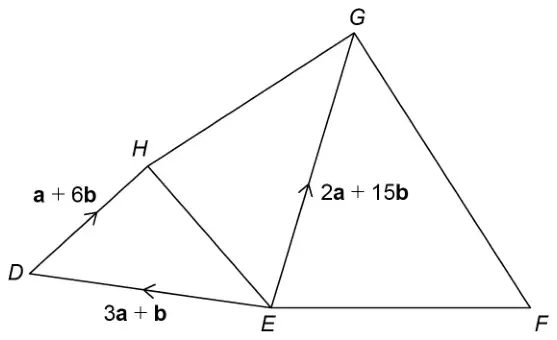
\(\overrightarrow{EH}\) may be seen on diagram or as part of a longer vector sum
\(2 \times\) their \((4\mathbf{a} + 7\mathbf{b})\) or \(8\mathbf{a} + 14\mathbf{b}\)
M1dep
\(\overrightarrow{FG}\) may be seen on diagram
Any correct path from \(F\) to \(E\) eg their \((8\mathbf{a} + 14\mathbf{b}) + (-2\mathbf{a} - 15\mathbf{b})\) or their \((8\mathbf{a} + 14\mathbf{b}) - (2\mathbf{a} + 15\mathbf{b})\) or \((-2\mathbf{a} - 15\mathbf{b}) + (3\mathbf{a} + \mathbf{b}) + (\mathbf{a} + 6\mathbf{b})\) or \(2\mathbf{a} - 8\mathbf{b}\) and their \((8\mathbf{a} + 14\mathbf{b})\) + their \((2\mathbf{a} - 8\mathbf{b}) + (-\mathbf{a} - 6\mathbf{b}) + (-3\mathbf{a} - \mathbf{b})\) or their \((8\mathbf{a} + 14\mathbf{b})\) + their \((2\mathbf{a} - 8\mathbf{b})\) + their \((-4\mathbf{a} - 7\mathbf{b})\)
Work out the vector that translates shape A to shape B. [2 marks]
Mark scheme
Answer
Mark
Comments
\(\begin{pmatrix} 7 \\ -2 \end{pmatrix}\)
B2
B1 \(\begin{pmatrix} 7 \\ a \end{pmatrix}\) or \(\begin{pmatrix} b \\ -2 \end{pmatrix}\) or \(\begin{pmatrix} -2 \\ 7 \end{pmatrix}\) or \(\begin{pmatrix} 7x \\ -2y \end{pmatrix}\) or \(\begin{pmatrix} -7 \\ 2 \end{pmatrix}\)
SC1 7 right 2 down or 2 down 7 right or \((7, -2)\)
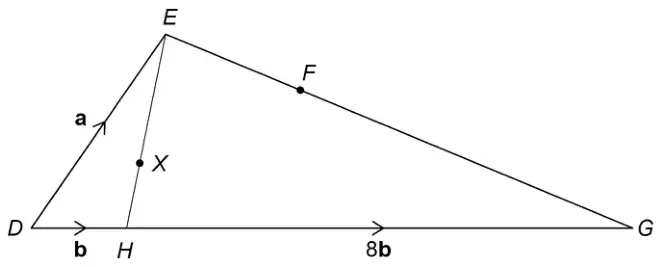
\((XF =)\ 2\left(\dfrac{1}{4}\mathbf{a} + \dfrac{3}{4}\mathbf{b}\right)\) and Yes
A1
oe using a different correct scalar multiple for \(XF\) and \(DX\)
Additional guidance
Method marks may be awarded for correct work seen on diagram or in working, with no or incorrect answer, even if this is seen amongst multiple attempts
Work out \(\quad 3\mathbf{a} + \mathbf{b}\) [2 marks]
Mark scheme
Answer
Mark
Comments
\(\begin{pmatrix} 11 \\ 19 \end{pmatrix}\)
B2
B1 unsimplified equivalent single vector eg \(\begin{pmatrix} 3 \times 2 + 5 \\ 3 \times 7 - 2 \end{pmatrix}\) or answer \(\begin{pmatrix} 11 \\ m \end{pmatrix}\) or answer \(\begin{pmatrix} n \\ 19 \end{pmatrix}\) or \(\begin{pmatrix} 6 \\ 21 \end{pmatrix}\) seen
Additional guidance
Condone fraction line for B2 or B1 eg \(\left(\dfrac{11}{19}\right)\)
B2
Answer \(\begin{pmatrix} 11 \\ m \end{pmatrix}\) must have \(m\) as a numerical value
Answer \(\begin{pmatrix} n \\ 19 \end{pmatrix}\) must have \(n\) as a numerical value
Must see the vector brackets to award any marks in the working eg \(\begin{matrix} 11 \\ 19 \end{matrix}\) or \(\dfrac{11}{19}\) or \(\dfrac{6 + 5}{21 - 2}\) or \(\begin{matrix} 6 \\ 21 \end{matrix}\)
B0
Unsimplified version may be awarded in the working but must be seen as a single vector eg \(\begin{pmatrix} 6 + 5 \\ 21 - 2 \end{pmatrix}\)
B1
\(\begin{pmatrix} 6 \\ 21 \end{pmatrix}\) may be awarded in the working if seen as a vector
(PQ =) \(\mathbf{a} + \mathbf{b} + \mathbf{c}\) and (XY =) \(\dfrac{2}{3}\mathbf{a} + \mathbf{b} + \dfrac{2}{3}\mathbf{c}\) and No, as XY is not a multiple of PQ
\(3 \times 6 \div 4.5\) or \(4\mathbf{a} + 3\mathbf{b}\)
M1dep
oe
4
A1
Alternative method 2: scale factor from \(k\mathbf{a} + 3\mathbf{b}\) and \(6\mathbf{a} + 4.5\mathbf{b}\)
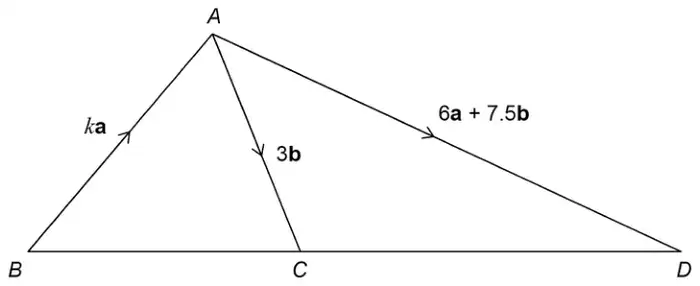
\((BC =)\ k\mathbf{a} + 3\mathbf{b}\) or \(4.5 \div 3\) or \(\dfrac{3}{2}\) or \(3 \div 4.5\) or \(\dfrac{2}{3}\) or \(4.5 \div 6\) or \(\dfrac{3}{4}\) or \(6 \div 4.5\) or \(\dfrac{4}{3}\)
M1
oe fractions or decimals
\(6 \div\) their \(\dfrac{3}{2}\) or \(6 \times\) their \(\dfrac{2}{3}\) or \(3 \div\) their \(\dfrac{3}{4}\) or \(3 \times\) their \(\dfrac{4}{3}\) or \(4\mathbf{a} + 3\mathbf{b}\)
M1dep
oe
4
A1
Alternative method 3: equal ratios from \((k + 6)\mathbf{a} + 7.5\mathbf{b}\) and \(6\mathbf{a} + 4.5\mathbf{b}\)
Alternative method 4: scale factor from \((k + 6)\mathbf{a} + 7.5\mathbf{b}\) and \(6\mathbf{a} + 4.5\mathbf{b}\)
\((BD =)\ k\mathbf{a} + 6\mathbf{a} + 7.5\mathbf{b}\) or \((BD =)\ (k + 6)\mathbf{a} + 7.5\mathbf{b}\) or \(7.5 \div 4.5\) or \(\dfrac{5}{3}\) or \(4.5 \div 7.5\) or \(\dfrac{3}{5}\) or \(4.5 \div 6\) or \(\dfrac{3}{4}\) or \(6 \div 4.5\) or \(\dfrac{4}{3}\)
M1
oe fractions or decimals
\(6 \times\) their \(\dfrac{5}{3}\) \(-\ 6\) or \(6 \div\) their \(\dfrac{3}{5}\) \(-\ 6\) or \(7.5 \div\) their \(\dfrac{3}{4}\) \(-\ 6\) or \(7.5 \times\) their \(\dfrac{4}{3}\) \(-\ 6\) or \(4\mathbf{a} + 3\mathbf{b}\)
M1dep
oe
4
A1
Additional guidance
Check the diagram for working
If working is not seen, only accept exact decimal values in place of fractions for method marks
Answer 4 with no working or no incorrect working
M1M1A1
Assumes that \(BC\) is \(3a + 2.25b\) (half the length of \(CD\)) or that \(BC\) is \(2a + 1.5b\) (one third of the length of \(CD\))
M0M0A0 M0M0A0
4a on the answer line does not get the A mark, but may have scored the method marks
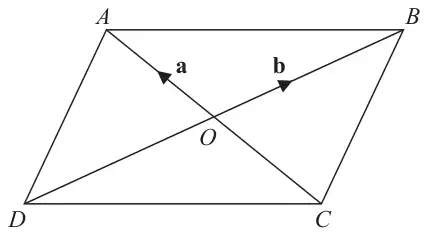
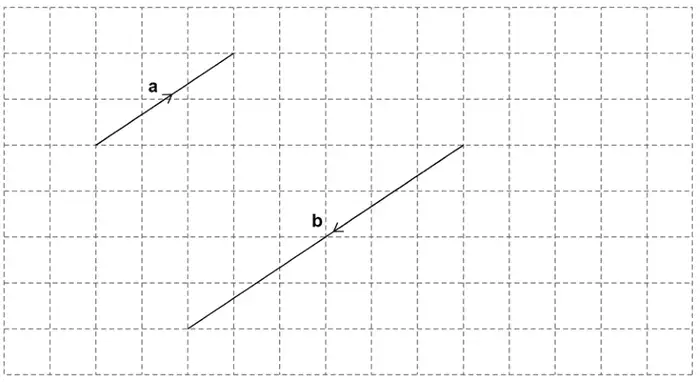
(a) Vectors \(\mathbf{a}\) and \(\mathbf{b}\) are drawn on a grid.
Write \(\mathbf{b}\) in terms of \(\mathbf{a}\). [1 mark]
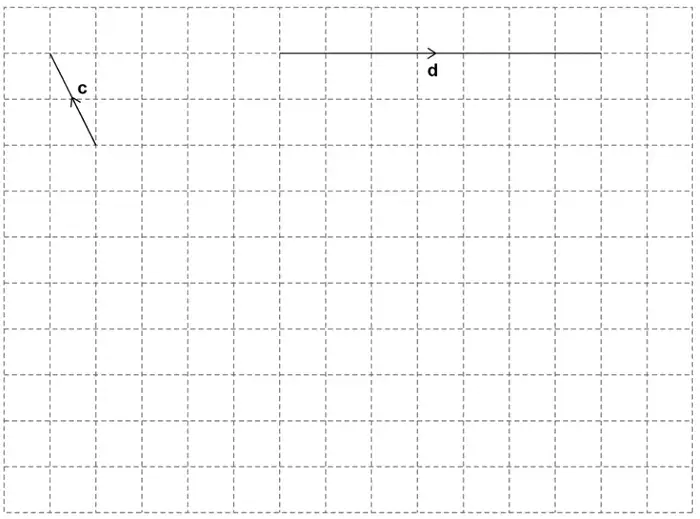
(b) Vectors \(\mathbf{c}\) and \(\mathbf{d}\) are drawn on a grid.
On the grid above, draw a vector representing \(\quad \mathbf{c} - \mathbf{d}\) [2 marks]
Mark scheme (a)
Answer
Mark
Comments
\(-2\mathbf{a}\)
B1
oe eg \(-\mathbf{a} - \mathbf{a}\) or \(2(-\mathbf{a})\)
Additional guidance
Do not accept in column vector form unless correct answer is also seen
Do not accept \(-\mathbf{a}2\) for \(-2\mathbf{a}\)
Mark scheme (b)
Answer
Mark
Comments
\(\begin{pmatrix} -8 \\ 2 \end{pmatrix}\) drawn on the grid with direction shown
B2
\(\pm\) ¼ centimetre square B1 \(\begin{pmatrix} -8 \\ 2 \end{pmatrix}\) seen in working or correct line drawn with incorrect direction or no direction shown or correctly joined vectors for \(\mathbf{c}\) and \(-\mathbf{d}\) with correct directions shown
Additional guidance
Mark intention, line does not need to be ruled and ignore all labelling for \(\mathbf{c}\), \(\mathbf{d}\) and \(\mathbf{c} - \mathbf{d}\)
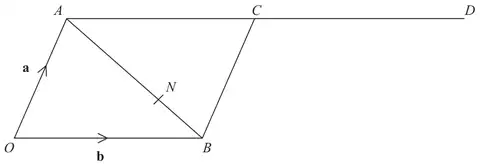
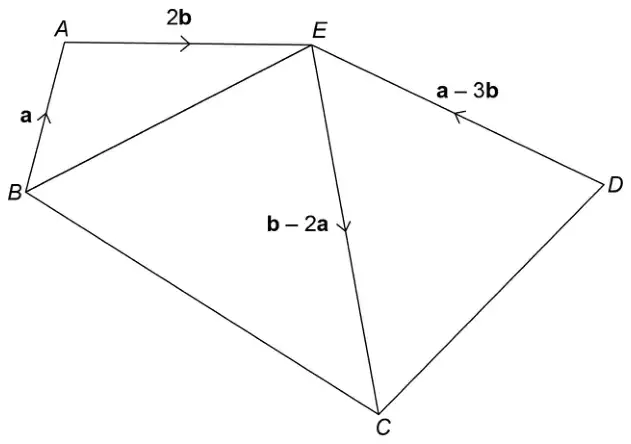
(\(\overrightarrow{BE}\) =) \(\mathbf{a} + 2\mathbf{b}\) and (\(\overrightarrow{CD}\) =) \(\mathbf{a} + 2\mathbf{b}\) or (\(\overrightarrow{EB}\) =) \(-\mathbf{a} - 2\mathbf{b}\) and (\(\overrightarrow{DC}\) =) \(-\mathbf{a} - 2\mathbf{b}\)
A1
Must see correct method for \(\overrightarrow{CD}\) or \(\overrightarrow{DC}\) oe eg (\(\overrightarrow{BE}\) =) \(\mathbf{a} + 2\mathbf{b}\) and (\(\overrightarrow{DC}\) =) \(-\mathbf{a} - 2\mathbf{b}\)
BE is equal and parallel to CD
A1
Must see two correct vectors for first A1 and have a statement oe eg BE is equal and parallel to DC
Alternative method 3 Shows that two pairs of opposite sides are parallel
(\(\overrightarrow{CB}\) =) \(\mathbf{a} - 3\mathbf{b}\) or (\(\overrightarrow{BC}\) =) \(3\mathbf{b} - \mathbf{a}\) or (\(\overrightarrow{BE}\) =) \(\mathbf{a} + 2\mathbf{b}\) and (\(\overrightarrow{CD}\) =) \(\mathbf{a} + 2\mathbf{b}\) or (\(\overrightarrow{EB}\) =) \(-\mathbf{a} - 2\mathbf{b}\) and (\(\overrightarrow{DC}\) =) \(-\mathbf{a} - 2\mathbf{b}\)
A1
Must see correct method for \(\overrightarrow{CB}\) or \(\overrightarrow{BC}\) or \(\overrightarrow{CD}\) or \(\overrightarrow{DC}\) oe eg (\(\overrightarrow{BE}\) =) \(\mathbf{a} + 2\mathbf{b}\) and (\(\overrightarrow{DC}\) =) \(-\mathbf{a} - 2\mathbf{b}\)
(\(\overrightarrow{CB}\) =) \(\mathbf{a} - 3\mathbf{b}\) and (\(\overrightarrow{BE}\) =) \(\mathbf{a} + 2\mathbf{b}\) and (\(\overrightarrow{CD}\) =) \(\mathbf{a} + 2\mathbf{b}\) and CB is parallel to DE and BE is parallel to CD
A1
Must see three correct vectors and have two statements oe eg (\(\overrightarrow{BC}\) =) \(3\mathbf{b} - \mathbf{a}\) and (\(\overrightarrow{BE}\) =) \(\mathbf{a} + 2\mathbf{b}\) and (\(\overrightarrow{DC}\) =) \(-\mathbf{a} - 2\mathbf{b}\) and BC is parallel to DE and BE is parallel to DC
Alternative method 4 Shows that two pairs of opposite sides are equal
(\(\overrightarrow{CB}\) =) \(\mathbf{a} - 3\mathbf{b}\) or (\(\overrightarrow{BC}\) =) \(3\mathbf{b} - \mathbf{a}\) or (\(\overrightarrow{BE}\) =) \(\mathbf{a} + 2\mathbf{b}\) and (\(\overrightarrow{CD}\) =) \(\mathbf{a} + 2\mathbf{b}\) or (\(\overrightarrow{EB}\) =) \(-\mathbf{a} - 2\mathbf{b}\) and (\(\overrightarrow{DC}\) =) \(-\mathbf{a} - 2\mathbf{b}\)
A1
Must see correct method for \(\overrightarrow{CB}\) or \(\overrightarrow{BC}\) or \(\overrightarrow{CD}\) or \(\overrightarrow{DC}\) oe eg (\(\overrightarrow{BE}\) =) \(\mathbf{a} + 2\mathbf{b}\) and (\(\overrightarrow{DC}\) =) \(-\mathbf{a} - 2\mathbf{b}\)
(\(\overrightarrow{CB}\) =) \(\mathbf{a} - 3\mathbf{b}\) and (\(\overrightarrow{BE}\) =) \(\mathbf{a} + 2\mathbf{b}\) and (\(\overrightarrow{CD}\) =) \(\mathbf{a} + 2\mathbf{b}\) and CB is equal to DE and BE is equal to CD
A1
Must see three correct vectors and have two statements oe eg (\(\overrightarrow{BC}\) =) \(3\mathbf{b} - \mathbf{a}\) and (\(\overrightarrow{BE}\) =) \(\mathbf{a} + 2\mathbf{b}\) and (\(\overrightarrow{DC}\) =) \(-\mathbf{a} - 2\mathbf{b}\) and BC is equal to DE and BE is equal to DC
Additional guidance
Choose the method that gives most marks
Ignore incorrect vectors if not contradictory
For parallel allow in the same direction or in the opposite direction
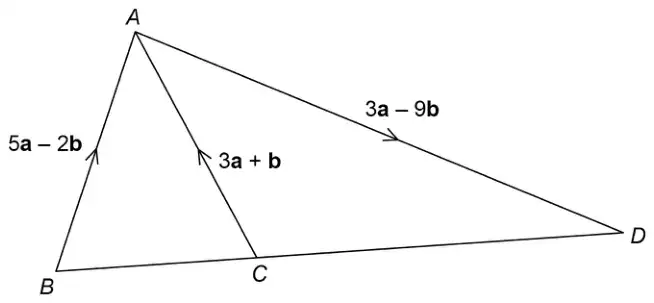
\((\boldsymbol{BC} =)\ 5\mathbf{a} - 2\mathbf{b} - 3\mathbf{a} - \mathbf{b}\) or \(2\mathbf{a} - 3\mathbf{b}\) or \((\boldsymbol{CD} =)\ 3\mathbf{a} + \mathbf{b} + 3\mathbf{a} - 9\mathbf{b}\) or \(6\mathbf{a} - 8\mathbf{b}\) or \((\boldsymbol{BD} =)\ 5\mathbf{a} - 2\mathbf{b} + 3\mathbf{a} - 9\mathbf{b}\) or \(8\mathbf{a} - 11\mathbf{b}\)
M1
oe eg \((\boldsymbol{CB} =)\ 3\mathbf{a} + \mathbf{b} - 5\mathbf{a} + 2\mathbf{b}\) or \(-2\mathbf{a} + 3\mathbf{b}\) or \((\boldsymbol{DC} =)\ -3\mathbf{a} + 9\mathbf{b} - 3\mathbf{a} - \mathbf{b}\) or \(-6\mathbf{a} + 8\mathbf{b}\) or \((\boldsymbol{DB} =)\ -3\mathbf{a} + 9\mathbf{b} - 5\mathbf{a} + 2\mathbf{b}\) or \(-8\mathbf{a} + 11\mathbf{b}\) Allow with brackets eg \((\boldsymbol{BC} =)\ 5\mathbf{a} - 2\mathbf{b} - (3\mathbf{a} + \mathbf{b})\)
Correct expressions for any two of \(\boldsymbol{BC}\), \(\boldsymbol{CD}\) and \(\boldsymbol{BD}\)
M1dep
oe eg1 correct expressions for \(\boldsymbol{BC}\) and \(\boldsymbol{DB}\) eg2 correct expressions for \(\boldsymbol{CB}\) and \(\boldsymbol{DC}\) Allow with brackets eg \((\boldsymbol{BC} =)\ 5\mathbf{a} - 2\mathbf{b} - (3\mathbf{a} + \mathbf{b})\) and \((\boldsymbol{DB} =)\ -(3\mathbf{a} - 9\mathbf{b}) - (5\mathbf{a} - 2\mathbf{b})\)
Correct simplified expressions for any two of \(\boldsymbol{BC}\), \(\boldsymbol{CD}\) and \(\boldsymbol{BD}\) and valid explanation and No
A1
oe eg correct expressions for \(\boldsymbol{BC}\) and \(\boldsymbol{DB}\) and valid explanation and No eg \(\boldsymbol{BC} = 2\mathbf{a} - 3\mathbf{b}\) and \(\boldsymbol{CD} = 6\mathbf{a} - 8\mathbf{b}\) and \(3(2\mathbf{a} - 3\mathbf{b}) = 6\mathbf{a} - 9\mathbf{b}\) and No or \(\boldsymbol{DC} = -6\mathbf{a} + 8\mathbf{b}\) and \(\boldsymbol{BD} = 8\mathbf{a} - 11\mathbf{b}\) and \(\boldsymbol{DC}\) is not a multiple of \(\boldsymbol{BD}\) and not straight
Additional guidance
Award marks for correct expressions, ignoring any incorrect ones unless contradictions of correct ones
\(\boldsymbol{BAD}\) means \(\boldsymbol{BD}\)
\(\boldsymbol{BD} = 5\mathbf{a} - 2\mathbf{b} + 3\mathbf{a} - 9\mathbf{b}\) or \(8\mathbf{a} - 11\mathbf{b}\) and \(\boldsymbol{BAD} =\) their \(\boldsymbol{BC} +\) their \(\boldsymbol{CD}\) and answer not \(8\mathbf{a} - 11\mathbf{b}\) Do not take \(\boldsymbol{BAD}\) to be a contradiction to \(\boldsymbol{BD}\)
Two correct simplified expressions used for a valid explanation and saying No with any incorrect non-contradictory expressions seen
M2A1
Condone absence of vector notation eg Condone CD to mean the vector from C to D
\(\overrightarrow{CD}\) means the vector from C to D and \(\overleftarrow{CD}\) means the vector from D to C
Do not allow any misreads
Missing brackets may be recovered
Allow for up to M2 expressions like \((\boldsymbol{BC} =)\ 5\mathbf{a} - 2\mathbf{b} + -3\mathbf{a} + -\mathbf{b}\)
Valid explanations: eg1 \(\;\boldsymbol{BC} = 2\mathbf{a} - 3\mathbf{b}\) and \(\boldsymbol{CD} = 6\mathbf{a} - 8\mathbf{b}\) and \(3(2\mathbf{a} - 3\mathbf{b}) = 6\mathbf{a} - 9\mathbf{b}\) is acceptable as there is a matching coefficient of \(\mathbf{a}\) eg2 \(\;\boldsymbol{CD} = 6\mathbf{a} - 8\mathbf{b}\) and \(\boldsymbol{BD} = 8\mathbf{a} - 11\mathbf{b}\) and \(2(6\mathbf{a} - 8\mathbf{b}) = 12\mathbf{a} - 16\mathbf{b}\) is not acceptable because there is no matching coefficient of \(\mathbf{a}\) or \(\mathbf{b}\) eg3 \(\;\boldsymbol{BC} = 2\mathbf{a} - 3\mathbf{b}\) and \(\boldsymbol{CD} = 6\mathbf{a} - 8\mathbf{b}\) and \(6\mathbf{a} - 8\mathbf{b} = 3(2\mathbf{a} - 2.6\mathbf{b})\) is acceptable because there is a matching coefficient of \(\mathbf{a}\) and no error in factorisation (just a truncation) eg4 \(\;\boldsymbol{BC} = 2\mathbf{a} - 3\mathbf{b}\) and \(\boldsymbol{CD} = 6\mathbf{a} - 8\mathbf{b}\) and \(3(2\mathbf{a} - 3\mathbf{b}) = 6\mathbf{a} - 10\mathbf{b}\) is not acceptable because there is an error in expansion
Allow not parallel or not same gradient for No
Allow \(\boldsymbol{DC}\) is not a factor of \(\boldsymbol{BD}\) as a valid explanation
Do not allow \(\boldsymbol{DC}\) is not a scalar of \(\boldsymbol{BD}\) as a valid explanation
Look for decision in working lines if answer line is blank
Note that \(\;\boldsymbol{BD} = \boldsymbol{BC} + \boldsymbol{CD}\;\) is a fact but is not a valid explanation
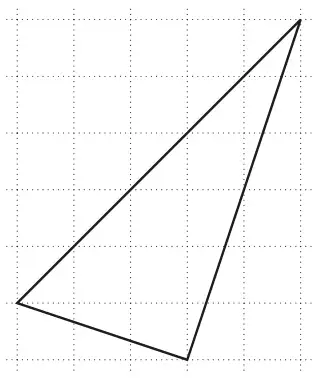
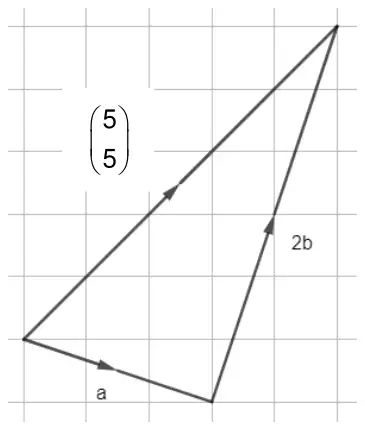
(a) On the grid below, draw \(\overrightarrow{\text{AB}}\).
[2]
(b) Work out \(\overrightarrow{\text{AC}}\). [2]
(c) Write down \(\overrightarrow{\text{BA}}\). [1]
Mark scheme (a)
Answer
Marks
Part marks and guidance
\(\begin{pmatrix} 3 \\ -1 \end{pmatrix}\) drawn with correct arrow
2
B1 for \(\begin{pmatrix} 3 \\ -1 \end{pmatrix}\) drawn with no or incorrect arrow or \(\begin{pmatrix} 3 \\ 1 \end{pmatrix}\) drawn with an arrow in either direction
Accept freehand Ignore BC on diagram Accept as part of triangle
Mark scheme (b)
Answer
Marks
Part marks and guidance
\(\begin{pmatrix} 5 \\ 5 \end{pmatrix}\)
2
B1 each value
Penalise by 1 mark first appearance of vinculum or poor form in vector but condone second use (applies to (b) and (c))
Mark scheme (c)
Answer
Marks
Part marks and guidance
\(\begin{pmatrix} -3 \\ 1 \end{pmatrix}\)
1
Penalise by 1 mark first appearance of vinculum or poor form in vector but condone second use (applies to (b) and (c))
(a) On the grid below, draw \(\overrightarrow{\text{AB}}\). [2]
(b) Work out \(\overrightarrow{\text{AC}}\). [2]
(c) Write down \(\overrightarrow{\text{BA}}\). [1]
Mark scheme (a)
Answer
Marks
Part marks and guidance
\(\begin{pmatrix} 3 \\ -1 \end{pmatrix}\) drawn with correct arrow
2
B1 for \(\begin{pmatrix} 3 \\ -1 \end{pmatrix}\) drawn with no or incorrect arrow or \(\begin{pmatrix} 3 \\ 1 \end{pmatrix}\) drawn with an arrow in either direction
Accept freehand Ignore BC on diagram Accept as part of a triangle
Mark scheme (b)
Answer
Marks
Part marks and guidance
\(\begin{pmatrix} 5 \\ 5 \end{pmatrix}\)
2
B1 each value
Penalise by 1 mark first appearance of vinculum or poor form in vector but condone second use
Mark scheme (c)
Answer
Marks
Part marks and guidance
\(\begin{pmatrix} -3 \\ 1 \end{pmatrix}\)
1
Penalise by 1 mark first appearance of vinculum or poor form in vector but condone second use
11 Vector \(\mathbf{a}\) and vector \(2\mathbf{b}\) are drawn on this grid.
(a) Write vector \(\mathbf{a}\) as a column vector. [2]
(b) Write a column vector that is different in direction but has the same length as vector \(\mathbf{a}\). [1]
(c) On the grid below, draw the vector \(\mathbf{a} - \mathbf{b}\). [3]
Mark scheme (a)
Answer
Marks
Part marks and guidance
\(\begin{pmatrix} -3 \\ 1 \end{pmatrix}\)
2
B1 for answer \(\begin{pmatrix} -3 \\ k \end{pmatrix}\) or \(\begin{pmatrix} k \\ 1 \end{pmatrix}\)
No fraction line in vector – but penalise 1 mark only in (a) and (b)
Mark scheme (b)
Answer
Marks
Part marks and guidance
Correct response e.g. a vector \(\begin{pmatrix} p \\ q \end{pmatrix}\) where \(p^2 + q^2 = 10\) or FT their (a)
1FT
Allow correct or FT their (a) Must be numeric and column vector
e.g. \(\begin{pmatrix} \pm 3 \\ \pm 1 \end{pmatrix}\) or \(\begin{pmatrix} \pm 1 \\ \pm 3 \end{pmatrix}\) or \(\begin{pmatrix} \sqrt{10} \\ 0 \end{pmatrix}\) etc but not their \(\begin{pmatrix} -3 \\ 1 \end{pmatrix}\) from (a)
Mark scheme (c)
Answer
Marks
Part marks and guidance
Vector \(\mathbf{a} - \mathbf{b}\) correctly drawn with correct direction arrow on the resultant
3
B2 for \(\mathbf{a} - \mathbf{b}\) correctly drawn but with an incorrect or no direction arrow or or B1 for their \(\begin{pmatrix} -3 \\ 1 \end{pmatrix} - \begin{pmatrix} 0 \\ -2 \end{pmatrix}\) or \(\begin{pmatrix} -3 \\ 3 \end{pmatrix}\) or for drawing \(\begin{pmatrix} -3 \\ 1 \end{pmatrix} - \begin{pmatrix} 0 \\ -2 \end{pmatrix}\) oe on grid as two sides of a potential triangle (condone missing/wrong arrows)
If 0 scored, SC1 for vector \(\begin{pmatrix} -3 \\ 5 \end{pmatrix}\) drawn on grid with correct direction arrow
Full marks may be within a triangle with correct direction arrow B2 may be within a triangle with no direction arrow[s]
B1 for either 3 or 11 in correct position or for \(\left[\begin{pmatrix} 5 \\ 3 \end{pmatrix} +\right] \begin{pmatrix} -2 \\ 8 \end{pmatrix}\) or \(\begin{pmatrix} 5 \\ 3 \end{pmatrix} - \begin{pmatrix} 2 \\ -8 \end{pmatrix}\)
\(\overrightarrow{\mathrm{OA}}\) = \(\mathbf{a}\) and \(\overrightarrow{\mathrm{OC}}\) = \(\mathbf{c}\). The point N lies on line AB such that AN : NB = 3 : 5.
(a) Find the following vectors in terms of a and c. Give your answers in their simplest form.
(i) \(\overrightarrow{\mathrm{OB}}\) [1]
(ii) \(\overrightarrow{\mathrm{ON}}\) [2]
(b) Line CN is extended to reach point P, such that \(\overrightarrow{\mathrm{CP}} = \frac{8}{5}\overrightarrow{\mathrm{CN}}\).
Show, using vectors, that OAP is a straight line. [4]
Mark scheme (a)
Answer
Marks
Part marks and guidance
(a)(i)
\(\mathbf{a} + \mathbf{c}\)
1
Not A + C, but if use of capitals in other parts of question, penalise the first occurrence only Accept \(\mathbf{c} + \mathbf{a}\)
(a)(ii)
\(\mathbf{a} + \frac{3}{8}\mathbf{c}\) final answer
2
M1 for correct route
or for \(\overrightarrow{\mathrm{AN}} = \frac{3}{8}\mathbf{c}\) or \(\overrightarrow{\mathrm{BN}} = -\frac{5}{8}\mathbf{c}\)
M1 for e.g. OA + AN, OC + \(\mathbf{a}\) – NB Condone poor vector notation for method Could be written on diagram
or FT (their(a)(ii)) – \(\mathbf{c}\) must be vector route in terms of \(\mathbf{a}\) and/or \(\mathbf{c}\)
Condone omission of vector arrows etc throughout question Allow \(\overrightarrow{\mathrm{CN}}\), \(\overrightarrow{\mathrm{CP}}\) and \(\overrightarrow{\mathrm{NP}}\) both unsimplified and isw attempts to simplify
NP may be embedded in working leading to OP when e.g. they do ON + NP
or \(\overrightarrow{\mathrm{NP}} = \frac{3}{5}\mathbf{a} - \frac{3}{8}\mathbf{c}\) oe
M1
or FT \(\overrightarrow{\mathrm{CP}} = \frac{8}{5}\)(their \(\overrightarrow{\mathrm{CN}}\)) must be vector route in terms of \(\mathbf{a}\) and/or \(\mathbf{c}\) or FT \(\overrightarrow{\mathrm{NP}} = \frac{3}{5}\)(their \(\overrightarrow{\mathrm{CN}}\)) must be vector route in terms of \(\mathbf{a}\) and/or \(\mathbf{c}\)
Alt method (using similar triangles NCB and NPA) M2 for \(\overrightarrow{\mathrm{AP}} = \frac{3}{5}\mathbf{a}\) oe
\(\overrightarrow{\mathrm{OP}} = \frac{8}{5}\mathbf{a}\) oe or \(\overrightarrow{\mathrm{AP}} = \frac{3}{5}\mathbf{a}\)
B1
Award B1 for e.g. OP = \(\mathbf{c} + \frac{8}{5}\mathbf{a} - \mathbf{c}\) Accept OAP = \(\frac{8}{5}\mathbf{a}\) oe
Correct conclusion \(\overrightarrow{\mathrm{OP}} = \frac{8}{5}\overrightarrow{\mathrm{OA}}\) oe or \(\overrightarrow{\mathrm{OP}}\) is a multiple of \(\overrightarrow{\mathrm{OA}}\) oe
A1
Dep on M2B1
Accept correct equivalent vector conclusions involving AP and OP or OA
(b) On the grid, draw vector \(\mathbf{a} + \mathbf{b}\).
[2]
Mark scheme (a)
Answer
Marks
Part marks and guidance
Vector \(\mathbf{a}\) correctly drawn with direction arrow
1
Across (a) and (b), penalise first instance only where direction arrow is omitted or in the incorrect direction
Mark scheme (b)
Answer
Marks
Part marks and guidance
Vector \(\mathbf{a} + \mathbf{b}\) correctly drawn with direction arrow
2
M1 for \(\begin{pmatrix} 4 \\ -2 \end{pmatrix}\) or for \(\begin{pmatrix} 3 \\ 2 \end{pmatrix} + \begin{pmatrix} 1 \\ -4 \end{pmatrix}\) correctly drawn in an incomplete vector triangle with or without arrows
Could be part of a complete vector triangle
For 2 or 1 marks allow correct vector drawn when construction/counting lines/arcs are drawn.
M1 for \(\overrightarrow{\mathrm{PQ}} + \overrightarrow{\mathrm{QR}}\) or \(\begin{pmatrix} 3 \\ 2 \end{pmatrix} + \begin{pmatrix} 4 \\ 1 \end{pmatrix}\) or B1 for answer \(\begin{pmatrix} 7 \\ k \end{pmatrix}\) or \(\begin{pmatrix} k \\ 3 \end{pmatrix}\)
M1 If fraction line in final answer For M1 allow 3 + 4 and 2 + 1
15 The diagram shows triangle OAB and points C and D.
Not to scale
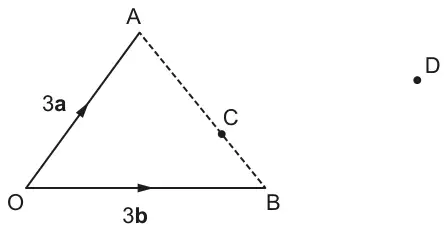
\(\overrightarrow{OA} = 3\mathbf{a}\) and \(\overrightarrow{OB} = 3\mathbf{b}\). C lies on AB such that AC = 2CB. D is such that \(\overrightarrow{BD} = 2\mathbf{a} + \mathbf{b}\).
Show, using vectors, that OCD is a straight line. [5]
Mark scheme
Answer
Marks
Part marks and guidance
Accept any correct justification e.g. two of OC = \(\mathbf{a} + 2\mathbf{b}\) OD = \(2\mathbf{a} + 4\mathbf{b}\) CD = \(\mathbf{a} + 2\mathbf{b}\)
and
correct conclusion e.g. OD = \(2(\mathbf{a} + 2\mathbf{b})\) = 2OC or OD is a multiple of OC or OC = CD (must be consistent with vectors found)
5
B1 for [AB =] \(3\mathbf{b} - 3\mathbf{a}\) oe M1 for each of e.g. OC = \(3\mathbf{a} + \frac{2}{3}(3\mathbf{b} - 3\mathbf{a})\) oe soi by \(\mathbf{a} + 2\mathbf{b}\) OD = \(3\mathbf{b} + 2\mathbf{a} + \mathbf{b}\) oe soi by \(2\mathbf{a} + 4\mathbf{b}\) CD = \(\frac{1}{3}(3\mathbf{b} - 3\mathbf{a}) + 2\mathbf{a} + \mathbf{b}\) oe soi by \(\mathbf{a} + 2\mathbf{b}\) to a maximum of M2 and may be on diagram and condone notation OCD for OD only
M1 for [OD =] \(2(\mathbf{a} + 2\mathbf{b})\) or 2OC = OD or OC = CD and must be consistent with vectors found If 0 scored M1 for any correct route leading to OC, CD or OD e.g. OC = OB + BC
For others, check that top + 5 is double bottom + 2
Mark scheme (b)
Answer
Marks
Part marks and guidance
\(m = -2\), \(n = 4\)
5
B1 for \(\begin{pmatrix} 4m \\ m \end{pmatrix}\) or \(\begin{pmatrix} 5n \\ 2n \end{pmatrix}\) soi and M1 for \(4m + 5n = 12\) or \(m + 2n = 6\) and M1 for multiplication by scalar(s) to equate coefficients in m or n or reduction to one variable by substitution e.g. \(4(6 - 2n) + 5n = 12\) and M1 for elimination or simplification to \(3m = -6\) or \(3n = 12\) oe
(b) Find the values of \(h\) and \(k\).\[\begin{pmatrix}h\\5\end{pmatrix} + \begin{pmatrix}2\\k\end{pmatrix} - \begin{pmatrix}3\\3\end{pmatrix} = \begin{pmatrix}0\\0\end{pmatrix}\]
B1 for \(\begin{pmatrix}6\\0\end{pmatrix}\) or \(\begin{pmatrix}-6\\8\end{pmatrix}\) or \(\begin{pmatrix}0\\k\end{pmatrix}\) or \(\begin{pmatrix}k\\0\end{pmatrix}\) as final vector
10 Two vectors, \(\mathbf{a}\) and \(\mathbf{b}\), are shown on the 1 centimetre grid below.
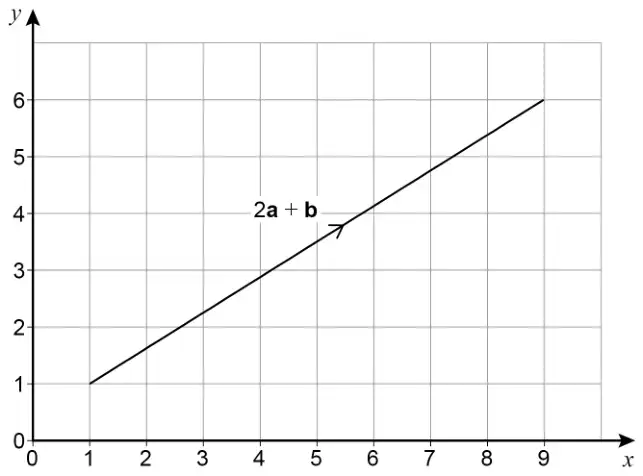
Show that the vector \(\mathbf{a} + 2\mathbf{b}\) has length 7 cm. You may use the grid below.
[3]
Mark scheme
Answer
Marks
Part marks and guidance
Correct triangle drawn with \(\mathbf{a} + 2\mathbf{b}\) labelled and with correct arrows or \(\mathbf{a}\) and \(2\mathbf{b}\) labelled and with correct arrows AND length 7cm indicated on diagram
3
M1 for vector \(2\mathbf{b}\) drawn on grid
M1 \(\mathbf{a} + k\mathbf{b}\) drawn on grid The two vectors must be joined end to end but arrows may be contradictory. \(k\mathbf{b}\) should be in the direction of \(\mathbf{b}\)
If both methods shown/started, mark the better one For M marks condone missing or incorrect arrows and labels on vectors
Mark intent: end of vectors within 2mm of of vertices of relevant square
Examples (ignore arrows): M1M1 for \(\mathbf{a} + 2\mathbf{b}\) drawn (3 marks if labelled and 7 cm indicated) M1M1 for \(\mathbf{a} - 2\mathbf{b}\) M1M0 for \(2\mathbf{b}\) or \(-2\mathbf{b}\) M0M1 for \(\mathbf{a} + \mathbf{b}\), \(\mathbf{a} - 1.5\mathbf{b}\) etc
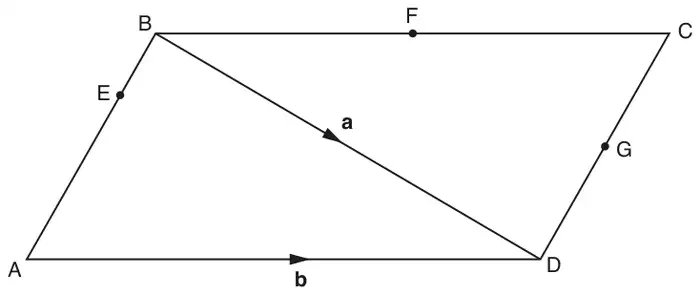
\(\overrightarrow{\mathrm{BD}}\) = \(\mathbf{a}\) and \(\overrightarrow{\mathrm{AD}}\) = \(\mathbf{b}\). F is the midpoint of BC. G is the midpoint of DC. AE = 3EB.
(a) Write down simplified expressions in terms of \(\mathbf{a}\) and \(\mathbf{b}\) for
(i) \(\overrightarrow{\mathrm{AB}}\), [1]
(ii) \(\overrightarrow{\mathrm{EB}}\). [1]
(b) Show that \(\overrightarrow{\mathrm{EF}}\) \(= \dfrac{1}{4}(3\mathbf{b} - \mathbf{a})\). [2]
(c) Prove that \(\overrightarrow{\mathrm{EF}}\) and \(\overrightarrow{\mathrm{AG}}\) are parallel. [3]
Mark scheme (a)
Answer
Marks
Part marks and guidance
(i) \(\mathbf{b} - \mathbf{a}\)
1
(ii) \(\dfrac{1}{4}(\mathbf{b} - \mathbf{a})\) or \(\dfrac{1}{4}\mathbf{b} - \dfrac{1}{4}\mathbf{a}\)
1
FT from (a)(i)
Mark scheme (b)
Answer
Marks
Part marks and guidance
\(\overrightarrow{\mathrm{EF}}\) = \(\overrightarrow{\mathrm{EB}}\) + \(\overrightarrow{\mathrm{BF}}\) = \(\dfrac{1}{4}(\mathbf{b} - \mathbf{a}) + \dfrac{1}{2}\mathbf{b}\) leading to \(\dfrac{1}{4}(3\mathbf{b} - \mathbf{a})\) as given.
2
M1 for their part (a)(ii) + \(\dfrac{1}{2}\mathbf{b}\) oe
(a)(ii) must be in terms of \(\mathbf{a}\) and \(\mathbf{b}\)
\(\overrightarrow{\mathrm{AG}}\) = 2\(\overrightarrow{\mathrm{EF}}\) oe so are parallel.
3
B2 for \(\overrightarrow{\mathrm{AG}}\) \(= \dfrac{3}{2}\mathbf{b} - \dfrac{1}{2}\mathbf{a}\) or M1 for \(\mathbf{b} + \dfrac{1}{2}\)(their part (a)(i)) oe
Allow vectors found in reverse throughout eg. \(\overrightarrow{\mathrm{GA}}\) instead of \(\overrightarrow{\mathrm{AG}}\)
Condone “AG and EF are multiples of each other”
Full marks dependent on both AG and EF in correct simplified forms
Find the value \(k\) so that \(k(\mathbf{a} - \mathbf{b}) = \mathbf{c}\). [2]
Mark scheme (a)
Answer
Marks
Part marks and guidance
(i) Draws vector \(\begin{pmatrix} 4 \\ 2 \end{pmatrix}\)
(ii) and Draws vector \(\begin{pmatrix} 0 \\ 2 \end{pmatrix}\)
2
B1 for each
In (a), penalise first instance only where direction arrow is omitted Condone good freehand mark intention
Could be part of correct vector triangle
Mark scheme (b)
Answer
Marks
Part marks and guidance
They are different in direction oe
1
Accept correct comments that mention the directions of the vectors
Accept any comment implying the directions of the 2 vectors are different e.g. ‘They are not parallel’ ‘They are going in different directions’ ‘They are going in opposite \(x\)–directions’ ‘Vector A is a [vertical] reflection of vector B’ ‘One goes left, the other goes right’ ‘One goes in positive direction the other goes in negative direction’ ‘One has –2 and the other has 2’ Condone ‘They are going in opposite directions’
Do not accept mention of just 1 vector only unless the reason clearly implies a comparison e.g. Do not accept ‘Vector a goes right’ ‘One of them has a minus sign’