22 The 2nd term of a geometric sequence is \(3 + 2\sqrt{2}\) The 3rd term of the sequence is \(13 + 9\sqrt{2}\)
Find the value of the common ratio of the sequence. Give your answer in the form \(a + \sqrt{b}\) where \(a\) and \(b\) are integers. You must show all your working. (4)
Mark scheme
Answer
Mark
Mark scheme
\(3 + \sqrt{2}\)
P1
for start of process to find the common ratio, eg writes \(\dfrac{13 + 9\sqrt{2}}{3 + 2\sqrt{2}}\)
P1
for process to rationalise the denominator, eg \(\dfrac{13 + 9\sqrt{2}}{3 + 2\sqrt{2}} \times \dfrac{3 - 2\sqrt{2}}{3 - 2\sqrt{2}}\)
P1
(dep P2) for expanding terms, condone one error in expansion of numerator or denominator, eg \(\dfrac{39 + 27\sqrt{2} - 18\sqrt{2}\sqrt{2} - 26\sqrt{2}}{9 + 6\sqrt{2} - 6\sqrt{2} - 4\sqrt{2}\sqrt{2}}\) or \(\dfrac{39 + 27\sqrt{2} - 26\sqrt{2} - 36}{9 - 8}\) oe
A1
cao
Additional guidance
Award P1 for process to rationalise the denominator of \(\dfrac{3 + 2\sqrt{2}}{13 + 9\sqrt{2}}\)
A correct answer with no supportive working gets 0 marks.
23 Write \(\dfrac{3\sqrt{3}}{4 - \sqrt{3}} - \dfrac{2}{\sqrt{3}}\) in the form \(\dfrac{a\sqrt{3} + b}{c}\) where \(a\), \(b\) and \(c\) are integers. (4)
Mark scheme
Answer
Mark
Mark scheme
\(\dfrac{10\sqrt{3} + 27}{39}\)
M1
for method to rationalise one of the fractions, eg \(\dfrac{3\sqrt{3}}{4 - \sqrt{3}} \times \dfrac{4 + \sqrt{3}}{4 + \sqrt{3}}\ \left(= \dfrac{12\sqrt{3} + 9}{16 - 3}\right)\) or \(\dfrac{2}{\sqrt{3}} \times \dfrac{\sqrt{3}}{\sqrt{3}}\ \left(= \dfrac{2\sqrt{3}}{3}\right)\) oe
M1
for method to rationalise both of the fractions eg \(\dfrac{3\sqrt{3}}{4 - \sqrt{3}} \times \dfrac{4 + \sqrt{3}}{4 + \sqrt{3}}\ \left(= \dfrac{12\sqrt{3} + 9}{16 - 3}\right)\) and \(\dfrac{2}{\sqrt{3}} \times \dfrac{\sqrt{3}}{\sqrt{3}}\ \left(= \dfrac{2\sqrt{3}}{3}\right)\) oe
M1
for method to write correct fractions with a common denominator eg \(\dfrac{3(12\sqrt{3} + 9)}{13 \times 3} - \dfrac{13 \times 2\sqrt{3}}{13 \times 3}\) or \(\dfrac{36\sqrt{3} + 27}{39} - \dfrac{26\sqrt{3}}{39}\) oe
A1
for \(\dfrac{10\sqrt{3} + 27}{39}\) oe
Alternative
M1
for method to write fractions with a common denominator, eg \(\dfrac{3\sqrt{3} \times \sqrt{3}}{\sqrt{3}(4 - \sqrt{3})} - \dfrac{2 \times (4 - \sqrt{3})}{\sqrt{3}(4 - \sqrt{3})}\) oe
M1
for writing as a correct single fraction without brackets, eg \(\dfrac{9 - 8 + 2\sqrt{3}}{4\sqrt{3} - 3}\) oe
M1
for method to rationalise a fraction of the form \(\dfrac{a + b\sqrt{3}}{c\sqrt{3} - d}\) where \(a\), \(b\), \(c\) and \(d\) are integers, eg \(\dfrac{1 + 2\sqrt{3}}{4\sqrt{3} - 3} \times \dfrac{4\sqrt{3} + 3}{4\sqrt{3} + 3}\) or \(\dfrac{4\sqrt{3} + 3 + 24 + 6\sqrt{3}}{48 + 12\sqrt{3} - 12\sqrt{3} - 9}\) oe
(a) Rationalise the denominator of \(\dfrac{22}{\sqrt{11}}\) Give your answer in its simplest form. (2)
(b) Show that \(\dfrac{\sqrt{3}}{2\sqrt{3} - 1}\) can be written in the form \(\dfrac{a + \sqrt{3}}{b}\) where \(a\) and \(b\) are integers. (3)
Mark scheme (a)
Answer
Mark
Mark scheme
\(2\sqrt{11}\)
M1
for method to multiply numerator and denominator by \(\sqrt{11}\) or a multiple of \(\sqrt{11}\), eg \(\dfrac{22}{\sqrt{11}} \times \dfrac{\sqrt{11}}{\sqrt{11}}\)
A1
for \(2\sqrt{11}\)
Mark scheme (b)
Answer
Mark
Mark scheme
\(\dfrac{6 + \sqrt{3}}{11}\)
M1
for method to multiply numerator and denominator by \(2\sqrt{3} + 1\) or a multiple of \(2\sqrt{3} + 1\), eg \(\dfrac{\sqrt{3}}{2\sqrt{3} - 1} \times \dfrac{2\sqrt{3} + 1}{2\sqrt{3} + 1}\)
M1
(dep) for \(\sqrt{3} \times 2\sqrt{3} = 6\) or \(2\sqrt{3} \times 2\sqrt{3} = 12\)
A1
for \(\dfrac{6 + \sqrt{3}}{11}\) (accept \(a = 6\) and \(b = 11\))
13 \(\sqrt{5}\left(\sqrt{8} + \sqrt{18}\right)\) can be written in the form \(a\sqrt{10}\) where \(a\) is an integer.
Find the value of \(a\). (3)
Mark scheme
Answer
Mark
Mark scheme
5
M1
for \(\sqrt{40}\) or \(\sqrt{90}\)
OR \(2\sqrt{2}\) or \(3\sqrt{2}\)
M1
for \(2\sqrt{10}\) or \(3\sqrt{10}\) or \(\sqrt{4} \times \sqrt{10}\) or \(\sqrt{9} \times \sqrt{10}\) or \(\sqrt{4 \times 10}\) or \(\sqrt{9 \times 10}\)
OR \(2\sqrt{2} + 3\sqrt{2}\)
A1
cao
Additional guidance
Answer of \(5\sqrt{10}\) from correct working gets M2 A0
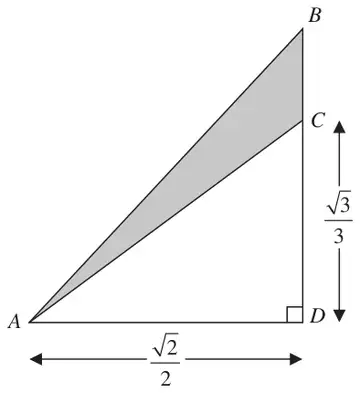
Work out the value of \(T\). Give your answer in the form \(c\sqrt{2}\) where \(c\) is an integer. (4)
Mark scheme
Answer
Mark
Notes
\(16\sqrt{2}\)
4
M1 for method to expand \((\sqrt{8} + 2)^2\) with at least 3 correct terms out of 4 terms M1 for method to expand \((\sqrt{8} - 2)^2\) with at least 3 correct terms out of 4 terms M1 (dep on M2) for a method to subtract the two expressions and use of \(\sqrt{8} = 2\sqrt{2}\) A1 cao
OR
M1 for factorising \(a^2 - b^2 = (a + b)(a - b)\) M1 for substituting for \(a\) and \(b\) with simplification (at least 1 of the two terms correct) M1 (dep on M2) for multiplying the 2 terms together and use of \(\sqrt{8} = 2\sqrt{2}\) A1 cao
M1 for \(\dfrac{5}{\sqrt{2}} \times \dfrac{\sqrt{2}}{\sqrt{2}}\) oe A1 for \(\dfrac{5\sqrt{2}}{2}\) oe
Mark scheme (b)
Answer
Mark
Notes
\(8\sqrt{3}\)
2
M1 for \(2 \times 2 + 2\sqrt{3} + 2\sqrt{3} + \sqrt{3} \times \sqrt{3}\) or \((4 + 4\sqrt{3} + 3) - (4 - 4\sqrt{3} + 3)\) or \(2 \times 2 - 2\sqrt{3} - 2\sqrt{3} + \sqrt{3} \times \sqrt{3}\) at least three terms in either correct; could be in a grid. A1 cao OR Difference of two squares M1 for \(\left((2 + \sqrt{3}) - (2 - \sqrt{3})\right)\left((2 + \sqrt{3}) + (2 - \sqrt{3})\right)\) A1 cao
(a) Show that \(\quad \dfrac{\sqrt{363}}{\sqrt{3}} \quad\) simplifies to an integer. [2 marks]
(b) Rationalise the denominator and simplify \(\quad \dfrac{20}{\sqrt{5}}\) [2 marks]
Mark scheme (a)
Answer
Mark
Comments
\(\dfrac{\sqrt{121}\sqrt{3}}{\sqrt{3}}\) or \(\dfrac{11\sqrt{3}}{\sqrt{3}}\) or \(\sqrt{121}\) or \(\dfrac{\sqrt{363}}{\sqrt{3}} \times \dfrac{\sqrt{3}}{\sqrt{3}}\) or \(\dfrac{\sqrt{363}\sqrt{3}}{3}\) or \(\dfrac{11\sqrt{3}\sqrt{3}}{3}\) or \(\dfrac{\sqrt{1089}}{3}\)
M1
oe with at least partial simplification of the numerator oe with correct method to rationalise the denominator rationalised
11 and \(\dfrac{\sqrt{121}\sqrt{3}}{\sqrt{3}}\) or \(\dfrac{11\sqrt{3}}{\sqrt{3}}\) or \(\sqrt{121}\) or 11 and \(\dfrac{11\sqrt{3}\sqrt{3}}{3}\) or \(\dfrac{\sqrt{1089}}{3}\)
A1
Additional guidance
For M1, allow multiplication or division by \(\sqrt{1}\) throughout
Mark scheme (b)
Answer
Mark
Comments
Correct expression with rationalisation of denominator seen or used
M1
eg \(\dfrac{20}{\sqrt{5}} \times \dfrac{\sqrt{5}}{\sqrt{5}}\) or \(\dfrac{20\sqrt{5}}{5}\) or \(\dfrac{4 \times \sqrt{5} \times \sqrt{5}}{\sqrt{5}}\) or \(\dfrac{4\sqrt{5}}{1}\)
\(\dfrac{7\sqrt{15}}{10}\) or \(\dfrac{14\sqrt{15}}{20}\)
A1
oe in the form \(\dfrac{x\sqrt{15}}{y}\) where \(x\) and \(y\) are integers
Alternative method 3
\(\dfrac{7}{\sqrt{2}} \times \dfrac{\sqrt{2}}{\sqrt{2}}\) or \(\dfrac{7\sqrt{2}}{2}\) or \(\dfrac{\sqrt{3}}{\sqrt{10}} \times \dfrac{\sqrt{10}}{\sqrt{10}}\) or \(\dfrac{\sqrt{30}}{10}\)
M1
oe
\(\dfrac{7\sqrt{2}}{2} \times \dfrac{\sqrt{30}}{10}\) or \(\dfrac{7\sqrt{60}}{20}\)
M1dep
oe rationalised
\(\dfrac{7\sqrt{15}}{10}\) or \(\dfrac{14\sqrt{15}}{20}\)
A1
oe in the form \(\dfrac{x\sqrt{15}}{y}\) where \(x\) and \(y\) are integers
\(\dfrac{7\sqrt{5}}{\sqrt{10}} \times \dfrac{\sqrt{3}}{\sqrt{10}}\) or \(\dfrac{7}{\sqrt{2}} \times \dfrac{\sqrt{15}}{\sqrt{50}}\) or \(\dfrac{7\sqrt{15}}{\sqrt{100}}\)
M1dep
oe one term or product of two terms with numerator \(7\sqrt{15}\)
\(\dfrac{7\sqrt{15}}{10}\) or \(\dfrac{14\sqrt{15}}{20}\)
A1
oe in the form \(\dfrac{x\sqrt{15}}{y}\) where \(x\) and \(y\) are integers
(a) Show that \(\quad \dfrac{14}{\sqrt{7}} \quad\) can be written in the form \(\quad a\sqrt{b} \quad\) where \(a\) and \(b\) are integers. [2 marks]
(b) Work out \(\quad 2\sqrt{10} \times \sqrt{80} \times \sqrt{18}\)
Give your answer as an integer. [3 marks]
Mark scheme (a)
Answer
Mark
Comments
\(\dfrac{14}{\sqrt{7}} \times \dfrac{\sqrt{7}}{\sqrt{7}}\) or \(\dfrac{14\sqrt{7}}{7}\)
M1
\(2\sqrt{7}\)
A1
do not award if further work eg \(\sqrt{14}\)
Additional guidance
Correct answer with no working
M1A1
Mark scheme (b)
Answer
Mark
Comments
240
B3
B2 any correct single value of the form \(a\sqrt{b}\) where \(a \geqslant 2\) eg \(24\sqrt{100}\) or \(12\sqrt{400}\) or \(8\sqrt{900}\) or \(6\sqrt{1600}\) or \(2\sqrt{14\,400}\) or correct product of two or more integers eg \(24 \times 10\) or \(8 \times 30\) or \(6 \times 40\) or \(2 \times 2 \times 5 \times 4 \times 3\) B1 \((\sqrt{80} =)\ 4\sqrt{5}\) or \((\sqrt{18} =)\ 3\sqrt{2}\) or correct product of two surds eg \(2\sqrt{800} \times \sqrt{18}\) or \(2\sqrt{180} \times \sqrt{80}\) or \(2\sqrt{10} \times \sqrt{1440}\) or \(\sqrt{40} \times \sqrt{80} \times \sqrt{18}\) or \(2\sqrt{10 \times 80 \times 18}\) or \(\sqrt{40 \times 80 \times 18}\) or \(2\sqrt{2 \times 5 \times 4 \times 4 \times 5 \times 2 \times 3 \times 3}\) or \(\sqrt{2^8 \times 5^2 \times 3^2}\) or \(\sqrt{57\,600}\)
24 Work out \(\quad \sqrt{18} - \dfrac{28}{\sqrt{50}}\)
Give your answer in the form \(\quad \dfrac{\sqrt{a}}{b} \quad\) where \(a\) and \(b\) are integers. [4 marks]
Mark scheme
Answer
Mark
Comments
Alternative method 1
\((\sqrt{18} =)\ \sqrt{9}\sqrt{2}\) or \(3\sqrt{2}\) or \((\sqrt{50} =)\ \sqrt{25}\sqrt{2}\) or \(5\sqrt{2}\)
M1
oe simplifies one surd implied by \(\dfrac{28}{5\sqrt{2}}\)
\(\dfrac{28}{\sqrt{50}} \times \dfrac{\sqrt{50}}{\sqrt{50}}\) or \(\dfrac{28\sqrt{50}}{50}\)
M1
oe rationalises second term \(\dfrac{28}{5\sqrt{2}} \times \dfrac{5\sqrt{2}}{5\sqrt{2}}\) or \(\dfrac{140\sqrt{2}}{50}\) or \(\dfrac{14\sqrt{2}}{5}\) implies M1M1
\(3\sqrt{2} - \dfrac{140\sqrt{2}}{50}\) or \(\dfrac{150\sqrt{2} - 140\sqrt{2}}{50}\) or \(\dfrac{10\sqrt{2}}{50}\)
M1dep
dep on M2 oe both terms rational with a common surd
\(\dfrac{\sqrt{2}}{5}\) or \(a = 2\), \(b = 5\)
A1
oe in the form \(\dfrac{\sqrt{a}}{b}\) eg \(\dfrac{\sqrt{50}}{25}\) or \(\dfrac{\sqrt{200}}{50}\)
Alternative method 2
\((\sqrt{18} =)\ \sqrt{9}\sqrt{2}\) or \(3\sqrt{2}\) or \((\sqrt{50} =)\ \sqrt{25}\sqrt{2}\) or \(5\sqrt{2}\) or \(\dfrac{\sqrt{18}\sqrt{50}}{\sqrt{50}}\) or \(\dfrac{\sqrt{900}}{\sqrt{50}}\)
M1
oe simplifies one surd implied by \(\dfrac{28}{5\sqrt{2}}\)
or changes first term to match second
\(\dfrac{\sqrt{900}}{\sqrt{50}} - \dfrac{28}{\sqrt{50}}\) or \(\dfrac{3\sqrt{2} \times 5\sqrt{2}}{\sqrt{50}} - \dfrac{28}{\sqrt{50}}\) or \(\dfrac{30 - 28}{\sqrt{50}}\) or \(\dfrac{2}{\sqrt{50}}\)
M1dep
oe common denominator
\(\dfrac{30 - 28}{\sqrt{50}} \times \dfrac{\sqrt{50}}{\sqrt{50}}\) or \(\dfrac{2\sqrt{50}}{50}\)
M1dep
oe rationalisation of a single term
\(\dfrac{\sqrt{2}}{5}\) or \(a = 2\), \(b = 5\)
A1
oe in the form \(\dfrac{\sqrt{a}}{b}\) eg \(\dfrac{\sqrt{50}}{25}\) or \(\dfrac{\sqrt{200}}{50}\)
Additional guidance
Ignore further work after a correct value, eg \(\dfrac{\sqrt{50}}{25} = \sqrt{2}\)
24 Show that \(\quad \dfrac{2\sqrt{6}}{\sqrt{5}} - \dfrac{\sqrt{3}}{\sqrt{10}} \quad\) can be written in the form \(\quad \dfrac{c\sqrt{d}}{10}\)
where \(c\) and \(d\) are integers. [3 marks]
Mark scheme
Answer
Mark
Comments
Alternative method 1
\(\dfrac{2\sqrt{6}}{\sqrt{5}} \times \dfrac{\sqrt{5}}{\sqrt{5}}\) or \(\dfrac{\sqrt{3}}{\sqrt{10}} \times \dfrac{\sqrt{10}}{\sqrt{10}}\)
M1
\(\dfrac{2\sqrt{30}}{5}\) or \(\dfrac{4\sqrt{30}}{10}\) or \(\dfrac{\sqrt{30}}{10}\)
M1dep
\(\dfrac{3\sqrt{30}}{10}\)
A1
Alternative method 2
\(\dfrac{2\sqrt{6}\sqrt{2}}{\sqrt{10}} - \dfrac{\sqrt{3}}{\sqrt{10}}\) or \(\dfrac{2\sqrt{12}}{\sqrt{10}} - \dfrac{\sqrt{3}}{\sqrt{10}}\)
M1
oe common denominator eg \(\dfrac{2\sqrt{60}}{\sqrt{50}} - \dfrac{\sqrt{15}}{\sqrt{50}}\)
\(\dfrac{4\sqrt{3}}{\sqrt{10}} - \dfrac{\sqrt{3}}{\sqrt{10}}\) or \(\dfrac{3\sqrt{3}}{\sqrt{10}}\)
M1dep
oe common denominator and common surd in numerator \(\dfrac{4\sqrt{15}}{\sqrt{50}} - \dfrac{\sqrt{15}}{\sqrt{50}}\) or \(\dfrac{3\sqrt{15}}{\sqrt{50}}\)
\(\dfrac{3\sqrt{30}}{10}\)
A1
Additional guidance
Ignore an attempt at further simplification after \(\dfrac{3\sqrt{30}}{10}\)
29 Work out the value of \(\qquad \left(\sqrt{3}\right)^2 \times \left(\sqrt{2}\right)^2\) [2 marks]
Mark scheme
Answer
Mark
Comments
\(\left(\left(\sqrt{3}\right)^2 =\right)\) 3 and \(\left(\left(\sqrt{2}\right)^2 =\right)\) 2 or \(\left(\sqrt{6}\right)^2\) or \(\sqrt{6^2}\) or \(\sqrt{36}\) or \(\sqrt{9} \times \sqrt{4}\) or \(\sqrt{9 \times 4}\)
M1
6
A1
Additional guidance
\(3 \times 2 = 6\) with answer eg \(\sqrt{6}\) or \(6^4\)
M0A0
Condone \(\sqrt{3} = 1.7\), \(1.7^2 = 3\) and \(\sqrt{2} = 1.4\), \(1.4^2 = 2\), otherwise \(\sqrt{3}\) or \(\sqrt{2}\) or \(3^2\) or \(2^2\) incorrectly evaluated does not score even if answer is 6 eg \(\sqrt{3} = 1.5\), \(1.5^2 = 3\), answer 6 \(\sqrt{2} = 1\), \(1^2 = 2\) \(3^2 = 6\), \(\sqrt{6} = 3\) \(\left(\sqrt{6}\right)^4\) \(\sqrt{2} = 1\)
6 Work out the value of \(\quad \left(\sqrt{3}\right)^2 \times \left(\sqrt{2}\right)^2\) [2 marks]
Mark scheme
Answer
Mark
Comments
\(\left(\left(\sqrt{3}\right)^2 =\right)\) 3 and \(\left(\left(\sqrt{2}\right)^2 =\right)\) 2 or \(\left(\sqrt{6}\right)^2\) or \(\sqrt{6^2}\) or \(\sqrt{36}\) or \(\sqrt{9} \times \sqrt{4}\) or \(\sqrt{9 \times 4}\)
M1
6
A1
Additional guidance
\(3 \times 2 = 6\) with answer eg \(\sqrt{6}\) or \(6^4\)
M0A0
Condone \(\sqrt{3} = 1.7\), \(1.7^2 = 3\) and \(\sqrt{2} = 1.4\), \(1.4^2 = 2\), otherwise \(\sqrt{3}\) or \(\sqrt{2}\) or \(3^2\) or \(2^2\) incorrectly evaluated does not score, even if answer is 6
Give your answer in the form \(a\sqrt{b}\), where \(a\) and \(b\) are integers.
You must show each step in your working. [3]
Mark scheme
Answer
Marks
Part marks and guidance
\(\sqrt{75}\ [-\sqrt{15} + \sqrt{15}] - \sqrt{3}\) or \(\sqrt{5}\sqrt{15}\ [-\sqrt{5}\sqrt{3} + \sqrt{15}] - \sqrt{3}\) or \(5\sqrt{3}\ [-\sqrt{15} + \sqrt{15}] - \sqrt{3}\)
M2
M1 for correct expansion with one error or omission or \(\sqrt{75} = 5\sqrt{3}\) Alternative 1 M2 for \(\sqrt{3}\,(\sqrt{5} - 1)(\sqrt{5} + 1)\) or better or M1 for \(\sqrt{15} - \sqrt{3} = \sqrt{3}\,(\sqrt{5} - 1)\)
Working must be in surds, working can be in tables e.g M2 for
\(\sqrt{15}\)
\(-\sqrt{3}\)
\(\sqrt{5}\)
\(\sqrt{75}\)
\(-\sqrt{15}\)
\(+1\)
\(\sqrt{15}\)
\(-\sqrt{3}\)
\(5\sqrt{3} - \sqrt{3} = 4\sqrt{3}\)
A1
for A1 allow \(5\sqrt{3} - \sqrt{3}\) to be seen in the M2 expression
Find the value of \(a\) and the value of \(b\). You must show each step in your working. [6]
Mark scheme
Answer
Marks
Part marks and guidance
[\(a =\)] 21 [\(b =\)] −31 with correct working
6
“Correct working” requires at least M1M1M1M1
M1 for \(\frac{2 - 3\sqrt{18}}{\sqrt{18} + 4} \times \frac{\sqrt{18} - 4}{\sqrt{18} - 4}\) M1 for multiplying their numerator e.g. \(2\sqrt{18} - 8 - 3 \times 18 + 12\sqrt{18}\) oe or better M1 for simplifying their numerator e.g. \(14\sqrt{18} - 62\) M1 for multiplying their denominator e.g. \(18 + 4\sqrt{18} - 4\sqrt{18} - 16\) oe or better e.g. 18 – 16 or 2 M1 for \(\sqrt{18} = 3\sqrt{2}\) at any stage and may be implied in working A1dep for [a =] 21 or [b =] −31 dep. on only M4 awarded
alternative : M1 for \(\sqrt{18} = 3\sqrt{2}\) M1 for \(\frac{2 - 9\sqrt{2}}{3\sqrt{2} + 4} \times \frac{3\sqrt{2} - 4}{3\sqrt{2} - 4}\) M1 for multiplying their numerator \(6\sqrt{2} - 8 - 3 \times 18 + 36\sqrt{2}\) oe or better M1 for simplifying their numerator e.g. \(42\sqrt{2} - 62\) M1 for \(18 + 12\sqrt{2} - 12\sqrt{2} - 16\) oe or better e.g. 18 – 16 or 2 A1dep for [a =] 21 or [b =] −31 dep. on only M4 awarded
Alternative: M1 for \([2 - 3\sqrt{18} =] (a\sqrt{2} + b)(\sqrt{18} + 4)\) M1 for \(a\sqrt{2}\sqrt{18} + 4a\sqrt{2} + b\sqrt{18} + 4b\) oe or better M1 for \(\sqrt{2}\sqrt{18} = 6\) or \(\sqrt{18} = 3\sqrt{2}\) M1 for \(6a + 4a\sqrt{2} + 3b\sqrt{2} + 4b\) M1 for \(2 = 6a + 4b\) oe and \(-9 = 4a + 3b\) oe A1dep for [a =] 21 or [b =] −31 dep. on only M4 awarded
If 0 scored SC1 for [a =] 21 and [b =] −31
Note : working may be implied by use rather than explicitly seen and follow through from any errors if subsequent working is correct
(a) Show that \(\sqrt{11} \times \sqrt{22} = 11\sqrt{2}\). [1]
(b) Show that \(\frac{\sqrt{11}}{13 + \sqrt{22}}\) can be written in the form \(\frac{a\sqrt{11} - 11\sqrt{2}}{b}\) where \(a\) and \(b\) are integers. [4]
(a) Complete this statement by writing the missing power in the box.\[784 = 2^{\square} \times 7^2\]
[1]
(b) Use your answer to part (a) to find the value of \(\sqrt{784}\). [2]
Mark scheme (a)
Answer
Marks
Part marks and guidance
4
1
Mark scheme (b)
Answer
Marks
Part marks and guidance
28
2
B1 for answer that is a multiple of 7 (not 7 or 14) but not a multiple of 49 and is less than 784
or \(n \times 7\) seen leading to the answer
28 scores 2 marks from any method Allow B1 for a correct equivalent to 28 of form \(a\sqrt{b}\) (\(a \ne 1\)) e.g. \(7\sqrt{16}\), \(4\sqrt{49}\), \(2\sqrt{196}\)
(b) There are two errors in Sam’s method for finding the value of \(64^{-\frac{2}{3}}\) shown below.
Find the cube root of 64 and then multiply by 2. The cube root of 64 is 4 and then 4 x 2 = 8. The negative power makes the answer negative so answer equals –8.
Describe these errors and then give the correct value of \(64^{-\frac{2}{3}}\). [3]
Mark scheme (a)
Answer
Marks
Part marks and guidance
(i) \(6\sqrt{2}\) final answer
2
M1 for \(\sqrt{25 \times 2}\) or better seen
(ii) \(\dfrac{5\sqrt{6}}{3}\) final answer
2
M1 for \(\frac{10}{\sqrt{6}} \times \frac{\sqrt{6}}{\sqrt{6}}\) oe
For 2 marks accept \(1\frac{2}{3}\sqrt{6}\)
Mark scheme (b)
Answer
Marks
Part marks and guidance
Identifies both errors and explains the correct steps e.g. Square not multiply by 2 oe negative power does not make answer negative it should be the reciprocal oe
2
B1 for each with no incorrect statement for either
Accept implication of error by a description of correct step e.g. should be squared should be reciprocal, should be 1/\(n\), should be 1/64 Descriptions must be in words do not accept numeric examples alone
SEE APPENDIX
\(\dfrac{1}{16}\)
1
isw attempt to convert to decimal
Appendix: Exemplar responses for Q15b
Accept reciprocal or one over for description of negative power, must use squared. Descriptions must be in words
Response
Mark
1
Make the fraction reciprocal
(Not clear as the fraction could be the index)
0
2
Negative power means find the inverse
0
3
Make it a reciprocal
1
4
The negative power makes it positive
0
5
Make it one over
1
6
He multiplied the power by 2
0
7
Need to turn into fraction ; The negative makes it a fraction
0
8
The –2 is the power so it must be squared
1
9
Square not times 2
1
10
Cube root should be squared and the negative power is 1 under
‘1 under’ is not quite right
1, 0
11
Top fraction is to square not double, and the negative makes it 1 over