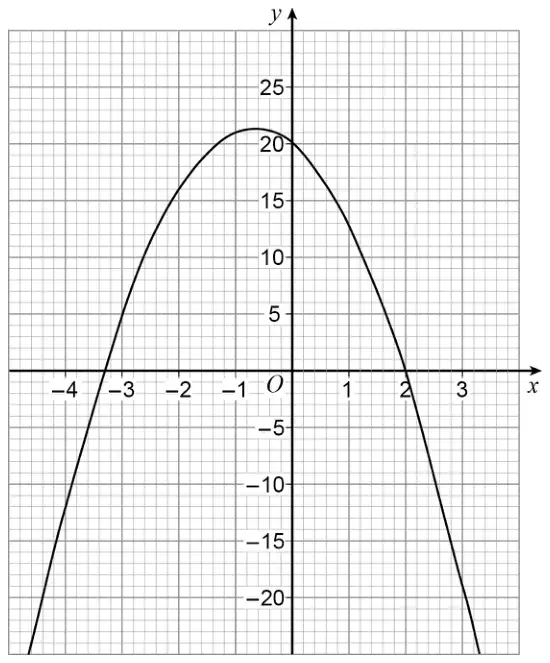
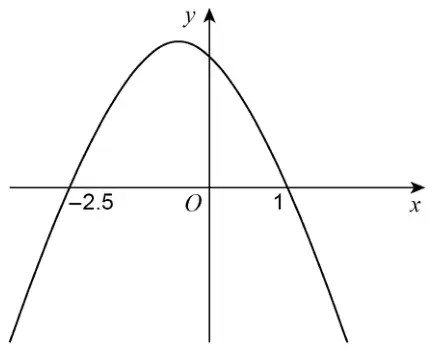
(dep on previous M1) for \(x \gt -3\) and \(x \lt \dfrac{4}{3}\) or \(x \gt c\) and \(x \lt d\) where \(c\) and \(d\) are their critical values and \(c \lt d\)
A1
for \(-2.5 \lt x \lt \dfrac{4}{3}\) oe eg \(x \lt \dfrac{4}{3}\), \(x \gt -2.5\)
Additional guidance
accept use of = or incorrect inequality symbol for 1st and 3rd M marks
This may be implied by a suitable diagram
A correct answer with no supportive working gets 0 marks
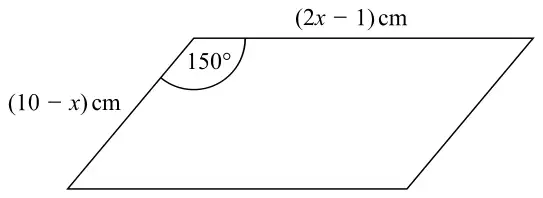
The area of the parallelogram is greater than 15 cm\(^2\)
(a) Show that \(2x^2 - 21x + 40 \lt 0\) (3)
(b) Find the range of possible values of \(x\). (3)
Mark scheme (a)
Answer
Mark
Mark scheme
Shown
C1
for a method to find the area of half of the parallelogram or of the whole parallelogram, eg \(\frac{1}{2}(2x - 1)(10 - x)\sin 150\) or \(\frac{1}{2}(2x - 1)(10 - x) \times \frac{1}{2}\) oe or \((2x - 1)(10 - x)\sin 150\) or \((2x - 1)(10 - x) \times \frac{1}{2}\) oe
C1
for a correct expansion of the whole area eg \(\frac{1}{2}(20x - 10 - 2x^2 + x)\) or \(\frac{1}{2}(-2x^2 + 21x - 10)\) or \(-x^2 + 10.5x - 5\)
C1
complete chain of reasoning with fully correct algebra dealing with the inequality eg \(x^2 - 10.5x + 5 \lt -15\) or \(x^2 - 10.5x + 20 \lt 0\) or \(2x^2 - 21x + 10 \lt -30\) which lead to \(2x^2 - 21x + 40 \lt 0\)
Mark scheme (b)
Answer
Mark
Mark scheme
\(2.5 \lt x \lt 8\)
M1
for factorising, \((2x - 5)(x - 8)\)
A1
for critical values, 2.5, 8
A1
for any statement that \(x\) is greater than 2.5 and \(x\) is less than 8
(a) Show that \((2x + 1)(x + 3)(3x + 7)\) can be written in the form \(ax^3 + bx^2 + cx + d\) where \(a\), \(b\), \(c\) and \(d\) are integers. (3)
(b) Solve \((1 - x)^2 \lt \dfrac{9}{25}\) (3)
Mark scheme (a)
Answer
Mark
Mark scheme
\(6x^3 + 35x^2 + 58x + 21\)
M1
for a method to find the product of two linear expressions, 3 correct terms out of 4 terms e.g. \(2x^2 + x + 6x + 3\) or \(3x^2 + 7x + 9x + 21\) or \(6x^2 + 14x + 3x + 7\)
M1
for a complete method to obtain all terms, at least half of which are correct (ft their first product) e.g. \(6x^3 + 32x^2 + 42x + 3x^2 + 16x + 21\)
A1
cao
Additional guidance
Note that, for example, \(7x + 3\) is regarded as three terms in the expansion of \((2x + 1)(x + 3)\)
First product must be a 3 or 4 term quadratic but need not be simplified or may be simplified incorrectly
for first step of finding the square root of both sides eg \(1 - x \lt \pm\dfrac{3}{5}\) OR for writing in the form \(ax^2 + bx + c\ (\lt 0)\) eg \(x^2 - 2x + \dfrac{16}{25}\ (\lt 0)\) or \(25x^2 - 50x + 16\ (\lt 0)\)
M1
for showing critical values \(\dfrac{2}{5}\ (= 0.4)\) and \(1\dfrac{3}{5}\ (= 1.6)\) oe
A1
for \(\dfrac{2}{5} \lt x \lt 1\dfrac{3}{5}\) oe
Additional guidance
Condone use of an “=” sign; accept one square root (eg \(\tfrac{3}{5}\)) only shown.
Critical values can be stated, or shown in an expression (which may have incorrect inequality symbols)
Could be written as two separate expressions eg \(x \gt \dfrac{2}{5}\) and \(x \lt 1\dfrac{3}{5}\) oe
for a correct method to begin rearranging to solve for \(m^2\) eg \(88 \lt m^2 + 7\) or \(m^2 + 7 \lt 128\) or \(81 \lt m^2 \lt 121\)
M1
for a complete method to \(m^2 = 81\) or \(m^2 = 121\) or better
M1
for a set of critical values: at least two out of 9, 11, \(-9\), \(-11\)
M1
for selecting a correct inequality for one set of critical values eg \(9 \lt m\) and \(m \lt -9\) or \(m \lt 11\) and \(-11 \lt m\) or \(9 \lt m\) and \(m \lt 11\) or a set of inequalities with some error eg \(9\ ?\ m\ ?\ 11\) and \(-11\ ?\ m\ ?\ -9\) where ? is an incorrect inequality symbol like \(9 \lt m \leqslant 11\) or \(9 \geqslant m \geqslant 11\) or answer given as \(\pm 9 \lt m \lt \pm 11\)
A1
\(9 \lt m \lt 11\) and \(-11 \lt m \lt -9\) given as boundaries of \(m\)
Additional guidance
It is insufficient to just multiply all three elements by 4; some rearrangement must occur such as showing as two separate inequalities or isolating \(m^2\)
Accept an inequality used in place of “=”. \(m^2\) must be isolated at this stage.
Do not award if other values are also given eg 10
Could be shown as \(9 \lt m \lt 11\) or \(-11 \lt m \lt -9\) or \(-11 \lt m \lt 11\)
20 \(n\) is an integer such that \(3n + 2 \leqslant 14\) and \(\dfrac{6n}{n^2 + 5} \gt 1\)
Find all the possible values of \(n\). (5)
Mark scheme
Answer
Mark
Mark scheme
2, 3, 4
M1
for method to solve \(3n + 2 \leqslant 14\) eg \(n \leqslant (14 - 2) \div 3\) oe
M1
for complete method to rearrange \(\dfrac{6n}{n^2 + 5} \gt 1\) to the form \(an^2 + bn + c\ (\lt 0)\)
M1
for method to begin to solve \(n^2 - 6n + 5\ (\lt 0)\) eg \((n \pm 5)(n \pm 1)\ (\lt 0)\)
M1
(dep on previous M2) for \(n \gt 1\) and \(n \leqslant 4\) or \(1 \lt n \lt 5\)
A1
(dep M4) cao
Additional guidance
This could be shown within an equation rather than an inequality at this stage
For the 2nd and 3rd M marks condone no ‘\(\lt 0\)’ and condone use of incorrect inequality signs or ‘=’ Accept \(\dfrac{-(-6) \pm \sqrt{(-6)^2 - 4 \times 1 \times 5}}{2 \times 1}\) (condone one sign error)
Must come from correct working Could be shown on a number line
Alternative method
Answer
Mark
Mark scheme
2, 3, 4
M1
for method to solve \(3n + 2 \leqslant 14\) eg \(n \leqslant (14 - 2) \div 3\) oe OR for \(3 \times 4 + 2 = 14\)
M3
for trials with 1, 2, 3 and 4 in the quadratic inequality, correctly evaluated
(M2
for trials with three of 1, 2, 3 and 4, correctly evaluated)
(M1
for trials with two of 1, 2, 3 and 4, correctly evaluated)
A1
(dep M4) cao
This could be shown within an equation rather than an inequality at this stage
The values from the trials may be given as improper fractions eg \(\dfrac{24}{21}\), \(\dfrac{18}{14}\), \(\dfrac{12}{9}\), \(\dfrac{6}{6}\)
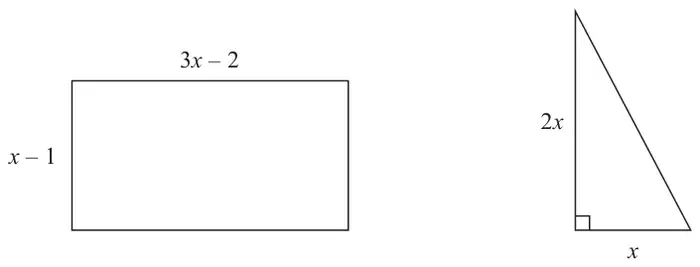
23 Here is a rectangle and a right-angled triangle.
All measurements are in centimetres. The area of the rectangle is greater than the area of the triangle.
Find the set of possible values of \(x\). (5)
Mark scheme
Answer
Mark
Notes
\(x \gt 2\)
P1
for process to derive algebraic expressions for area of both rectangle and triangle eg \((x - 1)(3x - 2)\) and \((2x \times x) \div 2\) (condone missing brackets)
M1
for method to rearrange inequality to \(2x^2-5x+2 \gt 0\) oe providing in the form \(ax^2 + bx + c \gt 0\)
M1
for a correct method to solve \(2x^2-5x+2\gt 0\)
M1
for establishing critical values 2 and \(\dfrac{1}{2}\)
for a first step to solve the quadratic e.g. factorisation: \((2x + 4)\left(x - \tfrac{1}{2}\right)\) or \((2x - 1)(x + 2)\) or using the formula \(\dfrac{-3 \pm \sqrt{3^2 - 4 \times 2 \times (-2)}}{2 \times 2}\)
Correct method to solve their three-term quadratic
M1
eg \((2x - 3)(x + 4)\ (\gt 0)\) or \(2\left(x + \dfrac{5}{4}\right)^2 - \dfrac{121}{8}\ (\gt 0)\) or \(\dfrac{-5 \pm \sqrt{5^2 - 4 \times 2 \times -12}}{2 \times 2}\) any of these imply B1M1
1.5 and \(-4\)
A1ft
oe ft their three-term quadratic
Both \(x \gt 1.5\) and \(x \lt -4\) stated
B1ft
oe ft B0M1 or B1M1A0 ft their two solutions for their three-term quadratic correct for their inequality in the form \(ax^2 + bx + c \gt 0\) or \(ax^2 + bx + c \lt 0\), which must be seen if it is not the correct inequality
Additional guidance
For the first B1 and the M1 condone = 0 in place of \(\gt 0\) or \(\lt 0\)
Trial and Improvement is 0, 3 (for 1.5 and \(-4\)) or 4 marks
Incorrectly joined inequalities cannot score the final B1 eg \(1.5 \lt x \lt -4\)
B1M1A1B0
Example where 1.5 and \(-4\) do not imply first B1: \(2x^2 + 5x - 12 \lt 0\), \((2x - 3)(x + 4) \lt 0\), \(x = 1.5\) and \(x = -4\), \(-4 \lt x \lt 1.5\) final B1ft is only awarded if B0M1 or B1M1A0 is scored
B0M1A1B1ft
\(2x^2 - 5x - 12 \lt 0\), \((2x + 3)(x - 4) \lt 0\), \(x = -1.5\) and \(x = 4\), \(-1.5 \lt x \lt 4\) joined inequality is correct for their three-term quadratic inequality
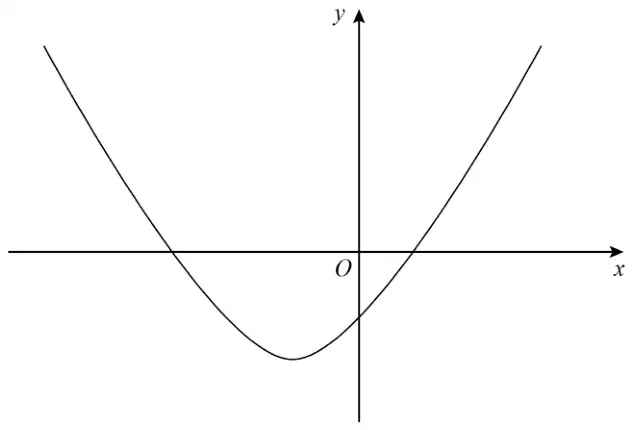
(b) Show the solution to \(\quad x^2 - 5x - 6 \lt 0 \quad\) on the number line. [1 mark]
Mark scheme (a)
Answer
Mark
Comments
\((x + 1)(x - 6)\) or \(\dfrac{5 \pm \sqrt{(-5)^2 - 4\ (\times 1) \times (-6)}}{2\ (\times 1)}\) or \(2.5 \pm \sqrt{12.25}\) or \(-1\) and 6 identified
M1
oe do not accept missing bracket on \((-5)^2\) unless recovered
\(-1 \lt x \lt 6\)
A1
condone \(-1 \lt x\) and \(x \lt 6\)
Mark scheme (b)
Answer
Mark
Comments
Open circles at \(-1\) and 6 joined by line
B1ft
ft their double-sided inequality in (a) if the bounds are within the number line condone ft an inequality given in two parts if the bounds are within the number line condone ft a single-sided inequality if the bound is within the number line
may be seen in inequalities or as intersections with \(x\)-axis on the graph must be selected if appearing in a list of values or a table
\(-6 < x < 2\) or \(2 > x > -6\)
A1ft
ft M1A0 and two values must be a single inequality
Additional guidance
To award A1ft the values must be used to give a continuous interval eg1 \((x + 6)(x - 2)\) followed by \((x =)\ 6\) and \((x =)\ {-2}\) Answer \(-2 < x < 6\) eg2 \((x + 6)(x - 2)\) followed by \((x =)\ 6\) and \((x =)\ {-2}\) Answer \(6 < x < -2\)
M1A0A1ft
M1A0A0ft
\(x < 2\) and \(x > -6\)
M1A1A0
\(-6 < x > 2\)
M1A1A0
\(-6 \leqslant x < 2\)
M1A1A0
\(-6 < x < 2\) in working with different answer on answer line
M1A1A0
\(-6 < x < 2\) in working with integers on answer line
Give your answer using set notation. You must show your working. [5]
Mark scheme
Answer
Marks
Part marks and guidance
\(\{x : -6 \leqslant x \leqslant 2\}\) final answer and with correct working
5
“correct working” requires at least M2 e.g. \((x + 6)(x - 2)\)
B4 for \(-6 \leqslant x \leqslant 2\) with correct working and not written separately
OR
M2 for \((x + 6)(x - 2)\) or \(\frac{-4 \pm \sqrt{4^2 - 4 \times 1 \times -12}}{2}\) or M1 for brackets which give two correct terms or the formula with at most two errors
B1 −6 and 2
condone \(x(x - 2) + 6(x - 2)\) for M2 could be seen as roots on a sketch of graph or with incorrect inequality symbols
completing the square : allow \((x + 2)^2 - 16\) for M2 or \((x + 2)^2 + k\) for M1
If 0 or 1 scored award instead SC2 for \(\{x : -6 \leqslant x \leqslant 2\}\) If 0 scored SC1 for \(-6 \leqslant x \leqslant 2\)
For M2 or M1, condone [= 0] M2 for correct formula or complete square condone 1 error M1 for \((x - 2.5)^2\) oe seen or for correct formula with 2 errors
Or M1 for \((x + a)(x + b)\) [\(\leqslant\) 0 ] where \(ab = -6\) or \(a + b = -5\)
B1 for –1 and 6 soi
Could be seen as roots on sketch of graph or in wrong inequality