\(y = x^2 - 6px - 7 \quad\) where \(\quad p \gt 0\)
showing the coordinates of the turning point, in terms of \(p\), and the coordinates of the intercept with the \(y\)-axis. You must show all your working. (5)
Mark scheme
Answer
Mark
Mark scheme
Sketch graph with minimum point at \((3p, -9p^2 - 7)\) in 4th quadrant and \(y\) intercept at \((0, -7)\)
B1
for a curve drawn with intercept at the point \((0, -7)\)
M1
for the start of a method to find the turning point, eg \((x - 3p)^2 \ldots\) or an \(x\) coordinate of \(3p\) at the vertex
M1
(dep) for a complete correct method to find the turning point, eg \((x - 3p)^2 - 9p^2 - 7\) or substitutes \(x = 3p\) into the equation to find \(y\)
B1
for turning point at \((3p, -9p^2 - 7)\)
C1
for a sketch of a parabola drawn with intercept at \((0, -7)\) and minimum turning point clearly shown as being at \((3p, -9p^2 - 7)\) in the 4th quadrant.
Additional guidance
where … can be any constant term(s) but not term(s) in \(x\)
Allow \((3p)^2\) for \(9p^2\) throughout
A correct answer with no supportive working gets 0 marks
(i) Write \(x^2 - 8x + 3\) in the form \((x - a)^2 - b\) where \(a\) and \(b\) are integers. (2)
(ii) Hence, write down the coordinates of the turning point on the graph of \(y = x^2 - 8x + 3\) (1)
(b) Solve \(7x^2 + 8x - 5 = 0\) Give your solutions correct to 3 significant figures. (3)
Alex has to find the solutions of the quadratic equation \(3k^2 + 10k - 8 = 0\) Here is his working and answer.
\[\begin{gathered} (3k - 2)(k + 4) = 0 \\ k = 2 \text{ or } k = -4 \end{gathered}\]
(c) What mistake has Alex made? (1)
Mark scheme (a)
Answer
Mark
Mark scheme
(i) \((x - 4)^2 - 13\)
M1
for start to method of completing the square, eg \((x - 4)^2\ldots\)
A1
cao
(ii) \((4, -13)\)
B1
ft from answer of form \((x - a)^2 - b\)
Additional guidance
(ii) This mark is dependent on a completed square form given in (a)(i)
Mark scheme (b)
Answer
Mark
Mark scheme
0.449 and \(-1.59\)
M1
for substitution into quadratic formula, eg \(\dfrac{-8 \pm \sqrt{8^2 - 4 \times 7 \times -5}}{2 \times 7}\) oe
M1
for simplification to \(\dfrac{-8 \pm \sqrt{204}}{14}\) or \(\dfrac{-4 \pm \sqrt{51}}{7}\) oe or for one correct solution in decimal form.
A1
for 0.448 to 0.449 and \(-1.59\) to \(-1.6(0)\)
Additional guidance
Condone one sign error
One correct solution in the required form out of two solutions given scores 2 marks
If an answer is shown in the range in working and then incorrectly rounded award full marks.
Mark scheme (c)
Answer
Mark
Mark scheme
Explanation
C1
for explanation Acceptable He hasn’t considered the coefficient of 3 He forgot about the 3 The answer \(x = 2\) should be \(x = \dfrac{2}{3}\) The first bracket was not \(k - 2\) \(k = 2\) is wrong, he should have divided by 3
Not acceptable One of the answers is wrong The solutions are not correct He should have written \(3(k - 2)(k + 4)\) The \(3k\) should not be inside the bracket 2 added to \(-4\) does not give 10 \(k = 2\) is wrong
showing the coordinates of the turning point and the exact coordinates of any intercepts with the coordinate axes. (5)
Mark scheme
Answer
Mark
Mark scheme
Sketch graph with TP at \((2, -13)\) and intercepts at \((0, -5)\), \(\left(2 + \sqrt{\frac{13}{2}}, 0\right)\) and \(\left(2 - \sqrt{\frac{13}{2}}, 0\right)\)
B1
for a parabola drawn with intercept at the point \((0, -5)\)
M1
for the start of a method to find the roots of \(y = 0\), eg. \(2(x - 2)^2 - 13\ (= 0)\) oe or (\(x =\)) \(\dfrac{--8 \pm \sqrt{(-8)^2 - 4 \times 2 \times -5}}{2 \times 2}\)
M1
(dep) for method to find the roots, eg. \(2 \pm \sqrt{\dfrac{13}{2}}\) oe
B1
for turning point at \((2, -13)\)
C1
for a fully correct parabola drawn with turning point at \((2, -13)\) and intercepts at \((0, -5)\), \(\left(2 + \sqrt{\dfrac{13}{2}}, 0\right)\) oe and \(\left(2 - \sqrt{\dfrac{13}{2}}, 0\right)\) oe clearly shown
Additional guidance
Turning point may be just seen and labelled on the sketch
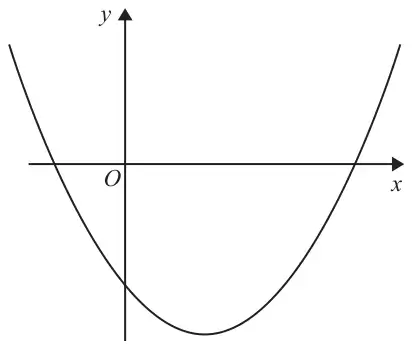
The equation of the curve is \(y = x^2 + ax + b\) where \(a\) and \(b\) are integers.
The points \((0, -5)\) and \((5, 0)\) lie on the curve.
Find the coordinates of the turning point of the curve. (4)
Mark scheme
Answer
Mark
Mark scheme
\((2, -9)\)
P1
substitutes \(x = 0\), \(y = -5\) into \(y = x^2 + ax + b\) \((b = -5)\) or substitutes \(x = 5\), \(y = 0\) into \(y = x^2 + ax + b\) \((0 = 25 + 5a + b)\) or starts process to find other intercept, eg writes \(y = (x - 5)(x - k)\)
P1
for complete process to find two intercepts, eg. substitutes the second point into \(y = x^2 + ax + b\) and solves to find \(a\ (= -4)\) and \(b\ (= -5)\) or substitutes \(x = 0\), \(y = -5\) into \(y = (x - 5)(x - k)\) and solves to find \(k\ (= -1)\)
P1
(dep on P2) for factorising or completing the square of \(x^2 + \text{``}{-}4\text{''}x + \text{``}{-}5\text{''}\) and identifying the \(x\)-coordinate of the turning point or for a complete process to find the \(x\)-coordinate of the turning point, eg \((5 + \text{``}{-}1\text{''})/2\)
A1
cao
Additional guidance
\(x\)-coordinate of 2 with no or incorrect working gets NO marks
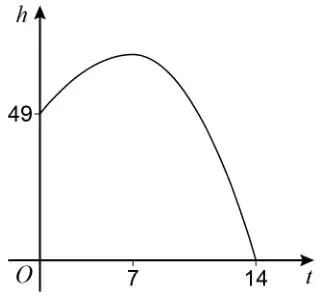
The height above ground level, \(h\), in metres, of the roller coaster is given by
\[h = -(t - 7)^2 + 49\]
where \(t\) is the time in seconds after the roller coaster starts.
Sam draws a graph of \(h\) against \(t\) for \(\quad 0 \leqslant t \leqslant 14\)
Make two criticisms of Sam’s graph. [2 marks]
Mark scheme
Answer
Mark
Comments
Any two from valid criticism about the \(h\)-intercept or valid criticism about the maximum point or valid criticism about the non-linear scaling on the horizontal axis
B2
eg graph should go through (0, 0) graph should intercept when \(h = 0\) \(y\)-intercept should be 0 eg the maximum point should be (7, 49) at \(t = 7\), \(h\) should be 49 eg 0, 7 and 14 should be evenly spaced B1 any one valid criticism
Additional guidance
Allow use of \(y\) for \(h\) or use of \(x\) for \(t\)
Each criticism may be implied by a correct, unambiguous graph drawn
may be embedded in or implied by an inequality or equation eg \((n - 15)^2 - 15^2 + 236 = 10\) \((n - 15)^2 - 15^2 + 236 \gt 10\) \((n - 15)^2 \gt -1\)
Valid explanation with M1 seen
A1
eg M1 seen and all the terms must be 11 or more or \((n - 15)^2 \geqslant 0\) and 11 is added
Additional guidance
Condone a different letter used eg \(x\)
M2 and all the terms must be greater than 11
M2A0
M2 and the 15th term is the smallest
M2A0
Least term is 11 with no working for completing the square
M0
M2 and squaring a bracket always has two digits then adding 11 means it has at least two digits
M2A0
\((n - 15)(n - 15)\) is equivalent to \((n - 15)^2\)
\((n - 15n)^2\)
M0
Ignore incorrect work after M2 eg \((n - 15)^2 + 11 = 0\)
M2
Condone \((n - 15)^2\) is positive and 11 is added
18 By completing the square, prove that \(\quad x^2 + 6x + 13 \quad\) is always positive. [3 marks]
Mark scheme
Answer
Mark
Comments
\((x + 3)^2\) …
M1
\((x + 3)^2 + 4\)
A1
\((x + 3)^2 + 4\) and valid argument
A1
eg \((x + 3)^2 + 4\) and \((x + 3)^2 \geqslant 0\) and adding 4 or \((x + 3)^2 + 4\) and this is \(\geqslant 4\) or correct reference to a minimum point and its position above the \(x\)-axis
Additional guidance
\((x + 3)^2 + 4\) and Even if \(x\) is negative it is squared so will be positive so the expression is always positive (no reference to the \(+ 4\))
M1A1A0
\((x + 3)^2 + 4\) and Turning point is \((-3, 4)\) which is positive on the \(y\)-axis and as \(x^2\) coefficient it is a U-shape therefore always positive
M1A1A1
Incorrect work after \((x + 3)^2 + 4\) seen, eg \((x + 3)^2 + 4 = 0\)
21 Express \(\quad x^2 - 6x - 15 \quad\) in the form \(\quad (x - a)^2 - b \quad\) where \(a\) and \(b\) are integers. [2 marks]
Mark scheme
Answer
Mark
Comments
\((x - 3)^2 - 24\) or \(a = 3\) and \(b = 24\)
B2
B1 \((x - 3)^2 \ldots\) or \((x - 3)(x - 3) \ldots\) or \(a = 3\) (implied by 3, \(-24\)) or \(x^2 - 2ax + a^2 - b\) or \(-2a = -6\) or \(2a = 6\) or \(a^2 - b = -15\) or correct \(b\) for their \(a\)
(a) Write \(x^2 - 6x + 5\) in the form \((x - a)^2 - b\). [3]
(b) Write down the coordinates of the turning point of \(y = x^2 - 6x + 5\). [2]
Mark scheme (a)
Answer
Marks
Part marks and guidance
\((x - 3)^2 - 4\) final answer
3
B1 for \((x - 3)^2\) B2FT for [+] 5 – (their (a))\(^2\) correctly evaluated after (\(x\) – their a)\(^2\) shown or M1 for [+] 5 – (their (a))\(^2\) shown If 0 scored, SC2 for final answer \((x - 3) - 4\)
FT can be implied eg answer \((x - 6)^2 - 31\) gets B2FT
Mark scheme (b)
Answer
Marks
Part marks and guidance
(3, –4)
2
correct or FTtheir part (a) B1FT for one correct coordinate
(b) Write \(x^2 + 8x + 11\) in the form \((x + a)^2 - b\). [3]
(c)
(i) Write down the coordinates of the turning point of the graph \(y = (x - 3)^2 + 8\). [2]
(ii) Describe the single transformation which maps the graph of \(y = x^2\) onto the graph of \(y = (x - 3)^2 + 8\). [2]
Mark scheme (a)
Answer
Marks
Part marks and guidance
\((3x - 2)(x + 4)\) oe
M2
M1 for \((3x + a)(x + b)\) with \(a + 3b = 10\) or \(ab = -8\) or \(3x(x + 4) - 2(x + 4)\) or \(x(3x - 2) + 4(3x - 2)\)
For M2 and M1 condone the omission of the final bracket. \(\frac{(3x - 2)(3x + 12)}{3}\) followed by \(3x - 2\) [= 0] and \(x + 4\) [= 0] scores M2. If no products of factors shown then \(3x - 2 = 0\) and \(x + 4 = 0\) scores M1. After \(3x(x + 4) - 2(x + 4)\) or \(x(3x - 2) + 4(3x - 2)\) followed by correct answers award M2B1 BOD
– 4 and \(\frac{2}{3}\)
B1FT
correct or FTtheir linear factors
Condone \(0.\dot{6}\) or 0.666… or 0.67 for \(\frac{2}{3}\)
Mark scheme (b)
Answer
Marks
Part marks and guidance
\((x + 4)^2 - 5\)
3
B1 for \((x + 4)^2\) B2FTtheir \((x + a)^2\) for their – 5 If 0 scored SC2 for ‘correct’ answer with missing power or power written in the wrong place
e.g. \((x + 11)^2 - 110\) scores B2FT e.g. SC2 for \((x + 4) - 5\) or \((x + 4^2) - 5\)
Mark scheme (c)
Answer
Marks
Part marks and guidance
(i) 3 8
2
B1 for either 3 or 8 in the correct place
(ii) Translation \(\begin{pmatrix} 3 \\ 8 \end{pmatrix}\)
2
B1 for each correct or FT the vector from their answer from (c)(i)
B3 for translation \(\begin{pmatrix} -3 \\ k \end{pmatrix}\) or translation \(\begin{pmatrix} k \\ -14 \end{pmatrix}\) OR M2 for [\(y =\)] \((x + 3)^2 - 5 - 3^2\) or better or M1 for [\(y =\)] \((x + 3)^2\) seen B1 for translation
If more than one transformation given then M2 maximum
(a) Write \((2x - 5)(x + 4)\) in the form \(2(x + a)^2 - b\).
You must show your working. [5]
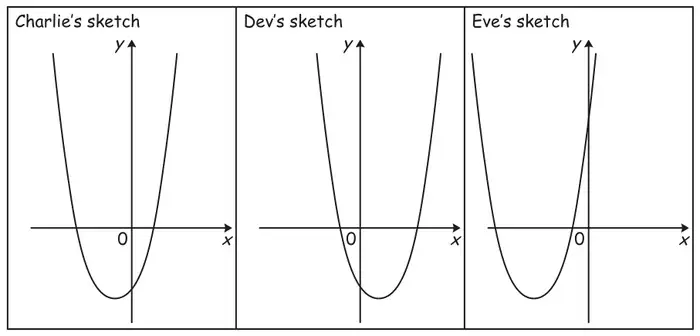
(b) Charlie, Dev and Eve all attempt to sketch the graph of \(y = (2x - 5)(x + 4)\).
Whose sketch is the most accurate? Write down the properties of the graph that you used in making your decision. [2]
Mark scheme (a)
Answer
Marks
Part marks and guidance
\(2\left(x + \frac{3}{4}\right)^2 - \frac{169}{8}\) as final answer with correct working
5
Method 1: B3 for \(2\left(x + \frac{3}{4}\right)^2\) in final answer with correct working or M1 for \(2x^2 - 5x + 8x - 20\) oe M1 for \(2\left(x^2 + \frac{3}{2}x\right)\) [– 20] oe
AND
M1 for [\(-b\) =] \(-2\left(their\ \frac{3}{4}\right)^2 - 20\) soi by \(-\frac{169}{8}\)
Method 2: B3 for \(2\left(x + \frac{3}{4}\right)^2\) in final answer with correct working or M1 for \(2x^2 - 5x + 8x - 20\) oe or for \(2(x^2 + ax + ax + a^2) - b\) oe M1 for \(4ax = 3x\) soi by [\(a\) =] \(\frac{3}{4}\)
AND
M1 for [\(-b\) =] \(-2\left(their\ \frac{3}{4}\right)^2 - 20\) soi by \(-\frac{169}{8}\)
Method 3: B3 for \(2\left(x + \frac{3}{4}\right)^2\) in final answer with correct working or M1 for roots \(-4\) and 2.5 M1 for turning point at [\(x\) =] \(\frac{-4 + 2.5}{2}\) soi by \(-\frac{3}{4}\)
AND
M1 for [\(-b\) =] \(\left(2\left(their\ -\frac{3}{4}\right) - 5\right)\left(\left(their\ -\frac{3}{4}\right) + 4\right)\) soi by \(-\frac{169}{8}\)
If no or insufficient working SC2 for \(2\left(x + \frac{3}{4}\right)^2 - \frac{169}{8}\) or SC1 for \(2\left(x + \frac{3}{4}\right)^2\) [\(+k\)]
‘Correct working’ requires evidence of at least M1 Accept decimal and mixed number equivalents throughout eg. \(2(x + 0.75)^2 - 21.125\) \(2\left(x + \frac{3}{4}\right)^2 - 21\frac{1}{8}\)
May be in a grid (Methods 1 and 2)
Mark scheme (b)
Answer
Marks
Part marks and guidance
Charlie with at least one bullet point and no incorrect statements:
The roots are \(-4\) and 2.5
The turning point is at [\(x\) =] \(-\frac{3}{4}\) oe and only one root is positive/negative
The turning point is at [\(x\) =] \(-\frac{3}{4}\) oe and \(y\)-intercept is \(-20\) or negative
2
B1 for Charlie with one bullet point and no incorrect statements:
Turning point is at [\(x\) =] \(-\frac{3}{4}\) oe
\(y\)-intercept is \(-20\) or negative
or SC1 for any of the following with no incorrect statements: Dev and \(y\)-intercept is \(-20\) or negative or Eve and turning point is at [\(x\) =] \(-\frac{3}{4}\) oe or A person linked correctly to a FT turning point from (a)
(a) Write \(x^2 - 8x + 9\) in the form \((x - a)^2 - b\). [3]
(b) Use your answer from part (a) to solve.\[x^2 - 8x + 9 = 0\]
Give your answers in exact form. You must show your working. [2]
Mark scheme (a)
Answer
Marks
Part marks and guidance
\((x - 4)^2 - 7\) final answer
3
B1 for \((x - 4)^2\) AND B2FT for \(-7\) or M1 for \(9 - (\textit{their } {-4})^2\) oe shown
No FT from \((x - 3)^2\) FT can be implied, check \(9 - (\textit{their } {-4})^2\)
If 0 or 1 scored, allow SC2 for final answer \((x - 4) - 7\)
Mark scheme (b)
Answer
Marks
Part marks and guidance
\(4 + \sqrt{7}\), \(4 - \sqrt{7}\) final answer with working from (a)
2FT
M1 for \((x - 4)^2 = \textit{their } 7\) FT from their (a) for solutions in exact form if working shown
Answers only score 0 Do not FT where \(b = 0\) e.g. \((x - 4)^2\) If their \(b\) is a perfect square, allow FT for \(a + \sqrt{b}\) and \(a - \sqrt{b}\) or simplified as two integers If \(b < 0\), a max of M1
14 Find the coordinates of the turning point of the graph of \(y = x^2 + 6x + 17\). [4]
Mark scheme
Answer
Marks
Part marks and guidance
−3, 8
4
B1 for \((x + 3)^2\) or \(-6 \div 2\) B2FT for +8, correct or ft their \((x + 3)^2\) or M1 for \((\textit{their } {-3})^2 + 6 \times (\textit{their } {-3}) + 17\) B1FT for \((-a, b)\) FTtheir \(\{(x + a)^2 + b\}\) to a maximum of 3 marks If no working B2 for either ordinate correct
accept any correct method (see appendix) B3 implied by \((x + 3)^2 + 8\)
Appendix: Question 14
The curve does not cross the \(x\)-axis so solving \(y = 0\) does not help.
Alternative method : find the line of symmetry Find the two points where e.g. \(y = 17\) \(x^2 + 6x + 17 = 17\) …..M1 \(x(x + 6) = 0\) so \(x = 0\) or \(-6\) …A1 So line of symmetry is \(x = -3\) and by substitution \(y = 8\) …B1 each to maximum of 3 marks
(a) Write \(x^2 - 10x + 22\) in the form \((x - a)^2 - b\). [3]
(b) Sketch the graph of \(y = x^2 - 10x + 22\). Show clearly the coordinates of any turning points and the value of the \(y\)-intercept.[4]
Mark scheme (a)
Answer
Marks
Part marks and guidance
\((x - 5)^2 - 3\) final answer
3
B1 for \((x - 5)^2\) B2 FT for – 3 or M1 for \(22 - (-5)^2\) oe
M1 FT \(22 - (\textit{their}\ {-5})^2\) oe
Mark scheme (b)
Answer
Marks
Part marks and guidance
Correct sketch with TP at (5, −3) in 4th quadrant and \(y\) – intercept at (0, 22)
4
FT their (a) for TP M1 for U shaped curve B2FTdeptheir (a)for TP at (5, –3) in correct quadrant or B1FTdep for turning point at (\(k\), –3) or (5, \(k\)) soi FT for B2 or B1 dep on answer of form \((x - a)^2 - b\) in part (a), \(a, b \ne 0\)
B1 for \(y\) – intercept at 22 indicated
Be generous for the U shape condone broken line Values for \(y\) - intercept and TP must be shown but could be marked on axes. Mark intention Accept turning point = (5, –3)FT written in working provided no contradiction on sketch If point (5, –3)FT only plotted on graph in 4th quadrant and no sketch then B2 only
(a) Write \(x^2 - 6x + 11\) in the form \((x - a)^2 + b\). [3]
(b) Sketch the graph of \(y = x^2 - 6x + 11\). Show clearly the coordinates of any turning points.[3]
Mark scheme (a)
Answer
Marks
Part marks and guidance
\((x - 3)^2 + 2\) final answer
3
B1 for \((x - 3)^2\) B2 FT for 2
or M1 for \(11 - (\textit{their} -3)^2\) If 0 scored, SC2 for final answer \((x - 3) + 2\)
FT can be implied, check \(11 - (\textit{their} -3)^2\)
Mark scheme (b)
Answer
Marks
Part marks and guidance
U shaped parabola with minimum value indicated in 1st quadrant at (3, 2)
3
FT U-shaped parabola with turning point at their (– \(a\), \(b\)) from part (a) dep on answer of form \((x + a)^2 + b\) where \(a \ne -3\) and/or \(b \ne 2\)
B1 for U shape curve
B1 for turning point at (3, \(k\)) or FT for turning point at (–\(a\), \(k\)) dep on answer of form \((x + a)^2 + b\) in part (a) B1 for turning point at (\(k\), 2) or FT for turning point at (\(k\), \(b\)) dep on answer of form \((x + a)^2 + b\) in part (a)
Be generous for the U shape condone broken line Sketch takes priority when marking Do not allow all 3 marks if (3, 2) indicated on U shaped parabola but TP on sketch is in wrong quadrant Values must be shown but could be marked on axes. Mark intention Accept turning point = (3, 2) written in working provided no contradiction on sketch
If point (3, 2) only plotted on graph and no sketch then B0B1B1
Notes
(corrected from the printed mark scheme: the form of the part (a) answer is printed as \((x + a)^2 - b\) in three places; it is \((x + a)^2 + b\), matching the turning point (–\(a\), \(b\)) and the answer \((x - 3)^2 + 2\))
(a) Write \(x^2 + 8x + 3\) in the form \((x + a)^2 - b\). [3]
(b) Sketch the graph of \(y = x^2 + 8x + 3\). Show clearly the coordinates of any turning points and the \(y\)-intercept.
[4]
Mark scheme (a)
Answer
Marks
Part marks and guidance
\((x + 4)^2 - 13\) final answer
3
B1 for \((x + 4)^2\)
B2FT for [+] 3 – their (a)\(^2\) after \((x +\) their \(a)^2\) correctly evaluated or B1 for [+] 3 – their \(a^2\) shown
If 0 scored, SC2 for final answer \((x + 4) - 13\)
FT can be implied eg \((x + 2)^2 - 1\) gets B2FT
Mark scheme (b)
Answer
Marks
Part marks and guidance
U shaped parabola with minimum value indicated in 3rd quadrant at (–4, –13) and intercepts positive \(y\) – axis at 3
4
FT U-shaped parabola with turning point at their \((-a, -b)\) from part (a) dep on answer of form \((x + a)^2 - b\) where \(a \ne 4\) and/or \(b \ne 13\)
Be generous for the U shape condone broken line TP values must be shown but could be marked on axes. Mark intention Sketch takes priority when marking Accept turning point = (– 4, –13) written in working or in table provided no contradiction on sketch
B1 for U shape curve B1 for their curve or line intercepts positive \(y\) – axis at 3
Must be stated on graph, 3 or (0, 3) Do not accept just in a table
B1 for turning point at \((-4, k)\) or FT for turning point at \((-a, k)\) dep on answer of form \((x + a)^2 - b\) in part (a) B1 for turning point at \((k, -13)\) or FT for turning point at \((k, -b)\) dep on answer of form \((x + a)^2 - b\) in part (a)
If point (– 4, –13) only plotted on graph and no sketch then can score these final 2 marks
(i) Write \(x^2 + 4x - 16\) in the form \((x + a)^2 - b\). [3]
(ii) Solve the equation \(x^2 + 4x - 16 = 0\). Give your answers in surd form as simply as possible. [4]
(b) Sketch the graph of \(y = x^2 + 4x - 16\), showing clearly the coordinates of any turning points.
[3]
Mark scheme (a)
Answer
Marks
Part marks and guidance
(i) \((x + 2)^2\) final answer
1
– 20 final answer
2
FTtheir \((x + 2)^2\) final answer M1 for after \((x + a)^2\) shows \(-16 -\) their \(a^2\)
(ii) \(-2 \pm 2\sqrt{5}\)
4
B3FTtheir (a)(i) for \(-2 + \sqrt{20}\) or \(-2 - \sqrt{20}\) or better or M2 for \(x + 2 = (\pm)\sqrt{20}\) FT their (a)(i) or M1 for \((x + 2)^2 = 20\) FT their (a)(i) OR Alternative method B3 for \(\dfrac{-4 \pm 4\sqrt{5}}{2}\) or M2 for \(\dfrac{-4 \pm \sqrt{80}}{2}\) oe or M1 for \(\dfrac{-4 \pm \sqrt{4^2 - 4 \times 1 \times -16}}{2 \times 1}\) oe
FT dep on expression in form \((x + a)^2 - b\) in part (a)(i)
Condone 1 slip e.g. 1 sign error, 1² for 1, short fraction line, short root
Mark scheme (b)
Answer
Marks
Part marks and guidance
U shaped parabola
1
Be generous for the U shape condone broken line Values must be shown but could be marked on axes. Mark intention Accept turning point = (–2, –20) written in working provided no contradiction on sketch If point (–2, –20) only plotted on graph in 3rd quadrant and no sketch then award 2 marks
with turning point in 3rd quadrant indicated at (–2, –20) soi
2
B1FT for turning point at (\(k\), –20) or (–2, \(k\)) soi FT their (a)(i)
(a) Sketch the graph of \(y = (x - 2)^2 - 3\). Show the coordinates of any turning points.
[3]
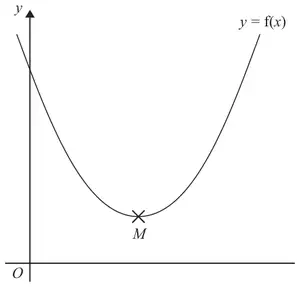
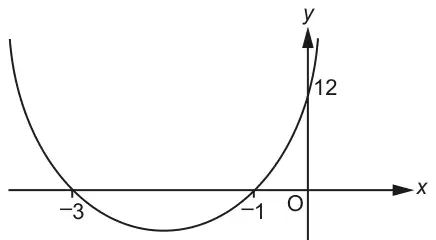
(b) The sketch shows part of a graph which has equation \(y = ax^2 + bx + c\).
Not to scale
Find the values of \(a\), \(b\) and \(c\). [5]
Mark scheme (a)
Answer
Marks
Part marks and guidance
U shaped parabola with minimum value indicated at (2, –3)
3
B1 for U shape curve
B1 for turning point at \((2, k)\) B1 for turning point at \((k, -3)\)
Be generous for the U shape condone broken line Values must be shown but could be marked on axes. Mark intention Accept turning point = (2, –3) written in working provided no contradiction on sketch If point (2, –3) only plotted on graph and no sketch then B0B1B1
Mark scheme (b)
Answer
Marks
Part marks and guidance
4, 16, 12
5
B4 for \(a = 4\) and \(b = 16\) OR B3 for \(c = 12\) and either \(a = 4\) or \(b = 16\) OR M1 for \((x + 3)(x + 1)\) seen isw A1 for \(x^2 + x + 3x + 3\) or better seen isw B1 for \(c = 12\)
OR B1 for \(c = 12\) soi
M1 for \((-1)^2a - 1b + 12 = 0\) oe and \((-3)^2a - 3b + 12 = 0\) oe
Alt method uses simultaneous equations with \(c = 12\) Allow recovery for omission of brackets if negatives correctly dealt with