Travelling Salesman

Edexcel

Edexcel · Old spec

A2 June 2025 Q3

EdexcelCurrent spec10 marksShortest PathTravelling Salesman

3.

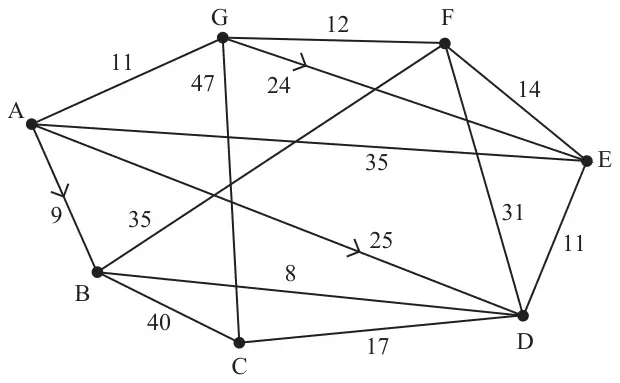
Figure 1: network on villages A to G with arcs AG 11, GF 12, GE 24 (one-way from G to E), GC 47, AE 35, AB 9 (one-way from A to B), AD 25 (one-way from A to D), BF 35, BD 8, BC 40, CD 17, FE 14, FD 31, ED 11
Figure 1

Direct roads between seven villages, A, B, C, D, E, F and G, are represented in Figure 1. The weight on each arc is the time, in minutes, taken to travel along the corresponding road. Three roads, AB, AD and GE, are one-way, as indicated by the arrow on the corresponding arc.

Floyd’s algorithm is to be used to find the complete network of shortest times between the seven villages.

(a) Set up an initial time matrix for this network. (2)

The time matrix after three iterations of Floyd’s algorithm is shown below.

ABCDEFG
A–94917354411
B∞–408∞3587
C∞40–17∞7547
D∞817–113164
E35448411–1446
F∞35753114–12
G112047282412–
(b) Perform the next two iterations of Floyd’s algorithm that follow from the table above.
You should show only the time matrix after each iteration. (5)

The final time matrix after completion of Floyd’s algorithm is shown below.

ABCDEFG
A–93417282311
B54–258193345
C5825–17284247
D46817–112537
E35192811–1426
F2332422514–12
G112045282412–

Albert must visit each village. He will start and finish at B and wishes to minimise the total time taken to visit each village.

(c)
(i) Use the nearest neighbour algorithm, starting at B, to find a Hamiltonian cycle in the complete network of shortest times shown above.
(ii) Find the total travel time for this cycle.
(iii) Given that he travels the Hamiltonian cycle found in (c)(i), interpret this cycle in terms of the actual villages visited by Albert. (3)

A2 June 2024 Q2

2. The table below represents a network of shortest distances, in miles, to travel between nine castles, A, B, C, D, E, F, G, H and J.

ABCDEFGHJ
A–5059265040876359
B50–28617963456448
C5928–335735703645
D266133–2464713733
E50795724–40643031
F4063356440–477071
G874570716447–3467
H63643637307034–33
J5948453331716733–
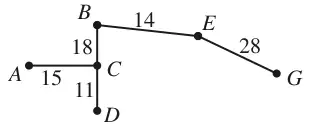
(a) Use Prim’s algorithm, starting at D, to find the minimum spanning tree for this network. You must clearly state the order in which you select the arcs of your tree. (3)
(b) State the weight of the minimum spanning tree found in part (a). (1)
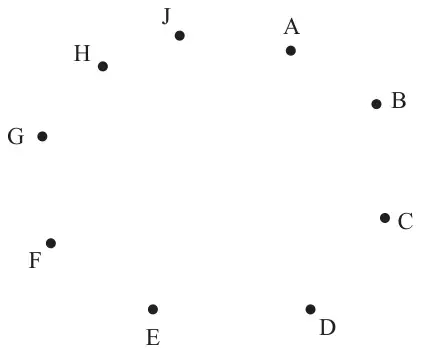
(c) Draw the minimum spanning tree using the vertices given in Diagram 1 in the answer book. (1)
Diagram 1: the nine vertices A, B, C, D, E, F, G, H and J with no arcs
Diagram 1

A historian needs to visit all of the castles, starting and finishing at the same castle, and wishes to minimise the total distance travelled.

(d) Use your answer to part (b) to calculate an initial upper bound for the length of the historian’s route. (1)
(e)
(i) Use the nearest neighbour algorithm, starting at D, to find an upper bound for the length of the historian’s route.
(ii) Write down the route which gives this upper bound. (3)

Using the nearest neighbour algorithm, starting at F, an upper bound of length 352 miles was found.

(f) State the best upper bound that can be obtained by using this information and your answers from parts (d) and (e). Give the reason for your answer. (1)
(g) By deleting A and all of its arcs, find a lower bound for the length of the historian’s route. (2)

By deleting J and all of its arcs, a lower bound of length 274 miles was found.

(h) State the best lower bound that can be obtained by using this information and your answer to part (g). Give the reason for your answer. (1)

A2 June 2023 Q5

5.

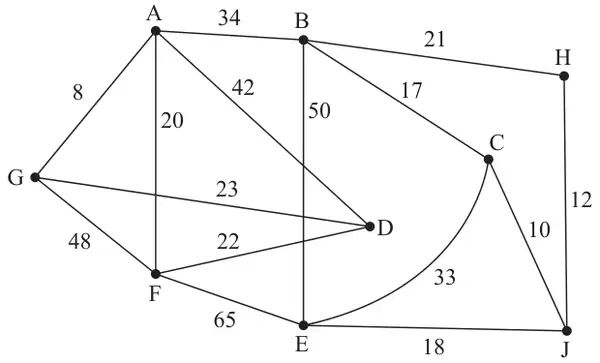
Figure 5: network on A to J with arcs AB 34, AG 8, AF 20, AD 42, BE 50, BH 21, BC 17, GD 23, GF 48, FD 22, FE 65, CE 33, CJ 10, HJ 12, EJ 18
Figure 5

[The total weight of the network is 423]

Direct roads between nine towns, A, B, C, D, E, F, G, H and J, are represented in Figure 5. The number on each arc represents the length, in miles, of the corresponding road.

The table below shows the shortest distances, in miles, between the nine towns.

ABCDEFGHJ
A–345131792085561
B34–17654554422127
C5117–822871592210
D316582–8722238692
E79452887–65873018
F2054712265–287581
G84259238728–6369
H55212286307563–12
J6127109218816912–

Table of shortest distances

A route is needed that minimises the total distance required to traverse each road at least once.

The route must start at F and finish at J.

(a)
(i) By considering the pairings of all relevant nodes, find the roads that would need to be traversed twice.
(ii) State the total length of this route. (5)
(b) Starting at A, use Prim’s algorithm to find the minimum spanning tree for the table of shortest distances. You must state the order in which you select the arcs of your tree. (3)

Pete needs to visit all nine towns, starting and finishing in the same town, and wishes to minimise the total distance he travels.

(c) Starting at G, use the nearest neighbour algorithm on the table of shortest distances to find an upper bound for the length of Pete’s route. Write down the route that gives this upper bound. (2)
(d) By deleting G and all of its arcs, find a lower bound for the length of Pete’s route. (2)

Pete decides to take the route he found in (c).

(e) Interpret the route in terms of the actual towns visited. (1)

A2 June 2022 Q3

EdexcelCurrent spec10 marksShortest PathTravelling Salesman

3. The initial distance matrix (Table 1) shows the lengths, in metres, of the corridors connecting six classrooms, A, B, C, D, E and F, in a school. For safety reasons, some of the corridors are one-way only.

ABCDEF
A–1232242911
B12–178∞∞
C3217–412∞
D24∞4–∞13
E∞∞1218–12
F11∞∞1312–

Table 1

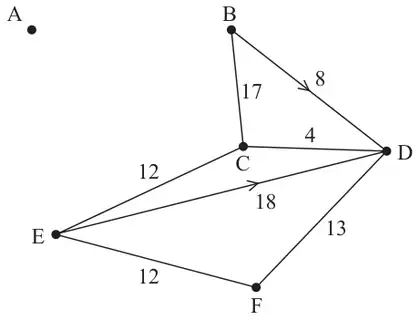
(a) By adding the arcs from vertex A, along with their weights, complete the drawing of this network on Diagram 1 in the answer book. (2)
Diagram 1: vertices A to F with arcs BC 17, BD 8 (one-way from B to D), CD 4, CE 12, ED 18 (one-way from E to D), EF 12, DF 13; vertex A has no arcs
Diagram 1

Floyd’s algorithm is to be used to find the complete network of shortest distances between the six classrooms.

The distance matrix after two iterations of Floyd’s algorithm is shown in Table 2.

ABCDEF
A–1229202911
B12–1784123
C2917–41240
D24364–5313
E∞∞1218–12
F1123401312–

Table 2

(b) Perform the next two iterations of Floyd’s algorithm that follow from Table 2. You should show the distance matrix after each iteration. (4)

The final distance matrix after completion of Floyd’s algorithm is shown in Table 3.

ABCDEF
A–1224202311
B12–1282421
C2817–41217
D24214–1613
E23291216–12
F1123171312–

Table 3

Yinka must visit each classroom. He will start and finish at E and wishes to minimise the total distance travelled.

(c)
(i) Use the nearest neighbour algorithm, starting at E, to find two Hamiltonian cycles in the completed network of shortest distances.
(ii) Find the length of each of the two cycles.
(iii) State, with a reason, which of the two cycles provides the better upper bound for the length of Yinka’s route. (4)

A2 October 2021 Q3

3.

ABCDEFGH
A–24424834373222
B24–403530413944
C4240–2126453836
D483521–32372927
E34302632–344028
F3741453734–4341
G323938294043–38
H22443627284138–

Table 1

Table 1 shows the shortest distances, in miles, between eight towns, A, B, C, D, E, F, G and H.

(a) Use Prim’s algorithm, starting at A, to find the minimum spanning tree for this table of distances. You must clearly state the order in which you select the edges of your tree. (3)
(b) State the weight of the minimum spanning tree. (1)
ABCDEFGH
J3127502943254935

Table 2

Table 2 shows the distances, in miles, between town J and towns A, B, C, D, E, F, G and H.

Pranav needs to visit all of the towns, starting and finishing at J, and wishes to minimise the total distance he travels.

(c) Starting at J, use the nearest neighbour algorithm to obtain an upper bound for the length of Pranav’s route. You must state your route and its length. (2)
(d) Starting by deleting J, and all of its edges, find a lower bound for the length of Pranav’s route. (2)

A2 October 2020 Q3

EdexcelCurrent spec9 marksShortest PathTravelling Salesman

3.

Figure 2: network on A, B, C, D and E with arcs AB 8, AC 4, AD 7, BC 3, BE 10, CE 6, DE 1 and DC 1 (one-way from D to C)
Figure 2

Direct roads between five villages, A, B, C, D and E, are shown in Figure 2. The weight on each arc is the time, in minutes, it takes to travel along the corresponding road. The road from D to C is one-way as indicated by the arrow on the corresponding arc.

Floyd’s algorithm is to be used to find the complete network of shortest times between the five villages.

(a) Set up initial time and route matrices. (2)

The matrices after two iterations of Floyd’s algorithm are shown below.

Time matrix

ABCDE
A–84718
B8–31510
C43–116
D7151–1
E181061–

Route matrix

ABCDE
AABCDB
BABCAE
CABCAE
DAACDE
EBBCDE
(b) Perform the next two iterations of Floyd’s algorithm that follow from the tables above. You should show the time and route matrices after each iteration. (4)

The final time matrix after completion of Floyd’s algorithm is shown below.

Final time matrix

ABCDE
A–7478
B7–3109
C43–76
D541–1
E6521–
(c)
(i) Use the nearest neighbour algorithm, starting at A, to find a Hamiltonian cycle in the complete network of shortest times.
(ii) Find the time taken for this cycle.
(iii) Interpret the cycle in terms of the actual villages visited. (3)

A2 June 2019 Q3

EdexcelCurrent spec14 marksShortest PathTravelling Salesman

3.

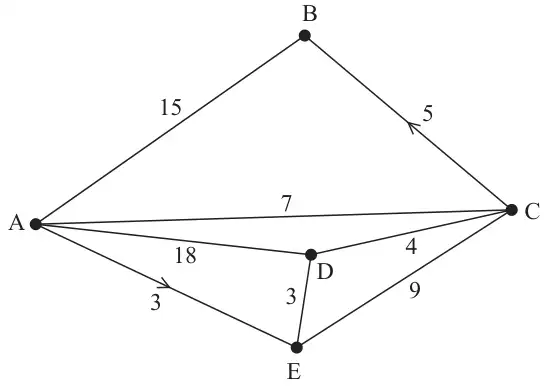
Figure 2: network on A, B, C, D and E with arcs AB 15, AC 7, AD 18, AE 3 (one-way from A to E), CB 5 (one-way from C to B), CD 4, CE 9, DE 3
Figure 2

The network in Figure 2 shows the direct roads linking five villages, A, B, C, D and E. The number on each arc represents the length, in miles, of the corresponding road. The roads from A to E and from C to B are one-way, as indicated by the arrows.

(a) Complete the initial distance and route tables for the network provided in the answer book. (2)

Initial distance table (answer book)

ABCDE
A                    
B                    
C                    
D                    
E                    

Initial route table (answer book)

ABCDE
A                    
B                    
C                    
D                    
E                    
(b) Perform the first three iterations of Floyd’s algorithm. You should show the distance table and the route table after each of the three iterations. (5)

After five iterations of Floyd’s algorithm the final distance table and partially completed final route table are shown below.

Distance table

ABCDE
A–12763
B15–222118
C75–47
D1194–3
E141273–

Route table

ABCDE
AA    
BAB   
CABC  
DCCCD 
EDDDDE
(c)
(i) Explain how the partially completed final route table can be used to find the shortest route from E to A.
(ii) State this route. (3)

Mabintou decides to use the distance table to try to find the shortest cycle that passes through each vertex. Starting at D, she applies the nearest neighbour algorithm to the final distance table.

(d)
(i) State the cycle obtained using the nearest neighbour algorithm.
(ii) State the length of this cycle.
(iii) Interpret the cycle in terms of the actual villages visited.
(iv) Prove that Mabintou’s cycle is not optimal. (4)

D2 June 2019 Q1

EdexcelOld spec5 marksTravelling Salesman

1.

ABCDEF
A–5347393540
B53–32464143
C4732–514737
D394651–3649
E35414736–42
F4043374942–

The table above shows the least distances, in km, between six towns, A, B, C, D, E and F. Jas needs to visit each town, starting and finishing at D, and wishes to minimise the total distance she travels.

(a) Starting at D, use the nearest neighbour algorithm to obtain an upper bound for the length of the route. You must state your route and its length. (2)
(b) Starting by deleting D, and all of its arcs, find a lower bound for the route length. (3)

D2 June 2017 Q1

EdexcelOld spec7 marksTravelling Salesman

1.

ABCDEF
A–8375826997
B83–9410377109
C7594–97120115
D8210397–105125
E6977120105–88
F9710911512588–

The table above shows the least distances, in km, between six towns, A, B, C, D, E and F.

(a) Starting at A, and making your working clear, find an initial upper bound for the travelling salesperson problem for this network, using
(i) the minimum spanning tree method,
(ii) the nearest neighbour algorithm.
(5)

By deleting A, and all of its arcs, a lower bound for the travelling salesperson problem for this network is found to be 500 km.

By deleting B, and all of its arcs, the corresponding lower bound is found to be 474 km.

(b) Using the results from (a) and the given lower bounds, write down the smallest interval that you can be confident contains the solution to the travelling salesperson problem for this network. (2)

D2 June 2016 Q1

EdexcelOld spec10 marksTravelling Salesman

1.

(a) Explain the difference between the classical travelling salesperson problem and the practical travelling salesperson problem. (2)
ABCDEFG
A–311512241722
B31–2025142550
C1520–16241921
D122516–213217
E24142421–2841
F1725193228–25
G225021174125–

The table above shows the least direct distances, in miles, between seven towns, A, B, C, D, E, F and G. Yiyi needs to visit each town, starting and finishing at A, and wishes to minimise the total distance she will travel.

(b) Show that there are two nearest neighbour routes that start from A. State these routes and their lengths. (3)
(c) Starting by deleting A, and all of its arcs, find a lower bound for the length of Yiyi’s route. (3)
(d) Use your results to write down the smallest interval which you can be confident contains the optimal length of Yiyi’s route. (2)

D2 June 2015 Q3

EdexcelOld spec12 marksTravelling Salesman

3.

ABCDEFG
A–\(x\)4143382130
B\(x\)–2738192951
C4127–24373540
D433824–445225
E38193744–2028
F2129355220–49
G305140252849–

The network represented by the table shows the least distances, in km, between seven theatres, A, B, C, D, E, F and G.

Jasmine needs to visit each theatre at least once starting and finishing at A. She wishes to minimise the total distance she travels. The least distance between A and B, is \(x\) km, where \(21 \lt x \lt 27\)

(a) Using Prim’s algorithm, starting at A, obtain a minimum spanning tree for the network.
You should list the arcs in the order in which you consider them. (2)
(b) Use your answer to (a) to determine an initial upper bound for the length of Jasmine’s route. (1)
(c) Use the nearest neighbour algorithm, starting at A, to find a second upper bound for the length of the route. (2)

The nearest neighbour algorithm starting at F gives a route of F – E – B – A – G – D – C – F.

(d) State which of these two nearest neighbour routes gives the better upper bound. Give a reason for your answer. (2)

Starting by deleting A, and all of its arcs, a lower bound of 159 km for the length of the route is found.

(e) Find \(x\), making your method clear. (3)
(f) Write down the smallest interval that you can be confident contains the optimal length of Jasmine’s route. Give your answer as an inequality. (2)

D2 June 2014 (R) Q2

EdexcelOld spec10 marksTravelling Salesman

2.

(a) Explain the difference between the classical and the practical travelling salesperson problem. (2)
ABCDEF
A–6548153040
B65–50513526
C4850–372034
D155137–1725
E30352017–14
F4026342514–

The table above shows the least distances, in km, between six towns, A, B, C, D, E and F. Keith needs to visit each town, starting and finishing at A, and wishes to minimise the total distance he will travel.

(b) Starting at A, use the nearest neighbour algorithm to obtain an upper bound. You must state your route and its length. (3)
(c) Starting by deleting A, and all of its arcs, find a lower bound for the route length. (3)
(d) Use your results to write down the smallest interval which you are confident contains the optimal length of the route. (2)

D2 June 2014 Q2

EdexcelOld spec10 marksTravelling Salesman

2. The table shows the least times, in seconds, that it takes a robot to travel between six points in an automated warehouse. These six points are an entrance, A, and five storage bins, B, C, D, E and F. The robot will start at A, visit each bin, and return to A. The total time taken for the robot’s route is to be minimised.

ABCDEF
A–901308535125
B90–801008388
C13080–108106105
D85100108–11088
E3583106110–75
F125881058875–
(a) Show that there are two nearest neighbour routes that start from A. You must make the routes and their lengths clear. (4)
(b) Starting by deleting F, and all of its arcs, find a lower bound for the time taken for the robot’s route. (3)
(c) Use your results to write down the smallest interval which you are confident contains the optimal time for the robot’s route. (3)

D2 June 2013 (R) Q2

EdexcelOld spec8 marksTravelling Salesman

2. The table shows the least distances, in km, between six towns, A, B, C, D, E and F.

ABCDEF
A–12221713710982
B122–110130128204
C217110–204238135
D137130204–98211
E10912823898–113
F82204135211113–

Liz must visit each town at least once. She will start and finish at A and wishes to minimise the total distance she will travel.

(a) Starting with the minimum spanning tree given in your answer book, use the shortcut method to find an upper bound below 810 km for Liz’s route. You must state the shortcut(s) you use and the length of your upper bound. (2)
(b) Use the nearest neighbour algorithm, starting at A, to find another upper bound for the length of Liz’s route. (2)
(c) Starting by deleting F, and all of its arcs, find a lower bound for the length of Liz’s route. (3)
(d) Use your results to write down the smallest interval which you are confident contains the optimal length of the route. (1)

D2 June 2013 Q1

EdexcelOld spec12 marksTravelling Salesman

1.

ABCDE
A–15192520
B15–151525
C1915–2211
D251522–18
E20251118–

The table shows the least distances, in km, between five hiding places, A, B, C, D and E.

Agent Goodie has to leave a secret message in each of the hiding places. He will start and finish at A, and wishes to minimise the total distance travelled.

(a) Use Prim’s algorithm to find a minimum spanning tree for this network. Make your order of arc selection clear. (2)
(b) Use your answer to part (a) to determine an initial upper bound for the length of Agent Goodie’s route. (1)
(c) Show that there are two nearest neighbour routes which start from A. State these routes and their lengths. (3)
(d) State the better upper bound from your answers to (b) and (c). (1)
(e) Starting by deleting B, and all of its arcs, find a lower bound for the length of Agent Goodie’s route. (4)
(f) Consider your answers to (d) and (e) and hence state an optimal route. (1)

D2 June 2012 Q2

EdexcelOld spec7 marksTravelling Salesman

2. The table shows the least distances, in km, between six towns, A, B, C, D, E and F.

ABCDEF
A-1625211215
B16-24222112
C2524-183027
D212218-1512
E12213015-18
F1512271218-

Toby must visit each town at least once. He will start and finish at A and wishes to minimise the total distance.

(a) Use the nearest neighbour algorithm, starting at A, to find an upper bound for the length of Toby’s route. (3)
(b) Starting by deleting A, and all of its arcs, find a lower bound for the route length. (4)

D2 June 2011 Q1

EdexcelOld spec10 marksTravelling Salesman

1.

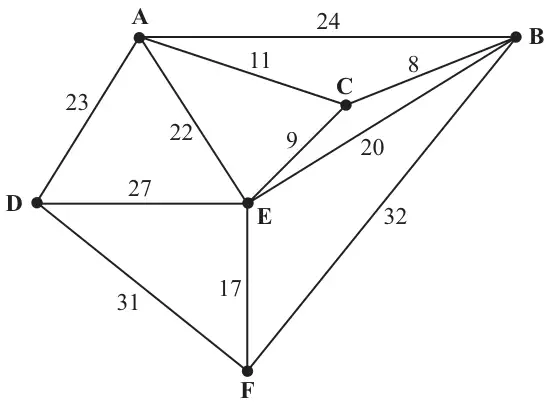
Figure 1: network of six towns. AB 24, AC 11, AD 23, AE 22, BC 8, BE 20, BF 32, CE 9, DE 27, DF 31, EF 17
Figure 1

The network in Figure 1 shows the distances, in km, between six towns, A, B, C, D, E and F. Mabintou needs to visit each town. She will start and finish at A and wishes to minimise the total distance travelled.

(a) By inspection, complete the two copies of the table of least distances in your answer book. (3)
(b) Starting at A, use the nearest neighbour algorithm to find an upper bound for the length of Mabintou’s route. Write down the route which gives this upper bound. (3)
(c) Starting by deleting A, and all of its arcs, find a lower bound for the route length. (4)

D2 June 2010 Q1

EdexcelOld spec11 marksTravelling Salesman

1. The table below shows the least costs, in pounds, of travelling between six cities, A, B, C, D, E and F.

ABCDEF
A-3618282422
B36-54222027
C1854-422724
D282242-2030
E24202720-13
F2227243013-

Vicky must visit each city at least once. She will start and finish at A and wishes to minimise the total cost.

(a) Use Prim’s algorithm, starting at A, to find a minimum spanning tree for this network. (2)
(b) Use your answer to part (a) to help you calculate an initial upper bound for the length of Vicky’s route. (1)
(c) Show that there are two nearest neighbour routes that start from A. You must make your routes and their lengths clear. (3)
(d) State the best upper bound from your answers to (b) and (c). (1)
(e) Starting by deleting A, and all of its arcs, find a lower bound for the route length. (4)

D2 June 2009 Q2

EdexcelOld spec12 marksTravelling Salesman
2. (a) Explain the difference between the classical and the practical travelling salesperson problems. (2)

The table below shows the distances, in km, between six data collection points, A, B, C, D, E, and F.

ABCDEF
A-7734566721
B77-58583674
C3458-737042
D565873-6838
E67367068-71
F2174423871-

Rachel must visit each collection point. She will start and finish at A and wishes to minimise the total distance travelled.

(b) Starting at A, use the nearest neighbour algorithm to obtain an upper bound. Make your method clear. (3)

Starting at B, a second upper bound of 293 km was found.

(c) State the better upper bound of these two, giving a reason for your answer. (1)

By deleting A, a lower bound was found to be 245 km.

(d) By deleting B, find a second lower bound. Make your method clear. (4)
(e) State the better lower bound of these two, giving a reason for your answer. (1)
(f) Taking your answers to (c) and (e), use inequalities to write down an interval that must contain the length of Rachel’s optimal route. (1)

D2 June 2008 Q7

EdexcelOld spec16 marksTravelling Salesman

7.

Network of distances in km between weather data collection points A to H

The network in the diagram above shows the distances, in km, between eight weather data collection points. Starting and finishing at A, Alice needs to visit each collection point at least once, in a minimum distance.

(a) Obtain a minimum spanning tree for the network using Kruskal’s algorithm, stating the order in which you select the arcs. (2)
(b) Use your answer to part (a) to determine an initial upper bound for the length of the route. (1)
(c) Starting from your initial upper bound use short cuts to find an upper bound, which is below 630 km. State the corresponding route. (4)
(d) Use the nearest neighbour algorithm starting at B to find a second upper bound for the length of the route. (3)
(e) By deleting C, and all of its arcs, find a lower bound for the length of the route. (4)
(f) Use your results to write down the smallest interval which you are confident contains the optimal length of the route. (2)

D2 June 2007 Q1

EdexcelOld spec11 marksTravelling Salesman

1.

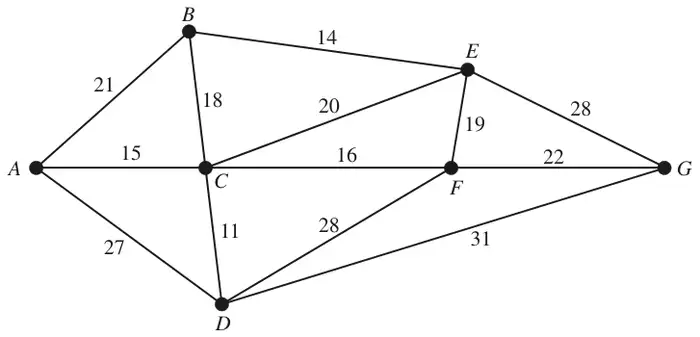
Network of distances in miles between gift shops A to G

The network above shows the distances, in miles, between seven gift shops, \(A\), \(B\), \(C\), \(D\), \(E\), \(F\) and \(G\).

The area manager needs to visit each shop. She will start and finish at shop A and wishes to minimise the total distance travelled.

(a) By inspection, complete the two copies of the table of least distances below. (4)
\(A\)\(B\)\(C\)\(D\)\(E\)\(F\)\(G\)
\(A\)–15365323
\(B\)–1738498049
\(C\)1517–216232
\(D\)363821–1142
\(E\)4911–3161
\(F\)5380624231–30
\(G\)2349326130–
(b) Starting at A, and making your method clear, find an upper bound for the route length, using the nearest neighbour algorithm. (3)
(c) By deleting A, and all of its arcs, find a lower bound for the route length. (4)

D2 June 2006 Q3

EdexcelOld spec11 marksTravelling Salesman

3. A college wants to offer five full-day activities with a different activity each day from Monday to Friday. The sports hall will only be used for these activities. Each evening the caretaker will prepare the hall by putting away the equipment from the previous activity and setting up the hall for the activity next day. On Friday evening he will put away the equipment used that day and set up the hall for the following Monday.

The 5 activities offered are Badminton (\(B\)), Cricket nets (\(C\)), Dancing (\(D\)), Football coaching (\(F\)) and Tennis (\(T\)). Each will be on the same day from week to week.

The college decides to offer the activities in the order that minimises the total time the caretaker has to spend preparing the hall each week.

The hall is initially set up for Badminton on Monday.

The table below shows the time, in minutes, it will take the caretaker to put away the equipment from one activity and set up the hall for the next.

To
Time\(B\)\(C\)\(D\)\(F\)\(T\)
From\(B\)–10815064100
\(C\)108–5410460
\(D\)15054–150102
\(F\)64104150–68
\(T\)1006010268–
(a) Explain why this problem is equivalent to the travelling salesman problem. (2)

A possible ordering of activities is

MondayTuesdayWednesdayThursdayFriday
\(B\)\(C\)\(D\)\(F\)\(T\)
(b) Find the total time taken by the caretaker each week using this ordering. (2)
(c) Starting with Badminton on Monday, use a suitable algorithm to find an ordering that reduces the total time spent each week to less than 7 hours. (3)
(d) By deleting \(B\), use a suitable algorithm to find a lower bound for the time taken each week. Make your method clear. (4)

D2 January 2006 Q6

EdexcelOld spec13 marksTravelling Salesman

6.

Network of roads between the towns with distances in km

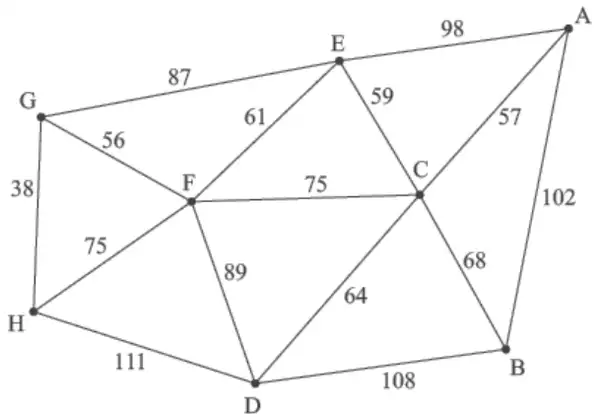
The network in the figure above, shows the distances in km, along the roads between eight towns, A, B, C, D, E, F, G and H. Keith has a shop in each town and needs to visit each one. He wishes to travel a minimum distance and his route should start and finish at A.

By deleting D, a lower bound for the length of the route was found to be 586 km.
By deleting F, a lower bound for the length of the route was found to be 590 km.

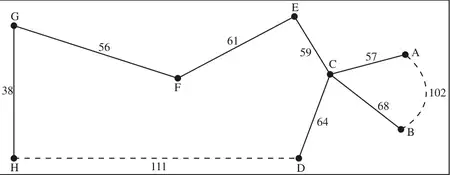
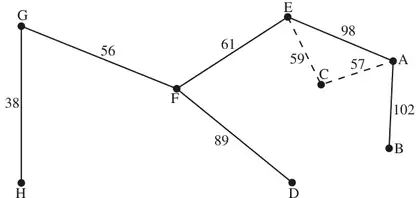
(a) By deleting C, find another lower bound for the length of the route. State which is the best lower bound of the three, giving a reason for your answer. (5)
(b) By inspection complete the table of least distances. (4)
ABCDEFGH
A-848513817314952
B84-13077126213222136
C85130-53888392
D1387753-49190
E1731268849-100180215
F21383100-163115
G14922292180163-97
H5213619021511597-

The table can now be taken to represent a complete network.

The nearest neighbour algorithm was used to obtain upper bounds for the length of the route: Starting at D, an upper bound for the length of the route was found to be 838 km.
Starting at F, an upper bound for the length of the route was found to be 707 km.

(c) Starting at C, use the nearest neighbour algorithm to obtain another upper bound for the length of the route. State which is the best upper bound of the three, giving a reason for your answer. (4)

D2 June 2005 Q2

EdexcelOld spec11 marksTravelling Salesman

2.

Network of cables between relay stations A to G with distances in km

The network in the diagram shows the distances, in km, of the cables between seven electricity relay stations \(A\), \(B\), \(C\), \(D\), \(E\), \(F\) and \(G\). An inspector needs to visit each relay station. He wishes to travel a minimum distance, and his route must start and finish at the same station.

By deleting \(C\), a lower bound for the length of the route is found to be 129 km.

(a) Find another lower bound for the length of the route by deleting \(F\). State which is the better lower bound of the two. (5)
(b) By inspection, complete the table of least distances. (2)

The table can now be taken to represent a complete network.

(c) Using the nearest-neighbour algorithm, starting at \(F\), obtain an upper bound to the length of the route. State your route. (4)