Route Inspection

From an AS paper

Edexcel

Edexcel · Old spec

A2 June 2025 Q4

EdexcelCurrent spec13 marksRoute InspectionShortest Path

4.

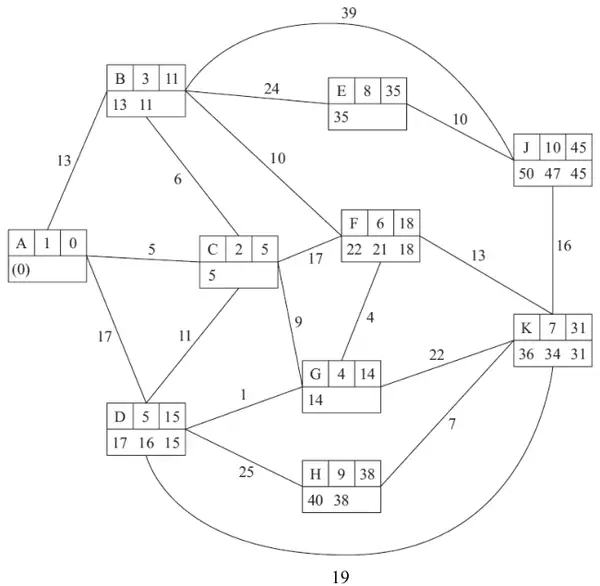
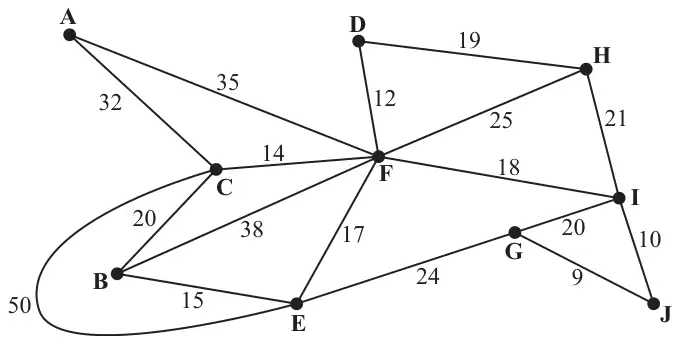
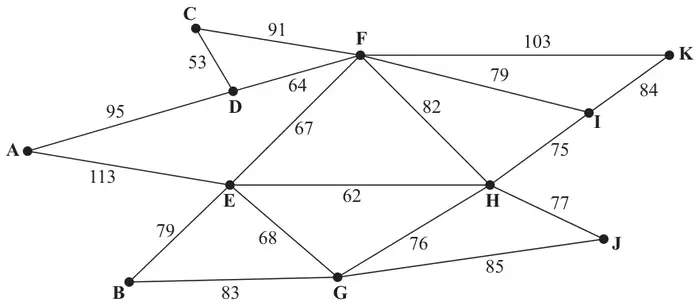
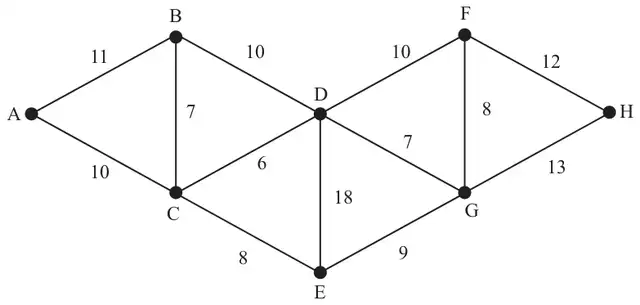
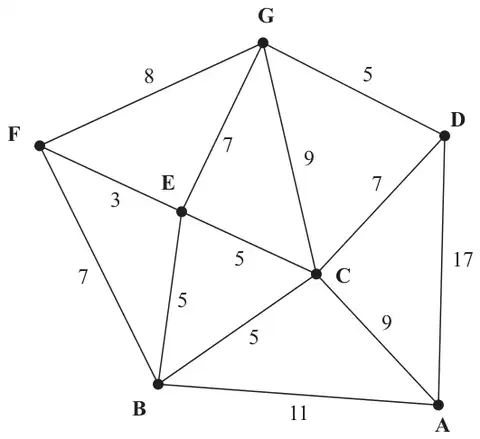
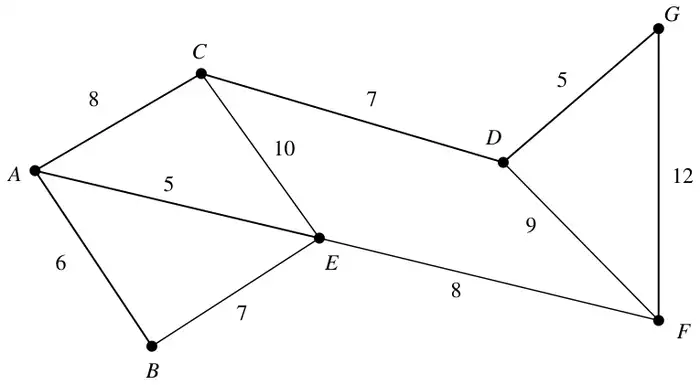
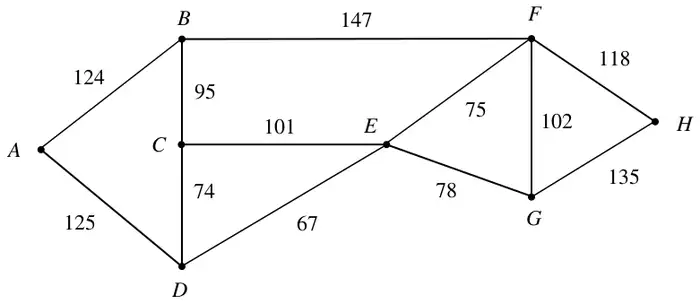
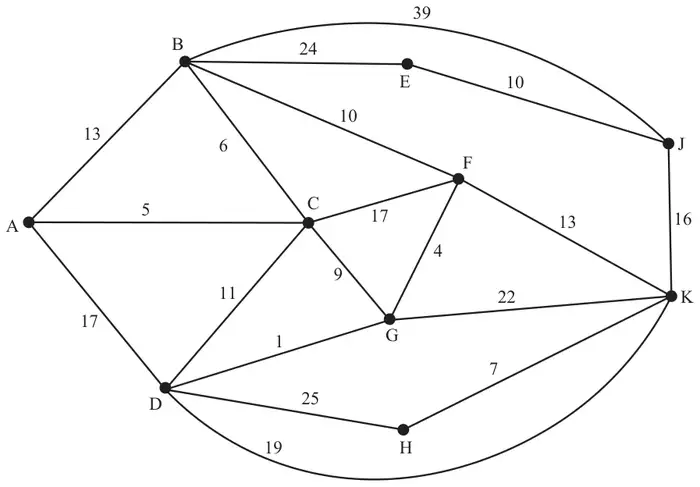
Figure 2: network on offices A to K with edges AB 13, AC 5, AD 17, BC 6, BE 24, BF 10, BJ 39, CF 17, CG 9, CD 11, DG 1, DH 25, DK 19, EJ 10, FG 4, FK 13, GK 22, HK 7, JK 16
Figure 2

[The total weight of the network is 268]

Figure 2 represents a network of corridors between 10 offices, A, B, C, D, E, F, G, H, J and K, in a building. The number on each edge represents the length, in metres, of the corresponding corridor.

On Monday morning, Turvi needs to walk from J to K via A. She wishes to minimise the distance she travels along the corridors.

(a)
(i) Use Dijkstra’s algorithm, starting at A, to find the shortest route from J to K via A.
(ii) State the length of this route. (6)

On Monday afternoon, Turvi needs a route that traverses each corridor at least once. She plans to start at J and finish at A and wants to minimise the distance travelled.

(b)
(i) By considering the pairings of all relevant nodes, find the corridors that would need to be traversed twice. You must make your method and working clear.
(ii) State the total length of this route. (5)

Turvi discovers that she cannot walk along corridors AB, CD and JK because they are being decorated. Turvi walks from J to A travelling along all the other corridors at least once. She does this in the minimum distance possible.

(c) Determine the difference between the length of the route Turvi travels and the length of the route found in (b). You must make the values used in your calculation clear. (2)

AS June 2025 Q3

EdexcelAS paperCurrent spec14 marksRoute InspectionShortest Path

3.

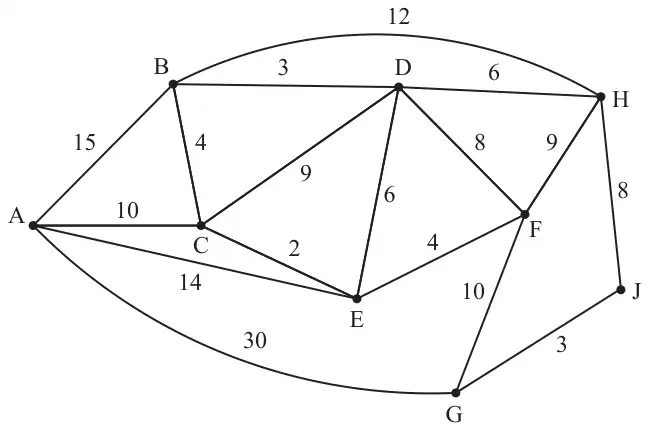
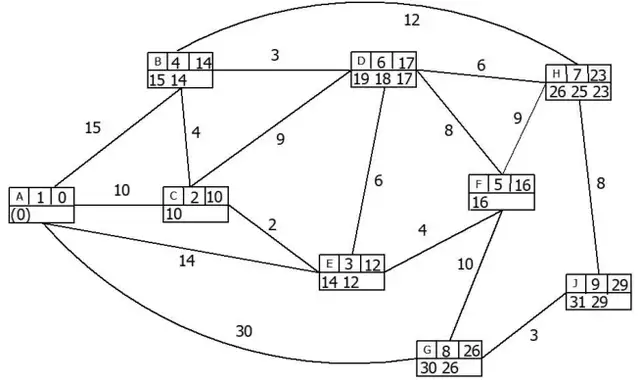
Figure 2: weighted network on vertices A to J with arcs AB 15, AC 10, AE 14, AG 30, BC 4, BD 3, BH 12, CD 9, CE 2, DE 6, DF 8, DH 6, EF 4, FH 9, FG 10, HJ 8, GJ 3
Figure 2

[The total weight of the network is 153]

Figure 2 models a network of roads in a town, where the nodes represent road junctions. The numbers on the edges are the times, in minutes, taken to walk along the corresponding roads.

(a) State, with a reason, whether the graph in Figure 2 is Eulerian, semi-Eulerian or neither. (1)
(b)
(i) Use Dijkstra’s algorithm to find the quickest path from A to J.
(ii) State the shortest time needed to walk from A to J. (6)

Ruby manages road maintenance from her office located at junction B. She needs to walk along each road at least once, starting and finishing at her office. Road AE is temporarily blocked so she is unable to walk along it. Ruby wishes to minimise her journey time.

(c)
(i) Use an appropriate algorithm to find the roads that Ruby needs to traverse twice. You must make your method and working clear.
(ii) Calculate Ruby’s journey time. (5)

Ruby can save some time by choosing to start her route from any junction and to finish at her home at A. Road AE is still blocked and Ruby again wishes to minimise her journey time.

(d)
(i) Write down the junction at which Ruby should start.
(ii) Calculate how much time she would save. (2)

A2 June 2024 Q3

EdexcelCurrent spec13 marksRoute InspectionShortest Path

3.

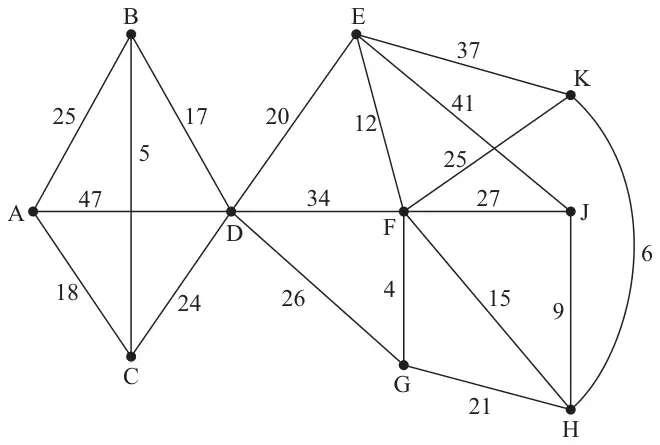
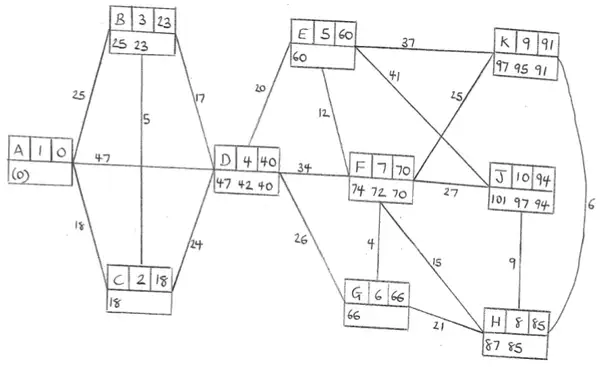
Figure 1: network on towns A to K with arcs AB 25, AC 18, AD 47, BC 5, BD 17, CD 24, DE 20, DF 34, DG 26, EF 12, EJ 41, EK 37, FK 25, FJ 27, FG 4, FH 15, GH 21, JH 9, KH 6
Figure 1

[The total weight of the network is 413]

Figure 1 represents a network of cycle tracks between ten towns, A, B, C, D, E, F, G, H, J and K. The number on each arc represents the length, in kilometres, of the corresponding track.

(a) Use Dijkstra’s algorithm to find the shortest path from A to J. (5)

Abi needs to travel along every track shown in Figure 1 to check that they are all in good repair. She needs to start her inspection route at town G and finish her route at either town J or town K.

Abi wishes to minimise the total distance required to traverse every track.

(b) By considering all relevant pairings of vertices, determine whether Abi should finish her inspection route at town J or town K. You must
  • state which tracks she will repeat in her route
  • state the total length of her route
(6)

The direct track between town B and town C and the direct track between town H and town K are now closed to all users. A second person, Tarig, is asked to check all the remaining tracks starting at G and finishing at H.

Tarig wishes to minimise the total length of his inspection route.

(c) Determine which route, Abi’s or Tarig’s, is shorter. You must make your working clear. (2)

AS June 2024 Q3

EdexcelAS paperCurrent spec11 marksRoute InspectionShortest Path

3.

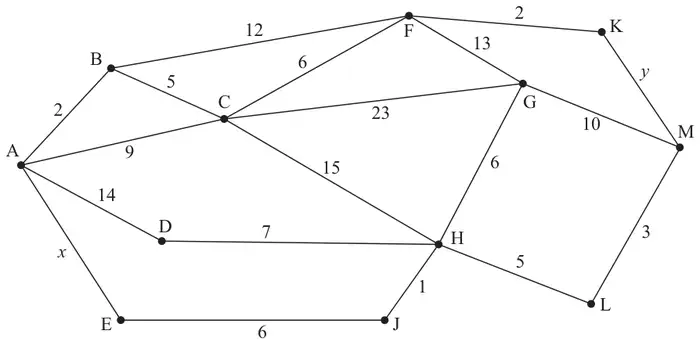
Figure 3: weighted network on vertices A to M with arcs AB 2, AC 9, AD 14, AE x, BC 5, BF 12, CF 6, CG 23, CH 15, DH 7, EJ 6, JH 1, FK 2, FG 13, GH 6, GM 10, KM y, HL 5, LM 3
Figure 3

[The total weight of the network is \(139 + x + y\)]

(a) Explain what is meant by the term “tree”. (1)

Figure 3 represents a network of walkways in a warehouse.
The arcs represent the walkways and the nodes represent junctions between them.
The number on each arc represents the length, in metres, of the corresponding walkway.

The values \(x\) and \(y\) are unknown, however it is known that \(x\) and \(y\) are integers and that

\[9 \lt x \lt y \lt 14\]
(b)
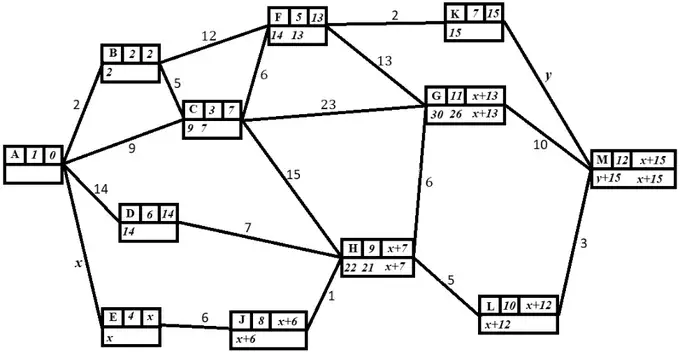
(i) Use Dijkstra’s algorithm to find the shortest route from A to M.
(ii) State an expression for the length of the shortest route from A to M. (6)

The warehouse manager wants to check that all of the walkways are in good condition.

Their inspection route starts at B and finishes at C.

The inspection route must traverse each walkway at least once and be as short as possible.

(c) State the arcs that are traversed twice. (1)
(d) State the number of times that H appears in the inspection route. (1)

The warehouse manager finds that the total length of the inspection route is 172 metres.

(e) Determine the value of \(x\) and the value of \(y\) (2)

A2 June 2023 Q5

5.

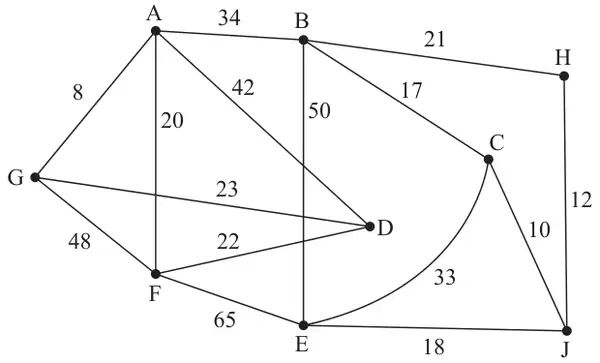
Figure 5: network on A to J with arcs AB 34, AG 8, AF 20, AD 42, BE 50, BH 21, BC 17, GD 23, GF 48, FD 22, FE 65, CE 33, CJ 10, HJ 12, EJ 18
Figure 5

[The total weight of the network is 423]

Direct roads between nine towns, A, B, C, D, E, F, G, H and J, are represented in Figure 5. The number on each arc represents the length, in miles, of the corresponding road.

The table below shows the shortest distances, in miles, between the nine towns.

ABCDEFGHJ
A–345131792085561
B34–17654554422127
C5117–822871592210
D316582–8722238692
E79452887–65873018
F2054712265–287581
G84259238728–6369
H55212286307563–12
J6127109218816912–

Table of shortest distances

A route is needed that minimises the total distance required to traverse each road at least once.

The route must start at F and finish at J.

(a)
(i) By considering the pairings of all relevant nodes, find the roads that would need to be traversed twice.
(ii) State the total length of this route. (5)
(b) Starting at A, use Prim’s algorithm to find the minimum spanning tree for the table of shortest distances. You must state the order in which you select the arcs of your tree. (3)

Pete needs to visit all nine towns, starting and finishing in the same town, and wishes to minimise the total distance he travels.

(c) Starting at G, use the nearest neighbour algorithm on the table of shortest distances to find an upper bound for the length of Pete’s route. Write down the route that gives this upper bound. (2)
(d) By deleting G and all of its arcs, find a lower bound for the length of Pete’s route. (2)

Pete decides to take the route he found in (c).

(e) Interpret the route in terms of the actual towns visited. (1)

AS June 2023 Q5

EdexcelAS paperCurrent spec8 marksGraphs & NetworksRoute Inspection

5.

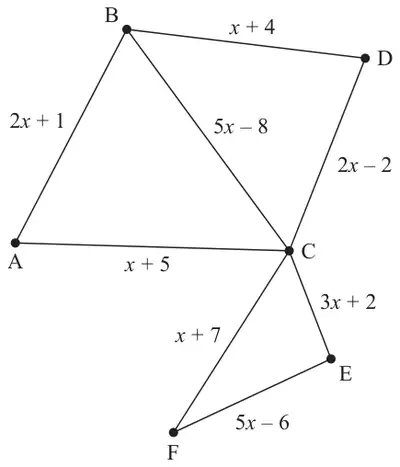
Figure 4: network with arcs AB 2x + 1, AC x + 5, BC 5x - 8, BD x + 4, CD 2x - 2, CE 3x + 2, CF x + 7, EF 5x - 6
Figure 4

[The weight of the network is \(20x + 3\)]

Figure 4 shows a graph G that contains 8 arcs and 6 vertices.

(a) State the minimum number of arcs that would need to be added to make G into an Eulerian graph. (1)
(b) Explain whether or not the route A – C – F – E – C – D – B is an example of a path on G. (1)

Figure 4 represents a network of 8 roads in a city. The expression on each arc gives the time, in minutes, to travel along the corresponding road.

You are given that \(x \gt 1.6\)

A route is required that

  • starts and finishes at the same vertex
  • traverses each road at least once
  • minimises the total time taken

The route inspection algorithm is applied to the network in Figure 4 and the time taken for the route is found to be at most 189 minutes.

Given that the inspection route contains two roads that need to be traversed twice,

(c) determine the range of possible values of \(x\), making your reasoning clear. (6)

AS June 2022 Q3

EdexcelAS paperCurrent spec14 marksRoute InspectionShortest Path

3.

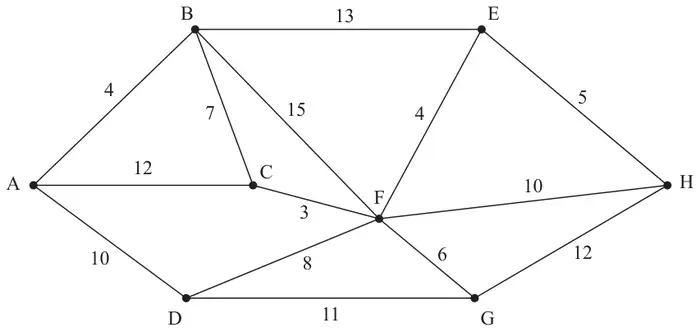
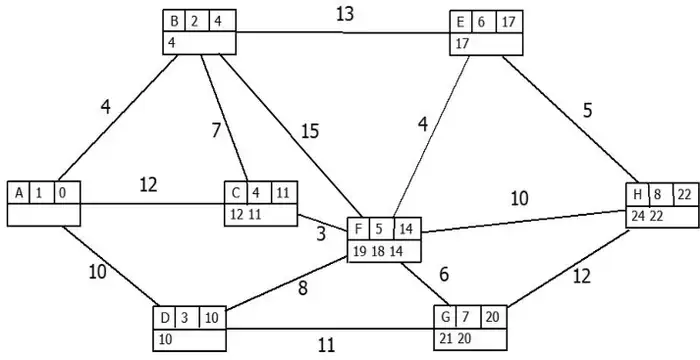
Figure 2: weighted network on vertices A to H with arcs AB 4, AC 12, AD 10, BC 7, BF 15, BE 13, CF 3, DF 8, DG 11, EF 4, EH 5, FH 10, FG 6, GH 12
Figure 2

[The total weight of the network is 120]

(a) Explain what is meant by the term “path”. (2)
(b) State, with a reason, whether the network in Figure 2 is Eulerian, semi-Eulerian or neither. (1)

Figure 2 represents a network of cycle tracks between eight villages, A, B, C, D, E, F, G and H. The number on each arc represents the length, in km, of the corresponding track. Samira lives in village A, and wishes to visit her friend, Daisy, who lives in village H.

(c) Use Dijkstra’s algorithm to find the shortest path that Samira can take. (5)

An extra cycle track of length 9 km is to be added to the network. It will either go directly between C and D or directly between E and G.

Daisy plans to cycle along every track in the new network, starting and finishing at H.

Given that the addition of either track CD or track EG will not affect the final values obtained in (c),

(d) use a suitable algorithm to find out which of the two possible extra tracks will give Daisy the shortest route, making your method and working clear. You must
  • state which tracks Daisy will repeat in her route
  • state the total length of her route
(6)

A2 June 2022 Q2

EdexcelCurrent spec13 marksRoute InspectionShortest Path

2.

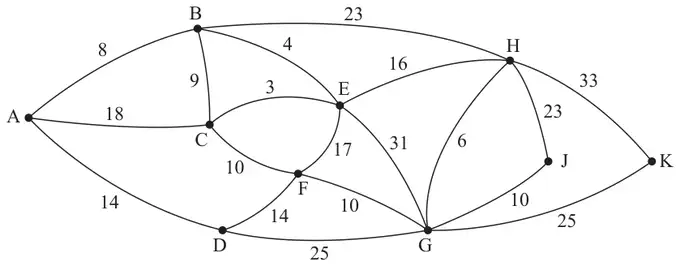
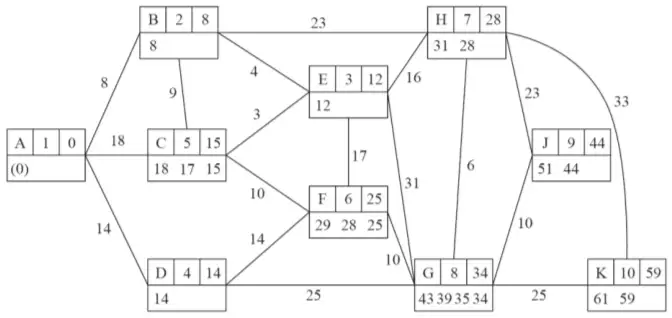
Figure 1: network on A, B, C, D, E, F, G, H, J and K with edges AB 8, AC 18, AD 14, BC 9, BE 4, BH 23, CE 3, CF 10, DF 14, DG 25, EF 17, EG 31, EH 16, FG 10, GH 6, GJ 10, GK 25, HJ 23, HK 33
Figure 1

[The total weight of the network is 299]

Figure 1 represents a network of cycle tracks between 10 landmarks, A, B, C, D, E, F, G, H, J and K. The number on each edge represents the length, in kilometres, of the corresponding track.

One day, Blanche wishes to cycle from A to K. She wishes to minimise the distance she travels.

(a)
(i) Use Dijkstra’s algorithm to find the shortest path from A to K.
(ii) State the length of the shortest path from A to K. (6)

The cycle tracks between the landmarks now need to be inspected. Blanche must travel along each track at least once. She wishes to minimise the length of her inspection route. Blanche will start her inspection route at D and finish at E.

(b)
(i) State the edges that will need to be traversed twice.
(ii) Find the length of Blanche’s route. (2)

It is now decided to start the inspection route at A and finish at K. Blanche must minimise the length of her route and travel along each track at least once.

(c) By considering the pairings of all relevant nodes, find the length of Blanche’s new route. You must make your method and working clear. (5)

A2 October 2021 Q4

EdexcelCurrent spec8 marksRoute InspectionShortest Path

4.

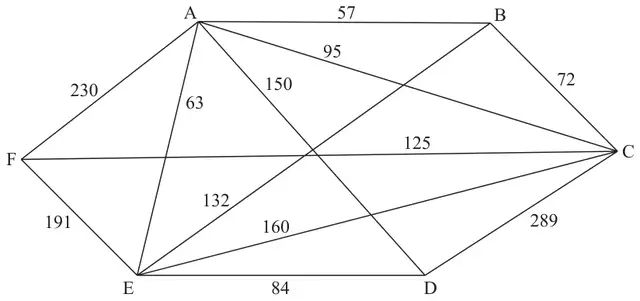
Figure 3: network on A, B, C, D, E and F with arcs AB 57, AC 95, AD 150, AE 63, AF 230, BC 72, BE 132, CD 289, CE 160, CF 125, DE 84, EF 191
Figure 3

[The total weight of the network is 1648]

Direct roads between six cities, A, B, C, D, E and F, are represented in Figure 3. The weight on each arc is the time, in minutes, required to travel along the corresponding road.

Floyd’s algorithm is to be used to find the complete network of shortest times between the six cities.

An initial route matrix is given in the answer book.

Initial route matrix (answer book)

ABCDEF
AABCDEF
BABCDEF
CABCDEF
DABCDEF
EABCDEF
FABCDEF
(a) Set up the initial time matrix. (1)
(b) Perform the first iteration of Floyd’s algorithm. You should show the time and route matrices after this iteration. (2)

The final time matrix after completion of Floyd’s algorithm is shown below.

ABCDEF
A–579514763220
B57–72204120197
C9572–242158125
D147204242–84275
E6312015884–191
F220197125275191–

A route is needed that minimises the total time taken to traverse each road at least once.

The route must start at B and finish at E.

(c) Use an appropriate algorithm to find the roads that will need to be traversed twice. You should make your method and working clear. (4)
(d) Write down the length of the route. (1)

A2 October 2020 Q6

EdexcelCurrent spec11 marksRoute InspectionShortest Path

6.

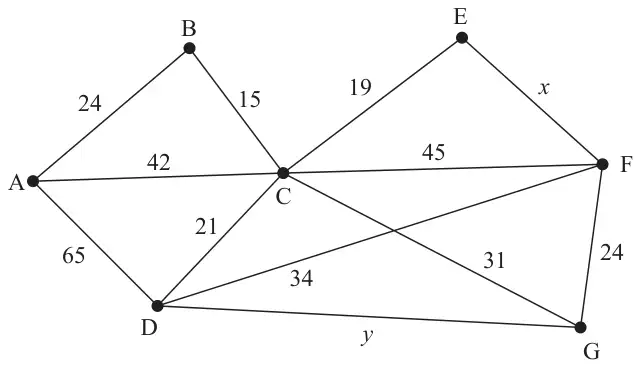
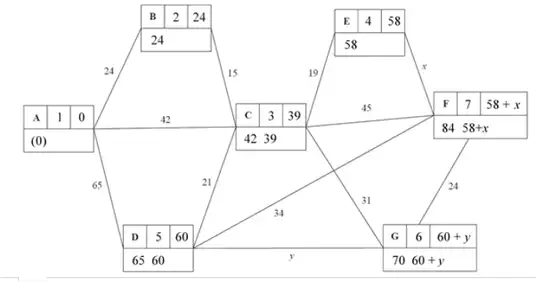
Figure 4: network on A to G with arcs AB 24, AC 42, AD 65, BC 15, CE 19, CF 45, CD 21, CG 31, DF 34, DG y, EF x, FG 24
Figure 4

[The total weight of the network is \(320 + x + y\)]

(a) State, with justification, whether the graph in Figure 4 is Eulerian, semi-Eulerian or neither. (2)

The weights on the arcs in Figure 4 represent distances. The weight on arc EF is \(x\) where \(12 \lt x \lt 26\) and the weight on arc DG is \(y\) where \(0 \lt y \lt 10\)

An inspection route of minimum length that traverses each arc at least once is found. The inspection route starts and finishes at A and has a length of 409

It is also given that the length of the shortest route from F to G via A is 140

(b) Using appropriate algorithms, find the value of \(x\) and the value of \(y\). (9)
AS October 2020 Q3

EdexcelAS paperCurrent spec11 marksMinimum Spanning TreesRoute Inspection

3.

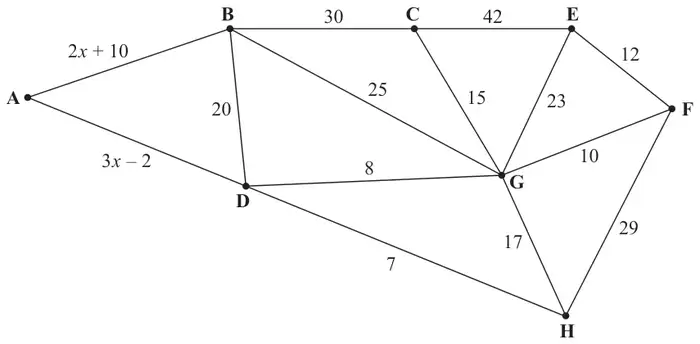
Figure 2: network on vertices A to H with arcs AB 2x + 10, AD 3x – 2, BC 30, BD 20, BG 25, CE 42, CG 15, DG 8, DH 7, EF 12, EG 23, FG 10, FH 29, GH 17
Figure 2

[The weight of the network is \(5x + 246\)]

(a) Explain why it is not possible to draw a graph with an odd number of vertices of odd valency. (2)
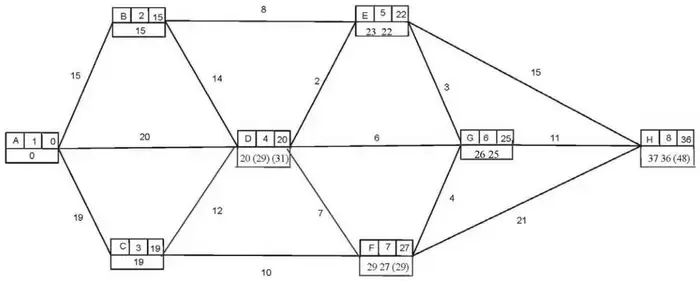
Figure 2 represents a network of 14 roads in a town. The expression on each arc gives the time, in minutes, to travel along the corresponding road.

Prim’s algorithm, starting at A, is applied to the network. The order in which the arcs are selected is AD, DH, DG, FG, EF, CG, BD. It is given that the order in which the arcs are selected is unique.

(b) Using this information, find the smallest possible range of values for \(x\), showing your working clearly. (3)

A route that minimises the total time taken to traverse each road at least once is required. The route must start and finish at the same vertex.

Given that the time taken to traverse this route is 318 minutes,

(c) use an appropriate algorithm to determine the value of \(x\), showing your working clearly. (6)

AS June 2019 Q4

EdexcelAS paperCurrent spec10 marksRoute InspectionShortest Path

4.

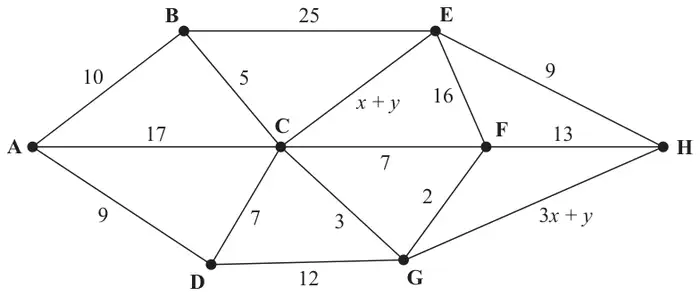
Figure 1: network on vertices A to H with arcs AB 10, AC 17, AD 9, BC 5, BE 25, CD 7, CE x + y, CF 7, CG 3, DG 12, EF 16, EH 9, FG 2, FH 13, GH 3x + y
Figure 1

[The total weight of the network is \(135 + 4x + 2y\)]

The weights on the arcs in Figure 1 represent distances. The weights on the arcs CE and GH are given in terms of \(x\) and \(y\), where \(x\) and \(y\) are positive constants and \(7 < x + y < 20\)

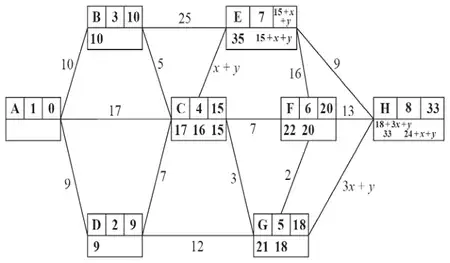
There are three paths from A to H that have the same minimum length.

(a) Use Dijkstra’s algorithm to find \(x\) and \(y\). (7)

An inspection route starting at A and finishing at H is found. The route traverses each arc at least once and is of minimum length.

(b) State the arcs that are traversed twice. (1)
(c) State the number of times that vertex C appears in the inspection route. (1)
(d) Determine the length of the inspection route. (1)

A2 June 2019 Q2

EdexcelCurrent spec14 marksRoute InspectionShortest Path

2.

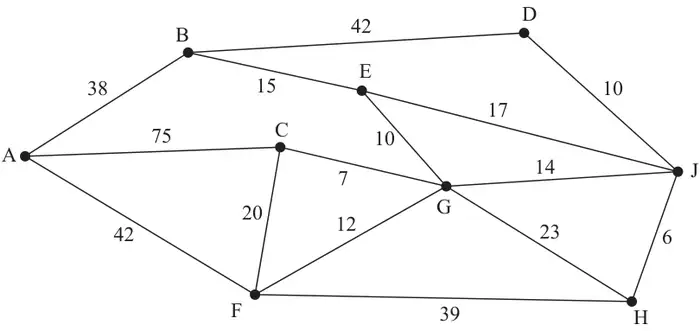
Figure 1: network on A to J with arcs AB 38, AC 75, AF 42, BD 42, BE 15, CF 20, CG 7, DJ 10, EG 10, EJ 17, FG 12, FH 39, GJ 14, GH 23, HJ 6
Figure 1

[The total weight of the network is 370]

Figure 1 represents a network of corridors in a building. The number on each arc represents the length, in metres, of the corresponding corridor.

(a) Use Dijkstra’s algorithm to find the shortest path from A to D, stating the path and its length. (6)

On a particular day, Naasir needs to check the paintwork along each corridor. Naasir must find a route of minimum length. It must traverse each corridor at least once, starting at B and finishing at G.

(b) Use an appropriate algorithm to find the arcs that will need to be traversed twice. You must make your method and working clear. (4)
(c) Find the length of Naasir’s route. (1)

On a different day, all the corridors that start or finish at B are closed for redecorating. Naasir needs to check all the remaining corridors and may now start at any vertex and finish at any vertex. A route is required that excludes all those corridors that start or finish at B.

(d)
(i) Determine the possible starting and finishing points so that the length of Naasir’s route is minimised. You must give reasons for your answer.
(ii) Find the length of Naasir’s new route. (3)

D1 June 2019 Q2

EdexcelOld spec11 marksRoute Inspection

2.

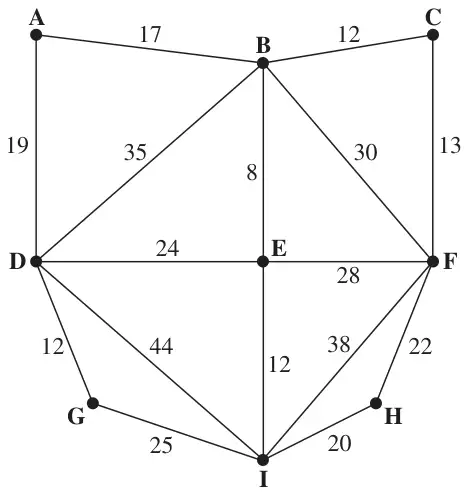
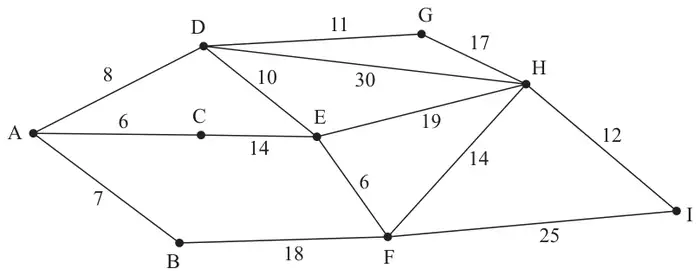
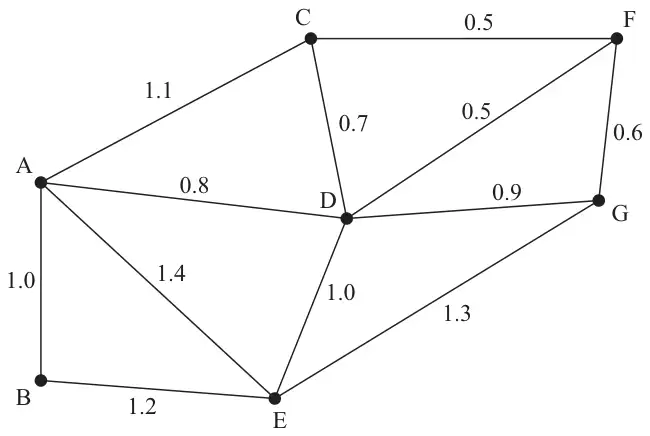
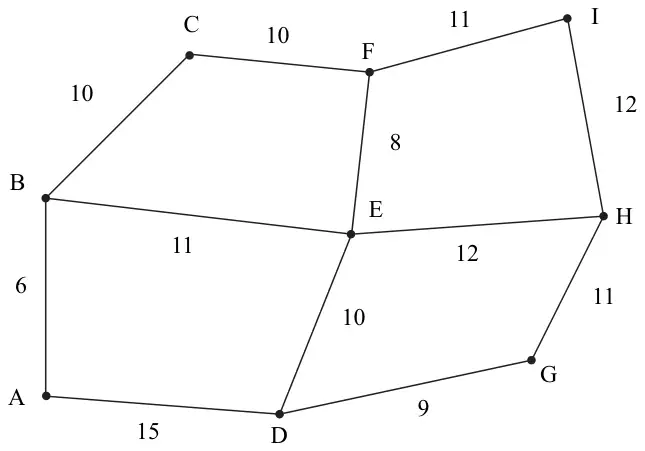
Figure 3: weighted network of roads on nodes A, B, C, D, E, F, G, H, J
Figure 3

[The total weight of the network is 48.2]

A surveyor needs to check the state of a number of roads to see whether they need resurfacing. The roads that need to be checked are represented by the arcs in Figure 3. The number on each arc represents the length of that road in miles. To check all the roads, she needs to travel along each road at least once. She wishes to minimise the total distance travelled.

The surveyor’s office is at F, so she starts and ends her journey at F.

(a) Find a route for the surveyor to follow. State your route and its length. You must make your method and reasoning clear. (4)

The surveyor lives at D and wonders if she can reduce the distance travelled by starting from home and inspecting all the roads on the way to her office at F.

(b) By considering the pairings of all relevant nodes, find the arcs that will need to be traversed twice in the inspection route from D to F. You must make your method and working clear. (5)
(c) Determine which of the two routes, the one starting at F and ending at F, or the one starting at D and ending at F, is longer. You must show your working. (2)

D1 June 2018 Q4

EdexcelOld spec14 marksRoute InspectionShortest Path

4.

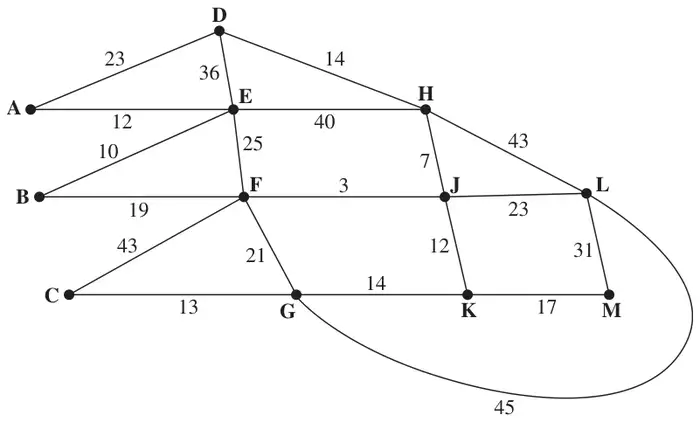
Figure 2: weighted network of roads with vertices A to J
Figure 2

[The total weight of the network is 293]

Figure 2 models a network of roads. The number on each edge gives the time, in minutes, taken to travel along the corresponding road.

(a) Use Dijkstra’s algorithm to find the shortest time needed to travel from A to J.
State the quickest route. (6)

The road represented by edge GJ is closed due to essential maintenance. Sahil needs to travel along all the other roads to check that they are in good repair. Sahil wishes to complete his route as quickly as possible and will start and finish at the same vertex.

(b) Use the route inspection algorithm to find the duration of Sahil’s quickest route. State the edges that will need to be traversed twice. You should make your method and working clear. (6)

Given that Sahil will start and finish at vertex C,

(c) state the number of times that Sahil will visit vertex E and vertex F in his inspection route. (2)

D1 June 2017 Q4

EdexcelOld spec15 marksRoute InspectionShortest Path

4.

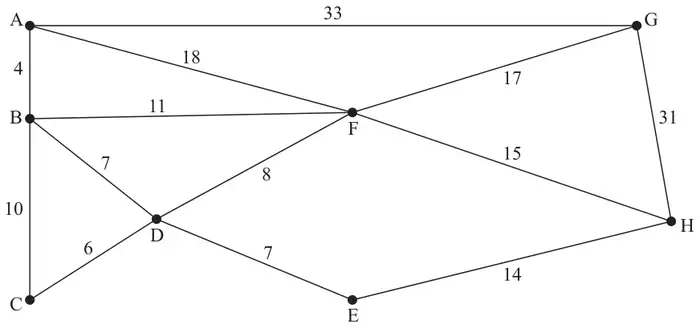
Figure 4: weighted network of roads with vertices A to J
Figure 4

[The total weight of the network is 85]

Figure 4 represents a network of roads. The number on each edge represents the length, in miles, of the corresponding road. Robyn wishes to travel from A to H. She wishes to minimise the distance she travels.

(a) Use Dijkstra’s algorithm to find the shortest path from A to H. State the shortest path and its length. (6)

On a particular day, Robyn needs to check each road. She must travel along each road at least once. Robyn must start and finish at vertex A.

(b) Use the route inspection algorithm to find the length of the shortest inspection route. State the edges that should be repeated. You should make your method and working clear. (5)

The roads BD and BE become damaged and cannot be used. Robyn needs to travel along all the remaining roads to check that there is no damage to any of them. The inspection route must still start and finish at vertex A.

(c)
(i) State the edges that should be repeated.
(ii) State a possible route and calculate its length. You must make your method and working clear. (4)

D1 June 2016 Q6

EdexcelOld spec11 marksRoute Inspection

6.

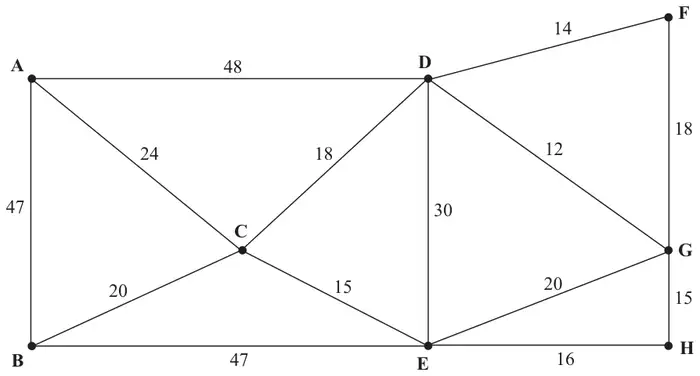
Figure 5: weighted network of corridors with vertices A to L
Figure 5

[The total weight of the network is 384]

Figure 5 models a network of corridors in an office complex that need to be inspected by a security guard. The number on each arc is the length, in metres, of the corresponding section of corridor.

Each corridor must be traversed at least once and the length of the inspection route must be minimised. The guard must start and finish at vertex A.

(a) Use the route inspection algorithm to find the length of the shortest inspection route. State the arcs that should be repeated. You should make your method and working clear. (5)

It is now possible for the guard to start at one vertex and finish at a different vertex. An inspection route that traverses each corridor at least once is still required.

(b) Explain why the inspection route should start at a vertex with odd degree. (2)

The guard decides to start the inspection route at F and the length of the inspection route must still be minimised.

(c) Determine where the guard should finish. You must give reasons for your answer. (2)
(d) State a possible route and its length. (2)

D1 June 2015 Q4

EdexcelOld spec12 marksRoute Inspection

4.

Figure 4: weighted network of roads with vertices A to H
Figure 4

[The total weight of the network is 2090]

(a) Explain why a network cannot have an odd number of vertices of odd valency. (2)

Figure 4 represents a network of 13 roads in a village. The number on each arc is the length, in metres, of the corresponding road. A route of minimum length that traverses each road at least once needs to be found. The route may start at any vertex and finish at any vertex.

(b) Write down the vertices at which the route will start and finish. (1)

A new road, AB, of length 130m is built. A route of minimum length that traverses each road, including AB, needs to be found. The route must start and finish at A.

(c) Use the route inspection algorithm to find the roads that will need to be traversed twice. You must make your method and working clear. (4)
(d) Calculate the length of a possible shortest inspection route. (2)

It is now decided to start and finish the inspection route at two distinct vertices. A route of minimum length that traverses each road, including AB, needs to be found. The route must start at A.

(e) State the finishing point so that the length of the route is minimised. Calculate how much shorter the length of this route is compared to the length of the route in (d). You must make your method and calculations clear. (3)

D1 June 2014 (R) Q4

EdexcelOld spec13 marksRoute Inspection

4.

Figure 4: weighted network with vertices A to I
Figure 4

[The total weight of the network is 359 cm]

Figure 4 represents the network of sensor wires used in a medical scanner. The number on each arc represents the length, in cm, of that section of wire.

After production, each scanner is tested.

A machine will be programmed to inspect each section of wire.

It will travel along each arc of the network at least once, starting and finishing at A. Its route must be of minimum length.

(a) Use the route inspection algorithm to find the length of a shortest inspection route. You must make your method and working clear. (5)

The machine will inspect 15 cm of wire per second.

(b) Calculate the total time taken, in seconds, to test 120 scanners. (2)

It is now possible for the machine to start at one vertex and finish at a different vertex. An inspection route of minimum length is still required.

(c) Explain why the machine should be programmed to start at a vertex with odd degree. (2)

Due to constraints at the factory, only B or D can be chosen as the starting point and there will also be a 2 second pause between tests.

(d) Determine the new minimum total time now taken to test 120 scanners. You must state which vertex you are starting from and make your calculations clear. (4)

D1 June 2014 Q3

EdexcelOld spec10 marksRoute Inspection

3.

Figure 1: network of forest tracks A to M with lengths in km
Figure 1

[The total weight of the network is 451]

Figure 1 models a network of tracks in a forest that need to be inspected by a park ranger. The number on each arc is the length, in km, of that section of the forest track.

Each track must be traversed at least once and the length of the inspection route must be minimised. The inspection route taken by the ranger must start and end at vertex A.

(a) Use the route inspection algorithm to find the length of a shortest inspection route. State the arcs that should be repeated. You should make your method and working clear. (5)
(b) State the number of times that vertex J would appear in the inspection route. (1)

The landowner decides to build two huts, one hut at vertex K and the other hut at a different vertex. In future, the ranger will be able to start his inspection route at one hut and finish at the other. The inspection route must still traverse each track at least once.

(c) Determine where the other hut should be built so that the length of the route is minimised. You must give reasons for your answer and state a possible route and its length. (4)

D1 June 2013 (R) Q5

EdexcelOld spec10 marksRoute Inspection

5.

Figure 4: network of power cables A to H
Figure 4

[The total weight of the network is 181 miles]

Figure 4 represents a network of power cables that have to be inspected. The number on each arc represents the length, in km, of that cable.

A route of minimum length that traverses each cable at least once and starts and finishes at A needs to be found.

(a) Use the route inspection algorithm to find the arcs that will need to be traversed twice. You must make your method and working clear. (5)
(b) Write down a possible shortest inspection route, giving its length. (2)

It is now decided to start and finish the inspection route at two distinct vertices. The route must still traverse each cable at least once.

(c) Determine possible starting and finishing points so that the length of the route is minimised. You must give reasons for your answer. (3)

D1 June 2013 Q5

EdexcelOld spec10 marksRoute Inspection

5.

Figure 4: railway network A to H with lengths in miles
Figure 4

[The total weight of the network is 344 miles]

Figure 4 represents a railway network. The number on each arc represents the length, in miles, of that section of the railway.

Sophie needs to travel along each section to check that it is in good condition.

She must travel along each arc of the network at least once, and wants to find a route of minimum length. She will start and finish at A.

(a) Use the route inspection algorithm to find the arcs that will need to be traversed twice. You must make your method and working clear. (5)
(b) Write down a possible shortest inspection route, giving its length. (2)

Sophie now decides to start the inspection route at E. The route must still traverse each arc at least once but may finish at any vertex.

(c) Determine the finishing point so that the length of the route is minimised. You must give reasons for your answer and state the length of your route. (3)

D1 January 2013 Q5

5.

Figure 5: network of roads A to J with lengths in km
Figure 5

[The weight of the network is 379]

Figure 5 represents the roads in a highland wildlife conservation park. The vertices represent warden stations. The number on each arc gives the length, in km, of the corresponding road.

During the winter months the park is closed. It is only necessary to ensure road access to the warden stations.

(a) Use Prim’s algorithm, starting at A, to find a minimum connector for the network in Figure 5. You must state the order in which you include the arcs. (3)
(b) Given that it costs £80 per km to keep the selected roads open in winter, calculate the minimum cost of ensuring road access to all the warden stations. (2)

At the end of winter, Ben inspects all the roads before the park re-opens. He needs to travel along each road at least once. He will start and finish at A, and wishes to minimise the length of his route.

(c) Use the route inspection algorithm to find the roads that will be traversed twice. You must make your method and working clear. (6)
(d) Find the length of the shortest inspection route. (1)

If Ben starts and finishes his inspection route at different warden stations, a shorter inspection route is possible.

(e) Determine the two warden stations Ben should choose as his starting and finishing points in order that his route has minimum length. Give a reason for your answer and state the length of the route. (3)

D1 June 2012 Q4

EdexcelOld spec12 marksGraphs & NetworksRoute Inspection

4.

Figure 3: network of pipes A to K with lengths in metres
Figure 3

[The total weight of the network is 1436 m]

(a) Explain the term valency. (2)

Figure 3 models a system of underground pipes. The number on each arc represents the length, in metres, of that pipe.

Pressure readings indicate that there is a leak in the system and an electronic device is to be used to inspect the system to locate the leak. The device will start and finish at A and travel along each pipe at least once. The length of this inspection route needs to be minimised.

(b) Use the route inspection algorithm to find the pipes that will need to be traversed twice. You should make your method and working clear. (5)
(c) Find the length of the inspection route. (1)

Pipe HI is now found to be blocked; it is sealed and will not be replaced. An inspection route is now required that excludes pipe HI. The length of the inspection route must be minimised.

(d) Find the length of the minimum inspection route excluding HI. Justify your answer. (2)
(e) Given that the device may now start at any vertex and finish at any vertex, find a minimum inspection route, excluding HI. (2)

D1 January 2012 Q2

EdexcelOld spec8 marksRoute Inspection

2.

Figure 2: network with arcs AB 11, AC 10, BC 7, BD 10, CD 6, CE 8, DE 18, DF 10, DG 7, EG 9, FG 8, FH 12, GH 13
Figure 2

[The weight of the network is 129 miles]

Figure 2 models a network of canals. The number on each arc gives the length, in miles, of that canal.

Brett needs to travel along each canal to check that it is in good repair. He wishes to minimise the length of his route.

(a) Use the route inspection algorithm to find the length of his route. State the arcs that should be repeated. You should make your method and working clear. (6)

A canal between B and F, of length 12 miles, is to be opened and needs to be included in Brett’s inspection route.

(b) Determine if the addition of this canal will increase or decrease the length of Brett’s minimum route. You must make your reasoning clear. (2)

D1 June 2011 Q5

EdexcelOld spec10 marksRoute Inspection

5.

Figure 5: network with arcs GF 8, GD 5, GE 7, GC 9, FE 3, FB 7, EC 5, EB 5, BC 5, CD 7, CA 9, DA 17, BA 11
Figure 5

[The total weight of the network is 98 km]

Figure 5 models a network of gas pipes that have to be inspected. The number on each arc represents the length, in km, of that pipe.

A route of minimum length that traverses each pipe at least once and starts and finishes at A needs to be found.

(a) Use the route inspection algorithm to find the pipes that will need to be traversed twice. You must make your method and working clear. (5)
(b) Write down a possible shortest inspection route, giving its length. (2)

It is now decided to start the inspection route at D. The route must still traverse each pipe at least once but may finish at any node.

(c) Determine the finishing point so that the length of the route is minimised. You must give reasons for your answer and state the length of your route. (3)

D1 January 2011 Q5

EdexcelOld spec11 marksRoute Inspection

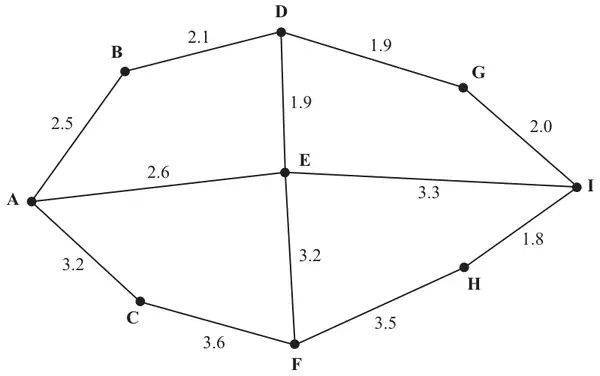
5.

Figure 5: network with arcs AB 2.5, AE 2.6, AC 3.2, BD 2.1, DE 1.9, DG 1.9, GI 2.0, EI 3.3, EF 3.2, CF 3.6, FH 3.5, HI 1.8
Figure 5

[The total weight of the network is 31.6 km]

Figure 5 models a network of roads. The road markings on these roads are to be renewed. The number on each arc represents the length, in km, of that road. In order to renew the road markings, each road must be traversed at least once.

(a) Use the route inspection algorithm, starting and finishing at A, to find a suitable route, which should be stated. You must make your method and working clear. (5)
(b) State the roads that must be traversed twice and the length of the route. (3)

The machine that will be used to renew the road markings can only be delivered to D. It will start at D, but it may finish at any vertex.
Each road must still be traversed at least once.

(c) Given that the route is to be minimised, determine where the machine should finish. Give reasons to justify your answer. (3)

D1 June 2010 Q4

EdexcelOld spec10 marksRoute Inspection

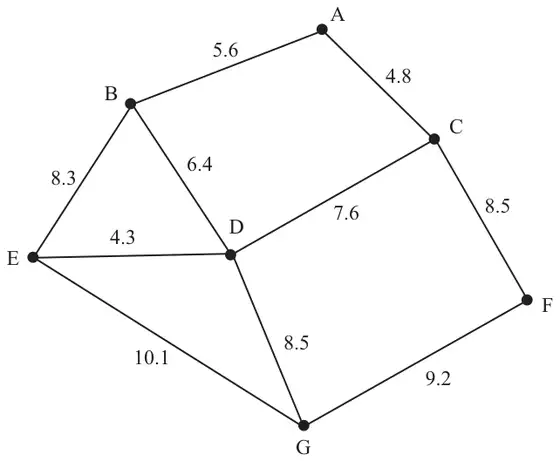
4.

Figure 2: network with arcs AB 5.6, AC 4.8, BE 8.3, BD 6.4, CD 7.6, CF 8.5, ED 4.3, EG 10.1, DG 8.5, FG 9.2
Figure 2

[The total weight of the network is 73.3 km]

Figure 2 models a network of tunnels that have to be inspected. The number on each arc represents the length, in km, of that tunnel.
Malcolm needs to travel through each tunnel at least once and wishes to minimise the length of his inspection route.
He must start and finish at A.

(a) Use the route inspection algorithm to find the tunnels that will need to be traversed twice. You should make your method and working clear. (5)
(b) Find a route of minimum length, starting and finishing at A.
State the length of your route. (3)

A new tunnel, CG, is under construction. It will be 10 km long.
Malcolm will have to include the new tunnel in his inspection route.

(c) What effect will the new tunnel have on the total length of his route?
Justify your answer. (2)

D1 January 2010 Q3

EdexcelOld spec10 marksRoute InspectionShortest Path

3.

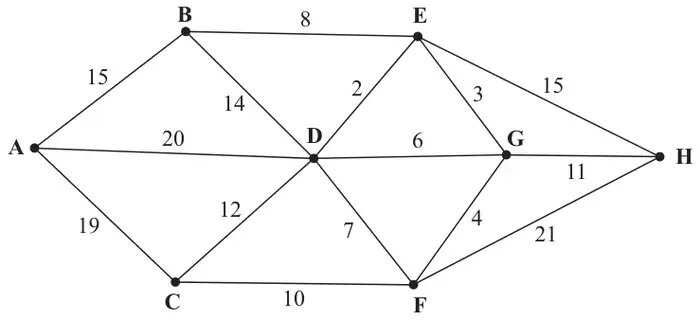
Figure 3: network with arcs AB 15, AD 20, AC 19, BE 8, BD 14, CD 12, CF 10, DE 2, DG 6, DF 7, EG 3, EH 15, GH 11, FG 4, FH 21
Figure 3

[The total weight of the network is 167]

Figure 3 represents a network of paths.  The number on each arc gives the time, in minutes, to travel along that path.

(a) Use Dijkstra’s algorithm to find the quickest route from A to H.  State your quickest route and the time taken. (5)

Kevin must walk along each path at least once and return to his starting point.

(b) Use an appropriate algorithm to find the time of Kevin’s quickest possible route, starting and finishing at A.  You should make your method and working clear. (5)

D1 June 2009 Q5

EdexcelOld spec9 marksRoute Inspection

5.

Figure 3: network of paths with vertices A to H and lengths in m
Figure 3

[The total weight of the network is 625 m]

Figure 3 models a network of paths in a park. The number on each arc represents the length, in m, of that path.

Rob needs to travel along each path to inspect the surface. He wants to minimise the length of his route.

(a) Use the route inspection algorithm to find the length of his route. State the arcs that should be repeated. You should make your method and working clear. (6)

The surface on each path is to be renewed. A machine will be hired to do this task and driven along each path.

The machine will be delivered to point G and will start from there, but it may be collected from any point once the task is complete.

(b) Given that each path must be traversed at least once, determine the finishing point so that the length of the route is minimised. Give a reason for your answer and state the length of your route. (3)

D1 January 2009 Q5

EdexcelOld spec8 marksRoute Inspection

5.

Figure 3: network of railway tracks with vertices A to H and lengths in km
Figure 3

(The total weight of the network in Figure 3 is 543 km.)

Figure 3 models a network of railway tracks that have to be inspected. The number on each arc is the length, in km, of that section of railway track.

Each track must be traversed at least once and the length of the inspection route must be minimised.

The inspection route must start and finish at the same vertex.

(a) Use an appropriate algorithm to find the length of the shortest inspection route. You should make your method and working clear. (5)

It is now permitted to start and finish the inspection at two distinct vertices.

(b) State which two vertices should be chosen to minimise the length of the new route. Give a reason for your answer. (3)

D1 June 2008 Q3

EdexcelOld spec9 marksRoute InspectionShortest Path

3.

Figure 3: network of roads with vertices A to I and lengths in km
Figure 3

Figure 3 shows a network of roads. The number on each arc represents the length, in km, of that road.

(a) Use Dijkstra’s algorithm to find the shortest route from A to I. State your shortest route and its length. (5)

Sam has been asked to inspect the network and assess the condition of the roads. He must travel along each road at least once, starting and finishing at A.

(b) Use an appropriate algorithm to determine the length of the shortest route Sam can travel. State a shortest route. (4)

(The total weight of the network is 197km)

D1 January 2008 Q3

EdexcelOld spec9 marksRoute Inspection

3.

Figure 4: network of roads with vertices A to G and lengths in km
Figure 4

Figure 4 models a network of roads in a housing estate. The number on each arc represents the length, in km, of the road.

The total weight of the network is 11 km.

A council worker needs to travel along each road once to inspect the road surface. He will start and finish at A and wishes to minimise the length of his route.

(a) Use an appropriate algorithm to find a route for the council worker. You should make your method and working clear. State your route and its length. (6)

A postal worker needs to walk along each road twice, once on each side of the road. She must start and finish at A. The length of her route is to be minimised. You should ignore the width of the road.

(b)
(i) Explain how this differs from the standard route inspection problem. (1)
(ii) Find the length of the shortest route for the postal worker. (2)

D1 June 2007 Q4

EdexcelOld spec7 marksRoute Inspection

4.

Figure 4: network of tunnels with vertices A to I and arc lengths in km
Figure 4

Figure 4 models a network of underground tunnels that have to be inspected. The number on each arc represents the length, in km, of each tunnel.

Joe must travel along each tunnel at least once and the length of his inspection route must be minimised.

The total weight of the network is 125 km.

The inspection route must start and finish at A.

(a) Use an appropriate algorithm to find the length of the shortest inspection route. You should make your method and working clear. (5)

Given that it is now permitted to start and finish the inspection at two distinct vertices,

(b) state which two vertices should be chosen to minimise the length of the new route. Give a reason for your answer. (2)

D1 January 2007 Q5

EdexcelOld spec7 marksGraphs & NetworksRoute Inspection

5.

(a) Explain why a network cannot have an odd number of vertices of odd degree. (2)
Figure 4: network of paths on A to I
Figure 4

Figure 4 shows a network of paths in a public park. The number on each arc represents the length of that path in metres. Hamish needs to walk along each path at least once to check the paths for frost damage starting and finishing at \(A\). He wishes to minimise the total distance he walks.

(b) Use the route inspection algorithm to find which paths, if any, need to be traversed twice. (4)
(c) Find the length of Hamish’s route.
[The total weight of the network in Figure 4 is 4180 m.] (1)

D1 June 2006 Q3

EdexcelOld spec7 marksRoute Inspection

3.

Figure 2: network of pipes on A to I
Figure 2

Figure 2 shows the network of pipes represented by arcs. The length of each pipe, in kilometres, is shown by the number on each arc. The network is to be inspected for leakages, using the shortest route and starting and finishing at \(A\).

(a) Use the route inspection algorithm to fins which arcs, if any, need to be traversed twice. (4)
(b) State the length of the minimum route. [The total weight of the network is 394 km.] (1)

It is now permitted to start and finish the inspection at two distinct vertices.

(c) State, with a reason, which two vertices should be chosen to minimise the length of the new route. (2)

D1 January 2006 Q2

2.

\(A\)\(B\)\(C\)\(D\)\(E\)\(F\)\(G\)
\(A\)–4811792–––
\(B\)48––––6355
\(C\)117––28––85
\(D\)92–28–58132–
\(E\)–––58–124–
\(F\)–63–132124––
\(G\)–5585––––

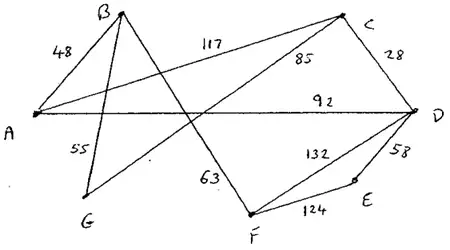
The table shows the lengths, in metres, of the paths between seven vertices \(A\), \(B\), \(C\), \(D\), \(E\), \(F\) and \(G\) in a network N.

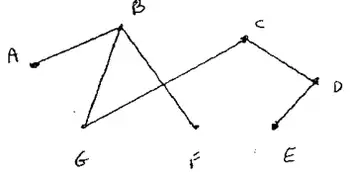
(a) Use Prim’s algorithm, starting at \(A\), to solve the minimum connector problem for this table of distances. You must clearly state the order in which you selected the edges of your tree, and the weight of your final tree. Draw your tree using the vertices given in Diagram 1 in the answer book. (5)
(b) Draw N using the vertices given in Diagram 2 in the answer book. (3)
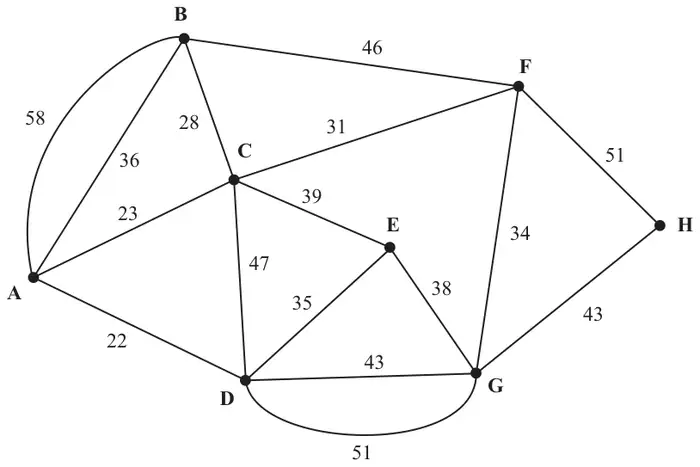
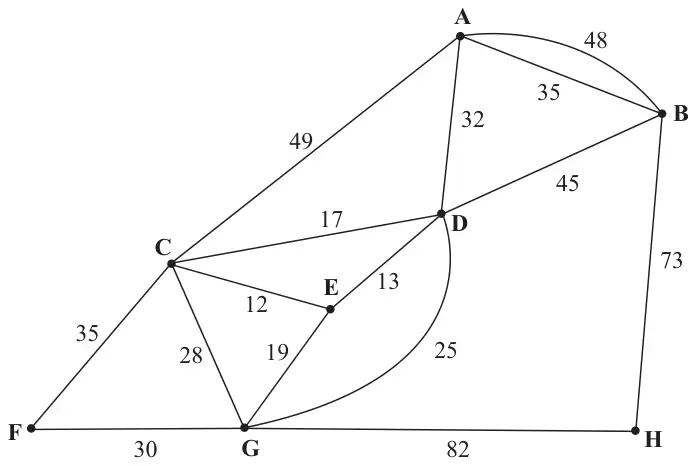
(c) Solve the Route Inspection problem for N. You must make your method of working clear. State a shortest route and find its length.
(The weight of N is 802.) (7)

D1 June 2005 Q3

EdexcelOld spec7 marksRoute Inspection

3.

Figure 2: road network on A to G
Figure 2

Figure 2 models a network of roads which need to be inspected to assess if they need to be resurfaced. The number on each arc represents the length, in km, of that road.

Each road must be traversed at least once and the length of the inspection route must be minimised.

(a) Starting and finishing at \(A\), solve this route inspection problem. You should make your method and working clear. State the length of the shortest route.
(The weight of the network is 77 km.) (5)

Given that it is now permitted to start and finish the inspection at two distinct vertices,

(b) state which two vertices you should choose to minimise the length of the route. Give a reason for your answer. (2)

D1 January 2005 Q5

EdexcelOld spec11 marksRoute InspectionShortest Path

5.

Figure 3: network of paths on A to H
Figure 3

Figure 3 shows a network of paths. The number on each arc gives the distance, in metres, of that path.

(i) Use Dijkstra’s algorithm to find the shortest distance from \(A\) to \(H\). (5)
(ii) Solve the route inspection problem for the network shown in Figure 3. You should make your method and working clear. State a shortest route, starting at \(A\), and find its length.

[The total weight of the network is 1241]

(6)