
AS June 2025 Q3
3.
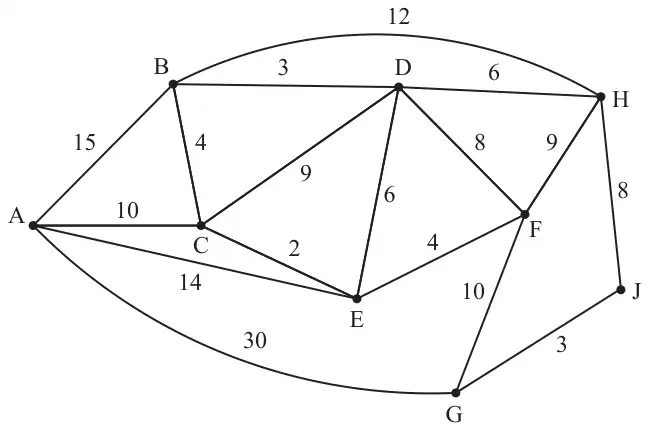
[The total weight of the network is 153]
Figure 2 models a network of roads in a town, where the nodes represent road junctions. The numbers on the edges are the times, in minutes, taken to walk along the corresponding roads.
Ruby manages road maintenance from her office located at junction B. She needs to walk along each road at least once, starting and finishing at her office. Road AE is temporarily blocked so she is unable to walk along it. Ruby wishes to minimise her journey time.
Ruby can save some time by choosing to start her route from any junction and to finish at her home at A. Road AE is still blocked and Ruby again wishes to minimise her journey time.
| Scheme | Marks | AO |
|---|---|---|
e.g. Graph is semi-Eulerian because
| B1 | 1.2 |
| (1) |
Notes
a1B1: Correct statement. Accept Semi-Eulerian as only (vertices) D and G are odd (oe). Must include bold text. Condone missing “exactly” and/or “degree”.
| Scheme | Marks | AO |
|---|---|---|
(i)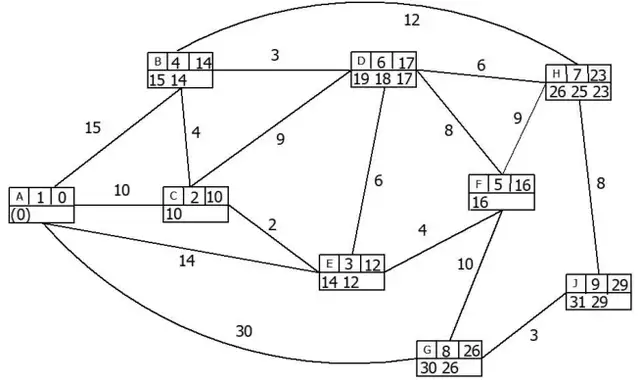 | M1 A1 (ACEB) A1 (FDH) A1ft (GJ) | 1.1b 1.1b 1.1b 1.1b |
| Quickest path A to J is A C E F G J | A1 | 2.2a |
| (ii) Shortest time is 29 (minutes) | A1ft | 1.1b |
| (6) |
Notes
In (b) all values at each node must be checked carefully, so the order of working values must be correct for the corresponding A marks to be awarded.
Order of labelling must also be checked carefully.
Order of labelling must be in a strictly increasing sequence. Errors in the final values and working values are penalised before errors in the order of labelling.
bi1M1: A larger working value replaced by a smaller value for at least two distinct vertices, B, D, E, G, H or J.
bi1A1: All values at A, C, E and B correct and working values in the correct order.
bi2A1: All values at F, D and H correct and working values in the correct order.
bi3A1ft: All values at G and J correct on follow through and working values in the correct order.
bi4A1: Correct path.
bii1A1ft: If their answer is not 29 then follow through their final value at J.
| Scheme | Marks | AO |
|---|---|---|
| (i) A(CB)D + E(F)G = 17 + 14 = 31 | M1 | 3.1b |
| A(C)E + D(HJ)G = 12 + 17 = 29 * | A1 | 1.1b |
| A(CEF)G + DE = 26 + 6 = 32 | A1 | 1.1b |
| Repeat AC, CE, DH, HJ, JG | A1 | 2.2a |
| (ii) Journey time = 153 – 14 + “29” = 168 (minutes) | A1ft | 2.2a |
| (5) |
Notes
ci1M1: Three distinct pairings of A, D, E and G.
ci1A1: Any two rows correct including pairings and totals.
ci2A1: All three rows correct including pairings and totals.
ci3A1: CAO Five correct arcs clearly stated. Must be AC, CE, DH, HJ, JG.
cii1A1ft: CAO ft their “29”, but must be their smallest from a choice of three totals.
| Scheme | Marks | AO |
|---|---|---|
| (i) Start at G | B1 | 2.2a |
| (ii) 23 (minutes) | B1 | 2.2a |
| (2) | ||
| (14 marks) |
Notes
diB1: CAO
diiB1: CAO (Repeat DE = 6 only, so save 29-6 = 23 minutes). No ft.