
A2 October 2020 Q6
6.
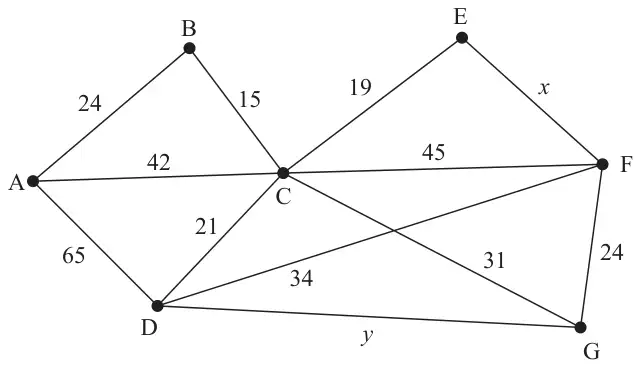
[The total weight of the network is \(320 + x + y\)]
The weights on the arcs in Figure 4 represent distances. The weight on arc EF is \(x\) where \(12 \lt x \lt 26\) and the weight on arc DG is \(y\) where \(0 \lt y \lt 10\)
An inspection route of minimum length that traverses each arc at least once is found. The inspection route starts and finishes at A and has a length of 409
It is also given that the length of the shortest route from F to G via A is 140
| Scheme | Marks | AO |
|---|---|---|
| The graph has exactly two odd nodes and so the graph is semi-Eulerian | B1 dB1 | 2.4 2.2a |
| (2) |
Notes
(a) B1: Explanation which consists of the graph having two odd nodes or stating graph is semi-Eulerian
dB1: Exactly two odd nodes (or two odd nodes and five even nodes or the rest even) together with the deduction that therefore the graph is semi-Eulerian
| Scheme | Marks | AO |
|---|---|---|
 | M1 A1 A1 A1 | 1.1b 1.1b 1.1b 1.1b |
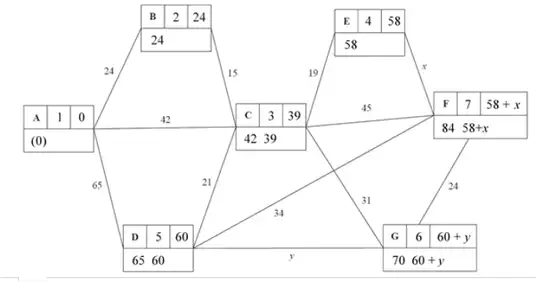
| Shortest path from A to F is \(58 + x\) and shortest path from A to G is \(60 + y\) | A1ft | 2.2a |
| \(58 + x + 60 + y = 140\) | M1 | 2.1 |
| The only odd nodes in the network are A and G | B1 | 2.2a |
| Route inspection algorithm: Shortest route between A and G is \(60 + y\) \(\Rightarrow\ 320 + x + y + 60 + y = 409\) | M1 | 3.1b |
| \(x = 15\) and \(y = 7\) | A1 | 2.2a |
| (9) | ||
| (11 marks) |
Notes
Corrected from the printed mark scheme: in the printed diagram arc BC is labelled 13 and there is a stray label “58 + x” between A and D. Arc BC is 15 (as in Figure 4, and the working value 39 at C = 24 + 15), and the stray label is not part of the working, so both have been corrected in the diagram above.
(b) M1: For a larger number replaced by a smaller one in two working value boxes at C, D, G or F
A1: For all values correct (and in correct order) at A, B and C
A1: For all values correct (and in correct order) at E and D
A1: For all values correct (and in correct order) at G and F
A1ft: Length of shortest path from A to F or A to G stated (may be seen in an equation(s))
M1: (length of shortest path from A to F) + (length of shortest path from A to G) = 140 – linear equation in \(x\) and \(y\)
B1: Correctly stating the two odd nodes (A and G) – could be implied by subsequent working
M1: For an equation based on the route from A to G (\(320 + x + y\) + final value at G (in \(y\)) = 409)
A1: CAO for \(x\) and \(y\)