
A2 June 2019 Q3
3.
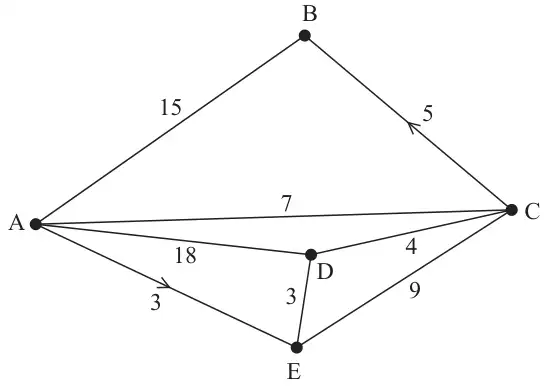
The network in Figure 2 shows the direct roads linking five villages, A, B, C, D and E. The number on each arc represents the length, in miles, of the corresponding road. The roads from A to E and from C to B are one-way, as indicated by the arrows.
Initial distance table (answer book)
| A | B | C | D | E | |
|---|---|---|---|---|---|
| A | |||||
| B | |||||
| C | |||||
| D | |||||
| E |
Initial route table (answer book)
| A | B | C | D | E | |
|---|---|---|---|---|---|
| A | |||||
| B | |||||
| C | |||||
| D | |||||
| E |
After five iterations of Floyd’s algorithm the final distance table and partially completed final route table are shown below.
Distance table
| A | B | C | D | E | |
|---|---|---|---|---|---|
| A | – | 12 | 7 | 6 | 3 |
| B | 15 | – | 22 | 21 | 18 |
| C | 7 | 5 | – | 4 | 7 |
| D | 11 | 9 | 4 | – | 3 |
| E | 14 | 12 | 7 | 3 | – |
Route table
| A | B | C | D | E | |
|---|---|---|---|---|---|
| A | A | ||||
| B | A | B | |||
| C | A | B | C | ||
| D | C | C | C | D | |
| E | D | D | D | D | E |
Mabintou decides to use the distance table to try to find the shortest cycle that passes through each vertex. Starting at D, she applies the nearest neighbour algorithm to the final distance table.
| Scheme | Marks | AO | ||||||||||||||||||||||||||||||||||||||||||||||||||||||||||||||||||||||||
|---|---|---|---|---|---|---|---|---|---|---|---|---|---|---|---|---|---|---|---|---|---|---|---|---|---|---|---|---|---|---|---|---|---|---|---|---|---|---|---|---|---|---|---|---|---|---|---|---|---|---|---|---|---|---|---|---|---|---|---|---|---|---|---|---|---|---|---|---|---|---|---|---|---|---|
Distance table
Route table
| B1 B1 | 1.1b 1.1b | ||||||||||||||||||||||||||||||||||||||||||||||||||||||||||||||||||||||||
| (2) |
Notes
IN THE DISTANCE AND ROUTE TABLE FOR PARTS (a) and (b) IGNORE WHATEVER IS WRITTEN IN THE LEAD DIAGONAL (TOP LEFT TO BOTTOM RIGHT)
(a) B1: Correct distance table (condone dashes, crosses, etc. for infinity but do not condone a ‘large’ number in these cells)
B1: Correct route table
| Scheme | Marks | AO | ||||||||||||||||||||||||||||||||||||||||||||||||||||||||||||||||||||||||
|---|---|---|---|---|---|---|---|---|---|---|---|---|---|---|---|---|---|---|---|---|---|---|---|---|---|---|---|---|---|---|---|---|---|---|---|---|---|---|---|---|---|---|---|---|---|---|---|---|---|---|---|---|---|---|---|---|---|---|---|---|---|---|---|---|---|---|---|---|---|---|---|---|---|---|
| 1st iteration: Distance table
Route table
| M1 A1 | 1.1b 1.1b | ||||||||||||||||||||||||||||||||||||||||||||||||||||||||||||||||||||||||
| 2nd iteration: Distance table
Route table
| A1ft | 1.1b | ||||||||||||||||||||||||||||||||||||||||||||||||||||||||||||||||||||||||
| 3rd iteration (SEE NOTES FOR VALID ALTERNATIVE): Distance table
Route table
| M1 A1 | 1.1b 1.1b | ||||||||||||||||||||||||||||||||||||||||||||||||||||||||||||||||||||||||
| (5) |
Notes
IN THE DISTANCE AND ROUTE TABLE FOR PARTS (a) and (b) IGNORE WHATEVER IS WRITTEN IN THE LEAD DIAGONAL (TOP LEFT TO BOTTOM RIGHT)
(b) M1: No change in the first row and first column of both tables with at least two values in the distance table correctly reduced and two letters in the route table correctly changed – all cells complete
A1: CAO (condone dashes, etc. in cells EA and EB)
A1ft: No change from candidate’s first iteration to second iteration for either table or ft from candidate’s first iteration
M1: No change in the third row and third column of both tables with at least two values in the distance table correctly reduced from their second iteration and two values in the route table correctly changed
A1: CAO for third iteration (note that the entry in row B column D for the route table could be an A)
| Scheme | Marks | AO |
|---|---|---|
| (i) Start at E(5th row) and read across to the A (1st column), there is a D there so the route from E to A is via D | B1 | 2.4 |
| Now consider both E to D and D to A – for E reading across to the D (4th column), there is a D indicating that the shortest path from E to D is ED. For D reading across to the A (1st column), there is a C indicating that the shortest path from D to A is via C | dB1 | 2.4 |
| (ii) EDCA | B1 | 2.2a |
| (3) |
Notes
(c) B1: Row E column A is D so the route is E to A via D (or implies that the order of the nodes in the route is EDA) or D implied from general argument or Row E column A is D therefore the route begins ED (in all cases must clearly imply row E and column A)
dB1: Row D column A is C therefore the route goes via C (before A) or complete general argument that allows the route from D to A to be found or allow those who say that row D column A is C so the route is EDC and then row C column A is A
B1: CAO (EDCA)
| Scheme | Marks | AO |
|---|---|---|
| (i) NNA: D – E – C – B – A – D | B1 | 1.1b |
| (ii) 3 + 7 + 5 + 15 + 6 = 36 miles | B1 | 1.1b |
| (iii) D – E – D – C – B – A – E – D | B1 | 3.2a |
| (iv) e.g. the cycle A – E – D – C – B – A has a length of 30 miles \(\lt\) 36 miles so Mabintou’s route is not optimal | B1 | 2.4 |
| (4) | ||
| (14 marks) |
Notes
(d)(i) B1: CAO (D – E – C – B – A – D)
(ii) B1: CAO (36 – no units required)
(iii) B1: CAO (D – E – D – C – B – A – E – D) or mentions that the cycle would visit E twice and D three times (or visit D before the end of the cycle – if D visited once stated and it is not clear that this isn’t the start or finish then B0) or mention of E to C via D and A to D via E
(iv) B1: A correct cycle stated (e.g. a cyclic permutation of A – E – D – C – B – A) with corresponding correct length – dependent on second B mark in this part (so must have had 36 in (d)(ii))