
D2 June 2009 Q2
The table below shows the distances, in km, between six data collection points, A, B, C, D, E, and F.
| A | B | C | D | E | F | |
|---|---|---|---|---|---|---|
| A | - | 77 | 34 | 56 | 67 | 21 |
| B | 77 | - | 58 | 58 | 36 | 74 |
| C | 34 | 58 | - | 73 | 70 | 42 |
| D | 56 | 58 | 73 | - | 68 | 38 |
| E | 67 | 36 | 70 | 68 | - | 71 |
| F | 21 | 74 | 42 | 38 | 71 | - |
Rachel must visit each collection point. She will start and finish at A and wishes to minimise the total distance travelled.
Starting at B, a second upper bound of 293 km was found.
By deleting A, a lower bound was found to be 245 km.
| Scheme | Marks |
|---|---|
| In the classical problem each vertex must be visited only once. In the practical problem each vertex must be visited at least once. | B2, 1, 0 |
| (2) |
Notes
1B1: Generous, on the right lines bod gets B1
2B1: cao, clear answer.
| Scheme | Marks |
|---|---|
| A F D B E C A {1 4 6 3 5 2} | M1 A1 |
| \(21 + 38 + 58 + 36 + 70 + 34 = 257\) | A1 |
| (3) |
Notes
1M1: Nearest Neighbour each vertex visited once (condone lack of return to start)
1A1: Correct route cao – must return to start.
2A1: 257 cao
| Scheme | Marks |
|---|---|
| 257 is the better upper bound, it is lower. | B1ft |
| (1) |
Notes
1B1ft: ft their lowest.
| Scheme | Marks |
|---|---|
R.M.S.T.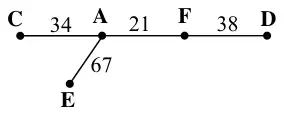 | M1 A1 |
| Lower bound is \(160 + 36 + 58 = 254\) | M1 A1 |
| (4) |
Notes
1M1: Finding correct RMST (maybe implicit) 160 sufficient
1A1: cao tree or 160.
2M1: Adding 2 least arcs to B, 36 and 58 only
2A1: 254
| Scheme | Marks |
|---|---|
| Better lower bound is 254, it is higher | B1ft |
| (1) |
Notes
1B1ft: ft their highest
| Scheme | Marks |
|---|---|
| \(254 \lt \text{optimal} \leqslant 257\) | B1 |
| (1) | |
| (12 marks) |
Notes
1B1: cao
(The printed scheme shows the marks for (e) and (f) together as (2).)