
D2 June 2014 (R) Q2
2.
| A | B | C | D | E | F | |
|---|---|---|---|---|---|---|
| A | – | 65 | 48 | 15 | 30 | 40 |
| B | 65 | – | 50 | 51 | 35 | 26 |
| C | 48 | 50 | – | 37 | 20 | 34 |
| D | 15 | 51 | 37 | – | 17 | 25 |
| E | 30 | 35 | 20 | 17 | – | 14 |
| F | 40 | 26 | 34 | 25 | 14 | – |
The table above shows the least distances, in km, between six towns, A, B, C, D, E and F. Keith needs to visit each town, starting and finishing at A, and wishes to minimise the total distance he will travel.
| Scheme | Marks |
|---|---|
| In the practical problem each vertex must be visited at least once. In the classical problem each vertex must be visited just once. | B2, 1, 0 |
| (2) |
Notes
a1B1: Understands the difference is connected to the number of times each vertex may be visited.
a2DB1: Correctly identifies which is classical and which is practical and correctly states the difference.
| Scheme | Marks |
|---|---|
| A D E F B C A 15 + 17 + 14 + 26 + 50 + 48 = 170 | M1 A1 A1 |
| (3) |
Notes
b1M1: Nearest neighbour A – D – E – F – B – C – or accept 145623 across top of table (condone lack of return to start).
b1A1: Route correctly stated, must return to A, accept link back to A.
b2A1: Length correctly stated. Do not ISW if candidates then go on to double the route length.
| Scheme | Marks |
|---|---|
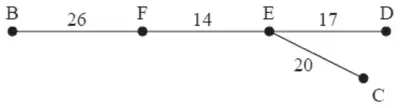 | |
| RMST weight = 26 + 14 + 17 + 20 = 77 (km) | M1 A1 |
| Lower bound = 77 + 15 + 30 = 122 (km) | A1 |
| (3) |
Notes
c1M1: Finding RST (maybe implicit) and using the correct two least lengths. Their RST must have only four arcs of which none are incident to A.
c1A1: RMST correct or list of arcs or 77 or 26 + 14 + 17 + 20 seen.
c2A1: CAO 122
| Scheme | Marks |
|---|---|
| 122 \(\leqslant\) length \(\leqslant\) 170 | B2,1,0 |
| (2) | |
| 10 marks |
Notes
d1B1ft: Their correct numbers correctly used (their upper bound must be a cycle and their lower bound must have scored M1 in (c)), accept any inequalities or any indication of interval from their 122 to their 170.
d2B2: CAO including correct inequalities (but condone 122 < length \(\leqslant\) 170).