Past Paper Questions by Topic › Higher (SQA) › Integration
Integration Topic Straight Line (11) Functions & Graphs (17) Exponentials & Logarithms (18) Polynomials (6) Quadratics (11) Recurrence Relations (3) Trig Formulae & Equations (12) Wave Function (5) Circles (11) Vectors (8) Differentiation (21) Integration (17) More questions on this topic: AS Pure: Integration (144)
Your progress
0 of 17 done
What do the colours mean? Save code Ticks are kept only in this browser : clearing your browsing data or changing device loses them. Get a free save code · I have a code · Keep them in this browser only
All specs Current spec All series May 2026 May 2025 May 2024 May 2023 May 2022 Any marks 1 to 4 marks 5 to 8 marks 9+ marks
Questions Step through List
‹ Previous All questions Next ›
10. Find \(\displaystyle\int_{\frac{\pi}{6}}^{\frac{\pi}{3}}6\sin\left(3x-\frac{\pi}{2}\right)dx\). [4]
Marking instructions
Marking instructions Mark Generic scheme Illustrative scheme •1 start to integrate \(-6\cos\left(3x-\dfrac{\pi}{2}\right)\) •2 complete integration \(\ldots\times\dfrac{1}{3}\) •3 substitute limits \(\left(-2\cos\left(3\times\dfrac{\pi}{3}-\dfrac{\pi}{2}\right)\right)-\left(-2\cos\left(3\times\dfrac{\pi}{6}-\dfrac{\pi}{2}\right)\right)\) •4 evaluate integral \(2\) (4)
Notes:
Award •1 for the appearance of \(-6\cos\left(3x-\dfrac{\pi}{2}\right)\) regardless of any constant multiplier. For candidates who differentiate throughout, make no attempt to integrate, or use another invalid approach – for example \(\cos\left(3x-\dfrac{\pi}{2}\right)^2\) or \(6\displaystyle\int\sin3x-\sin\dfrac{\pi}{2}\,dx\) – award 0/4. For candidates who write \(6-\cos(\ldots\), no further marks are available unless the lack of brackets is corrected on the next line of working. Do not penalise the inclusion of ‘\(+c\)’ at •2 or •3 . Do not penalise the continued appearance of the integral sign or ‘\(dx\)’ after integrating. Accept \(\left(-2\cos\left(\dfrac{\pi}{2}\right)\right)-\left(-2\cos(0)\right)\) or \(\left(-2\cos(3\times60-90)\right)-\left(-2\cos(3\times30-90)\right)\) for •3 . •4 is only available where candidates have considered both limits within a trigonometric function. Where candidates use a mixture of degrees and radians, for example, \(\left(-2\cos\left(3\times60^\circ-\dfrac{\pi}{2}\right)\right)-\left(-2\cos\left(3\times30^\circ-\dfrac{\pi}{2}\right)\right)\), •3 is not awarded. However, •4 is still available. Commonly Observed Responses:
Candidate A - incomplete integration
\(-6\cos\left(3x-\dfrac{\pi}{2}\right)\) •1 ✓ •2 ^ \(\left(-6\cos\left(3\times\dfrac{\pi}{3}-\dfrac{\pi}{2}\right)\right)-\left(-6\cos\left(3\times\dfrac{\pi}{6}-\dfrac{\pi}{2}\right)\right)\) •3 ✓1 \(6\) •4 ✓1
Candidate B - integrating over two lines
\(\displaystyle\int6\sin\left(3x-\dfrac{\pi}{2}\right)dx\) \(=-6\cos\left(3x-\dfrac{\pi}{2}\right)\) •1 ✓ \(=-6\cos\left(3x-\dfrac{\pi}{2}\right)\times\dfrac{1}{3}\) •2 ✗
•3 and •4 are available
Candidate C - integrated in part
\(6\cos\left(3x-\dfrac{\pi}{2}\right)\times\dfrac{1}{3}\) •1 ✗ •2 ✓1
•3 and •4 are available
Candidate D - integrated in part
\(-6\cos\left(3x-\dfrac{\pi}{2}\right)\times3\) •1 ✓ •2 ✗
•3 and •4 are available
Candidate E - insufficient evidence of integration
\(6\cos\left(3x-\dfrac{\pi}{2}\right)\) •1 ✗ •2 ^
•3 and •4 are not available
Candidate F - invalid approach
\(\pm6\sin\left(3x-\dfrac{\pi}{2}\right)\times\dfrac{1}{3}\) •1 ✗ •2 ✗
•3 and •4 are not available
Candidate G - working in degrees before integrating
\(\displaystyle\int_{30}^{60}6\sin(3x-90)\,dx\) \(-6\cos(3x-90)\times\dfrac{1}{3}\) •1 ✗ •2 ✗ \(\left(-2\cos(90)\right)-\left(-2\cos(0)\right)\) •3 ✓1 \(2\) •4 ✓1
Candidate H - BEWARE
\(-6\cos\left(3x-\dfrac{\pi}{2}\right)\times\dfrac{1}{3}\) •1 ✓ •2 ✓ \(\left(-2\cos\left(3\times\dfrac{\pi}{3}-\dfrac{\pi}{2}\right)\right)-\left(-2\cos\left(3\times\dfrac{\pi}{6}-\dfrac{\pi}{2}\right)\right)\) •3 ✓ \(\left(-2\cos\left(\dfrac{\pi}{2}\right)\right)-\left(-2\cos\quad\right)\) •4 ✗ \(2\)
[Annotation in the marking instructions: a dashed box around the second “cos ( )”, which has no angle in it]
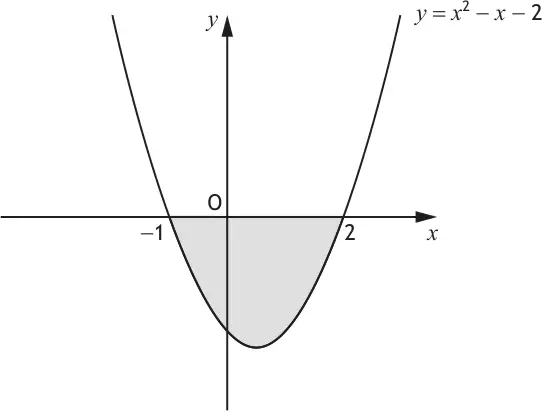
7. The diagram shows the curve with equation \(y=x^2-x-2\).
Calculate the shaded area. [4]
Marking instructions
Marking instructions Mark Generic scheme Illustrative scheme Method 1 Method 1 •1 state integral which represents the area eg \(-\displaystyle\int_{-1}^{2}\left(x^2-x-2\right)dx\)OR •2 integrate valid expression eg \(-\dfrac{x^3}{3}+\dfrac{x^2}{2}+2x\) •3 substitute limits \(\left(-\dfrac{(2)^3}{3}+\dfrac{(2)^2}{2}+2(2)\right)-\left(-\dfrac{(-1)^3}{3}+\dfrac{(-1)^2}{2}+2(-1)\right)\) •4 evaluate area \(\dfrac{9}{2}\left(\text{units}^2\right)\) Method 2 Method 2 •1 state integral which is related to the area eg \(\displaystyle\int_{-1}^{2}\left(x^2-x-2\right)dx\) •2 integrate valid expression eg \(\dfrac{x^3}{3}-\dfrac{x^2}{2}-2x\) •3 substitute limits \(\left(\dfrac{2^3}{3}-\dfrac{2^2}{2}-2(2)\right)-\left(\dfrac{(-1)^3}{3}-\dfrac{(-1)^2}{2}-2(-1)\right)\) •4 evaluate integral and state area \(-\dfrac{9}{2}\ \therefore\) area \(=\dfrac{9}{2}\left(\text{units}^2\right)\) (4)
Notes:
•1 is not available to candidates who omit ‘\(dx\)’. Limits must appear at the •1 stage for •1 to be awarded. In Method 1, accept \(\displaystyle\int_{-1}^{2}(0)-\left(x^2-x-2\right)dx\) OR \(\displaystyle\int_{2}^{-1}\left(x^2-x-2\right)dx\) for •1 . Where candidates differentiate one or more terms at •2 , then •3 and •4 are unavailable. Candidates who substitute limits without integrating do not gain •3 and •4 . Do not penalise the inclusion of ‘\(+c\)’ at •2 and •3 . Do not penalise the continued appearance of the integral sign or ‘\(dx\)’ after •1 . In Method 2, where a candidate’s integral leads to a positive value, •4 is not available. Commonly Observed Responses:
Candidate A - missing working
\(-\displaystyle\int_{-1}^{2}\left(x^2-x-2\right)\) •1 ^ \(=-\dfrac{x^3}{3}+\dfrac{x^2}{2}+2x\) •2 ✓ •3 ^ \(=\dfrac{9}{2}\) •4 ✓
Candidate B - evidence of substitution using a calculator
•1 ^ \(=-\dfrac{x^3}{3}+\dfrac{x^2}{2}+2x\) •2 ✓ \(=\dfrac{10}{3}-\left(-\dfrac{7}{6}\right)\) •3 ✓ \(=\dfrac{9}{2}\) •4 ✓
Candidate C - communication in Method 2
\(\vdots\) •4 ✓ \(=-\dfrac{9}{2}\) but area can’t be negative •4 ✓ \(=-\dfrac{9}{2}\) •4 ✓
Candidate D - communication in Method 2
\(\vdots\) •4 ✗ \(=-\dfrac{9}{2}\) but area can’t be negative •4 ✗ \(=-\dfrac{9}{2}\) •4 ✗
Candidate E - limits not stated initially
•1 ^ \(=-\dfrac{x^3}{3}+\dfrac{x^2}{2}+2x\) •2 ✓ \(=\left(-\dfrac{(2)^3}{3}+\dfrac{(2)^2}{2}+2(2)\right)\) •3 ✓ \(=\dfrac{9}{2}\) •4 ✓
Corrected by Westie's Workshop The board's marking instructions printed “\(=-\dfrac{x^3}{3}+\dfrac{x^2}{2}-2x\)”. Changed to “\(=-\dfrac{x^3}{3}+\dfrac{x^2}{2}+2x\)” because in Candidate A: the integral of \(-x^2+x+2\) is \(-\dfrac{x^3}{3}+\dfrac{x^2}{2}+2x\) (as in the illustrative scheme), and only \(+2x\) gives the answer \(\dfrac{9}{2}\). The board's marking instructions printed “\(=-\dfrac{x^3}{3}+\dfrac{x^2}{2}-2x\)”. Changed to “\(=-\dfrac{x^3}{3}+\dfrac{x^2}{2}+2x\)” because in Candidate B: the integral of \(-x^2+x+2\) is \(-\dfrac{x^3}{3}+\dfrac{x^2}{2}+2x\) (as in the illustrative scheme), and only \(+2x\) gives the answer \(\dfrac{9}{2}\). The board's marking instructions printed “\(=-\dfrac{x^3}{3}+\dfrac{x^2}{2}-2x\)”. Changed to “\(=-\dfrac{x^3}{3}+\dfrac{x^2}{2}+2x\)” because in Candidate E: the integral of \(-x^2+x+2\) is \(-\dfrac{x^3}{3}+\dfrac{x^2}{2}+2x\) (as in the illustrative scheme), and only \(+2x\) gives the answer \(\dfrac{9}{2}\). Original: see the board's marking instructions PDF (link above).
2. Find \(\displaystyle\int\left(15x^{\frac{2}{3}}+\frac{7}{x^2}\right)dx,\ x\gt0\). [4]
Marking instructions
Marking instructions Mark Generic scheme Illustrative scheme •1 express second term in integrable form \(\ldots+7x^{-2}\) •2 integrate first term \(\dfrac{15x^{\frac{5}{3}}}{\frac{5}{3}}\) •3 integrate second term \(+\dfrac{7x^{-1}}{-1}\) •4 complete integration \(9x^{\frac{5}{3}}-7x^{-1}+c\) (4)
Notes:
•1 may be implied by the appearance of \(-\dfrac{7x^{-1}}{1}\) or \(-\dfrac{7}{x}\). Do not penalise the appearance of ‘\(+c\)’, missing integral signs or missing ‘\(dx\)’ at •1 . •3 is only available for integrating a term with a negative power. Do not penalise the appearance of an integral sign and/or \(dx\) throughout. Do not penalise the omission of ‘\(+c\)’ at •2 or •3 . All coefficients must be simplified at •4 stage for •4 to be awarded. •4 is only available for attempting to integrate both terms. Accept \(9x^{\frac{5}{3}}+\dfrac{7}{-x}+c\) for •4 . However, do not accept \(9x^{\frac{5}{3}}+\dfrac{7}{-1x}+c\) or \(9x^{\frac{5}{3}}+-\dfrac{7}{x}+c\) for •4 . Commonly Observed Responses:
Candidate A - Integrating over two lines
\(\dfrac{15x^{\frac{5}{3}}}{\frac{5}{3}}+7x^{-2}\) •1 ✓ \(\dfrac{15x^{\frac{5}{3}}}{\frac{5}{3}}+\dfrac{7x^{-1}}{-1}\) •2 ✗ •3 ✓ \(9x^{\frac{5}{3}}-7x^{-1}+c\) •4 ✓1
Candidate B - error in integration
\(\displaystyle\int\left(15x^{\frac{2}{3}}+7x^{-2}\right)dx\) •1 ✓ \(\dfrac{15x^{\frac{5}{3}}}{\frac{5}{3}}+\dfrac{7x^{-3}}{-3}\) •2 ✓ •3 ✗ \(9x^{\frac{5}{3}}-\dfrac{7}{3}x^{-3}+c\) •4 ✓1
Candidate C - +c appears on a fully simplified line of working
\(9x^{\frac{5}{3}}-7x^{-1}\) •2 ✓ •3 ✓ \(9\sqrt[3]{x^5}-\dfrac{7}{x}+c\) •4 ✓
Candidate D - simplification never fully correct
\(\dfrac{15x^{\frac{5}{3}}}{\frac{5}{3}}+\dfrac{7x^{-1}}{-1}\) •2 ✓ •3 ✓ \(9x^{\frac{5}{3}}+\dfrac{7x^{-1}}{-1}+c\) \(9\sqrt[5]{x^3}-\dfrac{7}{x}+c\) •4 ✗
[Annotation in the marking instructions: dashed boxes around \(\dfrac{7x^{-1}}{-1}\) on the second line and around \(9\sqrt[5]{x^3}\) on the third line]
Candidate E - +c not present on a fully simplified line of working
\(\dfrac{15x^{\frac{5}{3}}}{\frac{5}{3}}+\dfrac{7x^{-1}}{-1}+c\) •2 ✓ •3 ✓ \(9x^{\frac{5}{3}}-7x^{-1}\) •4 ^
12. Given that:
\(\dfrac{dy}{dx}=6\cos x+8\sin 2x\), and \(y=4\) when \(x=\dfrac{\pi}{6}\), express \(y\) in terms of \(x\). [4]
Marking instructions
Marking instructions Mark Generic scheme Illustrative scheme •1 integrate one term \(6\sin x\ldots\) or \(\ldots-\dfrac{8}{2}\cos 2x\) •2 complete integration \(6\sin x-\dfrac{8}{2}\cos 2x+c\) •3 substitute for \(x\) and \(y\) \(4=6\sin\dfrac{\pi}{6}-\dfrac{8}{2}\cos\left(2\times\dfrac{\pi}{6}\right)+c\) •4 state equation \(y=6\sin x-4\cos 2x+3\) stated explicitly (4)
Notes:
Where candidates omit \(+c\), only •1 is available. Where candidates differentiate either term, •3 and •4 are not available. Where candidates substitute into the original expression, •3 and •4 are not available. Where candidates use an invalid approach, for example \(6\cos x^2\), •3 and •4 are unavailable. Do not penalise the appearance of an integral sign and/or ‘\(dx\)’ at •1 , •2 or •3 . Do not penalise candidates who substitute \(30^\circ\) after integrating. •4 is only available where candidates work with a double angle after integrating. Where candidates work with an expansion of \(\cos 2x\), an explicit statement of \(y=\ldots\) must still be stated. See Candidate D. Commonly Observed Responses:
Candidate A - incomplete substitution
\(y=6\sin x-4\cos 2x+c\) •1 ✓ •2 ✓ \(y=6\sin\dfrac{\pi}{6}-4\cos\dfrac{2\pi}{6}+c\) \(c=3\) •3 ^ \(y=6\sin x-4\cos 2x+3\) •4 ✓1
Candidate B - partial integration
\(y=6\sin x+8\sin 2x+c\) •1 ✓ •2 ✗ \(4=6\sin\dfrac{\pi}{6}+8\sin\dfrac{2\pi}{6}+c\) •3 ✓1 \(c=1-4\sqrt{3}\) \(y=6\sin x+8\sin 2x+1-4\sqrt{3}\) •4 ✓1
Candidate C - integration incomplete at •2 stage
\(y=6\sin x-4\cos 2x\) •1 ✓ •2 ^ \(y=6\sin x-4\cos 2x+c\) \(4=6\sin\dfrac{\pi}{6}-4\cos\dfrac{2\pi}{6}+c\) •3 ✓1 \(y=6\sin x-4\cos 2x+3\) •4 ✓1
Candidate D - use of double angles
\(y=6\sin x-4\cos 2x+c\) •1 ✓ •2 ✓ \(y=8\sin^2 x+6\sin x-4+c\) \(4=8\sin^2\left(\dfrac{\pi}{6}\right)+6\sin\left(\dfrac{\pi}{6}\right)-4+c\) •3 ✓ \(c=3\) \(y=8\sin^2 x+6\sin x-1\) •4 ✓
All three expansions of \(\cos 2x\) are valid.
7. Find \(\displaystyle\int (3x+2)^7\,dx\). [2]
Marking instructions
Marking instructions Mark Generic scheme Illustrative scheme •1 start to integrate \(\dfrac{(3x+2)^8}{8}\) •2 complete integration \(\cdots\times\dfrac{1}{3}+c\) (2)
Notes:
Award •1 for any appearance of \(\dfrac{(3x+2)^8}{8}\) regardless of any constant multiplier. Where candidates differentiate throughout or make no attempt to integrate , award 0/2. Where candidates start to integrate individual terms within the bracket or use another invalid approach, award 0/2. Do not penalise the continued appearance of the integral sign or ‘\(dx\)’. Commonly Observed Responses:
Candidate A
\(\dfrac{(3x+2)^8}{8}+c\) •1 ✓ •2 ^
Candidate B - NOT Differentiating throughout
\(7(3x+2)^6\times\dfrac{1}{3}+c\) •1 ✗ •2 ✓1
Candidate C - ‘Integrating’ over two lines
\(\dfrac{(3x+2)^8}{8}\) •1 ✓ •2 ^ \(\dfrac{(3x+2)^8}{8}\times\dfrac{1}{3}+c\) SEEN
Candidate D - integration incomplete at •2 stage
\(\dfrac{(3x+2)^8}{8}\times\dfrac{1}{3}\) •1 ✓ •2 ^ \(\dfrac{(3x+2)^8}{8}\times\dfrac{1}{3}+c\) SEEN
Candidate E - integration by substitution
\(\displaystyle\int u^7\times\frac{1}{3}\,du\) where \(u=3x+2\) and \(du=3dx\) •1 ✓ \(\dfrac{u^8}{24}+c\) \(\dfrac{(3x+2)^8}{24}+c\) •2 ✓
However, for \(\displaystyle\int u^7\,du\) or \(\displaystyle\int u^7\,dx\) leading to \(\dfrac{(3x+2)^8}{24}+c\) award 0/2.
3. Find \(\displaystyle\int\left(\frac{12}{x^2}+x^{\frac{1}{2}}\right)dx,\ x>0\). [4]
Marking instructions
Marking instructions Mark Generic scheme Illustrative scheme •1 express first term in integrable form \(12x^{-2}\ldots\) •2 integrate first term \(\dfrac{12x^{-1}}{-1}\) •3 integrate second term \(\dfrac{x^{\frac{3}{2}}}{\frac{3}{2}}\) •4 complete integration \(-12x^{-1}+\dfrac{2}{3}x^{\frac{3}{2}}+c\) (4)
Notes:
Do not penalise the appearance of ‘\(+c\)’, missing integral signs or missing ‘\(dx\)’ at •1 . •2 is only available for integrating a term with a negative power. Do not penalise the appearance of an integral sign and/or \(dx\) throughout. Do not penalise the omission of ‘\(+c\)’ at •2 or •3 . The ‘\(+c\)’ must appear in the first line of working where coefficients of both terms are fully simplified. See Candidates C and D. All coefficients must be simplified at •4 stage for •4 to be awarded. •4 is not available within an invalid strategy, such as differentiation. Accept \(\dfrac{12}{-x}+\dfrac{2}{3}x^{\frac{3}{2}}+c\) for •4 . However, do not accept \(\dfrac{12}{-1x}+\dfrac{2}{3}x^{\frac{3}{2}}+c\). Commonly Observed Responses:
Candidate A - Integrating over two lines
\(12x^{-2}+\dfrac{x^{\frac{3}{2}}}{\frac{3}{2}}\) •1 ✓ \(\dfrac{12x^{-1}}{-1}+\dfrac{x^{\frac{3}{2}}}{\frac{3}{2}}\) •2 ✓ •3 ✗ \(-12x^{-1}+\dfrac{2x^{\frac{3}{2}}}{3}+c\) •4 ✓1
Candidate B - error in integration
\(\displaystyle\int\left(12x^{-2}+x^{\frac{1}{2}}\right)dx\) •1 ✓ \(\dfrac{12x^{-3}}{-3}+\dfrac{x^{\frac{3}{2}}}{\frac{3}{2}}+c\) •2 ✗ •3 ✓ \(-4x^{-3}+\dfrac{2}{3}x^{\frac{3}{2}}+c\) •4 ✓1
Candidate C - integration incomplete at •4 stage
\(-12x^{-1}+\dfrac{2x^{\frac{3}{2}}}{3}\) •2 ✓ •3 ✓ •4 ^ \(-\dfrac{12}{x}+\dfrac{2}{3}\sqrt{x^3}+c\)
Candidate D
\(\dfrac{12x^{-1}}{-1}+\dfrac{x^{\frac{3}{2}}}{\frac{3}{2}}\) •2 ✓ •3 ✓ \(\dfrac{12x^{-1}}{-1}+\dfrac{2x^{\frac{3}{2}}}{3}+c\) \(-\dfrac{12}{x}+\dfrac{2\sqrt[3]{x^2}}{3}+c\) •4 ✗
(In the original, red dashed boxes are drawn round \(\dfrac{12x^{-1}}{-1}\) in the second line and round \(\dfrac{2\sqrt[3]{x^2}}{3}\) in the third line.)
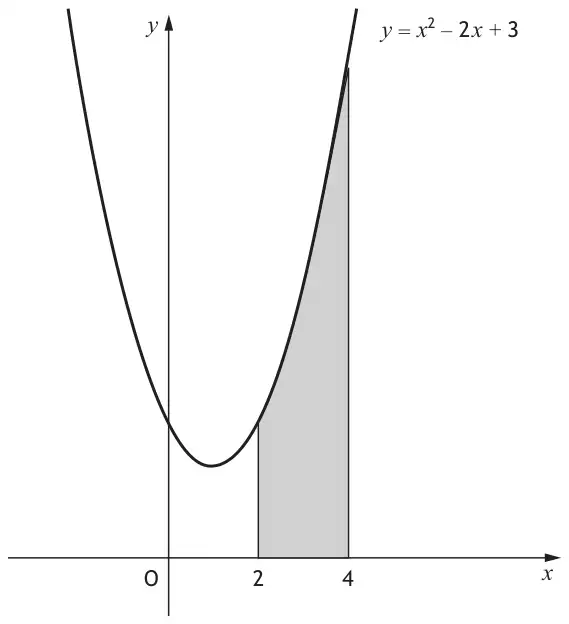
3. The diagram shows the graph of \(y=x^2-2x+3\).
Calculate the shaded area. [4]
Marking instructions
Marking instructions Mark Generic scheme Illustrative scheme •1 state appropriate definite integral \(\displaystyle\int_2^4 \left(x^2-2x+3\right)dx\) •2 integrate \(\dfrac{x^3}{3}-\dfrac{2x^2}{2}+3x\) •3 substitute limits \(\left(\dfrac{4^3}{3}-\dfrac{2(4)^2}{2}+3(4)\right)-\left(\dfrac{2^3}{3}-\dfrac{2(2)^2}{2}+3(2)\right)\) •4 calculate area \(\dfrac{38}{3}\) (4)
Notes:
•1 is not available to candidates who omit ‘\(dx\)’. Limits must appear at the •1 stage for •1 to be awarded. Where candidates differentiate one or more terms at •2 , then •3 and •4 are unavailable. Candidates who substitute limits without integrating do not gain •3 or •4 . Do not penalise the inclusion of ‘\(+c\)’ at •2 or •3 . Do not penalise the continued appearance of the integral sign or ‘\(dx\)’ after •1 . Do not penalise rounded or truncated answers with at least one decimal place. Commonly Observed Responses:
Candidate A - missing working
\(\displaystyle\int_2^4 x^2-2x+3\) •1 ^ \(=\dfrac{x^3}{3}-\dfrac{2x^2}{2}+3x\) •2 ✓ •3 ^ \(=\dfrac{38}{3}\) •4 ✓1
Candidate B - evidence of substitution using a calculator
•1 ^ \(=\dfrac{x^3}{3}-\dfrac{2x^2}{2}+3x\) •2 ✓ \(=\dfrac{52}{3}-\dfrac{14}{3}\) •3 ✓ \(=\dfrac{38}{3}\) •4 ✓
Candidate C - limits not stated at •1
•1 ^ \(=\dfrac{x^3}{3}-\dfrac{2x^2}{2}+3x\) •2 ✓ \(=\left(\dfrac{4^3}{3}-\dfrac{2(4)^2}{2}+3(4)\right)-\left(\dfrac{2^3}{3}-\dfrac{2(2)^2}{2}+3(2)\right)\) •3 ✓ \(=\dfrac{38}{3}\) •4 ✓
Candidate D - reversed limits
\(\displaystyle\int_4^2 \left(x^2-2x+3\right)dx\) … •2 ✓ •3 ✓ \(=-\dfrac{38}{3}\), hence area is \(\dfrac{38}{3}\) •1 ✓ •4 ✓ However, \(\displaystyle\int_4^2 \left(x^2-2x+3\right)dx\) … •2 ✓ •3 ✓ \(-\dfrac{38}{3}\) \(=\dfrac{38}{3}\) units2 •1 ✗ •4 ✗
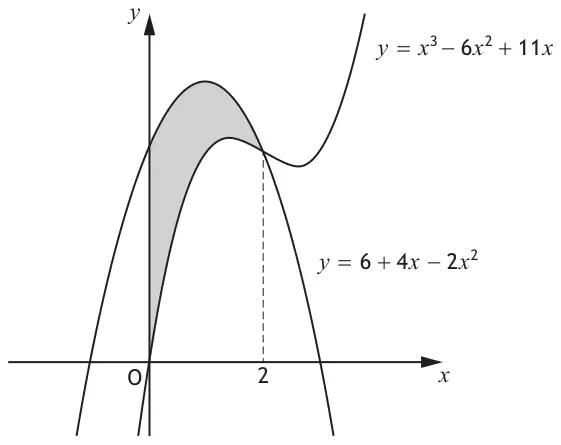
7. The diagram shows the curve with equation \(y=x^3-6x^2+11x\) intersecting the curve with equation \(y=6+4x-2x^2\) at \(x=2\).
Calculate the shaded area. [5]
Marking instructions
Marking instructions Mark Generic scheme Illustrative scheme Method 1 Method 1 •1 integrate using ‘upper’ − ‘lower’ \(\displaystyle\int\left(\left(6+4x-2x^2\right)-\left(x^3-6x^2+11x\right)\right)dx\) •2 identify limits \(\displaystyle\int_0^2\left(\left(6+4x-2x^2\right)-\left(x^3-6x^2+11x\right)\right)dx\) •3 integrate \(6x-\dfrac{7}{2}x^2+\dfrac{4}{3}x^3-\dfrac{1}{4}x^4\) •4 substitute limits \(\left(6(2)-\dfrac{7}{2}(2)^2+\dfrac{4}{3}(2)^3-\dfrac{1}{4}(2)^4\right)-0\) •5 evaluate area \(\dfrac{14}{3}\) (units2 ) Method 2 Method 2 •1 know to integrate between appropriate limits for both equations \(\displaystyle\int_0^2\ldots dx\) and \(\displaystyle\int_0^2\ldots dx\) •2 integrate both functions \(6x+\dfrac{4x^2}{2}-\dfrac{2x^3}{3}\) and \(\dfrac{x^4}{4}-\dfrac{6x^3}{3}+\dfrac{11x^2}{2}\) •3 substitute limits into both expressions \(\left(6(2)+\dfrac{4(2)^2}{2}-\dfrac{2(2)^3}{3}\right)-0\) and \(\left(\dfrac{(2)^4}{4}-\dfrac{6(2)^3}{3}+\dfrac{11(2)^2}{2}\right)-0\) •4 evaluate both integrals \(\dfrac{44}{3}\) and \(10\) •5 evidence of subtracting areas \(\dfrac{14}{3}\) (units2 ) (5)
Notes:
Correct answer with no working - award 1/5. Do not penalise lack of ‘\(dx\)’ at •1 in Method 1. In Method 1, limits and ‘\(dx\)’ must appear by the •2 stage for •2 to be awarded and in Method 2 by the •1 stage for •1 to be awarded. In Method 1, treat the absence of brackets at •1 stage as bad form only if the correct integrand is obtained. See Candidates C and D. Where a candidate differentiates one or more terms, or fails to integrate, no further marks are available. In Method 1, accept unsimplified expressions such as \(6x+\dfrac{4x^2}{2}-\dfrac{2x^3}{3}-\dfrac{x^4}{4}+\dfrac{6x^3}{3}-\dfrac{11x^2}{2}\) at •3 . Do not penalise the inclusion of ‘\(+c\)’. Do not penalise the continued appearance of the integral sign or \(dx\) after integrating. •5 is not available where solutions include statements such as ‘\(-\dfrac{14}{3}=\dfrac{14}{3}\) square units’. See Candidates A and B. In Method 1, where a candidate uses an invalid strategy the only marks available are •3 for integrating a polynomial with at least four terms (of different degree) and •4 for substituting the limits of 0 and 2 into the resulting expression. However, see Candidate E. At •4 , do not penalise candidates who reduce powers of 0. For example writing 0 in place of \(0^4\). Similarly, do not penalise candidates writing 0 in place of \(6(0)\). However, candidates who write \(0^3\) in place of \(0^4\) or \(2(0)\) in place of \(6(0)\) do not gain •4 . Commonly Observed Responses:
Candidate A - switched limits
\(\displaystyle\int_2^0\left(\left(6+4x-2x^2\right)-\left(x^3-6x^2+11x\right)\right)dx\) •2 ✓ \(=6x-\dfrac{7}{2}x^2+\dfrac{4}{3}x^3-\dfrac{1}{4}x^4\) •3 ✓ \(=0-\left(6(2)-\dfrac{7}{2}(2)^2+\dfrac{4}{3}(2)^3-\dfrac{1}{4}(2)^4\right)\) •4 ✓ \(=-\dfrac{14}{3}\) \(=\dfrac{14}{3}\) •1 ✗ •5 ✗
Candidate B - ‘lower’ - ‘upper’
\(\displaystyle\int_0^2\left(\left(x^3-6x^2+11x\right)-\left(6+4x-2x^2\right)\right)dx\) •2 ✓ \(\displaystyle\int_0^2 x^3-4x^2+7x-6\,dx\) \(=\dfrac{1}{4}x^4-\dfrac{4}{3}x^3+\dfrac{7}{2}x^2-6x\) •3 ✓ \(\left(\dfrac{1}{4}(2)^4-\dfrac{4}{3}(2)^3+\dfrac{7}{2}(2)^2-6(2)\right)-(0)\) •4 ✓ \(=-\dfrac{14}{3}\) \(\therefore\) Area \(=\dfrac{14}{3}\) •1 ✓ •5 ✓
Candidate C - missing brackets
\(\displaystyle\int_0^2 6+4x-2x^2-x^3-6x^2+11x\,dx\) \(\displaystyle\int_0^2 6-7x+4x^2-x^3\,dx\) •1 ✓ •2 ✓
Candidate D - missing brackets
\(\displaystyle\int_0^2 6+4x-2x^2-x^3-6x^2+11x\,dx\) •1 ✗ •2 ✓1 \(\displaystyle\int_0^2 6+15x-8x^2-x^3\,dx\) \(6x+\dfrac{15}{2}x^2-\dfrac{8}{3}x^3-\dfrac{1}{4}x^4\) •3 ✓1 \(\left(6(2)+\dfrac{15}{2}(2)^2-\dfrac{8}{3}(2)^3-\dfrac{1}{4}(2)^4\right)-(0)\) •4 ✓1 \(\dfrac{50}{3}\) •5 ✓1
Candidate E - ‘upper’ + ‘lower’
\(\displaystyle\int_0^2\left(\left(6+4x-2x^2\right)+\left(x^3-6x^2+11x\right)\right)dx\) •1 ✗ •2 ✓1 \(6x+\dfrac{15}{2}x^2-\dfrac{8}{3}x^3+\dfrac{1}{4}x^4\) •3 ✓1 \(\left(6(2)+\dfrac{15}{2}(2)^2-\dfrac{8}{3}(2)^3+\dfrac{1}{4}(2)^4\right)-0\) •4 ✓1 \(\dfrac{74}{3}\) •5 ✓1
Candidate F - incorrect substitution
\(\displaystyle\int_0^2\left(\left(6+4x-2x^2\right)-\left(x^3-6x^2+11x\right)\right)dx\) •1 ✓ •2 ✓ \(\left(6x+2x^2-\dfrac{2}{3}x^3\right)-\left(\dfrac{1}{4}x^4-2x^3+\dfrac{11}{2}x^2\right)\) •3 ✓ \(\left(6(2)+2(2)^2-\dfrac{2}{3}(2)^3\right)-\left(\dfrac{1}{4}(0)^4-2(0)^3+\dfrac{11}{2}(0)^2\right)\) •4 ✗ \(\dfrac{44}{3}\) •5 ✓2
Corrected by Westie's Workshop The board's marking instructions printed “candidates for who reduce powers of 0”. Changed to “candidates who reduce powers of 0” because the word “for” is a stray extra word. Original: see the board's mark scheme PDF (link above).
5. Evaluate \(\displaystyle\int_0^{\frac{\pi}{7}}\sin 5x\,dx\). [3]
Marking instructions
Marking instructions Mark Generic scheme Illustrative scheme •1 integrate \(-\dfrac{1}{5}\cos 5x\) •2 substitute limits \(\left(-\dfrac{1}{5}\cos\left(5\times\dfrac{\pi}{7}\right)\right)-\left(-\dfrac{1}{5}\cos(5\times 0)\right)\) •3 evaluate integral \(0.3246\ldots\) (3)
Notes:
For candidates who differentiate throughout, make no attempt to integrate, or use another invalid approach (for example \(\cos 5x^2\)) award 0/3. Do not penalise the inclusion of ‘\(+c\)’ or the continued appearance of the integral sign after integrating. Accept \(\left(-\dfrac{1}{5}\cos 5\left(\dfrac{\pi}{7}\right)\right)-\left(-\dfrac{1}{5}\cos 5(0)\right)\) for •2 . •3 is only available where candidates have considered both limits within a trigonometric function. Commonly Observed Responses:
Candidate A - integrated in part
\(-\cos 5x\) •1 ✗ \(-\cos\left(\dfrac{5\pi}{7}\right)-\left(-\cos(5\times 0)\right)\) •2 ✓1 \(1.623\ldots\) •3 ✓1
Candidate B - insufficient evidence of integration
\(\cos 5x\) •1 ✗ \(\cos\left(\dfrac{5\pi}{7}\right)-\left(\cos(5\times 0)\right)\) •2 ✓2 \(-1.623\) •3 ✓2
Candidate C - insufficient evidence of integration
\(\dfrac{1}{5}\sin 5x\) •1 ✗ \(\dfrac{1}{5}\sin\dfrac{5\pi}{7}-\dfrac{1}{5}\sin 0\) •2 ✓2 \(0.156\ldots\) •3 ✓2
Candidate D - working in degrees before integrating
\(\displaystyle\int_0^{25.7\ldots}\sin 5x\,dx\) •1 ✗ \(-\dfrac{1}{5}\cos 5x\) \(\left(-\dfrac{1}{5}\cos 128.57\ldots\right)-\left(-\dfrac{1}{5}\cos 0\right)\) •2 ✓1 \(0.3246\ldots\) •3 ✓1
12. A curve, for which \(\dfrac{dy}{dx}=8x^3+3\), passes through the point (−1, 3).
Express \(y\) in terms of \(x\). [4]
Marking instructions
Marking instructions Mark Generic scheme Illustrative scheme •1 integrate one term eg \(\dfrac{8x^4}{4}\ldots\) •2 complete integration eg \(\ldots+3x+c\) •3 substitute for \(x\) and \(y\) \(3=\dfrac{8\times(-1)^4}{4}+3\times(-1)+c\) •4 state expression for \(y\) \(y=2x^4+3x+4\) (4)
Notes:
For candidates who omit \(+c\) only •1 is available. For candidates who differentiate either term, •2 , •3 , and •4 are not available. Do not penalise the appearance of an integral sign and/or \(dx\) at •2 and •3 . Commonly Observed Responses:
Candidate A - incomplete substitution
\(y=2x^4+3x+c\) •1 ✓ •2 ✓ \(y=2(-1)^4+3(-1)+c\) \(c=4\) •3 ^ \(y=2x^4+3x+4\) •4 ✓1
Candidate B - partial integration
\(y=2x^4+3+c\) •1 ✓ •2 ✗ \(3=2(-1)^4+3+c\) •3 ✓1 \(c=-2\) \(y=2x^4+1\) •4 ✓1
Candidate C - integrating over two lines
\(y=2x^4+3x\) •1 ✓ •2 ✗ \(y=2x^4+3x+c\) \(3=2(-1)^4+3(-1)+c\) •3 ✓ \(y=2x^4+3x+4\) •4 ✓
11.
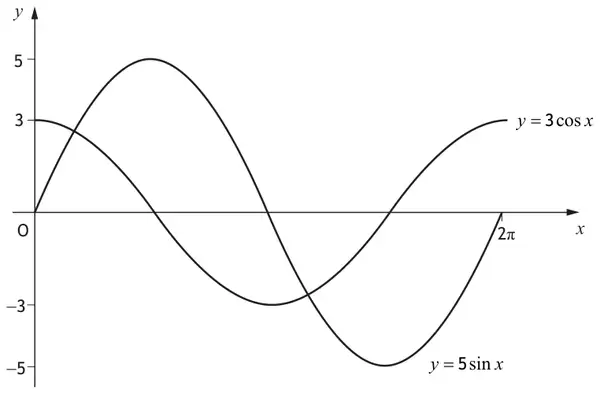
(a) Evaluate \(\displaystyle\int_{\frac{\pi}{2}}^{\pi}(5\sin x-3\cos x)\,dx\). [3]
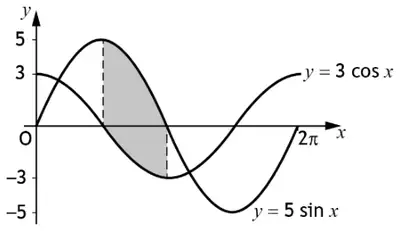
The diagram in your answer booklet (shown below) shows the graphs with equations \(y=5\sin x\) and \(y=3\cos x\), \(0\leqslant x\leqslant2\pi\).
(b) On the diagram in your answer booklet, shade the area represented by the integral in (a). [1]
Marking instructions (a) Marking instructions (b)
Marking instructions (a) Mark Generic scheme Illustrative scheme •1 integrate \(-5\cos x-3\sin x\) •2 substitute limits \([-5\cos\pi-3\sin\pi]\) •3 evaluate integral 8 (3)
Notes:
Where candidates make no attempt to integrate or use another invalid approach award 0/3 - see Candidate A. However see also Candidates B to F. Do not penalise the inclusion of ‘\(+c\)’ or the continued appearance of the integral sign. Candidates who change the limits to degrees before integrating cannot gain •1 . However, •2 and •3 are still available. •3 is only available where candidates have considered both limits within a trigonometric function. The minimum acceptable response for •2 is \(5-(-3)\). Commonly Observed Responses:
Candidate A - introducing a power
Eg \(5\sin x^2-3\cos x^2\) •1 ✗ •2 ✗ •3 ✗ \(\vdots\)
Candidate B - differentiating in full
\(5\cos x+3\sin x\) •1 ✗ \((5\cos\pi+3\sin\pi)-\left(5\cos\dfrac{\pi}{2}+3\sin\dfrac{\pi}{2}\right)\) •2 ✓2 \(-8\) •3 ✓1
Candidate C - integrating one term
\(5\cos x-3\sin x\) •1 ✗ \((5\cos\pi-3\sin\pi)-\left(5\cos\dfrac{\pi}{2}-3\sin\dfrac{\pi}{2}\right)\) •2 ✓1 \(-2\) •3 ✓1
Candidate D - integrating one term
\(-5\cos x+3\sin x\) •1 ✗ \((-5\cos\pi+3\sin\pi)-\left(-5\cos\dfrac{\pi}{2}+3\sin\dfrac{\pi}{2}\right)\) •2 ✓1 \(2\) •3 ✓1
Candidate E - integrating one term
Eg \(5\sin x-3\sin x\) •1 ✗ \((5\sin\pi-3\sin\pi)-\left(5\sin\dfrac{\pi}{2}-3\sin\dfrac{\pi}{2}\right)\) •2 ✓1 \(-2\) •3 ✓2
Mark 3 is not of equivalent difficulty - only 2 exact values
Candidate F - obtaining other expressions of the form \(a\sin x+b\cos x\)
Eg \(-\dfrac{1}{5}\cos x-\dfrac{1}{3}\sin x\) •1 ✗ \(\left(-\dfrac{1}{5}\cos\pi-\dfrac{1}{3}\sin\pi\right)-\left(-\dfrac{1}{5}\cos\dfrac{\pi}{2}-\dfrac{1}{3}\sin\dfrac{\pi}{2}\right)\) •2 ✓2 \(\dfrac{8}{15}\) •3 ✓1
Marking instructions (b) Mark Generic scheme Illustrative scheme •4 identify boundaries and shade area
(1)
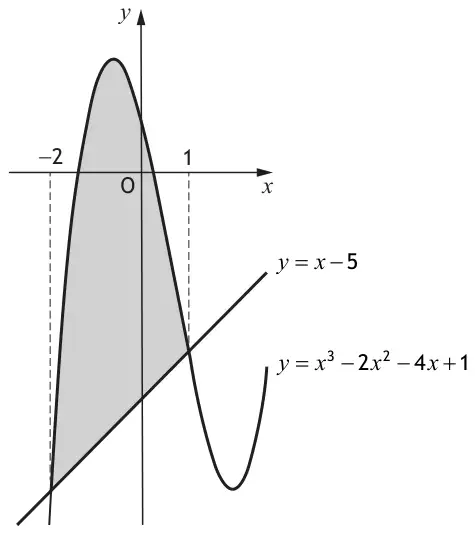
8. The diagram shows part of the curve with equation \(y=x^3-2x^2-4x+1\) and the line with equation \(y=x-5\).
The curve and the line intersect at the points where \(x=-2\) and \(x=1\).
Calculate the shaded area. [5]
Marking instructions
Marking instructions Mark Generic scheme Illustrative scheme Method 1 Method 1 •1 integrate using “upper - lower” \(\displaystyle\int\left(\left(x^3-2x^2-4x+1\right)-(x-5)\right)dx\) •2 identify limits \(\displaystyle\int_{-2}^{1}\left(\left(x^3-2x^2-4x+1\right)-(x-5)\right)dx\) •3 integrate \(\dfrac{x^4}{4}-\dfrac{2x^3}{3}-\dfrac{5x^2}{2}+6x\) •4 substitute limits \(\left(\dfrac{(1)^4}{4}-\dfrac{2(1)^3}{3}-\dfrac{5(1)^2}{2}+6(1)\right)-\) •5 calculate shaded area \(\dfrac{63}{4}\) or \(15\dfrac{3}{4}\) Method 2 Method 2 •1 know to integrate between appropriate limits for both integrals \(\displaystyle\int_{-2}^{1}\ldots dx\) and \(\displaystyle\int_{-2}^{1}\ldots dx\) •2 integrate both functions \(\dfrac{x^4}{4}-\dfrac{2x^3}{3}-\dfrac{4x^2}{2}+x\) and \(\dfrac{x^2}{2}-5x\) •3 substitute limits into both expressions \(\left(\dfrac{(1)^4}{4}-\dfrac{2(1)^3}{3}-\dfrac{4(1)^2}{2}+(1)\right)\)and •4 evaluate both integrals \(-\dfrac{3}{4}\) and \(-\dfrac{33}{2}\) •5 evidence of subtracting areas \(-\dfrac{3}{4}-\left(-\dfrac{33}{2}\right)=\dfrac{63}{4}\) (5)
Notes:
Correct answer with no working - award 1/5. In Method 1, treat the absence of brackets at •1 stage as bad form only if the correct integral is obtained at •3 - see Candidates A and B. Do not penalise lack of ‘\(dx\)’ at •1 . Limits and ‘\(dx\)’ must appear by the •2 stage for •2 to be awarded in Method 1 and by the •1 stage for •1 to be awarded in Method 2. Where a candidate differentiates one or more terms at •3 , then •3 , •4 and •5 are unavailable. Accept unsimplified expressions at •3 e.g. \(\dfrac{x^4}{4}-\dfrac{2x^3}{3}-\dfrac{4x^2}{2}+x-\dfrac{x^2}{2}+5x\). Do not penalise the inclusion of ‘\(+c\)’. Do not penalise the continued appearance of the integral sign after •2 Candidates who substitute limits without integrating do not gain •3 , •4 or •5 . •5 is not available where solutions include statements such as ‘\(-\dfrac{63}{4}=\dfrac{63}{4}\) square units’ - see Candidate B. Where a candidate only integrates \(x^3-2x^2-4x+1\) or another cubic or quartic expression, only •3 and •4 are available (from Method 1). Commonly Observed Responses:
Candidate A - bad form corrected
\(\displaystyle\int_{-2}^{1}x^3-2x^2-4x+1-x-5\,dx\) •2 ✓ \(=\dfrac{x^4}{4}-\dfrac{2x^3}{3}-\dfrac{5x^2}{2}+6x\) •3 ✓ \(\Rightarrow\) •1 ✓
Bad form at •1 must be corrected by the integration stage and may also take the form of a missing minus sign
Candidate B
\(\displaystyle\int_{-2}^{1}x^3-2x^2-4x+1-x-5\,dx\) •1 ✗ •2 ✓ \(=\dfrac{x^4}{4}-\dfrac{2x^3}{3}-\dfrac{5x^2}{2}-4x\) •3 ✓1 \(=\left(\dfrac{(1)^4}{4}-\dfrac{2(1)^3}{3}-\dfrac{5(1)^2}{2}-4(1)\right)\) •4 ✓1 \(-\dfrac{57}{4}\) cannot be negative so \(=\dfrac{57}{4}\) •5 ✗ However, \(\displaystyle\int\ldots=-\dfrac{57}{4}\) so Area \(=\dfrac{57}{4}\) •5 ✓1
Candidate C - lower − upper
\(\displaystyle\int_{-2}^{1}\left((x-5)-\left(x^3-2x^2-4x+1\right)\right)dx\) •2 ✓ \(-\dfrac{x^4}{4}+\dfrac{2x^3}{3}+\dfrac{5x^2}{2}-6x\) •3 ✓ \(\left(-\dfrac{(1)^4}{4}+\dfrac{2(1)^3}{3}+\dfrac{5(1)^2}{2}-6(1)\right)-\) •4 ✓ \(-\dfrac{63}{4}\) So Area \(=\dfrac{63}{4}\) •1 ✓ •5 ✓
Candidate D - reversed limits
\(\displaystyle\int_{1}^{-2}\left(\left(x^3-2x^2-4x+1\right)-(x-5)\right)dx\) •1 ✓ \(\dfrac{x^4}{4}-\dfrac{2x^3}{3}-\dfrac{5x^2}{2}+6x\) •3 ✓ \(\left(\dfrac{(-2)^4}{4}-\dfrac{2(-2)^3}{3}-\dfrac{5(-2)^2}{2}+6(-2)\right)\) •4 ✓ \(-\dfrac{63}{4}\) So Area \(=\dfrac{63}{4}\) •2 ✓ •5 ✓
Candidate E - ‘upper’ − ‘lower’
\(=x^3-2x^2-5x+6\) \(\displaystyle\int_{-2}^{1}\left(x^3-2x^2-5x+6\right)dx\) •1 ✓ •2 ✓ \(\dfrac{x^4}{4}-\dfrac{2x^3}{3}-\dfrac{5x^2}{2}+6x\) •3 ✓ \(\dfrac{37}{12}-\left(-\dfrac{38}{3}\right)\) •4 ✓ \(\dfrac{63}{4}\) •5 ✓
6. Find \(\displaystyle\int\left(2x^5-6\sqrt{x}\right)dx\), \(x\geqslant0\). [4]
Marking instructions
Marking instructions Mark Generic scheme Illustrative scheme •1 express second term in integrable form \(\ldots-6x^{\frac{1}{2}}\) •2 integrate one term \(\dfrac{2}{6}x^6\ldots\) or \(\ldots-\dfrac{6x^{\frac{3}{2}}}{\frac{3}{2}}\) •3 integrate other term \(\ldots-\dfrac{6x^{\frac{3}{2}}}{\frac{3}{2}}\) or \(\dfrac{2}{6}x^6\ldots\) •4 complete integration \(\dfrac{1}{3}x^6-4x^{\frac{3}{2}}+c\) (4)
Notes:
The mark for integrating the final term is only available if candidates integrate a term with a fractional index. Do not penalise the appearance of an integral sign and/or \(dx\) throughout. Do not penalise the omission of ‘\(+c\)’ at •2 or •3 . All coefficients must be simplified at •4 stage for •4 to be awarded. Accept \(\dfrac{x^6-12x^{\frac{3}{2}}}{3}+c\) for •4 but do not accept \(\dfrac{2x^6-24x^{\frac{3}{2}}}{6}+c\). •2 , •3 and •4 are not available within an invalid strategy. Commonly Observed Responses:
Candidate A
\(\displaystyle\int\left(2x^5-6x^{\frac{1}{2}}\right)dx\) •1 ✓ \(=\dfrac{2x^6}{6}-\dfrac{6x^{\frac{3}{2}}}{\frac{3}{2}}+c\) •2 ✓ •3 ✓ \(=\dfrac{2x^6}{6}-4x^{\frac{3}{2}}+c\) \(=\dfrac{1}{3}x^6-4\sqrt{x}+c\) •4 ✗
•4 cannot be awarded over two lines of working
(In the marking instructions \(\dfrac{2x^6}{6}\) on the third line and \(4\sqrt{x}\) on the fourth line are each marked with a red dashed box.)
Candidate B - integrating over two lines
\(\dfrac{2x^6}{6}-6x^{\frac{1}{2}}\) •1 ✓ \(=\dfrac{2x^6}{6}-\dfrac{6x^{\frac{3}{2}}}{\frac{3}{2}}+c\) •2 ✓ •3 ✗ \(=\dfrac{1}{3}x^6-4x^{\frac{3}{2}}+c\) •4 ✓1
Candidate C - insufficient evidence
\(\displaystyle\int 2x^5-6x^{\frac{1}{2}}dx\) •1 ✓ \(\dfrac{1}{3}x^6-9x^{\frac{3}{2}}+c\) •2 ✓ •3 ^ •4 ✗
Candidate D
\(\vdots\) •1 ✓ \(=\dfrac{1}{3}x^6-4x^{\frac{3}{2}}\) •2 ✓ •3 ✓ \(=\dfrac{1}{3}x^6-4\sqrt{x^3}+c\) •4 ✓
3. Find \(\displaystyle\int 7\cos\left(4x+\frac{\pi}{3}\right)dx\). [2]
Marking instructions
Marking instructions Mark Generic scheme Illustrative scheme •1 start to integrate \(7\sin\left(4x+\dfrac{\pi}{3}\right)\ldots\) •2 complete integration \(\ldots\times\dfrac{1}{4}+c\) (2)
Notes:
Award •1 for any appearance of \((+)7\sin\left(4x+\dfrac{\pi}{3}\right)\) regardless of any constant multiplier. Candidates who work in degrees from the start cannot gain •1 , however •2 is still available - see Candidate C. Where candidates use any other invalid approach, eg \(7\sin\left(4x+\dfrac{\pi}{3}\right)^2\), \(\displaystyle\int\left(7\cos4x+\cos\dfrac{\pi}{3}\right)dx\) or \(7\sin4x+\dfrac{\pi}{3}\) award 0/2. However, see Candidate E. Do not penalise the appearance of an integral sign and/or \(dx\) throughout. Commonly Observed Responses:
Candidate A - using addition formula
\(\displaystyle\int\left(7\cos4x\cos\dfrac{\pi}{3}-7\sin4x\sin\dfrac{\pi}{3}\right)dx\) \(=\dfrac{7}{4}\sin4x\cos\dfrac{\pi}{3}+\dfrac{7}{4}\cos4x\sin\dfrac{\pi}{3}\ldots\) •1 ✓ \(=\dfrac{7}{4}\sin4x\left(\dfrac{1}{2}\right)+\dfrac{7}{4}\cos4x\left(\dfrac{\sqrt{3}}{2}\right)+c\) •2 ✓
Candidate B
\(\dfrac{7}{4}\sin\left(4x+\dfrac{\pi}{3}\right)\) •1 ✓ \(=\dfrac{7}{4}\sin\left(4x+\dfrac{\pi}{3}\right)+c\) •2 ✓
Candidate C - working in degrees
\(\displaystyle\int7\cos(4x+60)\,dx\) \(=7\sin(4x+60)\times\dfrac{1}{4}+c\) •1 ✗ •2 ✓1
Candidate D - integrating over two lines
\(7\sin\left(4x+\dfrac{\pi}{3}\right)\) •1 ✓ \(=\dfrac{7}{4}\sin\left(4x+\dfrac{\pi}{3}\right)+c\) •2 ✗
Candidate E - integrating in part
\(-\dfrac{7}{4}\sin\left(4x+\dfrac{\pi}{3}\right)+c\) •1 ✗ •2 ✓1
Candidate F - insufficient evidence of integration
\(\dfrac{7}{4}\cos\left(4x+\dfrac{\pi}{3}\right)+c\) •1 ✗ •2 ✗
6. Evaluate \(\displaystyle\int_{-5}^{2}(10-3x)^{-\frac{1}{2}}\,dx\). [4]
Marking instructions
Marking instructions Mark Generic scheme Illustrative scheme •1 start to integrate \(\dfrac{(10-3x)^{\frac{1}{2}}}{\frac{1}{2}}\ldots\) •2 complete integration \(\ldots\times-\dfrac{1}{3}\) •3 process limits \(-\dfrac{2}{3}(10-3(2))^{\frac{1}{2}}-\left(-\dfrac{2}{3}(10-3(-5))^{\frac{1}{2}}\right)\) •4 evaluate integral 2 (4)
Notes:
For candidates who differentiate throughout or make no attempt to integrate , award 0/4. If candidates start to integrate individual terms within the bracket or attempt to expand a bracket or use another invalid approach no further marks are available. Do not penalise the inclusion of ‘\(+c\)’ or the continued appearance of the integral sign after •1 . •3 is only available for substitution into an expression which is equivalent to the integrand obtained at •2 . The integral obtained must contain a non-integer power for •4 to be available. •4 is only available to candidates who deal with the coefficient of \(x\) at the •2 stage. See Candidate A. Commonly Observed Responses:
Candidate A
\(\dfrac{(10-3x)^{\frac{1}{2}}}{\frac{1}{2}}\) •1 ✓ •2 ^ \(2(10-3(2))^{\frac{1}{2}}-2(10-3(-5))^{\frac{1}{2}}\) •3 ✓1 \(-6\) •4 ✓2 Note 6
Candidate B - NOT differentiating throughout
\(-\dfrac{1}{2}(10-3x)^{-\frac{3}{2}}\times-\dfrac{1}{3}\) •1 ✗ •2 ✓ \(\dfrac{1}{6}(10-3(2))^{-\frac{3}{2}}-\dfrac{1}{6}(10-3(-5))^{-\frac{3}{2}}\) •3 ✓1 \(\dfrac{39}{2000}\) •4 ✓1
Candidate C
\(\dfrac{(10-3x)^{\frac{1}{2}}}{\frac{1}{2}}\times-3\) •1 ✓ •2 ✗ \(-6(10-3(2))^{\frac{1}{2}}-\left(-6(10-3(-5))^{\frac{1}{2}}\right)\) •3 ✓1 \(18\) •4 ✓1
Candidate D - integrating over two lines
\(\dfrac{(10-3x)^{\frac{1}{2}}}{\frac{1}{2}}\) \(\dfrac{(10-3x)^{\frac{1}{2}}}{\frac{1}{2}}\times-\dfrac{1}{3}\) •1 ✓ •2 ^ \(-\dfrac{2}{3}(10-3(2))^{\frac{1}{2}}-\left(-\dfrac{2}{3}(10-3(-5))^{\frac{1}{2}}\right)\) •3 ✓1 \(2\) •4 ✓1
6. A curve with equation \(y=f(x)\) is such that \(\dfrac{dy}{dx}=1-\dfrac{3}{x^2}\), where \(x>0\).
The curve passes through the point \((3,6)\).
Express \(y\) in terms of \(x\). [5]
Marking instructions
Marking instructions Mark Generic scheme Illustrative scheme •1 write in integrable form \(1-3x^{-2}\) •2 integrate one term \(x\) or \(\cdots-\dfrac{3x^{-1}}{-1}\) •3 complete integration \(\cdots-\dfrac{3x^{-1}}{-1}+c\) or \(x\ldots+c\) •4 interpret information given and substitute for \(x\) and \(y\) \(6=3+3(3)^{-1}+c\) •5 state expression for \(y\) \(y=x+3x^{-1}+2\) (5)
Notes:
For candidates who make no attempt to integrate only •1 is available. For candidates who omit \(+c\) only •1 and •2 are available. For candidates who differentiate either term, •3 , •4 , and •5 are not available. Commonly Observed Responses:
Candidate A - incomplete substitution
\(y=x+3x^{-1}+c\) •1 ✓ •2 ✓ •3 ✓ \(y=3+3(3)^{-1}+c\) \(c=-4\) •4 ^ \(y=x+3x^{-1}-4\) •5 ✓1
Candidate B - partial integration
\(y=1+3x^{-1}+c\) •1 ✓ •2 ✓ •3 ✗ \(6=1+3(3)^{-1}+c\) •4 ✓1 \(c=4\) \(y=x+3x^{-1}+4\) •5 ✓1
Candidate C - inconsistent working
\(\dfrac{dy}{dx}=1-\dfrac{3}{x^2}\) \(x-3x^{-2}\) •1 ✗ \(y=x-\dfrac{3x^{-1}}{-1}+c\) •2 ✓1 •3 ✓1
Candidate D - inconsistent working
\(\dfrac{dy}{dx}=1-\dfrac{3}{x^2}\) \(x-3x^{-2}\) •1 ✗ \(y=\dfrac{x^2}{2}-\dfrac{3x^{-1}}{-1}+c\) •2 ✓1 •3 ✓1
Candidate E3 stage
\(\dfrac{dy}{dx}=1-3x^{-2}\) •1 ✓ \(y=x-\dfrac{3x^{-1}}{-1}\) •2 ✓ •3 ✗ \(y=x+3x^{-1}+c\)
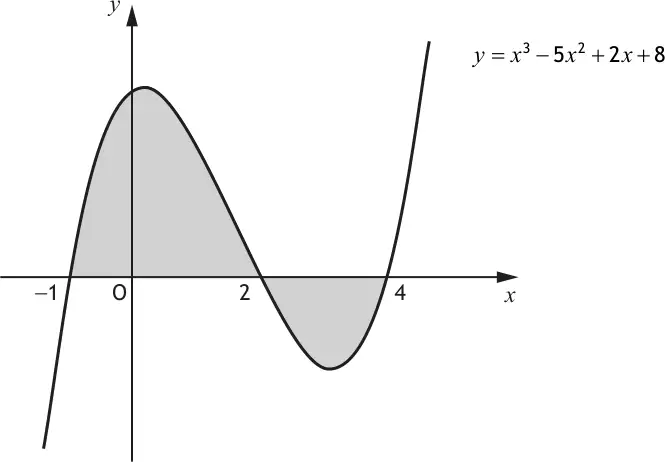
4. The graph shown has equation \(y=x^3-5x^2+2x+8\).
The total shaded area is bounded by the curve and the \(x\)-axis.
(a) Calculate the shaded area above the \(x\)-axis. [4]
(b) Hence calculate the total shaded area. [3]
Marking instructions (a) Marking instructions (b)
Marking instructions (a) Mark Generic scheme Illustrative scheme •1 state appropriate integral \(\displaystyle\int_{-1}^{2}\left(x^3-5x^2+2x+8\right)\,dx\) •2 integrate \(\dfrac{1}{4}x^4-\dfrac{5}{3}x^3+\dfrac{2x^2}{2}+8x\) •3 substitute limits \(\left(\dfrac{1}{4}(2)^4-\dfrac{5}{3}(2)^3+(2)^2+8(2)\right)\) •4 evaluate area \(\dfrac{63}{4}\) or 15.75 (4)
Notes:
Limits and ‘\(dx\)’ must appear at the •1 stage for •1 to be awarded. Where a candidate differentiates one or more terms at •2 , then •3 and •4 are not available. Candidates who substitute limits without integrating, do not gain •3 or •4 . Do not penalise the inclusion of ‘\(+c\)’. Do not penalise the continued appearance of the integral sign after •1 . •4 is not available where solutions include statements such as \(-\dfrac{63}{4}=\dfrac{63}{4}\). See Candidate C. Commonly Observed Responses:
Candidate A
\(\displaystyle\int_{-1}^{2}\left(x^3-5x^2+2x+8\right)\) •1 ✗ \(=\dfrac{1}{4}x^4-\dfrac{5}{3}x^3+\dfrac{2x^2}{2}+8x\) •2 ✓ •3 ^ \(=\dfrac{63}{4}\) •4 ✓1
Candidate B - evidence of substitution using a calculator
\(\displaystyle\int\left(x^3-5x^2+2x+8\right)\,dx\) •1 ✗ \(=\dfrac{1}{4}x^4-\dfrac{5}{3}x^3+\dfrac{2x^2}{2}+8x\) •2 ✓ \(=\dfrac{32}{3}-\left(-\dfrac{61}{12}\right)\) •3 ✓ \(=\dfrac{63}{4}\) •4 ✓
Candidate C - communication for •4
\(\displaystyle\int_{2}^{-1}\left(x^3-5x^2+2x+8\right)\,dx\) •1 ✓ … •2 ✓ •3 ✓ \(=-\dfrac{63}{4}\), hence area is \(\dfrac{63}{4}\). •4 ✓
However \(-\dfrac{63}{4}=\dfrac{63}{4}\) square units does not gain •4
Marking instructions (b) Mark Generic scheme Illustrative scheme Method 1 Method 1 •5 state appropriate integral \(\displaystyle\int_{2}^{4}\left(x^3-5x^2+2x+8\right)\,dx\) •6 evaluate integral \(-\dfrac{16}{3}\) •7 interpret result and evaluate total area \(\dfrac{253}{12}\) or \(21.083\ldots\) Method 2 Method 2 •5 state appropriate integral \(\displaystyle\int_{2}^{4}\left(0-\left(x^3-5x^2+2x+8\right)\right)dx\) •6 substitute limits \(-\left(\dfrac{1}{4}(4)^4-\dfrac{5}{3}(4)^3+(4)^2+8(4)\right)-\) •7 evaluate total area \(\dfrac{253}{12}\) or \(21.083\ldots\) (3)
Notes:
For candidates who only consider \(\displaystyle\int_{-1}^{4}\ldots dx\) or any other invalid integral, award 0/3. In part (b), at •5 do not penalise the omission of ‘\(dx\)’. In Method 1, •5 may be awarded for \(\left[\dfrac{1}{4}x^4-\dfrac{5}{3}x^3+\dfrac{2x^2}{2}+8x\right]_{2}^{4}\) or \(\left(\dfrac{1}{4}(4)^4-\dfrac{5}{3}(4)^3+(4)^2+8(4)\right)-\left(\dfrac{1}{4}(2)^4-\dfrac{5}{3}(2)^3+(2)^2+8(2)\right)\). In Method 2, •5 may be awarded for \(\left[\dfrac{1}{4}x^4-\dfrac{5}{3}x^3+\dfrac{2x^2}{2}+8x\right]_{4}^{2}\) or •5 and •6 may be awarded for \(\left(\dfrac{1}{4}(2)^4-\dfrac{5}{3}(2)^3+(2)^2+8(2)\right)-\left(\dfrac{1}{4}(4)^4-\dfrac{5}{3}(4)^3+(4)^2+8(4)\right)\). •7 is not available to candidates where solutions include statements such as \(-\dfrac{16}{3}=\dfrac{16}{3}\) square units. See Candidate D. In Method 1, where a candidate’s integral leads to a positive value, •7 is not available. Where a candidate has differentiated in both parts of the question see Candidate E. Commonly Observed Responses:
Candidate D - communication for •7
\(\displaystyle\int_{2}^{4}\left(x^3-5x^2+2x+8\right)\,dx=-\dfrac{16}{3}\) •5 ✓ •6 ✓ \(\dfrac{63}{4}+\dfrac{16}{3}=\dfrac{253}{12}\) •7 ✓
However, •7 is not available where statements such as “\(-\dfrac{16}{3}=\dfrac{16}{3}\) square units” or “ignore negative” appear.
Candidate E - differentiation in (a) and (b)
(a) \(\displaystyle\int_{-1}^{2}\left(x^3-5x^2+2x+8\right)\,dx\) •1 ✓ \(=3x^2-10x+2\) •2 ✗ \(=\left(3(2)^2-10(2)+2\right)-\left(3(-1)^2-10(-1)+2\right)\) •3 ✗ \(=-21\) •4 ✗ (b) \(\left(3(4)^2-10(4)+2\right)-\left(3(2)^2-10(2)+2\right)=16\) •5 ✓ •6 ✓1 Total Area \(=5\) •7 ✓2 see note 12
No questions match these filters.