
May 2022 Paper 2 Q4
4. The graph shown has equation \(y=x^3-5x^2+2x+8\).
The total shaded area is bounded by the curve and the \(x\)-axis.
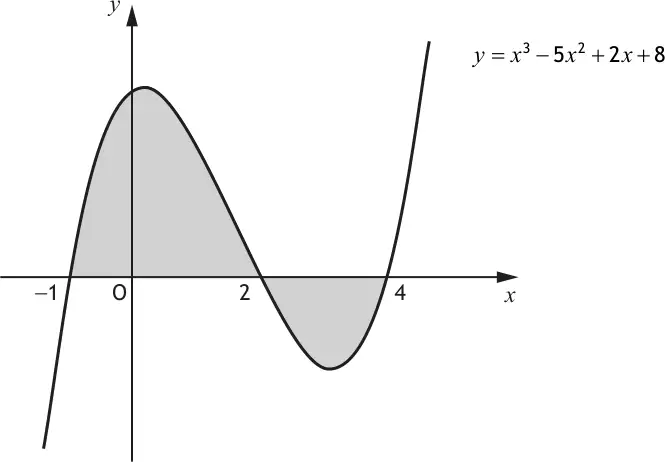
(a) Calculate the shaded area above the \(x\)-axis. [4]
(b) Hence calculate the total shaded area. [3]
| Mark | Generic scheme | Illustrative scheme |
|---|---|---|
| •1 | state appropriate integral | \(\displaystyle\int_{-1}^{2}\left(x^3-5x^2+2x+8\right)\,dx\) |
| •2 | integrate | \(\dfrac{1}{4}x^4-\dfrac{5}{3}x^3+\dfrac{2x^2}{2}+8x\) |
| •3 | substitute limits | \(\left(\dfrac{1}{4}(2)^4-\dfrac{5}{3}(2)^3+(2)^2+8(2)\right)\) \(-\left(\dfrac{1}{4}(-1)^4-\dfrac{5}{3}(-1)^3+(-1)^2+8(-1)\right)\) |
| •4 | evaluate area | \(\dfrac{63}{4}\) or 15.75 |
| (4) |
Notes:
- Limits and ‘\(dx\)’ must appear at the •1 stage for •1 to be awarded.
- Where a candidate differentiates one or more terms at •2, then •3 and •4 are not available.
- Candidates who substitute limits without integrating, do not gain •3 or •4.
- Do not penalise the inclusion of ‘\(+c\)’.
- Do not penalise the continued appearance of the integral sign after •1.
- •4 is not available where solutions include statements such as \(-\dfrac{63}{4}=\dfrac{63}{4}\). See Candidate C.
Commonly Observed Responses:
Candidate A
| \(\displaystyle\int_{-1}^{2}\left(x^3-5x^2+2x+8\right)\) | •1 ✗ |
| \(=\dfrac{1}{4}x^4-\dfrac{5}{3}x^3+\dfrac{2x^2}{2}+8x\) | •2 ✓ |
| •3 ^ | |
| \(=\dfrac{63}{4}\) | •4 ✓1 |
Candidate B - evidence of substitution using a calculator
| \(\displaystyle\int\left(x^3-5x^2+2x+8\right)\,dx\) | •1 ✗ |
| \(=\dfrac{1}{4}x^4-\dfrac{5}{3}x^3+\dfrac{2x^2}{2}+8x\) | •2 ✓ |
| \(=\dfrac{32}{3}-\left(-\dfrac{61}{12}\right)\) | •3 ✓ |
| \(=\dfrac{63}{4}\) | •4 ✓ |
Candidate C - communication for •4
| \(\displaystyle\int_{2}^{-1}\left(x^3-5x^2+2x+8\right)\,dx\) | •1 ✓ |
| … | •2 ✓ •3 ✓ |
| \(=-\dfrac{63}{4}\), hence area is \(\dfrac{63}{4}\). | •4 ✓ |
However \(-\dfrac{63}{4}=\dfrac{63}{4}\) square units does not gain •4
| Mark | Generic scheme | Illustrative scheme |
|---|---|---|
| Method 1 | Method 1 | |
| •5 | state appropriate integral | \(\displaystyle\int_{2}^{4}\left(x^3-5x^2+2x+8\right)\,dx\) |
| •6 | evaluate integral | \(-\dfrac{16}{3}\) |
| •7 | interpret result and evaluate total area | \(\dfrac{253}{12}\) or \(21.083\ldots\) |
| Method 2 | Method 2 | |
| •5 | state appropriate integral | \(\displaystyle\int_{2}^{4}\left(0-\left(x^3-5x^2+2x+8\right)\right)dx\) |
| •6 | substitute limits | \(-\left(\dfrac{1}{4}(4)^4-\dfrac{5}{3}(4)^3+(4)^2+8(4)\right)-\) \(\left(-\left(\dfrac{1}{4}(2)^4-\dfrac{5}{3}(2)^3+(2)^2+8(2)\right)\right)\) |
| •7 | evaluate total area | \(\dfrac{253}{12}\) or \(21.083\ldots\) |
| (3) |
Notes:
- For candidates who only consider \(\displaystyle\int_{-1}^{4}\ldots dx\) or any other invalid integral, award 0/3.
- In part (b), at •5 do not penalise the omission of ‘\(dx\)’.
- In Method 1, •5 may be awarded for \(\left[\dfrac{1}{4}x^4-\dfrac{5}{3}x^3+\dfrac{2x^2}{2}+8x\right]_{2}^{4}\) or \(\left(\dfrac{1}{4}(4)^4-\dfrac{5}{3}(4)^3+(4)^2+8(4)\right)-\left(\dfrac{1}{4}(2)^4-\dfrac{5}{3}(2)^3+(2)^2+8(2)\right)\).
- In Method 2, •5 may be awarded for \(\left[\dfrac{1}{4}x^4-\dfrac{5}{3}x^3+\dfrac{2x^2}{2}+8x\right]_{4}^{2}\) or •5 and •6 may be awarded for \(\left(\dfrac{1}{4}(2)^4-\dfrac{5}{3}(2)^3+(2)^2+8(2)\right)-\left(\dfrac{1}{4}(4)^4-\dfrac{5}{3}(4)^3+(4)^2+8(4)\right)\).
- •7 is not available to candidates where solutions include statements such as \(-\dfrac{16}{3}=\dfrac{16}{3}\) square units. See Candidate D.
- In Method 1, where a candidate’s integral leads to a positive value, •7 is not available.
- Where a candidate has differentiated in both parts of the question see Candidate E.
Commonly Observed Responses:
Candidate D - communication for •7
| \(\displaystyle\int_{2}^{4}\left(x^3-5x^2+2x+8\right)\,dx=-\dfrac{16}{3}\) | •5 ✓ •6 ✓ |
| \(\dfrac{63}{4}+\dfrac{16}{3}=\dfrac{253}{12}\) | •7 ✓ |
However, •7 is not available where statements such as “\(-\dfrac{16}{3}=\dfrac{16}{3}\) square units” or “ignore negative” appear.
Candidate E - differentiation in (a) and (b)
| (a) \(\displaystyle\int_{-1}^{2}\left(x^3-5x^2+2x+8\right)\,dx\) | •1 ✓ |
| \(=3x^2-10x+2\) | •2 ✗ |
| \(=\left(3(2)^2-10(2)+2\right)-\left(3(-1)^2-10(-1)+2\right)\) | •3 ✗ |
| \(=-21\) Area \(=21\) | •4 ✗ |
| (b) \(\left(3(4)^2-10(4)+2\right)-\left(3(2)^2-10(2)+2\right)=16\) | •5 ✓ •6 ✓1 |
| Total Area \(=5\) | •7 ✓2 see note 12 |