
May 2025 Paper 2 Q3
3. The diagram shows the graph of \(y=x^2-2x+3\).
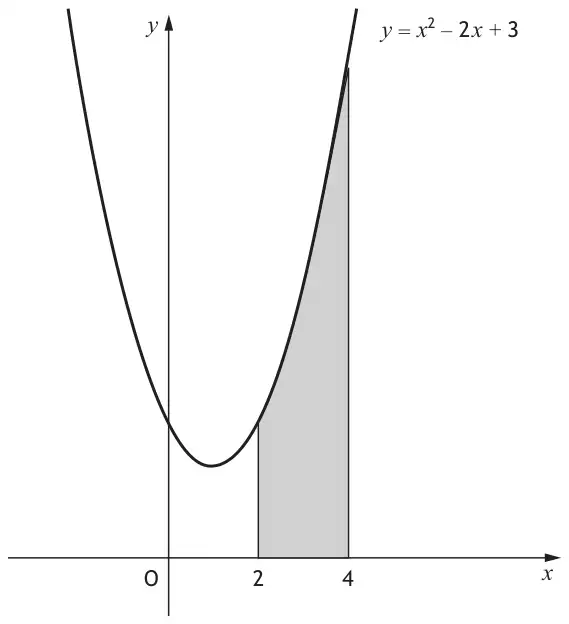
Calculate the shaded area. [4]
| Mark | Generic scheme | Illustrative scheme |
|---|---|---|
| •1 | state appropriate definite integral | \(\displaystyle\int_2^4 \left(x^2-2x+3\right)dx\) |
| •2 | integrate | \(\dfrac{x^3}{3}-\dfrac{2x^2}{2}+3x\) |
| •3 | substitute limits | \(\left(\dfrac{4^3}{3}-\dfrac{2(4)^2}{2}+3(4)\right)-\left(\dfrac{2^3}{3}-\dfrac{2(2)^2}{2}+3(2)\right)\) |
| •4 | calculate area | \(\dfrac{38}{3}\) |
| (4) |
Notes:
- •1 is not available to candidates who omit ‘\(dx\)’.
- Limits must appear at the •1 stage for •1 to be awarded.
- Where candidates differentiate one or more terms at •2, then •3 and •4 are unavailable.
- Candidates who substitute limits without integrating do not gain •3 or •4.
- Do not penalise the inclusion of ‘\(+c\)’ at •2 or •3.
- Do not penalise the continued appearance of the integral sign or ‘\(dx\)’ after •1.
- Do not penalise rounded or truncated answers with at least one decimal place.
Commonly Observed Responses:
Candidate A - missing working
| \(\displaystyle\int_2^4 x^2-2x+3\) | •1 ^ |
| \(=\dfrac{x^3}{3}-\dfrac{2x^2}{2}+3x\) | •2 ✓ |
| •3 ^ | |
| \(=\dfrac{38}{3}\) | •4 ✓1 |
Candidate B - evidence of substitution using a calculator
| •1 ^ | |
| \(=\dfrac{x^3}{3}-\dfrac{2x^2}{2}+3x\) | •2 ✓ |
| \(=\dfrac{52}{3}-\dfrac{14}{3}\) | •3 ✓ |
| \(=\dfrac{38}{3}\) | •4 ✓ |
Candidate C - limits not stated at •1
| •1 ^ | |
| \(=\dfrac{x^3}{3}-\dfrac{2x^2}{2}+3x\) | •2 ✓ |
| \(=\left(\dfrac{4^3}{3}-\dfrac{2(4)^2}{2}+3(4)\right)-\left(\dfrac{2^3}{3}-\dfrac{2(2)^2}{2}+3(2)\right)\) | •3 ✓ |
| \(=\dfrac{38}{3}\) | •4 ✓ |
Candidate D - reversed limits
| \(\displaystyle\int_4^2 \left(x^2-2x+3\right)dx\) | |
| … | •2 ✓ •3 ✓ |
| \(=-\dfrac{38}{3}\), hence area is \(\dfrac{38}{3}\) | •1 ✓ •4 ✓ |
| However, | |
| \(\displaystyle\int_4^2 \left(x^2-2x+3\right)dx\) | |
| … | •2 ✓ •3 ✓ |
| \(-\dfrac{38}{3}\) | |
| \(=\dfrac{38}{3}\) units2 | •1 ✗ •4 ✗ |