
May 2023 Paper 2 Q8
8. The diagram shows part of the curve with equation \(y=x^3-2x^2-4x+1\) and the line with equation \(y=x-5\).
The curve and the line intersect at the points where \(x=-2\) and \(x=1\).
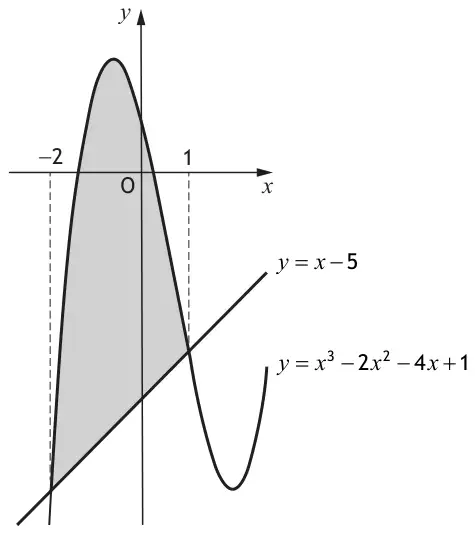
Calculate the shaded area. [5]
| Mark | Generic scheme | Illustrative scheme |
|---|---|---|
| Method 1 | Method 1 | |
| •1 | integrate using “upper - lower” | \(\displaystyle\int\left(\left(x^3-2x^2-4x+1\right)-(x-5)\right)dx\) |
| •2 | identify limits | \(\displaystyle\int_{-2}^{1}\left(\left(x^3-2x^2-4x+1\right)-(x-5)\right)dx\) |
| •3 | integrate | \(\dfrac{x^4}{4}-\dfrac{2x^3}{3}-\dfrac{5x^2}{2}+6x\) |
| •4 | substitute limits | \(\left(\dfrac{(1)^4}{4}-\dfrac{2(1)^3}{3}-\dfrac{5(1)^2}{2}+6(1)\right)-\) \(\left(\dfrac{(-2)^4}{4}-\dfrac{2(-2)^3}{3}-\dfrac{5(-2)^2}{2}+6(-2)\right)\) |
| •5 | calculate shaded area | \(\dfrac{63}{4}\) or \(15\dfrac{3}{4}\) |
| Method 2 | Method 2 | |
| •1 | know to integrate between appropriate limits for both integrals | \(\displaystyle\int_{-2}^{1}\ldots dx\) and \(\displaystyle\int_{-2}^{1}\ldots dx\) |
| •2 | integrate both functions | \(\dfrac{x^4}{4}-\dfrac{2x^3}{3}-\dfrac{4x^2}{2}+x\) and \(\dfrac{x^2}{2}-5x\) |
| •3 | substitute limits into both expressions | \(\left(\dfrac{(1)^4}{4}-\dfrac{2(1)^3}{3}-\dfrac{4(1)^2}{2}+(1)\right)\) \(-\left(\dfrac{(-2)^4}{4}-\dfrac{2(-2)^3}{3}-\dfrac{4(-2)^2}{2}+(-2)\right)\) and \(\left(\dfrac{(1)^2}{2}-5(1)\right)-\left(\dfrac{(-2)^2}{2}-5(-2)\right)\) |
| •4 | evaluate both integrals | \(-\dfrac{3}{4}\) and \(-\dfrac{33}{2}\) |
| •5 | evidence of subtracting areas | \(-\dfrac{3}{4}-\left(-\dfrac{33}{2}\right)=\dfrac{63}{4}\) |
| (5) |
Notes:
- Correct answer with no working - award 1/5.
- In Method 1, treat the absence of brackets at •1 stage as bad form only if the correct integral is obtained at •3 - see Candidates A and B.
- Do not penalise lack of ‘\(dx\)’ at •1.
- Limits and ‘\(dx\)’ must appear by the •2 stage for •2 to be awarded in Method 1 and by the •1 stage for •1 to be awarded in Method 2.
- Where a candidate differentiates one or more terms at •3, then •3, •4 and •5 are unavailable.
- Accept unsimplified expressions at •3 e.g. \(\dfrac{x^4}{4}-\dfrac{2x^3}{3}-\dfrac{4x^2}{2}+x-\dfrac{x^2}{2}+5x\).
- Do not penalise the inclusion of ‘\(+c\)’.
- Do not penalise the continued appearance of the integral sign after •2
- Candidates who substitute limits without integrating do not gain •3, •4 or •5.
- •5 is not available where solutions include statements such as ‘\(-\dfrac{63}{4}=\dfrac{63}{4}\) square units’ - see Candidate B.
- Where a candidate only integrates \(x^3-2x^2-4x+1\) or another cubic or quartic expression, only •3 and •4 are available (from Method 1).
Commonly Observed Responses:
Candidate A - bad form corrected
| \(\displaystyle\int_{-2}^{1}x^3-2x^2-4x+1-x-5\,dx\) | •2 ✓ |
| \(=\dfrac{x^4}{4}-\dfrac{2x^3}{3}-\dfrac{5x^2}{2}+6x\) | •3 ✓ \(\Rightarrow\) •1 ✓ |
Bad form at •1 must be corrected by the integration stage and may also take the form of a missing minus sign
Candidate B
| \(\displaystyle\int_{-2}^{1}x^3-2x^2-4x+1-x-5\,dx\) | •1 ✗ •2 ✓ |
| \(=\dfrac{x^4}{4}-\dfrac{2x^3}{3}-\dfrac{5x^2}{2}-4x\) | •3 ✓1 |
| \(=\left(\dfrac{(1)^4}{4}-\dfrac{2(1)^3}{3}-\dfrac{5(1)^2}{2}-4(1)\right)\) \(-\left(\dfrac{(-2)^4}{4}-\dfrac{2(-2)^3}{3}-\dfrac{5(-2)^2}{2}-4(-2)\right)\) | •4 ✓1 |
| \(-\dfrac{57}{4}\) cannot be negative so \(=\dfrac{57}{4}\) | •5 ✗ |
| However, \(\displaystyle\int\ldots=-\dfrac{57}{4}\) so Area \(=\dfrac{57}{4}\) | •5 ✓1 |
Candidate C - lower − upper
| \(\displaystyle\int_{-2}^{1}\left((x-5)-\left(x^3-2x^2-4x+1\right)\right)dx\) | •2 ✓ |
| \(-\dfrac{x^4}{4}+\dfrac{2x^3}{3}+\dfrac{5x^2}{2}-6x\) | •3 ✓ |
| \(\left(-\dfrac{(1)^4}{4}+\dfrac{2(1)^3}{3}+\dfrac{5(1)^2}{2}-6(1)\right)-\) \(\left(-\dfrac{(-2)^4}{4}+\dfrac{2(-2)^3}{3}+\dfrac{5(-2)^2}{2}-6(-2)\right)\) | •4 ✓ |
| \(-\dfrac{63}{4}\) | |
| So Area \(=\dfrac{63}{4}\) | •1 ✓ •5 ✓ |
Candidate D - reversed limits
| \(\displaystyle\int_{1}^{-2}\left(\left(x^3-2x^2-4x+1\right)-(x-5)\right)dx\) | •1 ✓ |
| \(\dfrac{x^4}{4}-\dfrac{2x^3}{3}-\dfrac{5x^2}{2}+6x\) | •3 ✓ |
| \(\left(\dfrac{(-2)^4}{4}-\dfrac{2(-2)^3}{3}-\dfrac{5(-2)^2}{2}+6(-2)\right)\) \(-\left(\dfrac{(1)^4}{4}-\dfrac{2(1)^3}{3}-\dfrac{5(1)^2}{2}+6(1)\right)\) | •4 ✓ |
| \(-\dfrac{63}{4}\) | |
| So Area \(=\dfrac{63}{4}\) | •2 ✓ •5 ✓ |
Candidate E - ‘upper’ − ‘lower’
| \(=x^3-2x^2-5x+6\) | |
| \(\displaystyle\int_{-2}^{1}\left(x^3-2x^2-5x+6\right)dx\) | •1 ✓ •2 ✓ |
| \(\dfrac{x^4}{4}-\dfrac{2x^3}{3}-\dfrac{5x^2}{2}+6x\) | •3 ✓ |
| \(\dfrac{37}{12}-\left(-\dfrac{38}{3}\right)\) | •4 ✓ |
| \(\dfrac{63}{4}\) | •5 ✓ |