Where \(\dfrac{dy}{dx}\) does not appear more than once after the candidate has completed differentiation, do not award •4.
Withhold •4 for incorrect simplification subsequent to a correct answer.
Marking instructions (b)
Mark
Generic scheme
Illustrative scheme
•5
explanation 1,2,3,4,5,6
eg \(e^{6y}\neq-1,\ x\neq0\)
(1)
Notes:
If the candidate uses an expression which could have a zero numerator, •5 is not available.
Do not award •5 where a candidate explicitly considers a zero denominator.
Where a candidate uses an incorrect simplification of an expression for which •4 has been withheld, •5 is still available.
Do not award •5 if an explanation contains any incorrect statement.
Where a candidate factorises the numerator, a statement about \(x\) is not required but candidates must state that \(e^{6y}\neq-1\), or stronger, eg \(e^{6y}>0\).
Where a candidate does not factorise the numerator, a statement about \(x\) not being 0 is required and candidates must state that \(e^{6y}\neq-1\), or stronger, eg \(e^{6y}>0\).
Where a candidate uses a variable other than \(t\) (or \(T\)) for time, eg “sec”, this must be explicitly defined. Otherwise, the mark where it is first used is not available.
Where a candidate equates \(V\) to its derivative, the relevant mark is not available.
For the award of •4, \(\dfrac{dh}{dt}=\ldots\) and units must appear.
For the award of •4, approximate answers (\(-1.0666\ldots\times10^{-5}\)) should be rounded to at least 2 significant figures. Accept an equivalent, eg \(-11\times10^{-6}\ \text{ms}^{-1}\).
For the award of •4, there must be a numerical value resulting from a calculation involving at least two substitutions.
Accept decimal equivalent to at least 2 significant figures (3.3).
Where a candidate produces two or more points, •4 is not available.
For •4, the rejection of \(t=-\dfrac{1}{2}\) may be communicated by eg \(t>0\). In this case, the potential solution \(t=-\dfrac{1}{2}\) need not be explicitly stated.
5. Given \(y=x^{4x}\), use logarithmic differentiation to find \(\dfrac{dy}{dx}\).
Write your answer in terms of \(x\). [5]
Marking instructions
Mark
Generic scheme
Illustrative scheme
•1
take logarithms on both sides and apply rule 1,2
\(\ln y=4x\ln x\)
•2
differentiate \(\ln y\) 2,3,4
\(\dfrac{1}{y}\dfrac{dy}{dx}\)
•3
evidence of product rule with one term correct 2,3,4,5,6
\(4\ln x+\ldots\) or \(\ldots+4x\cdot\dfrac{1}{x}\)
•4
complete differentiation 2,3,4,5,6
\(4\ln x+4x\cdot\dfrac{1}{x}\)
•5
write \(\dfrac{dy}{dx}\) in terms of \(x\) 1,2,3,4,6
\(\dfrac{dy}{dx}=x^{4x}(4\ln x+4)\)
(5)
Notes:
Accept ‘log’ as an alternative to ‘\(\ln\)’ provided a candidate does not indicate a base other than \(e\). For candidates who do use a base other than \(e\), only •1 and •5 are available.
For candidates who write \(y=e^{4x}\ln x\), do not award •1, •2 or •5. However, •3 and •4 are still available for a correct application of the product rule.
Where a candidate uses \(y=xe^{4x}\), do not award •2 or •5. However, •3 and •4 are still available for a correct application of the product rule.
Where a candidate expresses the intention to integrate:
If they then differentiate both sides, •2, •3, •4 and •5 are still available.
If they integrate both sides, •2, •3, •4 and •5 are not available.
If they integrate the RHS but differentiate the LHS, •2, •3 and •4 are not available.
For candidates who do not attempt to use the product rule, •3 and •4 are not available.
Accept '4' instead of '\(4x\cdot\dfrac{1}{x}\)' at •3 and •4. However, do not accept '\(4x\cdot\dfrac{1}{x}\)' at •5.
Where a candidate uses a variable other than \(t\) (or \(T\)) for time, eg “sec” this must be explicitly defined. Otherwise, the mark where it is first used is not available.
In Method 1, where a candidate equates \(\dfrac{dV}{dh}\) to \(V\), •2 is not available.
Where a candidate equates \(\dfrac{dV}{dt}\) to \(V\), •3 is not available.
Where a candidate has treated the increase and decrease separately, do not withhold •3 provided they subsequently combine them to produce the correct value.
At •4, candidates must explicitly identify \(\dfrac{dh}{dt}\).
Accept an answer (eg \(4.1\dot{6}\times10^{-5}\)) rounded or truncated to at least two significant figures.
9. Relative to a fixed origin, the velocity, \(v\) metres per second, of an object at time \(t\) seconds is given by \(v=2t+e^{5t}\).
(a) Find an expression for the displacement of the object, \(s\) metres, in terms of \(t\), given that when \(t=0,\ s=0\). [2]
(b) Show that the acceleration of the object is always positive. [2]
Marking instructions (a)
Mark
Generic scheme
Illustrative scheme
•1
integrate 1
\(\dfrac{2t^2}{2}+\dfrac{1}{5}e^{5t}+c\)
•2
evaluate constant and substitute 2,3
\(t^2+\dfrac{1}{5}e^{5t}-\dfrac{1}{5}\)
(2)
Notes:
For the award of •1, the constant of integration is not necessary.
Where a candidate does not write out a full expression (or writes an unsimplified version) after evaluating the constant of integration, •2 may be awarded for \(c=-\dfrac{1}{5}\), provided \(t^2+\dfrac{1}{5}e^{5t}+c\) has appeared earlier.
Ignore any reference to units.
Marking instructions (b)
Mark
Generic scheme
Illustrative scheme
•3
obtain expression for acceleration 1,2
\(2+5e^{5t}\)
•4
explanation 3,4,5
\(e^{5t}>0\)
(2)
Notes:
Where a candidate has given more than one (non-equivalent) expression for \(a\), •3 is not available.
Award •3 for the appearance of \(v'=2+5e^{5t}\) and ignore higher derivatives (unless acceleration is explicitly identified as a higher derivative). If the expression appears in (a), it must be explicitly identified as acceleration (eg “\(a=\ldots\)”).
At •4, do not accept “As \(t\to\infty,\ 5e^{5t}\to\infty\)”.
Do not withhold •4 where a candidate states “\(e^{5t}\geq0\)”, or “\(e^{5t}\) is never negative”.
At •4, disregard incorrect or irrelevant statements before or after an acceptable justification, even where these occur in the same sentence.
Where a candidate makes no attempt to differentiate, award 0/3.
Do not withhold •3 where a candidate labels \(\dfrac{d}{dt}\left(\dfrac{dy}{dx}\right)\) as \(\dfrac{d^2y}{dx^2}\) or produces other incorrect notation.
Where a candidate differentiates with respect to \(t\) an expression other than their answer to (a), do not award •3. If the differentiation involves a product or quotient, including a trigonometric term, and is carried out correctly, award •4.
Where a candidate produces an incorrect expression in (a), differentiation must involve a product or quotient, including a trigonometric term, for the award of •4 but •3 is still available.
For the award of •5, the final expression must be solely in terms of \(t\) and have required simplification.
Commonly Observed Responses:
Candidates who express \(y\) explicitly as a function of \(x\):
6. A curve is defined parametrically by \(x=t^2\) and \(y=4t\ln t\) where \(t>0\).
Find fully simplified expressions for:
(a) \(\dfrac{dy}{dx}\) [3]
(b) \(\dfrac{d^2y}{dx^2}\). [3]
Marking instructions (a)
Mark
Generic scheme
Illustrative scheme
•1
begin to find \(\dfrac{dy}{dt}\)
\(\dfrac{dy}{dt}=4\ln t+\ldots\) OR \(\dfrac{dy}{dt}=\ldots+4t\times\dfrac{1}{t}\)
•2
find \(\dfrac{dy}{dt}\) 1
\(\dfrac{dy}{dt}=4\ln t+4\)
•3
simplified expression for \(\dfrac{dy}{dx}\) 2
\(\dfrac{dy}{dx}=\dfrac{2(\ln t+1)}{t}\)
(3)
Notes:
Accept an unsimplified expression for \(\dfrac{dy}{dt}\) for the award of •2.
Accept \(\dfrac{dy}{dx}=\dfrac{2\ln t+2}{t}\).
Marking instructions (b)
Mark
Generic scheme
Illustrative scheme
•4
begin to differentiate \(\dfrac{dy}{dx}\) with respect to \(t\) 1
\(\dfrac{\frac{2}{t}t-\ldots}{t^2}\) or \(\dfrac{\ldots-2(\ln t+1)}{t^2}\)
•5
complete differentiation of \(\dfrac{dy}{dx}\) with respect to \(t\) 1,2
\(\dfrac{\frac{2}{t}t-2(\ln t+1)}{t^2}\)
•6
simplify \(\dfrac{d^2y}{dx^2}\) 1
\(\dfrac{-\ln t}{t^3}\)
(3)
Notes:
Where a candidate has not attempted to differentiate their answer to (a) with respect to \(t\), award 0/3.
Where a candidate produces an incorrect expression in (a), differentiation must involve a product or quotient, including a logarithmic term, for the award of •5.
Commonly Observed Responses:
Candidate uses a formula method
COR A (starting from unsimplified first derivative)
\(\dfrac{\frac{4}{t}\times2t-\ldots}{(2t)^3}\) or \(\dfrac{\ldots-2(4\ln t+4)}{(2t)^3}\)
5. The function \(f(x)\) is defined by \(f(x)=x^3-x,\ x\in\mathbb{R}\).
(a) Determine whether \(f(x)\) is even, odd or neither. [2]
(b) Show that the graph of \(y=f(x)\) has a point of inflection. [2]
Marking instructions (a)
Mark
Generic scheme
Illustrative scheme
•1
expression for \(f(-x)\) 1,2
\(f(-x)=(-x)^3-(-x)\), stated or implied
•2
justify that the function is odd 1,2
\(-x^3+x\) leading to \(=-f(x)\) or \(-(x^3-x)\) odd
(2)
Notes:
Where a candidate has used an exclusively graphical approach, a sketch including roots and stationary points is required for the award of •1. For •2, reference must made to half-turn symmetry about the origin.
Award 0/2 for a numerical approach.
Corrected by Westie's Workshop
The board's marking instructions printed “−x³ + x8”. Changed to “−x³ + x” because the “8” is a stray character, since f(−x) = −x³ + x.
Original: see the board's mark scheme PDF (link above).
Marking instructions (b)
Mark
Generic scheme
Illustrative scheme
•3
equate second derivative to 0 1,2,3
\(6x=0\)
•4
consider sign of \(f^{\prime\prime}(x)\) for \(x\lt 0\) and \(x\gt 0\) and state conclusion 4
\(x\gt 0\Rightarrow f^{\prime\prime}(x)\gt 0\) and \(x\lt 0\Rightarrow f^{\prime\prime}(x)\lt 0\) \(\therefore\) POI
(2)
Notes:
Given that the second derivative exists for all \(x\), it is sufficient to consider only a zero second derivative.
Do not withhold •3 where a candidate states that points of inflection occur when the second derivative equals zero.
Where a candidate does not explicitly equate \(6x\) to zero, •3 may be awarded for \(f^{\prime\prime}(x)=0\) provided they also write \(f^{\prime\prime}(x)=6x\).
May be awarded where \(f^{\prime\prime}(x)\) and \(f^{\prime\prime}(-x)\) have been calculated for a specific value of \(x\) close to 0 and shown to have opposite signs.
Where a candidate equates \(y\) to the derivative, •1 is still available.
For candidates who use the product rule, no marks may be awarded where an attempt to differentiate \(\dfrac{1}{1+x^2}\) produces an inverse trigonometric function.
Commonly Observed Responses:
COR A Product Rule
\(7\cos 7x\left(1+x^2\right)^{-1}-\ldots\) or \(\ldots-2x\sin 7x\left(1+x^2\right)^{-2}\)
11. On a building site, water is stored in a container.
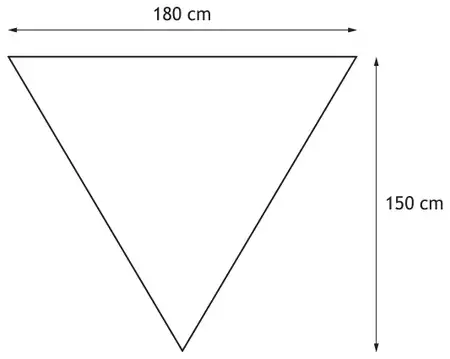
The container is a cone with diameter 180 cm at its widest point and height of 150 cm. A cross section of the cone is shown below.
(a) Show that when the water level is at a height of \(h\) cm, \(0\leqslant h\leqslant150\), the volume of water in the container can be written as\[V=\frac{3\pi h^3}{25}.\]
[The volume of a cone is given by \(V=\dfrac{1}{3}\pi r^2h\).] [1]
Water is pumped into the container at a constant rate of 10 litres per second.
(b) Find the rate at which the height is increasing when \(h=125\). [5]
Marking instructions (a)
Mark
Generic scheme
Illustrative scheme
•1
determine the relationship between \(r\) and \(h\)
\(r=\dfrac{90h}{150}\) (or equivalent) leading to \(V=\dfrac{3\pi h^3}{25}\)
(1)
Marking instructions (b)
Mark
Generic scheme
Illustrative scheme
•2
find \(\dfrac{dV}{dh}\) 2
\(\dfrac{dV}{dh}=\dfrac{9\pi h^2}{25}\)
•3
form relationship 3
eg \(\dfrac{dV}{dt}=\dfrac{dV}{dh}\dfrac{dh}{dt}\) stated or implied at •5
•4
interpret rate of change of \(V\) in \(\text{cm}^3\text{s}^{-1}\)
\(\dfrac{dV}{dt}=10000\)
•5
form expression for \(\dfrac{dh}{dt}\) in terms of \(h\) 5
Accept ‘log’ as an alternative to ‘\(\ln\)’ provided candidate does not indicate a base other than \(e\). For candidates who do use a base other than \(e\), only •1 and •5 are available.
For candidates who do not attempt to use the product rule, •3 and •4 are not available.
Accept ‘\(5x\)’ instead of ‘\(5x^2\cdot\dfrac{1}{x}\)’ for •3 and •4. However, do not accept ‘\(5x^2\cdot\dfrac{1}{x}\)’ for •5.
•5 is not available for candidates who subsequently produce an incorrect statement - eg \(x^{5x^2}\left(10x\ln x+5x\right)\) becomes \(x^{6x^2}\left(10\ln x+5\right)\).
Commonly Observed Responses:
COR A For candidates who write \(y=e^{\ln x^{5x^2}}\), marks may be awarded as follows.
\(10x\ln x+\ldots\) or \(\ldots+5x^2\cdot\dfrac{1}{x}\)
•5 complete differentiation
\(\dfrac{dy}{dx}=x^{5x^2}\left(10x\ln x+5x\right)\) or \(\dfrac{dy}{dx}=e^{5x^2\ln x}\left(10x\ln x+5x\right)\)
COR B For candidates who write \(y=e^{5x^2}\ln x\) do not award •1, •2 or •5. However, •3 and •4 are still available for a correct application of the product rule.
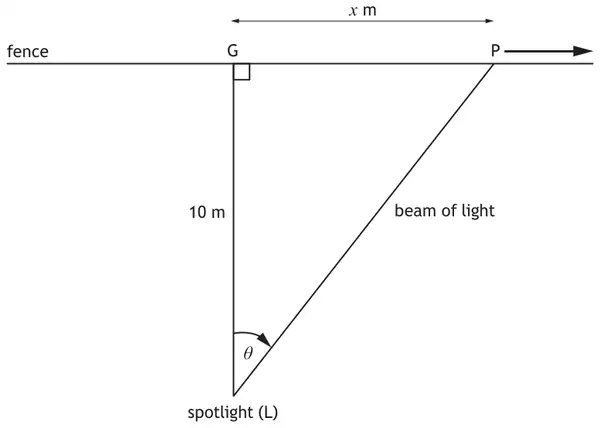
13. A security spotlight is situated 10 metres from a straight fence. The spotlight rotates at a constant speed and makes one full revolution every 12 seconds.
The situation at time \(t\) seconds is modelled in the diagram below, where:
L is the position of the spotlight
G is the point on the fence nearest to the spotlight
P is the position where the light hits the fence
\(\theta\) is the angle between LG and LP
\(x\) is the distance in metres from G to P.
(a) Show that:
(i) \(\dfrac{d\theta}{dt}=\dfrac{\pi}{6}\) radians per second [1]
(ii) \(\dfrac{dx}{dt}=\dfrac{5\pi}{3}\sec^2\theta\) metres per second. [4]
(b) Prove that \(1+\tan^2\theta=\sec^2\theta\). [1]
(c) Hence, or otherwise, find the exact value of \(\dfrac{dx}{dt}\) when P is 5 metres from G. [3]
Marking instructions (a)(i)
Mark
Generic scheme
Illustrative scheme
•1
full turn divided by time 1, 2
\(\dfrac{2\pi}{12}\) leading to \(\dfrac{\pi}{6}\).
(1)
Notes:
•1 is available to candidates who work in degrees and then convert to radians.
If \(\dfrac{2\pi}{12}\) follows directly from an incorrect assumption, eg the rate of change of \(LP\) with respect to time is a constant, then •1 is not available.
Commonly Observed Responses:
Angular velocity approach
Given that the angular velocity in this case is constant, •1 may be awarded.
\(\dfrac{dx}{d\theta}=10\sec^2\theta\) stated or implied
•5
substitute and simplify
\(\dfrac{dx}{dt}=10\sec^2\theta.\dfrac{\pi}{6}\) leading to \(\dfrac{dx}{dt}=\dfrac{5\pi}{3}\sec^2\theta\)
(4)
Notes:
•4 is not available for a candidate who differentiates \(x=\dfrac{5\pi}{3}\tan\theta\).
•4 may be awarded only where a candidate differentiates a clearly defined expression for \(x\), other than \(x=\dfrac{5\pi}{3}\tan\theta\), and the differentiation is beyond Higher Mathematics standard.
Marking instructions (b)
Mark
Generic scheme
Illustrative scheme
•6
complete proof 1
eg \(\begin{aligned}&1+\dfrac{\sin^2\theta}{\cos^2\theta}\\&=\dfrac{\cos^2\theta+\sin^2\theta}{\cos^2\theta}\ \text{ or }\ \dfrac{\cos^2\theta}{\cos^2\theta}+\dfrac{\sin^2\theta}{\cos^2\theta}\\&=\dfrac{1}{\cos^2\theta}\\&=\sec^2\theta\end{aligned}\)
(1)
Notes:
Accept proof using another (single) variable in place of \(\theta\).
Both lines of working must be present for the award of •6
Corrected by Westie's Workshop
The board's marking instructions printed “\(\dfrac{\sin^2\theta}{\cos\theta}\)”. Changed to “\(\dfrac{\sin^2\theta}{\cos^2\theta}\)” because every term is divided by \(\cos^2\theta\), so this denominator is \(\cos^2\theta\) too.
The board's marking instructions printed “\(1+\tan^2 2\theta=\sec^2\theta\)”. Changed to “\(1+\tan^2\theta=\sec^2\theta\)” because the identity being proved is \(1+\tan^2\theta=\sec^2\theta\); the extra 2 is a stray character.
Original: see the board's marking instructions PDF (link above).
Marking instructions (c)
Mark
Generic scheme
Illustrative scheme
•7
find \(\tan\theta\) or \(\sec\theta\)
\(\tan\theta=\dfrac{5}{10}\) or \(\sec\theta=\dfrac{\sqrt{125}}{10}\)
•8
corresponding value of \(\sec^2\theta\) 1
\(1+\left(\dfrac{5}{10}\right)^2\), \(\dfrac{125}{100}\) or \(1+\left(\tan\left(\tan^{-1}\dfrac{1}{2}\right)\right)^2\) or equivalent
•9
substitute and simplify 2, 3
\(\dfrac{25\pi}{12}\) ms-1.
(3)
Notes:
Where a candidate finds and rounds an angle for \(\theta\), •8 is available only when rounding occurs to at least 2 significant figures.
Where a candidate substitutes an angle in degrees into their calculation, withhold •9.
Units must appear beside an exact value for the award of •9.
•5 is available for candidates who either have an incorrect integrating factor at •4 or who have incorrectly simplified a correct integrating factor prior to •5. SEE CORS.
Do not withhold •5 for the omission of ‘\(dx\)’ on the right-hand side.
Where a candidate writes \(\displaystyle\int\frac{d}{dx}\ldots\) on the left-hand side do not withhold •5 provided the candidate later produces evidence that they have integrated with respect to \(x\).
Accept \(y=\dfrac{-e^{-x}+c}{e^{x\ln x-x}}\) for the award of •6.
For a candidate who omits the constant of integration or produces an integrand which is not beyond Higher Mathematics standard, •6 is not available.
Commonly Observed Responses:
Correct integrating factor at •4 followed by incorrect simplification
\(e^{\int\ln x\,dx}\) leading to eg \(e^{x\ln x-x}=\dfrac{1}{x}\). Award •3 and •4. If followed by \(y\dfrac{1}{x}=\displaystyle\int\frac{1}{x}x^{-x}\,dx\), award •5. Do not award •6.
Incorrect integrating factor at •4
\(e^{\int\ln x\,dx}\) leading to eg \(\dfrac{1}{x}\) (without evidence of \(e^{x\ln x-x}\)). Award •3, do not award •4. If followed by \(y\dfrac{1}{x}=\displaystyle\int\frac{1}{x}x^{-x}\,dx\), award •5.
We'd like to use Google Analytics cookies to count visits and see which pages help most. They're optional, and the site works exactly the same either way. Privacy policy