In Method 1, at each of •2 and •3, the mark is awarded for the appearance of the given term, regardless of coefficients. These need to be correct for the award of the final mark.
Where a candidate adopts any strategy other than exemplified in Methods 1 and 2, the maximum mark available is 1/4, awarded for the appearance of \(\ln\left(x^2+4\right)\) or \(\tan^{-1}\left(\dfrac{x}{2}\right)\).
Disregard the omission of \(dx\) and the absence of the constant of integration.
(a) Use the substitution \(u=x-1\) to find \(\displaystyle\int x(x-1)^4\,dx\). [3]
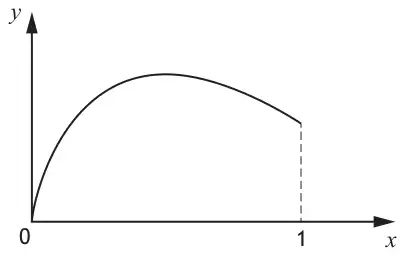
(b) Hence find the exact volume of the solid formed by rotating the curve with equation \(y=2\sqrt{x}\,(x-1)^2\) about the \(x\) axis through \(2\pi\) radians, from \(x=0\) to \(x=1\). [4]
Marking instructions (a)
Mark
Generic scheme
Illustrative scheme
•1
differentiate
\(\dfrac{du}{dx}=1\) or \(du=dx\)
•2
rewrite integral and expand brackets 1
\(\displaystyle\int u^5+u^4\,du\)
•3
integrate 1,2
\(\dfrac{1}{6}(x-1)^6+\dfrac{1}{5}(x-1)^5+c\)
(3)
Notes:
Other than in COR C below, where a candidate attempts to integrate an expression containing \(x\) and \(u\), •2 and •3 are not available.
Where the integration involves a single power, •3 is not available.
Disregard the omission of the constant of integration.
For the award of •4, limits and \(dx\) must appear at some point.
Where a candidate writes \(dy\) instead of \(dx\) but integrates with respect to \(x\), •5, •6 and •7 are still available.
Where a candidate produces an expression with more than one variable, •6 and •7 are unavailable. Do not treat this as a repeated error from (a).
Other than in COR A, B or C in (a), for the award of •7, the evaluation must involve the addition or subtraction of two fractions with different denominators.
Where a candidate produces a final answer which is not positive, •7 is not available.
Where a candidate reverses the expressions to integrate and differentiate for the second application, only •1 and •2 are available.
Where a candidate differentiates or integrates both functions in the first or second application, •1 and •2or •3 and •4 respectively are not available.
Disregard the omission of \(dx\).
Disregard the mistreatment or omission of the constant of integration.
For the award of •5, accept eg \(\dfrac{25\left(\dfrac{2}{25}e^{2x}\sin5x-\dfrac{1}{5}e^{2x}\cos5x\right)}{29}\).
Where a candidate makes a second attempt using the other method, mark both attempts and award the higher mark.
Commonly Observed Responses:
Tabular Method:
D
I
\(+\)
\(e^{2x}\)
\(\sin5x\)
\(-\)
\(2e^{2x}\)
\(-\dfrac{1}{5}\cos5x\)
\(+\)
\(4e^{2x}\)
\(-\dfrac{1}{25}\sin5x\)
D
I
\(+\)
\(\sin5x\)
\(e^{2x}\)
\(-\)
\(5\cos5x\)
\(\dfrac{1}{2}e^{2x}\)
\(+\)
\(-25\sin5x\)
\(\dfrac{1}{4}e^{2x}\)
(In each table, arrows run diagonally from each D entry to the I entry in the row below.)
first three rows (including headings – although these may vary)
•1
final row
•2
\(-\dfrac{1}{5}e^{2x}\cos5x+\dfrac{2}{25}e^{2x}\sin5x+\displaystyle\int\ldots\) or \(\dfrac{1}{2}e^{2x}\sin5x-\dfrac{5}{4}e^{2x}\cos5x+\displaystyle\int\ldots\)
•3
\(\displaystyle\int-\dfrac{4}{25}e^{2x}\sin5x\,dx\) or \(\displaystyle\int-\dfrac{25}{4}e^{2x}\sin5x\,dx\)
9. Relative to a fixed origin, the velocity, \(v\) metres per second, of an object at time \(t\) seconds is given by \(v=2t+e^{5t}\).
(a) Find an expression for the displacement of the object, \(s\) metres, in terms of \(t\), given that when \(t=0,\ s=0\). [2]
(b) Show that the acceleration of the object is always positive. [2]
Marking instructions (a)
Mark
Generic scheme
Illustrative scheme
•1
integrate 1
\(\dfrac{2t^2}{2}+\dfrac{1}{5}e^{5t}+c\)
•2
evaluate constant and substitute 2,3
\(t^2+\dfrac{1}{5}e^{5t}-\dfrac{1}{5}\)
(2)
Notes:
For the award of •1, the constant of integration is not necessary.
Where a candidate does not write out a full expression (or writes an unsimplified version) after evaluating the constant of integration, •2 may be awarded for \(c=-\dfrac{1}{5}\), provided \(t^2+\dfrac{1}{5}e^{5t}+c\) has appeared earlier.
Ignore any reference to units.
Marking instructions (b)
Mark
Generic scheme
Illustrative scheme
•3
obtain expression for acceleration 1,2
\(2+5e^{5t}\)
•4
explanation 3,4,5
\(e^{5t}>0\)
(2)
Notes:
Where a candidate has given more than one (non-equivalent) expression for \(a\), •3 is not available.
Award •3 for the appearance of \(v'=2+5e^{5t}\) and ignore higher derivatives (unless acceleration is explicitly identified as a higher derivative). If the expression appears in (a), it must be explicitly identified as acceleration (eg “\(a=\ldots\)”).
At •4, do not accept “As \(t\to\infty,\ 5e^{5t}\to\infty\)”.
Do not withhold •4 where a candidate states “\(e^{5t}\geq0\)”, or “\(e^{5t}\) is never negative”.
At •4, disregard incorrect or irrelevant statements before or after an acceptable justification, even where these occur in the same sentence.
(a) Express \(\dfrac{-2}{x(x+1)}\) in partial fractions. [2]
(b) Use integration by parts to find \(\displaystyle\int xe^{3x}\,dx\). [3]
(c) Using your answers to (a) and (b), solve\[\frac{dy}{dx}-\frac{2y}{x(x+1)}=\frac{x^3e^{3x}}{(x+1)^2}.\] [5]
Marking instructions (a)
Mark
Generic scheme
Illustrative scheme
•1
state expression
\(\dfrac{A}{x}+\dfrac{B}{x+1}\)
•2
obtain values for \(A\) and \(B\)
\(A=-2\) and \(B=2\)
(2)
Marking instructions (b)
Mark
Generic scheme
Illustrative scheme
•3
integrate to find "\(uv-\)" 1,2
\(\dfrac{1}{3}xe^{3x}-\ldots\)
•4
differentiate to find "\(\displaystyle\int u'v\,dx\)" 1,2,3
\(\ldots\displaystyle\int\frac{1}{3}e^{3x}\,dx\)
•5
obtain full solution 1,2,4
\(\dfrac{1}{3}xe^{3x}-\dfrac{1}{9}e^{3x}+c\)
(3)
Notes:
Where a candidate integrates both functions, award 0/3.
Where a candidate differentiates both functions, award 0/3, unless they have communicated the intention to integrate (see COR B).
Disregard the omission of \(dx\) at •4.
Disregard the omission of \(+c\) at •5
Commonly Observed Responses:
COR A Use of tabular method.
\(D\)
\(I\)
\(+\)
\(x\)
\(e^{3x}\)
\(-\)
\(1\)
\(\dfrac{1}{3}e^{3x}\)
\(+\)
\(\dfrac{1}{9}e^{3x}\)
(Arrows in the scheme link \(x\) to \(\frac{1}{3}e^{3x}\) and \(1\) to \(\frac{1}{9}e^{3x}\).)
Award •3 for first three rows, and •4 for the final row. Headings may differ.
COR B Candidate communicates that \(v'=e^{3x}\), \(v=3e^{3x}\).
Do not award •3 but •4 and •5 are still available. In the case of •5, this may be as a result of integrating correctly the second time, or as a repeated error.
COR C Candidate chooses to differentiate \(e^{3x}\) and integrate \(x\).
Do not award •3 but •4 is available. For the award of •5, further applications will be needed to arrive at the correct solution.
Marking instructions (c)
Mark
Generic scheme
Illustrative scheme
•6
state form of integrating factor 1,2,3
\(e^{\int\frac{-2}{x(x+1)}dx}\) stated or implied
•7
substitute partial fractions into expression for integrating factor 1,3
8. Use the substitution \(u=\tan 2x\) to evaluate \(\displaystyle\int_0^{\frac{\pi}{8}}\frac{\sqrt{\tan 2x}}{\cos^2 2x}\,dx\). [4]
Marking instructions
Mark
Generic scheme
Illustrative scheme
•1
differentiate
\(du=2\sec^2 2x\,dx\) or \(\dfrac{du}{dx}=2\sec^2 2x\)
•2
determine new limits and begin to rewrite integrand 1,2
\(\displaystyle\int_0^1\ldots du\)
•3
complete integrand 2,3,4,5
\(\displaystyle\int_0^1\frac{1}{2}\sqrt{u}\,du\)
•4
evaluate 5
\(\dfrac{1}{3}\)
(4)
Notes:
Any working leading to calculation of new limits at •2 must be consistent (General Marking Principle (n)).
Except as indicated in COR A, candidates must produce an integral including the correct new limits and \(du\) at some point for the award of •2.
Except as indicated in COR A, disregard the omission of \(du\) and/or limits for the award of •3.
Where the integrand contains terms in \(x\), •3 is still available provided these terms are clearly and correctly “cancelled out”.
Where candidates attempt to integrate an expression containing both \(u\) and \(x\), where \(x\) is either inside the integrand or taken outside as a constant, •3 and •4 are not available.
Commonly Observed Responses:
COR A
No limits in new integral and return to original variable:
8. A solid is formed by rotating part of the curve with equation \(y=\dfrac{1}{\sqrt{1+x^2}}\) about the \(x\)-axis through \(2\pi\) radians, from \(x=0\) to \(x=a\).
The value of the volume of the solid is \(\dfrac{\pi^2}{3}\).
Determine the value of \(a\). [5]
Marking instructions
Mark
Generic scheme
Illustrative scheme
•1
correct form of integral including limits 1
\(\displaystyle\int_0^a \pi y^2\,dx\)
•2
square \(y\) and substitute 1
\(\displaystyle\int_0^a \pi\frac{1}{1+x^2}\,dx\)
•3
integrate 2
\(\tan^{-1}x\)
•4
substitute limits and simplify 3
\(\tan^{-1}a=\dfrac{\pi}{3}\)
•5
evaluate 3
\(\sqrt{3}\)
(5)
Notes:
For the award of •1:
limits must appear at some point
\(dx\) must appear at some point.
For the award of •3, the integration must be beyond Higher level.
Neither •4 nor •5 is available where a candidate produces either:
limits which are both constants
an expression which is not an inverse trigonometric function.
(a) Use the substitution \(u=y^2+1\), or otherwise, to find the exact value of \[\int_0^5\dfrac{4y}{\sqrt{y^2+1}}\,dy.\] [4]
Student engineers are using a 3D printer to make a model.
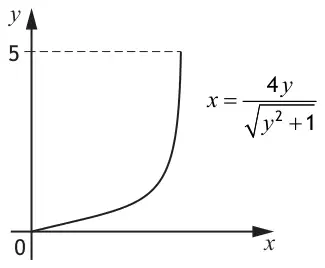
Relative to a suitable set of axes, the cross-section of the model is symmetrical about the \(y\)-axis and is represented in the first quadrant by the curve with equation \(x=\dfrac{4y}{\sqrt{y^2+1}}\), \(0\leqslant y\leqslant 5\), as shown in the diagram.
(b) State the area of the cross-section. [1]
(c) Express \(\dfrac{y^2}{y^2+1}\) in the form \(a+\dfrac{b}{y^2+1}\) where \(a\) and \(b\) are real numbers. [1]
The curve \(x=\dfrac{4y}{\sqrt{y^2+1}}\), \(0\leqslant y\leqslant 5\), will be rotated through \(2\pi\) radians about the \(y\)-axis to make the model.
(d) Find the volume of the model. [4]
Marking instructions (a)
Mark
Generic scheme
Illustrative scheme
•1
differentiate 1
\(\dfrac{du}{dy}=2y\) or \(du=2y\,dy\)
•2
determine new limits and begin to rewrite integral 1
At •7 accept \(V=\pi\displaystyle\int_0^5\left[f(y)\right]^2dy\).
Where a candidate attempts to process an integrand containing both \(u\) and \(y\), •9 and •10 are unavailable.
•9 is available only for the integration of a term of the form \(\pm\dfrac{b}{y^2+1}\), \(b\in\mathbb{R}\).
•10 is not available where:
the integrand at •8 is not beyond Higher Mathematics standard
a candidate produces an undefined expression eg \(\ln 0\).
Corrected by Westie's Workshop
The board's marking instructions printed “b ∈ □”. Changed to “b ∈ ℝ” because the printed symbol did not display (an empty box) and the set of real numbers, ℝ, is clearly meant.
Original: see the board's mark scheme PDF (link above).
For candidates who choose to integrate \(\left(x+2\right)\) and differentiate \(\left(2x+7\right)^{\frac{1}{2}}\) and process this correctly award •1 only.
Disregard the omission of \(dx\) at •2.
General marking principle (l) applies at •3 to candidates who eg repeatedly fail to divide by 2.
We'd like to use Google Analytics cookies to count visits and see which pages help most. They're optional, and the site works exactly the same either way. Privacy policy