15 There are only 7 blue pens and 3 red pens in a box.
Raja takes at random one of the pens. He notes the colour of the pen and puts the pen back into the box.
Raja does this two more times.
Show that the probability that Raja takes at least two blue pens is \(\dfrac{98}{125}\) (4)
Mark scheme
Answer
Mark
Mark scheme
Shown
M1
for one correct product eg \(\dfrac{7}{10} \times \dfrac{7}{10} \times \dfrac{7}{10}\ \left(= \dfrac{343}{1000}\right)\) oe or \(\dfrac{7}{10} \times \dfrac{7}{10} \times \dfrac{3}{10}\ \left(= \dfrac{147}{1000}\right)\) oe or \(\dfrac{3}{10} \times \dfrac{3}{10} \times \dfrac{3}{10}\ \left(= \dfrac{27}{1000}\right)\) oe or \(\dfrac{3}{10} \times \dfrac{3}{10} \times \dfrac{7}{10}\ \left(= \dfrac{63}{1000}\right)\) oe or \(\dfrac{7}{10} \times \dfrac{7}{10}\ \left(= \dfrac{49}{100}\right)\) oe or \(\dfrac{3}{10} \times \dfrac{3}{10}\ \left(= \dfrac{9}{100}\right)\) oe
M1
for \(\dfrac{7}{10} \times \dfrac{7}{10} \times \dfrac{7}{10}\ \left(= \dfrac{343}{1000}\right)\) oe and \(\dfrac{7}{10} \times \dfrac{7}{10} \times \dfrac{3}{10}\ \left(= \dfrac{147}{1000}\right)\) oe or \(\dfrac{3}{10} \times \dfrac{3}{10} \times \dfrac{3}{10}\ \left(= \dfrac{27}{1000}\right)\) oe and \(\dfrac{3}{10} \times \dfrac{3}{10} \times \dfrac{7}{10}\ \left(= \dfrac{63}{1000}\right)\) oe or \(\dfrac{7}{10} \times \dfrac{7}{10}\ \left(= \dfrac{49}{100}\right)\) oe and \(\dfrac{7}{10} \times \dfrac{7}{10} \times \dfrac{3}{10}\ \left(= \dfrac{147}{1000}\right)\) oe or \(\dfrac{3}{10} \times \dfrac{3}{10}\ \left(= \dfrac{9}{100}\right)\) oe and \(\dfrac{3}{10} \times \dfrac{3}{10} \times \dfrac{7}{10}\ \left(= \dfrac{63}{1000}\right)\) oe
M1
for \(\dfrac{7}{10} \times \dfrac{7}{10} \times \dfrac{7}{10}\) oe and \(3 \times \dfrac{7}{10} \times \dfrac{7}{10} \times \dfrac{3}{10}\) oe or \(\dfrac{3}{10} \times \dfrac{3}{10} \times \dfrac{3}{10}\) oe and \(3 \times \dfrac{3}{10} \times \dfrac{3}{10} \times \dfrac{7}{10}\) oe or \(\dfrac{7}{10} \times \dfrac{7}{10}\) oe and \(2 \times \dfrac{7}{10} \times \dfrac{7}{10} \times \dfrac{3}{10}\) oe or \(\dfrac{3}{10} \times \dfrac{3}{10}\) oe and \(2 \times \dfrac{3}{10} \times \dfrac{3}{10} \times \dfrac{7}{10}\) oe
C1
for a complete method and chain of reasoning leading to \(\dfrac{98}{125}\) eg \(\dfrac{7}{10} \times \dfrac{7}{10} \times \dfrac{7}{10} + 3 \times \dfrac{7}{10} \times \dfrac{7}{10} \times \dfrac{3}{10} = \dfrac{98}{125}\) or \(1 - \dfrac{3}{10} \times \dfrac{3}{10} \times \dfrac{3}{10} - 3 \times \dfrac{3}{10} \times \dfrac{3}{10} \times \dfrac{7}{10} = \dfrac{98}{125}\) or \(\dfrac{7}{10} \times \dfrac{7}{10} + 2 \times \dfrac{7}{10} \times \dfrac{7}{10} \times \dfrac{3}{10} = \dfrac{98}{125}\) or \(1 - \dfrac{3}{10} \times \dfrac{3}{10} - 2 \times \dfrac{3}{10} \times \dfrac{3}{10} \times \dfrac{7}{10} = \dfrac{98}{125}\)
Additional guidance
Throughout accept probabilities given as decimals or percentages Condone sampling without replacement for the first method mark only provided it is in the form \(\dfrac{a}{10} \times \dfrac{b}{9} \times \dfrac{c}{8}\) where \(a\), \(b\), \(c\) are integers and \(a \lt 10\) and \(b \lt 9\) and \(c \lt 8\)
Condone any labelling, even if incorrect for the method marks
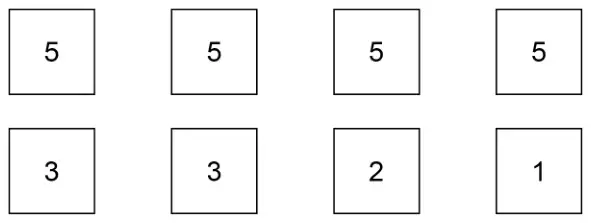
“The probability that the sum of the numbers on the two balls will be an even number is greater than the probability that the product of the numbers will be an even number.”
Is Lee correct? You must show how you get your answer. (5)
Mark scheme
Answer
Mark
Mark scheme
No (supported)
P1
for P(OO) = \(\dfrac{5}{9} \times \dfrac{4}{8}\ \left(= \dfrac{20}{72}\right)\) or P(OE) = \(\dfrac{5}{9} \times \dfrac{4}{8}\ \left(= \dfrac{20}{72}\right)\) or P(EO) = \(\dfrac{4}{9} \times \dfrac{5}{8}\ \left(= \dfrac{20}{72}\right)\) or P(EE) = \(\dfrac{4}{9} \times \dfrac{3}{8}\ \left(= \dfrac{12}{72}\right)\)
P1
for P(OO) = \(\dfrac{5}{9} \times \dfrac{4}{8}\ \left(= \dfrac{20}{72}\right)\) and P(EE) = \(\dfrac{4}{9} \times \dfrac{3}{8}\ \left(= \dfrac{12}{72}\right)\) OR for P(OE) = \(\dfrac{5}{9} \times \dfrac{4}{8}\ \left(= \dfrac{20}{72}\right)\) and P(EO) = \(\dfrac{4}{9} \times \dfrac{5}{8}\ \left(= \dfrac{20}{72}\right)\) and P(EE) = \(\dfrac{4}{9} \times \dfrac{3}{8}\ \left(= \dfrac{12}{72}\right)\)
P1
for a process to find probability of sum being even, eg P(OO) + P(EE) = \(\dfrac{5}{9} \times \dfrac{4}{8} + \dfrac{4}{9} \times \dfrac{3}{8}\ \left(= \dfrac{32}{72}\right)\)
P1
for a process to work with probability of product being even, eg P(EO) + P(OE) + P(EE) = \(\dfrac{4}{9} \times \dfrac{5}{8} + \dfrac{5}{9} \times \dfrac{4}{8} + \dfrac{4}{9} \times \dfrac{3}{8}\ \left(= \dfrac{52}{72}\right)\) or 1 – P(OO) = \(1 - \dfrac{5}{9} \times \dfrac{4}{8}\ \left(= \dfrac{52}{72}\right)\)
C1
for No supported by correct probabilities, eg \(\dfrac{32}{72}\) and \(\dfrac{52}{72}\)
SC B2 for \(\dfrac{41}{81}\) and \(\dfrac{56}{81}\) and No SC B1 for \(\dfrac{41}{81}\) and \(\dfrac{56}{81}\) with no decision or incorrect decision
Additional guidance
Accept equivalent probabilities throughout
Sample space diagram or listing: Award P3 for P(sum even) = \(\dfrac{32}{72}\) or P(product even) = \(\dfrac{52}{72}\), P4 for both
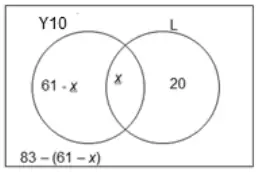
12 A factory makes mountain bikes and road bikes. Each bike has disc brakes or rim brakes or caliper brakes.
In June the factory makes a total of 240 bikes.
102 of the bikes are mountain bikes. 75 of the 110 bikes with disc brakes are mountain bikes. 105 bikes have rim brakes. 20 of the mountain bikes have caliper brakes.
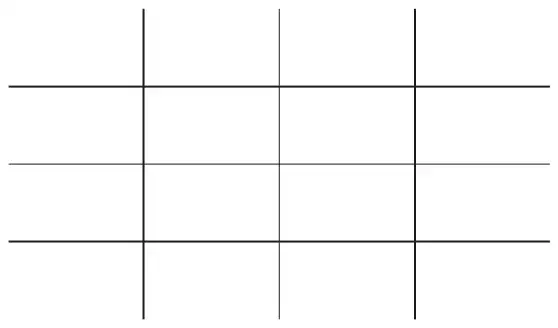
Use this information to complete the two-way table. (3)
22 There are only red counters and yellow counters in a box. \(\dfrac{3}{5}\) of the counters are red.
Sophie takes at random two counters from the box.
The probability that the two counters are the same colour is \(\dfrac{41}{80}\)
Work out the number of yellow counters in the box. You must show all your working. (5)
Mark scheme
Answer
Mark
Mark scheme
26
P1
for a correct 2nd probability, eg \(\dfrac{2x - 1}{5x - 1}\) or \(\dfrac{3x - 1}{5x - 1}\) or \(\dfrac{2x}{5x - 1}\) or \(\dfrac{3x}{5x - 1}\) or \(\dfrac{\frac{3}{5}n - 1}{n - 1}\) or \(\dfrac{\frac{2}{5}n - 1}{n - 1}\)
P1
for a correct product, eg \(\dfrac{3x}{5x} \times \dfrac{3x - 1}{5x - 1}\) or \(\dfrac{2x}{5x} \times \dfrac{2x - 1}{5x - 1}\) or \(\dfrac{3}{5} \times \dfrac{2x}{5x - 1}\) or \(\dfrac{2}{5} \times \dfrac{3x}{5x - 1}\) or \(\dfrac{3}{5} \times \dfrac{\frac{3}{5}n - 1}{n - 1}\) or \(\dfrac{2}{5} \times \dfrac{\frac{2}{5}n - 1}{n - 1}\) oe
P1
for process to form equation, eg \(\dfrac{3x}{5x} \times \dfrac{3x - 1}{5x - 1} + \dfrac{2x}{5x} \times \dfrac{2x - 1}{5x - 1} = \dfrac{41}{80}\) or \(2 \times \dfrac{3}{5} \times \dfrac{2x}{5x - 1} = \dfrac{39}{80}\) or \(\dfrac{3}{5} \times \dfrac{\frac{3}{5}n - 1}{n - 1} + \dfrac{2}{5} \times \dfrac{\frac{2}{5}n - 1}{n - 1}\) oe
P1
for process to eliminate fractions and reduce equation to linear or quadratic form, eg \(1040x - 400 = 1025x - 205\) or \(960x = 975x - 195\) or \(1040x^2 - 400x = 1025x^2 - 205x\) or \(960x^2 = 975x^2 - 195x\) or \(\dfrac{208}{5}n - 80 = 41n - 41\) or \(x = 13\) or \(n = 65\)
19 In the semi-finals of a chess tournament, player A will play player B and player C will play player D.
The two winners will then play each other in the final.
The probability that player A will win against player B is 0.6 The probability that player A will win against player C is 0.5 The probability that player A will win against player D is 0.3 The probability that player C will win against player D is 0.2
Work out the probability that player A will win the chess tournament. (4)
Mark scheme
Answer
Mark
Mark scheme
0.204
P1
for a process to find a correct product,
eg P(A plays C in the final) \(= 0.6 \times 0.2\ (= 0.12)\) or P(A plays D in the final) \(= 0.6 \times 0.8\ (= 0.48)\)
or P(A wins against B and C) \(= 0.6 \times 0.5\ (= 0.3)\) or P(A wins against B and D) \(= 0.6 \times 0.3\ (= 0.18)\)
P1
for a process to find the probability of A winning against C or winning against D in the final,
eg P(A wins against C in the final) \(= \text{``}0.12\text{''} \times 0.5\ (= 0.06)\) or P(A wins against D in the final) \(= \text{``}0.48\text{''} \times 0.3\ (= 0.144)\)
or P(A wins against C in the final) \(= \text{``}0.3\text{''} \times 0.2\ (= 0.06)\) or P(A wins against D in the final) \(= \text{``}0.18\text{''} \times 0.8\ (= 0.144)\)
P1
for a complete process,
eg P(A wins the tournament) \(= \text{``}0.06\text{''} + \text{``}0.144\text{''}\)
11 500 people were asked what type of film they liked best.
280 of the 500 people were adults. 100 of the adults said they liked action films best. 80 of the children said they liked thriller films best.
150 of the people said they liked action films best. 200 of the people said they liked comedy films best.
(a) Complete the two-way table.
Comedy
Thriller
Action
Total
Adults
Children
Total
500
(3)
One of these 500 people is chosen at random.
(b) Find the probability that this person is an adult who said they liked action films best. (2)
Mark scheme (a)
Answer
Mark
Mark scheme
110
70
100
280
90
80
50
220
200
150
150
500
C3
for a fully correct table
(C2
for 6 or 7 or 8 or 9 or 10 correct entries)
(C1
for 3 or 4 or 5 correct entries)
Mark scheme (b)
Answer
Mark
Mark scheme
\(\dfrac{100}{500}\)
M1
for \(\dfrac{a}{500}\) where \(0 \lt a \lt 500\) or for \(\dfrac{100}{b}\) where \(100 \lt b \leqslant 500\) or ft their table
A1
for \(\dfrac{100}{500}\) oe or ft their table
Additional guidance
100:500 scores M1A0
For M1 ft their table this is for \(\dfrac{\textit{their}\text{ value of adult action from table}}{c}\) where their value of action adult \(\lt c \leqslant 500\)
For A1 ft their table is for \(\dfrac{\textit{their}\text{ value of adult action from table}}{500}\)
18 There are only 4 red counters, 3 yellow counters and 1 green counter in a bag.
Tony takes at random three counters from the bag.
Work out the probability that there are now more yellow counters than red counters in the bag. You must show all your working. (5)
Mark scheme
Answer
Mark
Mark scheme
\(\dfrac{5}{28}\)
P1
for a correct probability for 2nd or 3rd counter, eg \(\dfrac{3}{7}\) or \(\dfrac{4}{7}\) or \(\dfrac{1}{7}\) or \(\dfrac{1}{6}\) or \(\dfrac{2}{6}\) or \(\dfrac{3}{6}\)
P1
for a correct product for 2 red and 1 green eg, \((\text{P(RRG)} =)\ \dfrac{4}{8} \times \dfrac{3}{7} \times \dfrac{1}{6}\ \left(= \dfrac{12}{336} \text{ or } \dfrac{1}{28}\right)\) or \((\text{P(RGR)} =)\ \dfrac{4}{8} \times \dfrac{1}{7} \times \dfrac{3}{6}\ \left(= \dfrac{12}{336} \text{ or } \dfrac{1}{28}\right)\) or \((\text{P(GRR)} =)\ \dfrac{1}{8} \times \dfrac{4}{7} \times \dfrac{3}{6}\ \left(= \dfrac{12}{336} \text{ or } \dfrac{1}{28}\right)\)
P1
for a correct product for 3 red, eg \((\text{P(RRR)} =)\ \dfrac{4}{8} \times \dfrac{3}{7} \times \dfrac{2}{6}\ \left(= \dfrac{24}{336} \text{ or } \dfrac{2}{28}\right)\)
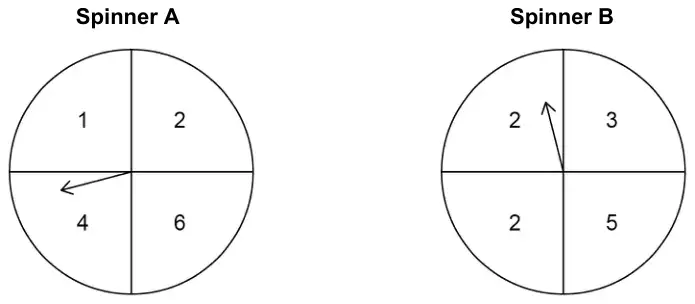
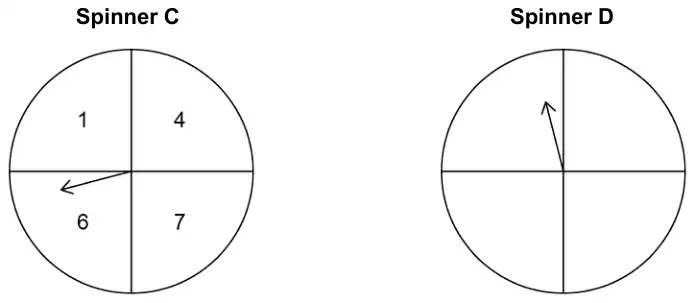
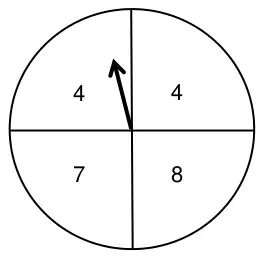
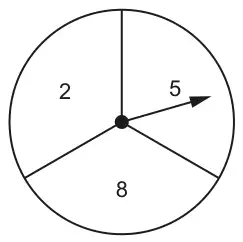
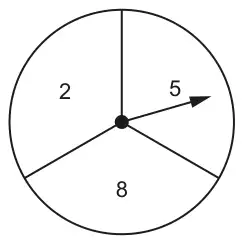
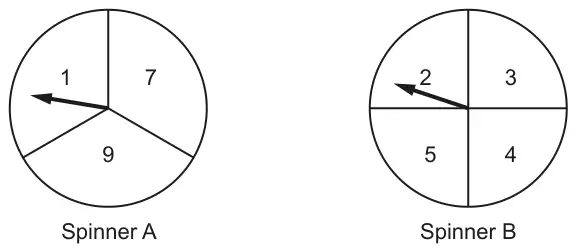
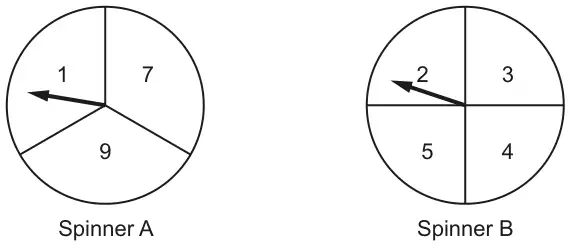
The probability that spinner A lands on red is \(\dfrac{1}{4}\)
The probability that both spinner A and spinner B land on red is \(\dfrac{1}{24}\)
Work out the probability that one spinner lands on red and the other spinner does not land on red. (4)
Mark scheme
Answer
Mark
Mark scheme
\(\dfrac{1}{3}\)
P1
for start of process to find the probability of spinner B landing on red eg \(\dfrac{1}{4}x = \dfrac{1}{24}\) oe or \(\dfrac{1}{24} \div \dfrac{1}{4}\) or \(x = \dfrac{1}{6}\)
P1
for process to find probability of one red and one not red eg \(\dfrac{1}{4} \times \left(1 - \text{``}\dfrac{1}{6}\text{''}\right) \left(= \dfrac{5}{24}\right)\) or \(\left(1 - \dfrac{1}{4}\right) \times \text{``}\dfrac{1}{6}\text{''} \left(= \dfrac{3}{24}\right)\)
or process to find probability of both not red, eg \(\left(1 - \text{``}\dfrac{1}{4}\text{''}\right) \times \left(1 - \text{``}\dfrac{1}{6}\text{''}\right) \left(= \dfrac{15}{24}\right)\)
P1
for a complete process to find the required probability eg \(\text{``}\dfrac{5}{24}\text{''} + \text{``}\dfrac{3}{24}\text{''}\) or \(1 - \dfrac{1}{24} - \text{``}\dfrac{15}{24}\text{''}\)
There are \(x\) pink counters and 5 blue counters in the box. The rest of the counters are green.
\(x : y = 1 : 3\)
Freda takes at random two counters from the box.
Find, in terms of \(x\), an expression for the probability that Freda takes two counters of the same colour.
Give your answer as a fraction in the form \(\dfrac{ax^2 + bx + c}{dx^2 + ex}\) where \(a\), \(b\), \(c\), \(d\) and \(e\) are integers. (5)
Mark scheme
Answer
Mark
Mark scheme
\(\dfrac{5x^2 - 23x + 50}{9x^2 - 3x}\)
P1
for using \(y = 3x\) or \(x = \dfrac{1}{3}y\) to obtain an expression for a probability in one variable
P1
for a correct second probability eg \(\dfrac{x - 1}{y - 1}\) or \(\dfrac{x - 1}{3x - 1}\) or \(\dfrac{4}{y - 1}\) or \(\dfrac{4}{3x - 1}\) or \(\dfrac{y - x - 6}{y - 1}\) or \(\dfrac{2x - 6}{3x - 1}\)
P1
for forming a correct product eg \(\dfrac{x}{y} \times \dfrac{x - 1}{y - 1}\) or \(\dfrac{x}{3x} \times \dfrac{x - 1}{3x - 1}\) or \(\dfrac{5}{y} \times \dfrac{4}{y - 1}\) or \(\dfrac{5}{3x} \times \dfrac{4}{3x - 1}\) or \(\dfrac{y - x - 5}{y} \times \dfrac{y - x - 6}{y - 1}\) or \(\dfrac{2x - 5}{3x} \times \dfrac{2x - 6}{3x - 1}\)
22 There are only blue pens and red pens in a box.
The number of blue pens is four times the number of red pens.
Rita takes at random one pen from the box. She records the colour of the pen and then replaces it in the box. Rita does this \(n\) times, where \(n \geqslant 2\)
Write down an expression, in terms of \(n\), for the probability that Rita gets a blue pen at least once and a red pen at least once. (2)
for start to the process, eg P(at least one blue and at least one red) = 1 − P(all blue) − P(all red) oe or P(all blue) = \(\left(\dfrac{4}{5}\right)^n\) oe or P(all red) = \(\left(\dfrac{1}{5}\right)^n\)
A1
for \(1 - \left(\dfrac{4}{5}\right)^n - \left(\dfrac{1}{5}\right)^n\) oe
The table shows information about the number that the dice lands on each time.
Number on dice
1
2
3
4
5
6
Frequency
12
7
8
9
9
15
Gethin throws the dice twice.
(a) Work out an estimate for the probability that the dice will land on 6 both times. (3)
Sally is going to throw the same dice \(n\) times and record the number it lands on each time.
She will use her results to work out a more reliable estimate for the probability in part (a).
(b) What can you say about the value of \(n\)? (1)
Mark scheme (a)
Answer
Mark
Mark scheme
\(\dfrac{225}{3600}\)
P1
for process to use relative frequency for landing on a 6, eg \(\dfrac{15}{60}\) oe
P1
for \(\dfrac{15}{60} \times \dfrac{15}{60}\) oe, eg \(\dfrac{1}{4} \times \dfrac{1}{4}\)
A1
for \(\dfrac{225}{3600}\) oe, eg \(\dfrac{1}{16}\)
Additional guidance
Accept any equivalent fraction, decimal form 0.06(25) or 0.062 or 0.063, percentage form 6(.25)% or 6.2% or 6.3% Ignore subsequent attempts to write the correct answer in a different form.
Mark scheme (b)
Answer
Mark
Mark scheme
Explanation
C1
for a correct explanation Acceptable examples \(n\) must be greater than 60 She must do it more times than in (a) \(n\) must be bigger, eg 100
Not acceptable examples If you increase the number of results, you increase the accuracy \(n\) must be bigger \(n\) is an integer \(n\) is 100
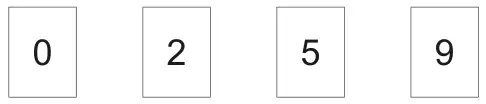
He has 3 blue cards 7 green cards and 1 white card.
Alfie takes at random 2 of these cards.
Work out the probability that he takes cards of different colours. (3)
Mark scheme
Answer
Mark
Mark scheme
\(\dfrac{62}{110}\)
P1
for process to find a probability of 2 cards of different colours, eg \(\dfrac{3}{11} \times \dfrac{7}{10}\) or \(\dfrac{3}{11} \times \dfrac{1}{10}\) or \(\dfrac{7}{11} \times \dfrac{3}{10}\) or \(\dfrac{7}{11} \times \dfrac{1}{10}\) or \(\dfrac{1}{11} \times \dfrac{3}{10}\) or \(\dfrac{1}{11} \times \dfrac{7}{10}\) oe or \(\dfrac{3}{11} \times \dfrac{8}{10}\) oe or \(\dfrac{7}{11} \times \dfrac{4}{10}\) oe or \(\dfrac{1}{11} \times \dfrac{10}{10}\) oe
for process to find a probability of 2 cards of the same colour, eg \(\dfrac{3}{11} \times \dfrac{2}{10}\) or \(\dfrac{7}{11} \times \dfrac{6}{10}\) or \(\dfrac{1}{11} \times \dfrac{0}{10}\) oe
P1
for a complete process, eg \(1 - \dfrac{3}{11} \times \dfrac{2}{10} - \dfrac{7}{11} \times \dfrac{6}{10}\ \left(- \dfrac{1}{11} \times \dfrac{0}{10}\right)\) oe
A1
for \(\dfrac{62}{110}\) oe
SC B1 for answer of \(\dfrac{62}{121}\) (replacement)
Additional guidance
May see fraction with denominator 110
Accept equivalent fraction, decimal form 0.56(36…) or percentage form 56(.36…)%
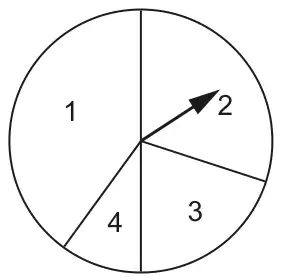
Lina is now going to spin the spinner another two times.
(a) Work out an estimate for the probability that she gets a score of 5 both times. (2)
Derek is going to spin the spinner a large number of times.
(b) Work out an estimate for the percentage of times Derek can expect to get a score of 1 (2)
Mark scheme (a)
Answer
Mark
Mark scheme
\(\dfrac{1}{16}\)
M1
for method to find probability of getting a score of 5, eg \(\dfrac{10}{6 + 8 + 9 + 7 + 10}\ \left(= \dfrac{10}{40}\right)\) oe
A1
for \(\dfrac{1}{16}\) oe
Additional guidance
Accept any equivalent fraction, decimal form 0.06(25) or 0.063, percentage form 6(.25)% or 6.3% Ignore subsequent incorrect attempts to write the correct answer in a different form.
Mark scheme (b)
Answer
Mark
Mark scheme
15
M1
for method to find the proportion of 1s, eg \(\dfrac{6}{40}\) oe
He works out the sum of the numbers on the three cards and records the result.
Work out the probability that the result is an even number. (4)
Mark scheme
Answer
Mark
Mark scheme
\(\dfrac{11}{21}\)
P1
for any product of 3 probabilities of the form \(\dfrac{a}{9} \times \dfrac{b}{8} \times \dfrac{c}{7}\) where \(a \lt 9\), \(b \lt 8\), \(c \lt 7\)
P1
for a product of 3 probabilities giving an even sum, eg E,E,E \(= \dfrac{4}{9} \times \dfrac{3}{8} \times \dfrac{2}{7}\) or E,O,O \(= \dfrac{4}{9} \times \dfrac{5}{8} \times \dfrac{4}{7}\)
P1
for summing the product of at least three correct triples, eg (E,E,E + E,O,O + O,O,E =) \(\dfrac{4}{9} \times \dfrac{3}{8} \times \dfrac{2}{7} + \dfrac{4}{9} \times \dfrac{5}{8} \times \dfrac{4}{7} + \dfrac{5}{9} \times \dfrac{4}{8} \times \dfrac{4}{7}\) OR \(3\left(\dfrac{4}{9} \times \dfrac{5}{8} \times \dfrac{4}{7}\right)\)
A1
for \(\dfrac{11}{21}\) oe
SCB1 for answer of \(\dfrac{364}{729}\) (replacement)
Additional guidance
May see fraction with denominator 504
Students who indicate they are using the approach P(even) = 1 – P(odd) should be given credit as appropriate
Accept any equivalent fraction, decimal form 0.52(38...) or percentage form 52(.38…)%
13 Sophie works in a bed shop. During the last three months she sold 198 beds.
59 beds were sold without a mattress. 45 beds were double beds. 17 of the single beds were sold without a mattress. 67 of the 83 king size beds were sold with a mattress.
Use this information to complete the two-way table. (3)
if it rains on one day, the probability that it will rain on the next day is 0.8 if it does not rain on one day, the probability that it will rain on the next day is 0.6
A weather forecaster says, “There is a 70% chance that it will rain in the village on Monday.”
Work out an estimate for the probability that it will rain in the village on Wednesday. You must show all your working. (4)
Mark scheme
Answer
Mark
Mark scheme
0.748
P1
for a process to find a correct probability product for 2 consecutive days, eg. \(0.7 \times 0.8\) (rain M + T) or \(0.7 \times 0.2\) (rain M + no rain T) or \(0.3 \times 0.6\) (no rain M + rain on T) or \(0.3 \times 0.4\) (no rain M + T)
P1
for process to find a correct triple probability product for it raining on Wednesday, eg. \(0.7 \times 0.8 \times 0.8\) (rain M + T + W) (= 0.448 or \(\dfrac{56}{125}\) oe) or \(0.7 \times 0.2 \times 0.6\) (rain M + no rain T + rain W) (= 0.084 or \(\dfrac{21}{250}\) oe) or \(0.3 \times 0.6 \times 0.8\) (no rain M + rain T + rain W) (= 0.144 or \(\dfrac{18}{125}\) oe) or \(0.3 \times 0.4 \times 0.6\) (no rain M + no rain T + rain W) (= 0.072 or \(\dfrac{9}{125}\) oe)
21 When a biased coin is thrown 4 times, the probability of getting 4 heads is \(\dfrac{16}{81}\)
Work out the probability of getting 4 tails when the coin is thrown 4 times. (2)
Mark scheme
Answer
Mark
Mark scheme
\(\dfrac{1}{81}\)
M1
for finding the probability of heads eg \(\sqrt[4]{\dfrac{16}{81}}\ \left(= \dfrac{2}{3}\right)\) or for finding the probability of tails \(1 - \sqrt[4]{\dfrac{16}{81}}\ \left(= \dfrac{1}{3}\right)\)
A1
oe
Additional guidance
Seeing a probability of \(\dfrac{2}{3}\) or \(\dfrac{1}{3}\) is enough for this mark
16 Marek has 9 cards. There is a number on each card.
1
2
3
4
5
6
7
8
9
Marek takes at random two of the cards. He works out the product of the numbers on the two cards.
Work out the probability that the product is an even number. (3)
Mark scheme
Answer
Mark
Mark scheme
\(\dfrac{52}{72}\)
P1
for \(\dfrac{4}{9} \times \dfrac{3}{8}\ \left(\dfrac{12}{72}\right)\) or \(\dfrac{4}{9} \times \dfrac{5}{8}\) or \(\dfrac{5}{9} \times \dfrac{4}{8}\ \left(\dfrac{20}{72}\right)\)
P1
for \(1 - \left(\dfrac{5}{9} \times \dfrac{4}{8}\right)\) or \(\dfrac{4}{9} \times \dfrac{3}{8} + \dfrac{4}{9} \times \dfrac{5}{8} + \dfrac{5}{9} \times \dfrac{4}{8}\) oe
A1
for \(\dfrac{52}{72}\), \(\dfrac{13}{18}\) oe
SC B1 for answer of \(\dfrac{56}{81}\) (replacement)
Additional guidance
Accept equivalent fractions, decimals (0.72…) or percentages (72.22…%)
14 Victoria throws an ordinary fair 6-sided dice once.
She says,
“The probability of getting a 3 is half the probability of getting a 6”
(a) Is Victoria correct? You must explain your answer. (1)
Andy throws the dice twice. He says,
“The probability of getting a 6 on both throws is \(\dfrac{2}{6}\)”
(b) Is Andy correct? You must explain your answer. (1)
Indre throws the dice once. She also throws a coin to get Heads or Tails.
(c) List all the possible outcomes she can get. (2)
Mark scheme (a)
Answer
Mark
Mark scheme
No (supported)
C1
No and explanation eg “it is \(\dfrac{1}{6}\)” or “each number is the same probability”
Acceptable examples No, they are both 1/6 (accept 1 in 6 or 1 : 6 etc) No, they are both the same No, an equal chance No, it’s a fair dice No, there’s only one of each number
Not acceptable examples No, it’s an even chance No, it’s 50 – 50 No, 1 : 6
Mark scheme (b)
Answer
Mark
Mark scheme
No (supported)
C1
No and explanation eg “it is out of 36” or “it is \(\dfrac{1}{6}\) times \(\dfrac{1}{6}\)”
Acceptable examples No, the probability is 1/36 No, it’s out of 36 No, he should times not add
Not acceptable examples No, it’s \(1/6 \times 1/6\), the probability is 1/12 No, he’s more likely to get it once only No, there’s only one 6 on a dice No, you will have a 2/12 chance
Mark scheme (c)
Answer
Mark
Mark scheme
1H, 2H, 3H, 4H, 5H, 6H, 1T, 2T, 3T, 4T, 5T, 6T
B2
for all 12 outcomes with no extras or repeats
(B1
for at least 6 correct outcomes, ignoring extras and repeats)
Additional guidance
Pairs must be unambiguous Accept words and abbreviations
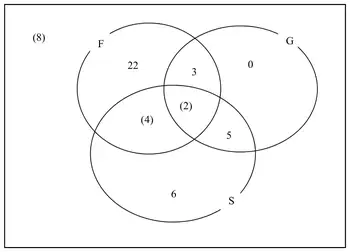
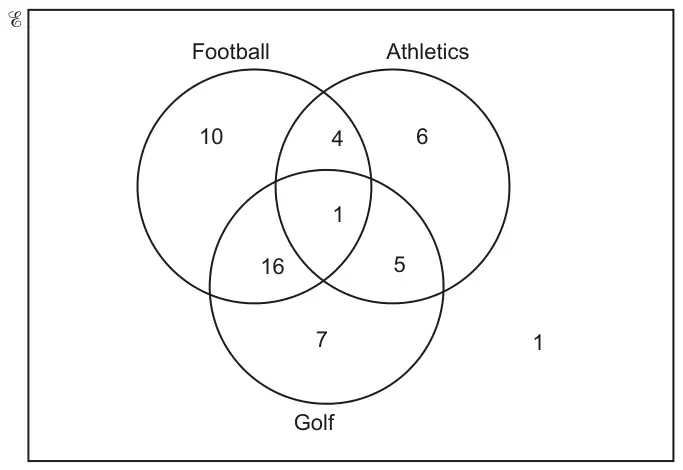
20 50 people were asked if they speak French or German or Spanish.
Of these people,
31 speak French 2 speak French, German and Spanish 4 speak French and Spanish but not German 7 speak German and Spanish 8 do not speak any of the languages all 10 people who speak German speak at least one other language
Two of the 50 people are chosen at random.
Work out the probability that they both only speak Spanish. (5)
Mark scheme
Answer
Mark
Mark scheme
\(\dfrac{6}{490}\)
P1
for start to process information, eg draws Venn diagram and shows at least 1 unknown amount, eg 5 speak German and Spanish but not French
P1
for process to find at least 3 unknown amounts from, eg 5 speak German and Spanish but not French 3 speak French and German but not Spanish 22 speak French but not German or Spanish 0 speak German but not French or Spanish
P1
for complete process to find number of people who speak only Spanish (= 6)
26 When a drawing pin is dropped it can land point down or point up.
Lucy, Mel and Tom each dropped the drawing pin a number of times.
The table shows the number of times the drawing pin landed point down and the number of times the drawing pin landed point up for each person.
Lucy
Mel
Tom
point down
31
53
16
point up
14
27
9
Rachael is going to drop the drawing pin once.
(a) Whose results will give the best estimate for the probability that the drawing pin will land point up? Give a reason for your answer. (1)
Stuart is going to drop the drawing pin twice.
(b) Use all the results in the table to work out an estimate for the probability that the drawing pin will land point up the first time and point down the second time. (2)
Mark scheme (a)
Answer
Mark
Notes
Mel (supported)
B1
Mel with reference to greatest number of throws
Mark scheme (b)
Answer
Mark
Notes
\(\dfrac{2}{9}\)
M1
selects overall total and multiplies P(point up) \(\times\) P(point down) eg \(\dfrac{50}{150} \times \dfrac{100}{150}\) oe (accept \(\dfrac{14}{45} \times \dfrac{31}{45}\) or \(\dfrac{27}{80} \times \dfrac{53}{80}\) or \(\dfrac{9}{25} \times \dfrac{16}{25}\))
21 There are 12 counters in a bag. There is an equal number of red counters, blue counters and yellow counters in the bag. There are no other counters in the bag.
3 counters are taken at random from the bag.
(a) Work out the probability of taking 3 red counters. (2)
The 3 counters are put back into the bag.
Some more counters are now put into the bag. There is still an equal number of red counters, blue counters and yellow counters in the bag. There are no counters of any other colour in the bag.
3 counters are taken at random from the bag.
(b) Is it now less likely or equally likely or more likely that the 3 counters will be red? You must show how you get your answer. (2)
Mark scheme (a)
Answer
Mark
Notes
\(\dfrac{1}{55}\)
M1
for \(\dfrac{4}{12} \times \dfrac{3}{11} \times \dfrac{2}{10}\)
A1
for \(\dfrac{1}{55}\) oe
Mark scheme (b)
Answer
Mark
Notes
Conclusion (supported)
C1
starts correct argument, eg by calculating a relevant probability, eg \(\dfrac{5}{15} \times \dfrac{4}{14} \times \dfrac{3}{13}\)
C1
statement of “more likely” from eg comparison of probabilities, ft answer to (a) eg \(\dfrac{1}{55}\ (= 0.018\ldots)\) and \(\dfrac{2}{91}\ (= 0.021\ldots\) or \(0.022)\)
8 When a drawing pin is dropped it can land point down or point up.
Lucy, Mel and Tom each dropped the drawing pin a number of times.
The table shows the number of times the drawing pin landed point down and the number of times the drawing pin landed point up for each person.
Lucy
Mel
Tom
point down
31
53
16
point up
14
27
9
Rachael is going to drop the drawing pin once.
(a) Whose results will give the best estimate for the probability that the drawing pin will land point up? Give a reason for your answer. (1)
Stuart is going to drop the drawing pin twice.
(b) Use all the results in the table to work out an estimate for the probability that the drawing pin will land point up the first time and point down the second time. (2)
Mark scheme (a)
Answer
Mark
Notes
Mel (supported)
B1
Mel with reference to greatest number of throws
Mark scheme (b)
Answer
Mark
Notes
\(\dfrac{2}{9}\)
M1
selects overall total and multiplies P(point up) \(\times\) P(point down) eg \(\dfrac{50}{150} \times \dfrac{100}{150}\) oe (accept \(\dfrac{14}{45} \times \dfrac{31}{45}\) or \(\dfrac{27}{80} \times \dfrac{53}{80}\) or \(\dfrac{9}{25} \times \dfrac{16}{25}\))
23 There are 7 blue counters, 3 green counters and 1 red counter in a bag. There are no other counters in the bag.
Hubert takes at random 2 counters from the bag.
(a) Work out the probability that both counters are blue. (3)
(b) Work out the probability that the 2 counters are different colours. (3)
Mark scheme (a)
Answer
Mark
Notes
\(\dfrac{42}{110}\)
3
M1 for use of 11 and 10 in the denominators M1 for \(\tfrac{7}{11} \times \tfrac{6}{10}\) oe A1 for \(\tfrac{42}{110}\) oe SC for replacement: B1 for \(\tfrac{7}{11} \times \tfrac{7}{11}\ \left(= \tfrac{49}{121}\right)\)
Mark scheme (b)
Answer
Mark
Notes
\(\dfrac{62}{110}\)
3
M1 for correct method for GG \(\tfrac{3}{11} \times \tfrac{2}{10}\ \left(= \tfrac{6}{110}\right)\) M1 (dep) \(1 - (\text{BB} + \text{GG}) = 1 - \left(\text{``}\tfrac{42}{110}\text{''} + \text{``}\tfrac{6}{110}\text{''}\right)\) A1 for \(\tfrac{62}{110}\) oe
OR M1 for at least two of \(\tfrac{7}{11} \times \tfrac{3}{10}\), \(\tfrac{7}{11} \times \tfrac{1}{10}\), \(\tfrac{3}{11} \times \tfrac{1}{10}\) oe M1 for a complete method eg \(2 \times \left(\tfrac{7}{11} \times \tfrac{3}{10} + \tfrac{7}{11} \times \tfrac{1}{10} + \tfrac{3}{11} \times \tfrac{1}{10}\right)\) oe A1 for \(\tfrac{62}{110}\) oe
SC for replacement: B2 for \(2 \times \left(\tfrac{7}{11} \times \tfrac{3}{11} + \tfrac{7}{11} \times \tfrac{1}{11} + \tfrac{3}{11} \times \tfrac{1}{11}\right)\) oe \(\left(= \tfrac{62}{121}\right)\) or \(\left(\tfrac{7}{11} \times \tfrac{4}{11} + \tfrac{3}{11} \times \tfrac{8}{11} + \tfrac{10}{11} \times \tfrac{1}{11}\right)\) oe \(\left(= \tfrac{62}{121}\right)\) or \(1 - \left(\text{``}\tfrac{49}{121}\text{''} + \tfrac{9}{121} + \tfrac{1}{121}\right)\) oe \(\left(= \tfrac{62}{121}\right)\) (B1 for at least two of \(\tfrac{7}{11} \times \tfrac{3}{11}\), \(\tfrac{7}{11} \times \tfrac{1}{11}\), \(\tfrac{3}{11} \times \tfrac{1}{11}\) oe)
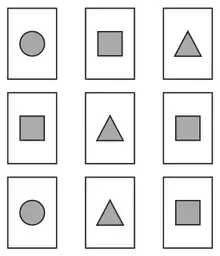
In a game the cards are turned over so that the shapes are hidden. The cards are then mixed up.
Katie turns over at random two of the cards. Work out the probability that these two cards have different shapes on them. You must show all your working. (4)
Mark scheme
Answer
Mark
Notes
\(\dfrac{52}{72}\)
4
B1 for \(\dfrac{3}{8}\) or \(\dfrac{2}{8}\) or \(\dfrac{1}{8}\) seen as second probability M1 for \(\dfrac{4}{9} \times \dfrac{3}{8}\) or \(\dfrac{3}{9} \times \dfrac{2}{8}\) or \(\dfrac{2}{9} \times \dfrac{1}{8}\) M1 for \(1 - \left(\dfrac{4}{9} \times \dfrac{3}{8} + \dfrac{3}{9} \times \dfrac{2}{8} + \dfrac{2}{9} \times \dfrac{1}{8}\right)\) or \(\dfrac{4}{9} \times \dfrac{3}{8} + \dfrac{4}{9} \times \dfrac{2}{8} + \dfrac{3}{9} \times \dfrac{4}{8} + \dfrac{3}{9} \times \dfrac{2}{8} + \dfrac{2}{9} \times \dfrac{4}{8} + \dfrac{2}{9} \times \dfrac{3}{8}\) A1 for \(\dfrac{52}{72}\) oe OR B1 for \(\dfrac{5}{8}\) or \(\dfrac{6}{8}\) or \(\dfrac{7}{8}\) seen as second probability M1 for \(\dfrac{4}{9} \times \dfrac{5}{8}\) or \(\dfrac{3}{9} \times \dfrac{6}{8}\) or \(\dfrac{2}{9} \times \dfrac{7}{8}\) M1 for \(\dfrac{4}{9} \times \dfrac{5}{8} + \dfrac{3}{9} \times \dfrac{6}{8} + \dfrac{2}{9} \times \dfrac{7}{8}\) A1 for \(\dfrac{52}{72}\) oe
M1 for any 3 combinations with no incorrect combinations or for \(3 \times 3\) A1 for all 9 combinations with no duplicates or extras or for 9 B1 (dep on M1) for \(\dfrac{1}{\text{``}9\text{''}}\)
Alternative scheme B1 for \(\frac{1}{3}\) seen M1 for \(\frac{1}{3} \times \frac{1}{3}\) A1 for \(\frac{1}{9}\) oe
She has 18 fruit sweets 7 aniseed sweets 5 mint sweets
Nomusa is going to take at random two sweets.
Work out the probability that the two sweets will not be the same type of sweet.
You must show all your working.(4)
Mark scheme
Working
Answer
Mark
Notes
\(\tfrac{18}{30}\times\tfrac{12}{29}+\tfrac{7}{30}\times\tfrac{23}{29}+\tfrac{5}{30}\times\tfrac{25}{29}\) or \(1 - \left(\tfrac{18}{30}\times\tfrac{17}{29}+\tfrac{7}{30}\times\tfrac{6}{29}+\tfrac{5}{30}\times\tfrac{4}{29}\right)\) or \(\tfrac{18}{30}\times\tfrac{7}{29}+\tfrac{18}{30}\times\tfrac{5}{29}+\tfrac{7}{30}\times\tfrac{18}{29}\) \(+\tfrac{7}{30}\times\tfrac{5}{29}+\tfrac{5}{30}\times\tfrac{18}{29}+\tfrac{5}{30}\times\tfrac{7}{29}\)
\(\dfrac{502}{870}\)
4
B1 for a second ‘branch’ probability seen (could be seen in a tree) M1 for a product of any first and second stage correct probabilities M1 for a complete method to find the required probability A1 for \(\tfrac{502}{870}\) oe Note if decimals used they must be correct to 2 decimal places
SC with replacement B2 for \(\tfrac{502}{900}\) oe B0 M1 \(\tfrac{18}{30}\times\tfrac{12}{30}\) or \(\tfrac{7}{30}\times\tfrac{23}{30}\) or \(\tfrac{5}{30}\times\tfrac{25}{30}\) M1 \(\tfrac{18}{30}\times\tfrac{12}{30}+\tfrac{7}{30}\times\tfrac{23}{30}+\tfrac{5}{30}\times\tfrac{25}{30}\) A0
19 There are \(n\) sweets in a bag. 6 of the sweets are orange. The rest of the sweets are yellow.
Hannah takes at random a sweet from the bag. She eats the sweet.
Hannah then takes at random another sweet from the bag. She eats the sweet.
The probability that Hannah eats two orange sweets is \(\dfrac{1}{3}\)
(a) Show that \(n^2 - n - 90 = 0\) (3)
(b) Solve \(n^2 - n - 90 = 0\) to find the value of \(n\). (3)
Mark scheme (a)
Answer
Mark
Notes
Proof
3
M1 for \(\dfrac{6}{n}\) or \(\dfrac{5}{n - 1}\) M1 for \(\dfrac{6}{n} \times \dfrac{5}{n - 1} \left(= \dfrac{1}{3}\right)\) A1 for fully correct algebra leading to \(n^2 - n - 90 = 0\)
Mark scheme (b)
Answer
Mark
Notes
10
3
M1 for correct start to a solution, eg. \((n \pm 10)(n \pm 9)\) or substitution into the quadratic formula, condoning one sign error or \((n - 0.5)^2 - 0.25 - 90\) A1 for \((n - 10)(n + 9)\) or for 10 and \(-9\) or \(\tfrac{1 \mp 19}{2}\) oe A1 for 10 only
23 Paul has 8 cards. There is a number on each card.
Paul takes at random 3 of the cards. He adds together the 3 numbers on the cards to get a total \(T\).
Work out the probability that \(T\) is an odd number. (4)
Mark scheme
Answer
Mark
Notes
\(\dfrac{156}{336}\)
4
Method 1 (Combinations for odd T) M1 for one probability for odd T, eg P(2,3,4) = \(\tfrac{1}{8} \times \tfrac{2}{7} \times \tfrac{1}{6}\) or P(2,4,5) = \(\tfrac{1}{8} \times \tfrac{1}{7} \times \tfrac{4}{6}\) or P(3,3,5) = \(\tfrac{2}{8} \times \tfrac{1}{7} \times \tfrac{4}{6}\) or P(3,5,5) = \(\tfrac{2}{8} \times \tfrac{4}{7} \times \tfrac{3}{6}\) or P(5,5,5) = \(\tfrac{4}{8} \times \tfrac{3}{7} \times \tfrac{2}{6}\) M1 for adding at least two probabilities for odd T, eg \(\tfrac{1}{8} \times \tfrac{2}{7} \times \tfrac{1}{6} + \tfrac{1}{8} \times \tfrac{1}{7} \times \tfrac{4}{6}\) or \(3\left(\tfrac{2}{8} \times \tfrac{1}{7} \times \tfrac{4}{6}\right)\) M1 for completely correct method, ie \(6\left(\tfrac{1}{8} \times \tfrac{2}{7} \times \tfrac{1}{6}\right) + 6\left(\tfrac{1}{8} \times \tfrac{1}{7} \times \tfrac{4}{6}\right) + 3\left(\tfrac{2}{8} \times \tfrac{1}{7} \times \tfrac{4}{6}\right) + 3\left(\tfrac{2}{8} \times \tfrac{4}{7} \times \tfrac{3}{6}\right) + \left(\tfrac{4}{8} \times \tfrac{3}{7} \times \tfrac{2}{6}\right)\) oe A1 for \(\tfrac{156}{336}\) oe, eg \(\tfrac{13}{28}\) or 0.46(4…)
OR Method 2 (Combinations for even T) M1 for one probability for even T, eg P(3,4,5) = \(\tfrac{2}{8} \times \tfrac{1}{7} \times \tfrac{4}{6}\) or P(2,3,3) = \(\tfrac{1}{8} \times \tfrac{2}{7} \times \tfrac{1}{6}\) or P(2,5,5) = \(\tfrac{1}{8} \times \tfrac{4}{7} \times \tfrac{3}{6}\) or P(2,3,5) = \(\tfrac{1}{8} \times \tfrac{2}{7} \times \tfrac{4}{6}\) or P(4,5,5) = \(\tfrac{1}{8} \times \tfrac{4}{7} \times \tfrac{3}{6}\) or P(3,3,4) = \(\tfrac{2}{8} \times \tfrac{1}{7} \times \tfrac{1}{6}\) M1 for adding at least two probabilities for even T, eg \(\tfrac{2}{8} \times \tfrac{1}{7} \times \tfrac{4}{6} + \tfrac{1}{8} \times \tfrac{2}{7} \times \tfrac{1}{6}\) or \(3\left(\tfrac{1}{8} \times \tfrac{2}{7} \times \tfrac{1}{6}\right)\) M1 for completely correct method, ie \(1 - \left[6\left(\tfrac{2}{8} \times \tfrac{1}{7} \times \tfrac{4}{6}\right) + 3\left(\tfrac{1}{8} \times \tfrac{2}{7} \times \tfrac{1}{6}\right) + 3\left(\tfrac{1}{8} \times \tfrac{4}{7} \times \tfrac{3}{6}\right) + 6\left(\tfrac{1}{8} \times \tfrac{2}{7} \times \tfrac{4}{6}\right) + 3\left(\tfrac{1}{8} \times \tfrac{4}{7} \times \tfrac{3}{6}\right) + 3\left(\tfrac{2}{8} \times \tfrac{1}{7} \times \tfrac{1}{6}\right)\right]\) oe A1 for \(\tfrac{156}{336}\) oe, eg \(\tfrac{13}{28}\) or 0.46(4…)
OR Method 3 (Combinations of odd and even numbers - odd totals) M1 for one probability for odd T, eg P(E,E,O) = \(\tfrac{2}{8} \times \tfrac{1}{7} \times \tfrac{6}{6}\) or P(O,O,O) = \(\tfrac{6}{8} \times \tfrac{5}{7} \times \tfrac{4}{6}\) M1 for adding at least two probabilities for odd T, eg \(3\left(\tfrac{2}{8} \times \tfrac{1}{7} \times \tfrac{6}{6}\right)\) or \(\left(\tfrac{2}{8} \times \tfrac{1}{7} \times \tfrac{6}{6}\right) + \left(\tfrac{6}{8} \times \tfrac{5}{7} \times \tfrac{4}{6}\right)\) M1 for completely correct method, ie \(3\left(\tfrac{2}{8} \times \tfrac{1}{7} \times \tfrac{6}{6}\right) + \left(\tfrac{6}{8} \times \tfrac{5}{7} \times \tfrac{4}{6}\right)\) A1 for \(\tfrac{156}{336}\) oe, eg \(\tfrac{13}{28}\) or 0.46(4…)
OR Method 4 (combinations of odd and even numbers - even totals) M1 for probability for even T, ie = \(\tfrac{2}{8} \times \tfrac{6}{7} \times \tfrac{5}{6}\) M1 for adding at least two probabilities for even T, eg \(3\left(\tfrac{2}{8} \times \tfrac{6}{7} \times \tfrac{5}{6}\right)\) M1 for completely correct method, ie \(1 - 3\left(\tfrac{2}{8} \times \tfrac{6}{7} \times \tfrac{5}{6}\right)\) A1 for \(\tfrac{156}{336}\) oe, eg \(\tfrac{13}{28}\) or 0.46(4…)
SC (with replacement) For example, M0 M1 for adding at least two probabilities for odd or even T, eg P(E,E,O) = \(\tfrac{2}{8} \times \tfrac{2}{8} \times \tfrac{6}{8}\) or P(O,O,O) = \(\tfrac{6}{8} \times \tfrac{6}{8} \times \tfrac{6}{8}\) M1 for completely correct method, eg \(3\left(\tfrac{2}{8} \times \tfrac{2}{8} \times \tfrac{6}{8}\right) + \left(\tfrac{6}{8} \times \tfrac{6}{8} \times \tfrac{6}{8}\right)\) or \(\tfrac{288}{512}\) oe, eg \(\tfrac{9}{16}\) or 0.56(25) A0
*22 Shabeen has a biased coin. The probability that the coin will land on heads is 0.6
Shabeen is going to throw the coin 3 times.
She says the probability that the coin will land on tails 3 times is less than 0.1
Is Shabeen correct? You must show all your working. (3)
Mark scheme
Answer
Mark
Notes
Yes
3
M1 for \(1 - 0.6\) (=0.4) M1 for \((\text{``}0.4\text{''})^3\) oe C1 (dep on M1) for 0.064 oe leading to a correct deduction
OR
M1 for \(1 - \text{Pr}(3\text{H}, 0\text{T}) - \text{Pr}(2\text{H}, 1\text{T}) - \text{Pr}(1\text{H}, 2\text{T})\) oe M1 for \(1 - (0.6)^3 - 3(0.6)^2(0.4) - 3(0.6)(0.4)^2\) C1 (dep on M1) for 0.064 oe leading to a correct deduction
26 Fiza has 10 coins in a bag. There are three £1 coins and seven 50 pence coins.
Fiza takes at random, 3 coins from the bag.
Work out the probability that she takes exactly £2.50 (4)
Mark scheme
Working
Answer
Mark
Notes
50 1 1 1 50 1 1 1 50
\(\dfrac{126}{720}\)
4
M1 for 3 fractions \(\dfrac{a}{10}, \dfrac{b}{9}, \dfrac{c}{8}\) where \(a \lt 10\), \(b \lt 9\) and \(c \lt 8\) M1 for \(\dfrac{7}{10} \times \dfrac{3}{9} \times \dfrac{2}{8}\) or \(\dfrac{3}{10} \times \dfrac{7}{9} \times \dfrac{2}{8}\) or \(\dfrac{3}{10} \times \dfrac{2}{9} \times \dfrac{7}{8}\) \(\left(= \dfrac{42}{720}\right)\) M1 for \(\dfrac{7}{10} \times \dfrac{3}{9} \times \dfrac{2}{8} + \dfrac{3}{10} \times \dfrac{7}{9} \times \dfrac{2}{8} + \dfrac{3}{10} \times \dfrac{2}{9} \times \dfrac{7}{8}\) or \(3 \times \dfrac{3}{10} \times \dfrac{2}{9} \times \dfrac{7}{8}\) A1 for \(\dfrac{126}{720}\) oe. eg. \(\dfrac{7}{40}\)
Alternative Scheme for With Replacement M1 for \(\dfrac{7}{10} \times \dfrac{3}{10} \times \dfrac{3}{10}\) \(\left(= \dfrac{63}{1000}\right)\) M1 for \(\dfrac{7}{10} \times \dfrac{3}{10} \times \dfrac{3}{10} \times 3\) \(\left(= \dfrac{189}{1000}\right)\) M0 A0 No further marks
24 There are three different types of sandwiches on a shelf.
There are 4 egg sandwiches, 5 cheese sandwiches and 2 ham sandwiches.
Erin takes at random 2 of these sandwiches.
Work out the probability that she takes 2 different types of sandwiches. (5)
Mark scheme
Working
Answer
Mark
Notes
EE + CC + HH
\(\dfrac{76}{110}\)
5
M1 for use of 10 as denominator for 2nd probability M1 for \(\frac{4}{11} \times \frac{3}{10}\) or \(\frac{5}{11} \times \frac{4}{10}\) or \(\frac{2}{11} \times \frac{1}{10}\) M1 for \(\frac{4}{11} \times \frac{3}{10} + \frac{5}{11} \times \frac{4}{10} + \frac{2}{11} \times \frac{1}{10}\) \(\left(= \frac{34}{110}\right)\) M1 (dep on previous M1) for \(1 -\) ‘\(\frac{34}{110}\)’ A1 for \(\frac{76}{110}\) oe
Or EC+EH+CE+CH+HE+HC
Or M1 for use of 10 as denominator for 2nd probability M1 for \(\frac{4}{11} \times \frac{5}{10}\) or \(\frac{4}{11} \times \frac{2}{10}\) or \(\frac{5}{11} \times \frac{4}{10}\) or \(\frac{5}{11} \times \frac{2}{10}\) or \(\frac{2}{11} \times \frac{4}{10}\) or \(\frac{2}{11} \times \frac{5}{10}\) M2 for \(\frac{4}{11} \times \frac{5}{10} + \frac{4}{11} \times \frac{2}{10} + \frac{5}{11} \times \frac{4}{10} + \frac{5}{11} \times \frac{2}{10} + \frac{2}{11} \times \frac{4}{10} + \frac{2}{11} \times \frac{5}{10}\) (M1 for at least 3 of these) A1 for \(\frac{76}{110}\) oe
Or E,not E + C,not C + H,not H
Or M1 for use of 10 as denominator for 2nd probability M1 for \(\frac{4}{11} \times \frac{7}{10}\) or \(\frac{5}{11} \times \frac{6}{10}\) or \(\frac{2}{11} \times \frac{9}{10}\) M2 for \(\frac{4}{11} \times \frac{7}{10} + \frac{5}{11} \times \frac{6}{10} + \frac{2}{11} \times \frac{9}{10}\) (M1 for two of these added) A1 for \(\frac{76}{110}\) oe
(a) On the probability scale below, mark with a cross (\(\times\)) the probability that he gets a head.(1)
Ann rolls a fair dice once.
(b) On the probability scale below, mark with a cross (\(\times\)) the probability that she gets a 7(1)
Fred throws a fair coin and rolls a fair dice.
(c)
(i) List all the possible combinations. The first one has been done for you. (H, 1)
(ii) Write down the probability that Fred gets a head and an even number. (4)
Mark scheme (a)
Answer
Mark
Notes
Cross at \(\frac{1}{2}\)
1
B1 for cross (\(\times\)) within overlay
Mark scheme (b)
Answer
Mark
Notes
Cross at 0
1
B1 for cross (\(\times\)) within overlay
Mark scheme (c)
Working
Answer
Mark
Notes
(i) H1 H2 H3 H4 H5 H6 T1 T2 T3 T4 T5 T6
(ii)
\(\frac{3}{12}\)
4
(i) M1 for evidence of attempting combinations eg at least 5 correct A1 for all 12, no extras or repeats (Can repeat H1)
(ii) M1 ft for evidence of correct numerator or denominator in a fraction less than 1 A1 ft from (i) Note probability must written as a percentage, decimal or fraction
Jim takes at random a tile. He does not replace the tile. Jim then takes at random a second tile.
(a) Calculate the probability that both the tiles Jim takes have the number 1 on them. (2)
(b) Calculate the probability that the number on the second tile Jim takes is greater than the number on the first tile he takes. (3)
Mark scheme (a)
Working
Answer
Mark
Notes
\(\dfrac{2}{7} \times \dfrac{1}{6}\) OR
\(\dfrac{2}{42}\)
2
M1 \(\dfrac{2}{7} \times \dfrac{1}{6}\) A1 \(\dfrac{2}{42}\) oe OR M1 Fully correct sample space with the correct cases identified A1 \(\dfrac{2}{42}\) oe SC : B1 for an answer of \(\dfrac{4}{49}\)
Mark scheme (b)
Working
Answer
Mark
Notes
\(\dfrac{2}{7} \times \dfrac{5}{6} + \dfrac{3}{7} \times \dfrac{2}{6}\) OR
\(\dfrac{16}{42}\)
3
M1 for identifying all 3 possibilities of (1,2) and (1,3) and (2,3) OR at least one of \(\frac{2}{7} \times \frac{3}{6}\) (1, 2) or \(\frac{2}{7} \times \frac{2}{6}\) (1, 3) or \(\frac{3}{7} \times \frac{2}{6}\) (2, 3) or \(\frac{2}{7} \times \frac{5}{6}\) (1, 2 or 3) M1 \(\frac{2}{7} \times \frac{5}{6} + \frac{3}{7} \times \frac{2}{6}\) or \(\frac{2}{7} \times \frac{3}{6} + \frac{2}{7} \times \frac{2}{6} + \frac{3}{7} \times \frac{2}{6}\) A1 \(\frac{16}{42}\) oe OR M2 Fully correct sample space with the correct cases identified (M1 for 1,2 and 1,3 and 2,3 identified on a sample space) A1 \(\frac{16}{42}\) oe SC: B2 for an answer of \(\frac{16}{49}\)
B1 for \(\frac{12}{19}\) or \(\frac{5}{19}\) or \(\frac{3}{19}\) (could be seen in working or on a tree diagram) M1 for \(\frac{12}{20} \times \frac{5}{19}\) or \(\frac{12}{20} \times \frac{3}{19}\) or \(\frac{5}{20} \times \frac{12}{19}\) or \(\frac{5}{20} \times \frac{3}{19}\) or \(\frac{3}{20} \times \frac{12}{19}\) or \(\frac{3}{20} \times \frac{5}{19}\) M1 for \(\frac{12}{20} \times \frac{5}{19} + \frac{12}{20} \times \frac{3}{19} + \frac{5}{20} \times \frac{12}{19} + \frac{5}{20} \times \frac{3}{19} + \frac{3}{20} \times \frac{12}{19} + \frac{3}{20} \times \frac{5}{19}\) A1 for \(\frac{222}{380}\) oe or 0.58(421...) OR B1 for \(\frac{8}{19}\) or \(\frac{15}{19}\) or \(\frac{17}{19}\) M1 for \(\frac{12}{20} \times \frac{8}{19}\) or \(\frac{5}{20} \times \frac{15}{19}\) or \(\frac{3}{20} \times \frac{17}{19}\) M1 for \(\frac{12}{20} \times \frac{8}{19} + \frac{5}{20} \times \frac{15}{19} + \frac{3}{20} \times \frac{17}{19}\) A1 for \(\frac{222}{380}\) oe or 0.58(421...) OR B1 for \(\frac{11}{19}\) or \(\frac{4}{19}\) or \(\frac{2}{19}\) M1 for \(\frac{12}{20} \times \frac{11}{19}\) or \(\frac{5}{20} \times \frac{4}{19}\) or \(\frac{3}{20} \times \frac{2}{19}\) M1 for \(1 - \left(\frac{12}{20} \times \frac{11}{19} + \frac{5}{20} \times \frac{4}{19} + \frac{3}{20} \times \frac{2}{19}\right)\) A1 for \(\frac{222}{380}\) oe or 0.58(421...)
Notes
NB if decimals used they must be correct to at least 2 decimal places
SC : with replacement B2 for \(\frac{111}{200}\) oe OR e.g. B0 M1 for \(\frac{12}{20} \times \frac{8}{20}\) or \(\frac{5}{20} \times \frac{15}{20}\) or \(\frac{3}{20} \times \frac{17}{20}\) M1 for \(\frac{12}{20} \times \frac{8}{20} + \frac{5}{20} \times \frac{15}{20} + \frac{3}{20} \times \frac{17}{20}\) A0
17 When a biased coin is spun, \(\quad\) P(Heads) : P(Tails) \(= 5 : 2\)
In a game, the player spins the coin four times.
The player can win in two ways.
1st way to win Spin 4 heads
2nd way to win Spin a Head, then a Tail, then a Head, then a Tail
How many times more likely is a player to win the 1st way than the 2nd way? [3 marks]
Mark scheme
Answer
Mark
Comments
\(\left(\dfrac{5}{5 + 2}\right)^4\) or \(\left(\dfrac{5}{7}\right)^4\) or \(\dfrac{625}{2401}\) or \(\left(\dfrac{5}{7}\right)^2 \times \left(1 - \dfrac{5}{7}\right)^2\) or \(\left(\dfrac{5}{7}\right)^2 \times \left(\dfrac{2}{7}\right)^2\) or \(\dfrac{100}{2401}\)
M1
oe eg \([0.71, 0.72]^4\) or [0.25, 0.27] or \([0.71, 0.72]^2 \times [0.28, 0.29]^2\) or [0.039, 0.044]
\(\left(\dfrac{5}{7}\right)^4 \div \left[\left(\dfrac{5}{7}\right)^2 \times \left(\dfrac{2}{7}\right)^2\right]\) or \(\dfrac{625}{2401} \div \dfrac{100}{2401}\)
M1dep
oe full method eg \([0.71, 0.72]^4 \div ([0.71, 0.72]^2 \times [0.28, 0.29]^2)\) or \([0.25, 0.27] \div [0.039, 0.044]\)
6.25 or \(6\dfrac{1}{4}\)
A1
oe value eg \(\dfrac{625}{100}\)
Additional guidance
Working in percentages can score up to 3 marks eg \([71, 72]^4\) or [25 000 000, 27 000 000] or \([71, 72]^2 \times [28, 29]^2\) or [3 900 000, 4 400 000] \([71, 72]^4 \div ([71, 72]^2 \times [28, 29]^2)\) 6.25
M1
M1dep A1
\(5^4\) or 625 or \(5^2 \times 2^2\) or 100 with no further correct working scores M0 but \(5^4 \div (5^2 \times 2^2)\) or \(625 \div 100\) scores M1M1
Ashley picks three of the discs at random without replacement.
Ashley’s first disc is red.
Work out the probability that all three discs are different colours. [3 marks]
Mark scheme
Answer
Mark
Comments
\(\dfrac{9}{24}\) or \(\dfrac{5}{24}\)
M1
oe eg 0.375 or 0.208(3…) may be seen on a diagram or embedded in a calculation
\(\dfrac{9}{24} \times \dfrac{5}{23}\ (\times 2)\) or \(\dfrac{5}{24} \times \dfrac{9}{23}\ (\times 2)\) or \(\dfrac{45}{552}\ (\times 2)\)
M1dep
oe eg \(\dfrac{15}{184}\ (\times 2)\) or 0.08(15…) \((\times 2)\)
\(\dfrac{90}{552}\) or \(\dfrac{15}{92}\) or 0.163(0…)
A1
oe fraction, decimal or percentage accept 0.16 with M2 awarded
Additional guidance
Ignore incorrect conversion if correct answer seen
A correct embedded value seen eg \(\dfrac{11}{25} \times \dfrac{9}{24} \times \dfrac{5}{23}\) or \(\dfrac{11}{25} \times \dfrac{5}{24} \times \dfrac{9}{23}\)
13 A bag contains one £5 note, one £10 note, one £20 note and one £50 note.
Amaan picks two of the notes at random without replacement.
Work out the probability that he has picked at least £30 [2 marks]
Mark scheme
Answer
Mark
Comments
Alternative method 1
\(4 \times 3\ (\div 2)\) or \(12\ (\div 2)\) or 6 or correct list of all possible combinations or all possible qualifying combinations (5,10) (5,20) 5,50 (10,5) 10,20 10,50 (20,5) 20,10 20,50 50,5 50,10 50,20 or (5,10) (5,20) 5,50 10,20 10,50 20,50
M1
number of possible combinations
may be implied by the correct total for each combination
\(\dfrac{4}{6}\) or \(\dfrac{8}{12}\)
A1
oe fraction, decimal or percentage with M1 awarded
Alternative method 2
\(\dfrac{1}{4} \times \dfrac{1}{3}\) or \(\dfrac{1}{12}\) and \(\dfrac{1}{4} \times \dfrac{2}{3}\ (\times 2)\) or \(\dfrac{2}{12}\ (\times 2)\) or \(\dfrac{4}{12}\) and \(\dfrac{1}{4}\ (\times 1)\) or \(\dfrac{3}{12}\)
M1
picking £5 first
picking £10 first or £20 first
picking £50 first oe probabilities
\(\dfrac{4}{6}\) or \(\dfrac{8}{12}\)
A1
oe fraction, decimal or percentage with M1 awarded
Additional guidance
Decimals or percentages should be rounded or truncated to 2dp or better
In Alt 1, combinations may be seen in a grid, table or other diagram
In Alt 1, do not accept repeat combinations or incorrect combinations for M1
9 A number is picked at random from the first three positive odd numbers.
A number is picked at random from the first four prime numbers.
The two numbers are multiplied to get a score.
(a) Complete the table. [4 marks]
prime
\(\times\)
2
3
7
odd
1
5
15
(b) What is the probability that the score is a square number?
Give your answer as a fraction. [2 marks]
Mark scheme (a)
Answer
Mark
Comments
3 in left column
B1
5 in top row
B1
All products correct
B2ft
ft their 3 and their 5 B1ft 3 to 10 correctly evaluated products
Additional guidance
If their 3 is 0, 1 or 5, do not consider those products If their 5 is 0, 2, 3 or 7, do not consider those products
Mark scheme (b)
Answer
Mark
Comments
\(\dfrac{\text{their number of square numbers}}{\text{their number of completed cells}}\)
B2ft
oe fraction ft their table even if incomplete B1ft their number of square numbers as a numerator or their number of completed cells as a denominator or square numbers identified on their grid or in working
Additional guidance
ft must produce a non-zero probability to score
Ignore attempt to simplify or convert if correct fraction seen
To play the game Choose tiles at random one at a time and do not replace the tiles. You win if at any stage the total of the numbers on your tiles is 10
Amber plays the game once.
Work out the probability that she wins. [4 marks]
Mark scheme
Answer
Mark
Comments
\(\dfrac{4}{8} \times \dfrac{3}{7}\) or \(\dfrac{12}{56}\) or \(\dfrac{3}{14}\)
M1
oe fractions or decimals probability of first two discs being 5s
\(\dfrac{4}{8} \times \dfrac{2}{7} \times \dfrac{1}{6}\) or \(\dfrac{8}{336}\) or \(\dfrac{1}{42}\)
M1
oe fractions or decimals probability of one 5, one 3 and one 2
\(6 \times\) their \(\dfrac{1}{42}\) or \(\dfrac{1}{7}\)
M1dep
oe fraction or decimal probability of three discs with a total of 10 dep on 2nd M1 accept 3! for 6
\(\dfrac{5}{14}\) or 0.357(1…) or 35.7(1…)%
A1
oe fraction, decimal or percentage allow 0.36 or 36% with M3 awarded
Additional guidance
For M marks allow decimals rounded to 2 dp or better
Ignore incorrect simplification or conversion after correct answer seen
Option 2 Pick one card from Set B and pick one card from Set C
The cards are picked at random.
The player wins if the total of their two cards is exactly 10
Which option gives a better chance of winning?
Option 1
Option 2
Show working to support your answer. [4 marks]
Mark scheme
Answer
Mark
Comments
\(\dfrac{3}{8}\ (\times)\ \dfrac{2}{7}\) or \(\dfrac{6}{56}\) or \(\dfrac{3}{28}\)
M1
oe fraction, decimal or percentage allow \(\dfrac{2}{7}\) to be [0.285, 0.286] or [28.5, 28.6]% allow \(\dfrac{6}{56}\) to be [0.107, 0.107143] or [10.7, 10.7143]% may be seen on a tree diagram allow 6 out of 56
\(\dfrac{1}{7}\ (\times)\ \dfrac{1}{4}\ (\times 2)\) or \(\dfrac{1}{28}\ (\times 2)\) or \(\dfrac{2}{28}\) or \(\dfrac{1}{14}\)
M1
oe fraction, decimal or percentage allow \(\dfrac{1}{7}\) to be [0.142, 0.143] or [14.2, 14.3]% allow \(\dfrac{1}{28}\) to be [0.035, 0.036] or [3.5, 3.6]% allow \(\dfrac{2}{28}\) to be [0.071, 0.07143] or [7.1, 7.143]% may be seen on a tree diagram allow 1 out of 28 or 2 out of 28
\(\dfrac{6}{56}\) and \(\dfrac{2}{28}\)
A1
oe fractions, decimals or percentages allow 6 out of 56 and 2 out of 28
Probabilities in comparable form and Option 1
A1ft
ft their \(\dfrac{6}{56}\) and their \(\dfrac{2}{28}\) with M2A0 correct comparisons include \(\dfrac{3}{28}\) and \(\dfrac{2}{28}\) \(\dfrac{6}{56}\) and \(\dfrac{4}{56}\) 0.107 and 0.071 10.7% and 7.1% 6 out of 56 and 4 out of 56
Additional guidance
Up to M2 may be awarded for correct work with no answer or incorrect answer, even if this is seen amongst multiple attempts
3 ways to win in Option 1 and 2 ways to win in Option 2 so Option 1
M0M0A0A0
\(\dfrac{3}{8} \times \dfrac{2}{7} = \dfrac{6}{56} \qquad \dfrac{1}{7} \times \dfrac{1}{4} = \dfrac{1}{28}\) \(\dfrac{6}{56}\) and \(\dfrac{2}{56}\) and Option 1
M1M1 A0A1ft
Assuming replacement can score a maximum of M0M1A0A0
Choosing Option 1 cannot be implied by inequalities
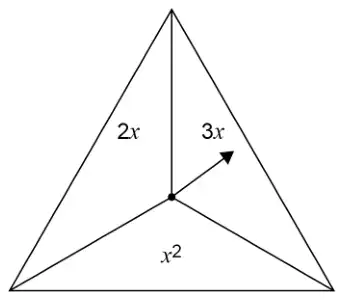
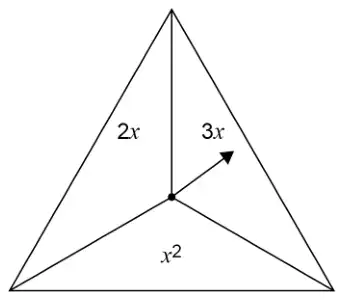
The score is the dice number substituted into the spinner expression.
(a) Complete the table to show all of the possible scores. [2 marks]
1
2
3
4
5
6
\(2x\)
8
\(3x\)
6
\(x^2\)
25
(b) A player wins the game if their score is 10 or more.
Work out the probability that they win the game. [1 mark]
(c) The game is played 711 times.
Estimate the number of games that are won. [2 marks]
Mark scheme (a)
Answer
Mark
Comments
All values correct
B2
B1 1 or 2 rows correct
Additional guidance
1
2
3
4
5
6
\(2x\)
2
4
6
8
10
12
\(3x\)
3
6
9
12
15
18
\(x^2\)
1
4
9
16
25
36
B2
Mark scheme (b)
Answer
Mark
Comments
\(\dfrac{8}{18}\) or \(\dfrac{4}{9}\) or 0.44(4…) or 44(.4…)%
B1ft
oe fraction, decimal or percentage ft their table with \(\geqslant 12\) values must be using 18 for the total number of possible scores
Additional guidance
Ignore simplification or conversion attempt (not ratio) after correct probability seen
Ratio answer eg 8 : 18, even alongside a correct probability is B0
ft decimals or percentages must be correct to the same accuracy as in the scheme eg 10 winning values in their table \(\dfrac{10}{18}\) or 0.55(5…) or 0.56 or 0.556 or 55(.5…)% or 56% or 55.6%
B1ft
Mark scheme (c)
Answer
Mark
Comments
\(711 \times\) their \(\dfrac{8}{18}\)
M1
oe ft their probability from (b) or if no probability in (b), ft their table with \(\geqslant 12\) values where \(0 \lt\) their probability \(\lt 1\) probabilities, if rounded in (c), must be truncated or rounded to at least 2 sf
316
A1
SC2 395
Additional guidance
Answer 316
M1A1
\(\dfrac{316}{711}\) on answer line
M1A0
Condone 316 out of 711
M1A1
Do not treat estimating by rounding as a misread eg1 700 used instead of 711 eg2 (b) 0.44 (c) \(0.4 \times 711\) (rounded to 1sf in (c) for the probability) eg3 (b) 0.4 (c) \(0.4 \times 711\) (follows through their (b))
M0A0 M0A0 M1A0
Do not allow ft for a ratio from (b) but may ft their (a) instead
For \(0.44 \times 711\), accept \(44\% \times 711\) but do not accept 44% of 711 unless recovered
The method mark may be implied by a ft answer (decimal or truncated to the nearest integer or rounded up to the nearest integer) eg1 (b) \(\dfrac{7}{18}\) (c) 276.5 or 276 or 277 (correct ft method implied using (b)) eg2 (a) completed table has 7 winning values (b) no probability shown (c) 276.5 or 276 or 277 (correct ft method implied using (a))
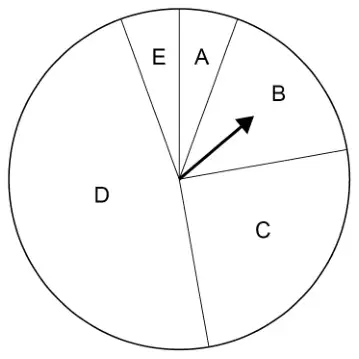
The spinner is most likely to land on section \(\ldots\ldots\)
The spinner is equally likely to land on sections \(\ldots\ldots\) and \(\ldots\ldots\)
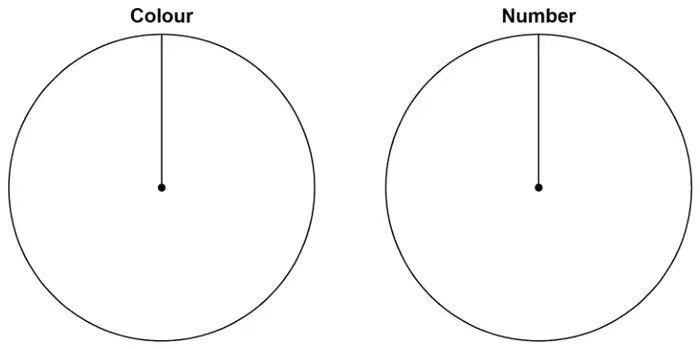
(b) Two different spinners are spun.
One spinner has sections labelled with colours. The other spinner has sections labelled with numbers.
Here is a list of all the possible outcomes.
Red 1
Red 2
Red 3
Red 4
Blue 1
Blue 2
Blue 3
Blue 4
Green 1
Green 2
Green 3
Green 4
Show the possible sections on the two spinners. [2 marks]
Mark scheme (a)
Answer
Mark
Comments
D
B1
A and E
B1
either order
Mark scheme (b)
Answer
Mark
Comments
Colour spinner with all sections labelled red, blue or green with at least one of each and number spinner with all sections labelled 1, 2, 3 or 4 with at least one of each
B2
B1 one spinner with all sections labelled red, blue or green with at least one of each or one spinner with all sections labelled 1, 2, 3 or 4 with at least one of each
Additional guidance
Allow any unambiguous labelling eg R for Red
Allow any unambiguous splitting into sections eg unruled
Number spinner under Colour heading and/or Colour spinner under Number heading can score a maximum of B1
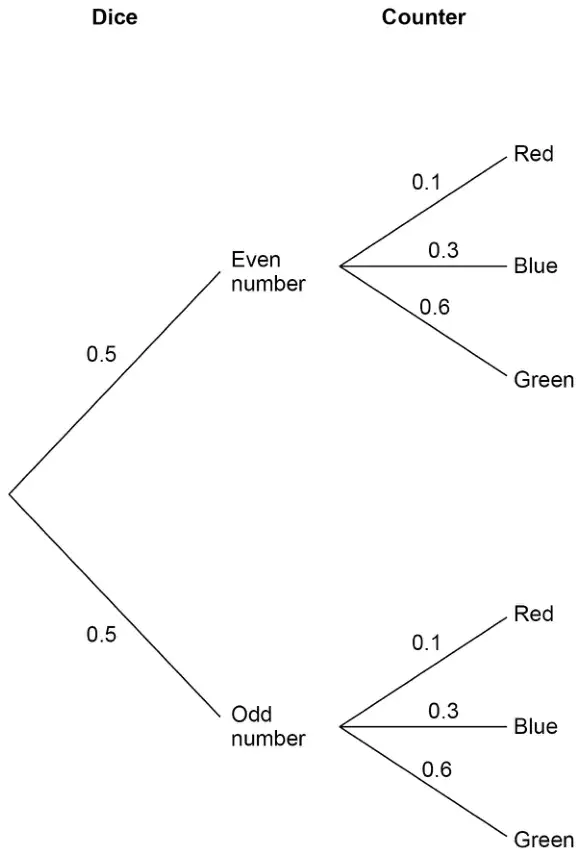
20 There should be a train leaving a station every hour from 7 am
No trains leave early.
P(the first train leaves on time) = 0.9
For all the other trains,
if the previous train did leave on time, P(this train leaves on time) = 0.8 if the previous train did not leave on time, P(this train leaves on time) = 0.65
(a) Work out \(\quad\) P(the first three trains leave on time) [2 marks]
(b) The 2 pm train does not leave on time.
Work out \(\quad\) P(exactly one of the next two trains does not leave on time) [3 marks]
Mark scheme (a)
Answer
Mark
Comments
\(0.9 \times 0.8^2\) or \(0.9 \times 0.64\)
M1
oe
0.576 or 0.58 or \(\dfrac{72}{125}\)
A1
oe fraction decimal or percentage
Additional guidance
Ignore any attempt to convert a correct answer
M1A1
Mark scheme (b)
Answer
Mark
Comments
Alternative method 1
(late, on time =) \((1 - 0.65) \times 0.65\) or \(0.35 \times 0.65\) or 0.2275 or (on time, late =) \(0.65 \times (1 - 0.8)\) or \(0.65 \times 0.2\) or 0.13
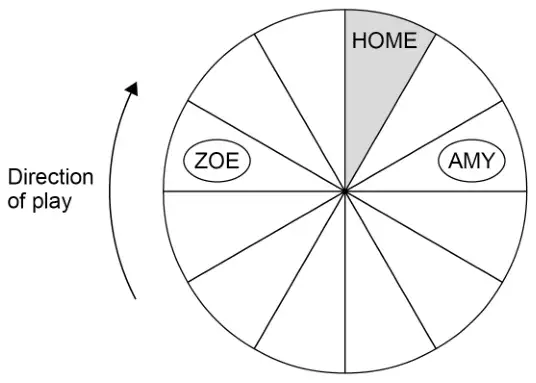
They each have one disc and take turns to roll a fair, ordinary dice.
The player moves their disc clockwise the number of spaces shown on the dice.
The winner is the first player whose disc is on HOME at the end of a turn.
Here is the board after Amy’s turn.
Work out the probability that Zoe wins within her next two turns. [4 marks]
Mark scheme
Answer
Mark
Comments
\((\text{P}(3) =)\ \dfrac{1}{6}\) or \((\text{P}(1, 2) =)\) or \((\text{P}(2, 1) =)\) \(\dfrac{1}{6} \times \dfrac{1}{6}\) or \(\dfrac{1}{36}\)
M1
oe 3 on first roll or 1 on first roll and 2 on second or 2 on first roll and 1 on second
\(\dfrac{1}{6}\) and \(\dfrac{1}{6} \times \dfrac{1}{6}\) or \(\dfrac{1}{6}\) and \(\dfrac{1}{36}\) or \(\dfrac{1}{6} \times \dfrac{1}{6} \times 2\) or \(\dfrac{1}{36} \times 2\) or \(\dfrac{2}{6} \times \dfrac{1}{6}\) or \(\dfrac{2}{36}\)
\(\dfrac{2}{9}\) or \(\dfrac{8}{36}\) or \(\dfrac{4}{18}\)
A1
oe fraction, decimal or percentage
Additional guidance
For the first and second marks, do not allow \(\dfrac{1}{6}\) seen only as part of a multiplication string, but do allow it seen only in an addition
For the first and second marks, do not allow \(\dfrac{1}{6} \times \dfrac{1}{6}\ (\times 2)\) or \(\dfrac{2}{6} \times \dfrac{1}{6}\) seen only as part of a longer multiplication string or in \(1 - \left(\dfrac{1}{6} \times \dfrac{1}{6}\right)\), but do allow them seen only in an addition
Allow working in decimals rounded correctly to at least 2 dp for M marks, but answer must be given correctly as \(0.\dot{2}\) or \(22.\dot{2}\)%
Ignore an incorrect simplification or conversion of a correct value
Two of the discs are taken at random from the bag.
Work out the probability that the first disc has a smaller number than the second disc. [4 marks]
Mark scheme
Answer
Mark
Comments
Alternative method 1
\(\dfrac{4}{20} \times \dfrac{16}{19}\) or \(\dfrac{64}{380}\) or \(\dfrac{16}{95}\) or \(\dfrac{6}{20} \times \dfrac{10}{19}\) or \(\dfrac{60}{380}\) or \(\dfrac{3}{19}\) or \(\dfrac{7}{20} \times \dfrac{3}{19}\) or \(\dfrac{21}{380}\)
M1
oe fractions or decimals condone \(\dfrac{4}{20} \times \dfrac{16}{20}\) etc
Any 2 of \(\dfrac{4}{20} \times \dfrac{16}{19}\) or \(\dfrac{64}{380}\) or \(\dfrac{16}{95}\) and \(\dfrac{6}{20} \times \dfrac{10}{19}\) or \(\dfrac{60}{380}\) or \(\dfrac{3}{19}\) and \(\dfrac{7}{20} \times \dfrac{3}{19}\) or \(\dfrac{21}{380}\)
oe fractions or decimals eg \(\dfrac{16}{95} + \dfrac{3}{19} + \dfrac{21}{380}\)
\(\dfrac{145}{380}\) or \(\dfrac{29}{76}\) or [0.381, 0.382] or [38.1%, 38.2%]
A1
accept 0.38 or 38% with full working SC2 \(\dfrac{145}{400}\) or \(\dfrac{29}{80}\) or 0.3625 or 36.25%
Alternative method 2
\(\dfrac{6}{20} \times \dfrac{4}{19}\) or \(\dfrac{24}{380}\) or \(\dfrac{6}{95}\) or \(\dfrac{7}{20} \times \dfrac{10}{19}\) or \(\dfrac{70}{380}\) or \(\dfrac{7}{38}\) or \(\dfrac{3}{20} \times \dfrac{17}{19}\) or \(\dfrac{51}{380}\)
M1
oe fractions or decimals condone \(\dfrac{6}{20} \times \dfrac{4}{20}\) etc
Any 2 of \(\dfrac{6}{20} \times \dfrac{4}{19}\) or \(\dfrac{24}{380}\) or \(\dfrac{6}{95}\) and \(\dfrac{7}{20} \times \dfrac{10}{19}\) or \(\dfrac{70}{380}\) or \(\dfrac{7}{38}\) and \(\dfrac{3}{20} \times \dfrac{17}{19}\) or \(\dfrac{51}{380}\)
oe fractions or decimals eg \(\dfrac{6}{95} + \dfrac{7}{38} + \dfrac{51}{380}\)
\(\dfrac{145}{380}\) or \(\dfrac{29}{76}\) or [0.381, 0.382] or [38.1%, 38.2%]
A1
accept 0.38 or 38% with full working SC2 \(\dfrac{145}{400}\) or \(\dfrac{29}{80}\) or 0.3625 or 36.25%
Alternative method 3
\(\dfrac{6}{20} \times \dfrac{15}{19}\) or \(\dfrac{90}{380}\) or \(\dfrac{9}{38}\) or \(\dfrac{7}{20} \times \dfrac{9}{19}\) or \(\dfrac{63}{380}\) or \(\dfrac{3}{20} \times \dfrac{2}{19}\) or \(\dfrac{6}{380}\) or \(\dfrac{3}{190}\)
M1
oe fractions or decimals condone \(\dfrac{6}{20} \times \dfrac{15}{20}\) etc
Any 2 of \(\dfrac{6}{20} \times \dfrac{15}{19}\) or \(\dfrac{90}{380}\) or \(\dfrac{9}{38}\) and \(\dfrac{7}{20} \times \dfrac{9}{19}\) or \(\dfrac{63}{380}\) and \(\dfrac{3}{20} \times \dfrac{2}{19}\) or \(\dfrac{6}{380}\) or \(\dfrac{3}{190}\)
\(\dfrac{145}{380}\) or \(\dfrac{29}{76}\) or [0.381, 0.382] or [38.1%, 38.2%]
A1
accept 0.38 or 38% with full working SC2 \(\dfrac{145}{400}\) or \(\dfrac{29}{80}\) or 0.3625 or 36.25%
Alternative method 4
\(\dfrac{7}{20} \times \dfrac{16}{19}\) or \(\dfrac{112}{380}\) or \(\dfrac{28}{95}\) or \(\dfrac{6}{20} \times \dfrac{9}{19}\) or \(\dfrac{54}{380}\) or \(\dfrac{27}{190}\) or \(\dfrac{4}{20} \times \dfrac{3}{19}\) or \(\dfrac{12}{380}\) or \(\dfrac{3}{95}\)
M1
oe fractions or decimals condone \(\dfrac{7}{20} \times \dfrac{16}{20}\) etc
Any 2 of \(\dfrac{7}{20} \times \dfrac{16}{19}\) or \(\dfrac{112}{380}\) or \(\dfrac{28}{95}\) and \(\dfrac{6}{20} \times \dfrac{9}{19}\) or \(\dfrac{54}{380}\) or \(\dfrac{27}{190}\) and \(\dfrac{4}{20} \times \dfrac{3}{19}\) or \(\dfrac{12}{380}\) or \(\dfrac{3}{95}\)
16 The table shows information about how 150 students travel to school.
Walk
Bus
Car
Girls
22
33
17
Total = 72
Boys
24
41
13
Total = 78
(a) What fraction of the girls walk to school?
Give your answer in its simplest form. [2 marks]
(b) One of the boys is chosen at random.
What is the probability that the boy travels to school by bus? [1 mark]
(c) What percentage of the 150 students travel to school by car? [2 marks]
Mark scheme (a)
Answer
Mark
Comments
\(\dfrac{11}{36}\)
B2
B1 \(\dfrac{22}{72}\) or 11 out of 36 or correctly simplified proper fraction that originally had a denominator >13
Additional guidance
Condone 11 out of 36 with \(\dfrac{11}{36}\) (together on the answer line) \(\dfrac{11}{36}\) in working and 11 out of 36 on answer line
B2 B1
\(\dfrac{22}{150} = \dfrac{11}{75}\)
B1
\(\dfrac{2}{4} = \dfrac{1}{2}\)
B0
22 out of 72 with no other working 22 out of 72 with \(\dfrac{22}{72}\)
B0 B1
11 : 36
B0
Mark scheme (b)
Answer
Mark
Comments
\(\dfrac{41}{78}\)
B1
oe fraction, decimal or percentage
Additional guidance
Ignore attempts to simplify or convert a correct fraction
Ignore probability words
Decimals or percentages to 2sf or better
41 out of 78 or 41 in 78 or 41 : 78 is B0 however, condone 41 out of 78 or 41 in 78 with a correct fraction, decimal or percentage (together on answer line) but do not accept 41 : 78 with a correct fraction, decimal or percentage (together on answer line)
B1 B0
Mark scheme (c)
Answer
Mark
Comments
\(\dfrac{17 + 13}{150}\) or \(\dfrac{30}{150}\) or \(30 \div 150\) or 0.2
M1
oe
20
A1
SC1 for 80 (not car) or 49 or better (Bus) or 31 or better (Walk)
2 balls are taken from the bag at random without replacement.
(a) Write down the probability that there is at least 1 red ball still in the bag. [1 mark]
(b) Work out the probability that there are at least 2 red balls still in the bag. [3 marks]
Mark scheme (a)
Answer
Mark
Comments
1 or 100%
B1
oe fraction, decimal or percentage eg \(\dfrac{56}{56}\)
Additional guidance
Do not accept answers in words only, eg ‘Certain’
B0
Mark scheme (b)
Answer
Mark
Comments
Alternative method 1
\(\dfrac{3}{8}\) and \(\dfrac{2}{7}\) or \(\dfrac{6}{56}\)
M1
may be seen on a tree diagram oe fraction, decimal or percentage eg \(\dfrac{3}{28}\)
\(1 - \left(\dfrac{3}{8} \times \dfrac{2}{7}\right)\) or \(1 - \dfrac{6}{56}\)
M1dep
\(\dfrac{50}{56}\)
A1
oe fraction, decimal or percentage eg \(\dfrac{25}{28}\)
Alternative method 2
\(\dfrac{5}{8}\) and \(\dfrac{4}{7}\) or \(\dfrac{20}{56}\) or \(\dfrac{5}{8}\) and \(\dfrac{3}{7}\) or \(\dfrac{3}{8}\) and \(\dfrac{5}{7}\) or \(\dfrac{15}{56}\) or \(\dfrac{30}{56}\)
M1
may be seen on a tree diagram oe fraction, decimal or percentage
\(\dfrac{5}{8} \times \dfrac{4}{7} + 2\left(\dfrac{5}{8} \times \dfrac{3}{7}\right)\) or \(\dfrac{20}{56} + 2\left(\dfrac{15}{56}\right)\) or \(\dfrac{20}{56} + \dfrac{30}{56}\)
oe fraction, decimal or percentage eg \(\dfrac{25}{28}\)
Additional guidance
Condone a correct pair of fractions seen in a multiplication chain for M1 eg \(\dfrac{3}{8} \times \dfrac{2}{7} \times \dfrac{1}{6}\) or \(\dfrac{5}{8} \times \dfrac{2}{7} \times \dfrac{3}{8} \times \dfrac{4}{7}\) (includes \(\dfrac{5}{8} \times \dfrac{4}{7}\))
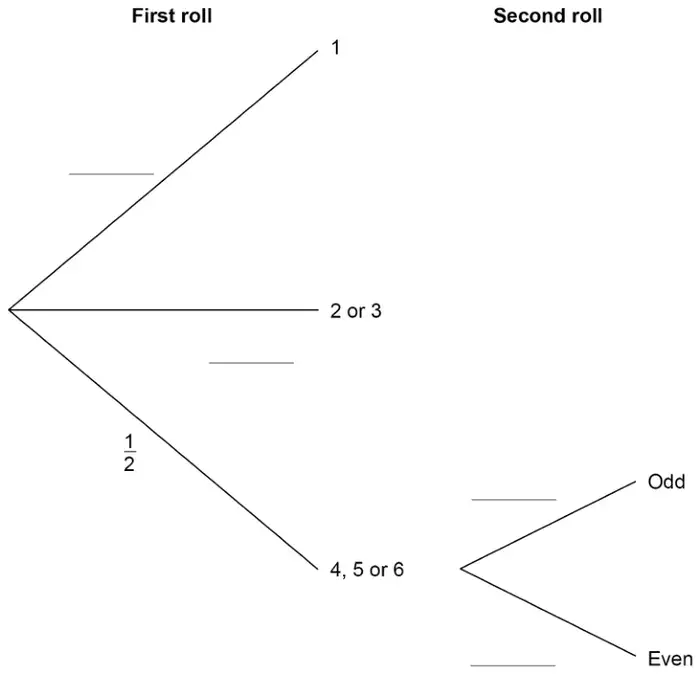
If she rolls 1 she wins. If she rolls 2 or 3 she loses. If she rolls 4, 5 or 6 she rolls again.
When she has to roll again,
if she rolls an odd number she wins if she rolls an even number she loses.
(a) Complete the tree diagram with the four missing probabilities. [2 marks]
(b) Is Anna more likely to win or to lose?
You must work out the probability that she wins. [4 marks]
Mark scheme (a)
Answer
Mark
Comments
\(\dfrac{1}{6}\) on ‘1’ and \(\dfrac{1}{3}\) or \(\dfrac{2}{6}\) on ‘2 or 3’ and \(\dfrac{1}{2}\) on each of ‘Odd’ and ‘Even’
B2
oe fraction, decimal or percentage B1 \(\dfrac{1}{6}\) on ‘1’ and \(\dfrac{1}{3}\) or \(\dfrac{2}{6}\) on ‘2 or 3’ or \(\dfrac{1}{2}\) on each of ‘Odd’ and ‘Even’ or all correct unsimplified probabilities with one or more simplification errors eg \(\dfrac{3}{6}\) on ‘Odd’ simplified to \(\dfrac{1}{3}\)
Additional guidance
Accept decimals or percentages rounded or truncated correctly to at least 2 significant figures
Only withhold a mark for simplification errors if B2 would otherwise be awarded
Ignore extra branches added
Ignore attempts to work out combined probabilities to the right of the tree diagram
If an answer line is blank, the student may have written their answer elsewhere on the branch
Mark scheme (b)
Answer
Mark
Comments
Alternative method 1: P(1) + P(4, 5 or 6) × P(Odd)
\(\dfrac{1}{2}\) \(\times\) their \(\dfrac{1}{2}\) or \(\dfrac{1}{4}\)
M1
oe
their \(\dfrac{1}{4}\) + their \(\dfrac{1}{6}\)
M1dep
oe
(P(win) =) \(\dfrac{10}{24}\) or \(\dfrac{5}{12}\)
A1ft
oe ft their tree diagram
Lose (and P(Lose) = \(\dfrac{14}{24}\) or \(\dfrac{7}{12}\) oe)
A1ft
ft correct decision for their \(\dfrac{5}{12}\) (and their \(\dfrac{7}{12}\)) with M2 scored
Alternative method 2: 1 – P(2 or 3) – P(4, 5 or 6) × P(Even)
\(\dfrac{1}{2}\) \(\times\) their \(\dfrac{1}{2}\) or \(\dfrac{1}{4}\)
M1
oe
their \(\dfrac{1}{4}\) + their \(\dfrac{1}{3}\) or P(lose) = \(\dfrac{7}{12}\)
M1dep
oe ft their tree diagram
(P(win) =) \(\dfrac{10}{24}\) or \(\dfrac{5}{12}\)
A1ft
oe ft their tree diagram
Lose (and P(Lose) = \(\dfrac{14}{24}\) or \(\dfrac{7}{12}\) oe)
A1ft
ft correct decision for their \(\dfrac{5}{12}\) (and their \(\dfrac{7}{12}\)) with M2 scored
Additional guidance
Check the tree diagram for working
Any ‘their’ or ft probability must be \(> 0\) and \(< 1\) for marks to be awarded
For the second A1ft, the ft can be from an incorrect tree (which may score 4 marks) or an arithmetic error (which scores 3 marks, M1M1A0A1ft)
Accept equivalent fractions or decimals within calculations and equivalent fractions, decimals or percentages for final probabilities
Accept decimals or percentages rounded or truncated correctly to at least 2 significant figures
Condone \(\dfrac{1}{2}\) \(\times\) their \(\dfrac{1}{2}\) as part of a longer, incorrect multiplication eg \(\dfrac{1}{2} \times \dfrac{1}{2} \times \dfrac{1}{6}\)
M1M0A0A0
Condone decimals used within fractions eg P(Win) \(= \dfrac{2.5}{6}\)
at least M1M1A1
For the method marks, condone incorrect mathematical notation eg \(\dfrac{1}{2} \times \dfrac{1}{2} = \dfrac{1}{4} + \dfrac{1}{6} = \ldots\)
at least M1M1 (may go on to score 3 or 4 marks)
For the second A1ft, if the student gives a value for P(Lose), their P(Win) + their P(Lose) must equal 1 However, allow a comparison to \(\dfrac{1}{2}\) unless it is clearly an incorrect value for P(Lose)
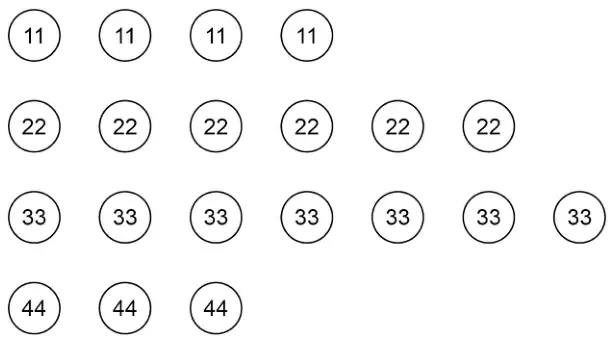
Work out the probability that the total of the two numbers is more than 30 [3 marks]
Mark scheme
Answer
Mark
Comments
Alternative Method 1
Lists at least 5 correct combinations or at least 5 correct outcomes or constructs correct two-way table eg 17 and 12 or 29 17 and 23 or 40 17 and 15 or 32 17 and 16 or 33 12 and 23 or 35 12 and 15 or 27 12 and 16 or 28 23 and 15 or 38 23 and 16 or 39 15 and 16 or 31 or
17
12
23
15
16
17
12
23
15
16
M1
outcomes may be seen in the two-way table
ignore additional combinations such as 17 and 17 for M1
ignore any totals in a correctly constructed two-way table
17 and 12 & 12 and 17 are accepted as two different combinations
Fully correct list or two-way table eg 29, 40, 32, 33, 35, 27, 28, 38, 39, 31 or 40, 32, 33, 35, 38, 39, 31 or
17
12
23
15
16
17
29
40
32
33
12
29
35
27
28
23
40
35
38
39
15
32
27
38
31
16
33
28
39
31
A1
accept ticks/crosses with correct pairs instead of values
in the two-way table, it is acceptable to have only one set of ten cells completed (top right or bottom left) if all correct
accept ticks and/or crosses in cells
do not accept incorrect combinations such as 17 and 17 for A1
\(\dfrac{7}{10}\) or 0.7 or 70%
A1ft
oe ft their list or two-way table with M1 scored and a probability > 0 and < 1
Alternative Method 2
States that outcomes of 30 or under may only be achieved by using the 12
M1
oe
Lists the three (or six) combinations which give outcomes of 30 or under 12 and 15 (15 and 12) 12 and 16 (16 and 12) 12 and 17 (17 and 12) or Lists the three outcomes of 30 or under (may be repeated) 27 28 29
A1
\(\dfrac{7}{10}\) or 0.7 or 70%
A1ft
oe ft their list with M1 scored and a probability > 0 and < 1 eg if only 27 and 28 found and answer 0.8 given score M1A0A1ft
Additional guidance
Correct answer with no incorrect working
M1A1A1
If work is crossed out, this may be the removal of totals not above 30 and these should still be considered if appropriate
This example shows that the answer 0.7 may not score full marks.
17
12
23
15
16
17
29
40
32
33
12
29
36
27
28
23
40
36
37
39
15
32
27
37
31
16
33
28
39
31
and answer of 0.7
M1A0A1ft
This is an example of following through from their table to give A1ft.
17
12
23
15
16
17
29
40
32
33
12
29
35
27
28
23
40
36
38
39
15
32
27
37
21
16
33
28
39
21
and answer of 0.6
M1A0A1ft
Ignore use of probability words unless contradictory
If more than one product is seen, the correct one(s) must be selected for 2nd M1 \(\dfrac{10}{19} \times \dfrac{6}{18} + \dfrac{3}{19} \times \dfrac{10}{18}\)
M1M0A0
Both correct products selected but multiplied together scores M1 only \(\dfrac{10}{19} \times \dfrac{3}{18} \times \dfrac{3}{19} \times \dfrac{10}{18}\)
M1M0A0
Ignore incorrect conversion if correct answer seen
5 out of 57 cannot score 2nd M1 but implies 1st M1
One disc is taken out at random and replaced by two of the other colour. Another disc is then taken out at random and replaced by two of the other colour. Another disc is then taken out at random.
Work out the probability that all three discs taken out are red. [3 marks]
Mark scheme
Answer
Mark
Comments
\(\dfrac{10}{30}\) and \(\dfrac{9}{31}\) seen or \(\dfrac{1}{3}\) and \(\dfrac{9}{31}\) seen
If the numbers the arrows land on are different, the score is the higher number.
If the numbers the arrows land on are the same, the score is 0
(a) Complete the table to show the possible scores. [2 marks]
Spinner B
2
2
3
5
Spinner A
1
2
2
0
4
6
(b) Write down the probability that the score is an odd number. [1 mark]
(c) The same game is played using spinners C and D.
The numbers on C are shown.
The table shows some of the possible scores.
Spinner D
Spinner C
1
4
4
0
6
7
0
8
Write the missing numbers on spinner D. [2 marks]
Mark scheme (a)
Answer
Mark
Comments
All values correct
B2
B1 one correct row or one correct column
Additional guidance
Spinner B
2
2
3
5
Spinner A
1
2
2
3
5
2
0
0
3
5
4
4
4
4
5
6
6
6
6
6
Mark scheme (b)
Answer
Mark
Comments
\(\dfrac{5}{16}\)
B1ft
oe fraction, decimal or percentage ft their table if at least 8 values
Additional guidance
Answer must match their table, if table blank, accept \(\dfrac{5}{16}\) (oe) for B1
5 out of 16, 5 in 16, 5 : 16
B0
\(\dfrac{5}{16}\) (matches their table) \(= \dfrac{1}{4}\)
B1ft (ignore further work)
Mark scheme (c)
Answer
Mark
Comments
B2
numbers can be in any section if the spinner is blank, mark the top row of table, where the numbers must be in the order 4 4 7 8 for B2 B1 for any two or three correct numbers on spinner or, if spinner is blank, in the correct position in the table
Additional guidance
Ignore any other values written in table
Spinner takes precedence over table eg top row of table is 4 4 7 8 spinner is 2 3 5 8
14 A number is picked at random from the first four prime numbers.
A number is picked at random from the first four square numbers.
The two numbers are added to get a score.
(a) Complete the table. [4 marks]
Square numbers
+
1
4
9
Prime numbers
2
3
12
7
(b) What is the probability that the score is a prime number? [1 mark]
Mark scheme (a)
Answer
Mark
Comments
16 in top row
B1
5 in left column
B1
All totals correct or All totals correct including for their 16 and their 5
B2ft
B1ft for seven or more correct totals for the given numbers and their 16 and their 5 (if present) If their 16 is 0, 1, 4 or 9, do not consider those totals If their 5 is 0, 2, 3 or 7, do not consider those totals
Additional guidance
Fully correct table
+
1
4
9
16
2
3
6
11
18
3
4
7
12
19
5
6
9
14
21
7
8
11
16
23
B4
Mark scheme (b)
Answer
Mark
Comments
\(\dfrac{\text{their correct number of primes}}{\text{their number of completed cells}}\) \(\dfrac{6}{16}\) or \(\dfrac{3}{8}\) if (a) fully correct
B1ft
oe ft their table even if incomplete but must be attempted
Additional guidance
Correct decimal and percentage values are 0.375 and 37.5% Do not accept truncated or rounded values unless the correct value has been seen Do not accept ratios or words
24 A school has three terms, Autumn, Spring and Summer.
In class A there were 90 absences in the Autumn term, 120 absences in the Spring term and 40 absences in the Summer term.
Compared to class A, class B had:
\(\dfrac{3}{10}\) fewer absences in the Autumn term
5% more absences in the Spring term
7 more absences in the Summer term.
Design and complete a two-way table to show this information. [6]
Mark scheme
Answer
Marks
Part marks and guidance
Correct two-way table constructed and completed
6
For all marks ignore additional columns or rows on table for attempts to find totals
Ignore extra rows if not used
Autumn
Spring
Summer
Class A
90
120
40
Class B
63
126
47
B3 for 63 and 126 or B2 for 63 or 126 or M1 for \(120 \times 1.05\) oe or for [5% =] 6 or for \(\dfrac{7}{10} \times 90\) oe or for \(\left[\dfrac{3}{10} =\right]\) 27
For M and A marks ignore calculations in cells alongside values in 3 by 2 table
M2 for correctly designed table with headings or M1 for 3 by 2 or 2 by 3 table with no headings or error[s] in headings
Accept e.g. 3 by 2 table Condone internal/external lines omitted in table Accept abbreviated heading e.g. A S S Allow table headings in any order
A1 (dep on M2 or M1 for table) for six correct or FT entries placed consistently in table
21 There are 10 sweets in a bag. 4 of the sweets are red, 4 are green and 2 are yellow.
(a) Charlie says,
The probability of picking the two yellow sweets at random from the bag can be found by working out \(\frac{2}{10} \times \frac{2}{10}\).
Write down the assumption that Charlie has made. [1]
(b) Mia takes one of the 10 sweets from the bag at random and eats it. Ben then takes a sweet from the bag and eats it.
Find the probability that the bag now holds more red sweets than green sweets.
You must show your working. [5]
Mark scheme (a)
Answer
Marks
Part marks and guidance
The two events are independent or probability of yellow stays the same or there are 10 sweets in the bag for the 2nd pick
OR Puts the first sweet back oe e.g. the sweets are replaced
1
Do not accept incorrect statements e.g. You do not pick a yellow sweet first and if you do you put it back in the bag
Mark scheme (b)
Answer
Marks
Part marks and guidance
\(\frac{28}{90}\) oe with correct working
5
Correct working requires evidence of at least M4 isw cancelling/conversion to dec/% after \(\frac{28}{90}\) leading to answer For method marks throughout e.g. RY = \(\frac{4}{10} \times \frac{2}{9}\) ignore label RY
16 A fair four-sided dice is numbered 3, 4, 5 and 6. The dice is rolled twice and the two scores are multiplied together.
(a) Complete the table to show all the possible outcomes.
First roll
\(\times\)
3
4
5
6
Second roll
3
12
15
18
4
12
16
20
24
5
15
20
30
6
18
24
30
[1]
(b) Find the probability that the outcome is a multiple of 8. [2]
Mark scheme (a)
Answer
Marks
Part marks and guidance
\(\times\)
3
4
5
6
3
9
12
15
18
4
12
16
20
24
5
15
20
25
30
6
18
24
30
36
1
Mark scheme (b)
Answer
Marks
Part marks and guidance
\(\dfrac{3}{16}\) oe
2FT
Strict FTtheir table for multiples of 8
M1 for 16 and both 24s and any FT multiples of 8 identified with no extras or omissions or for \(\dfrac{\textit{their}\ 3}{n}\) where \(n \geqslant 13\)
Do not accept ratio or words Accept 0.187[5], 0.188, 18.7[5]% or 18.8% If scoring fraction seen in body isw attempt to change form or cancel to final answer
Note: If (a) is NR (b) \(\dfrac{3}{16}\) scores 2 marks and \(\dfrac{3}{n}\) where \(n \geqslant 13\) scores 1 mark
1 A fair four-sided dice is numbered 3, 4, 5 and 6. The dice is rolled twice and the two scores are multiplied together.
(a) Complete the table to show all the possible outcomes.
First roll
×
3
4
5
6
Second roll
3
12
15
18
4
12
16
20
24
5
15
20
30
6
18
24
30
[1]
(b) Find the probability that the outcome is a multiple of 8. [2]
Mark scheme (a)
Answer
Marks
Part marks and guidance
First roll
×
3
4
5
6
Second roll
3
9
12
15
18
4
12
16
20
24
5
15
20
25
30
6
18
24
30
36
1
Mark scheme (b)
Answer
Marks
Part marks and guidance
\(\frac{3}{16}\) oe
2FT
Strict FTtheir table for multiples of 8
M1 for 16 and both 24s and any FT multiples of 8 identified with no extras or omissions or for \(\frac{\textit{their } 3}{n}\) where \(n \geqslant 13\)
Do not accept ratio or words Accept 0.187[5], 0.188, 18.7[5]% or 18.8% If scoring fraction seen in body isw attempt to change form or cancel to final answer
Note: If (a) is NR (b) \(\frac{3}{16}\) scores 2 marks and \(\frac{3}{n}\) where \(n \geqslant 13\) scores 1 mark
One card is taken at random from each set. Sasha adds the numbers on the two cards to get a total.
(a) Complete the table to show all the possible totals.
Set A
Total
1
2
3
4
Set B
8
10
11
12
9
11
13
10
11
12
[2]
(b) Find the probability that the total is a prime number. Give your answer as a fraction. [2]
Mark scheme (a)
Answer
Marks
Part marks and guidance
Set A
Total
1
2
3
4
Set B
8
9
10
11
12
9
10
11
12
13
10
11
12
13
14
2
B1 for 3 or 4 correct
Notes
The answers are shown in bold in the completed table; the printed mark scheme lists only the missing totals.
Mark scheme (b)
Answer
Marks
Part marks and guidance
\(\dfrac{5}{12}\)
2
\(\dfrac{5}{12}\) or FTtheir table
B1FT for their correct numerator B1FT for their correct denominator
If 0 scored, SC1 for answer only rounding to 0.42 or 42% without \(\dfrac{5}{12}\) seen or answer \(\dfrac{7}{16}\)
Their table may be complete or incomplete eg \(\dfrac{4}{7}\) after NR in (a) scores 2 Ignore attempts to change form once correct answer seen Do not accept ratio or words
One card is taken at random from each set. Sasha adds the numbers on the two cards to get a total.
(a) Complete the table to show all the possible totals.
Set A
Total
1
2
3
4
Set B
8
10
11
12
9
11
13
10
11
12
[2]
(b) Find the probability that the total is a prime number. Give your answer as a fraction. [2]
Mark scheme (a)
Answer
Marks
Part marks and guidance
Set A
Total
1
2
3
4
Set B
8
9
10
11
12
9
10
11
12
13
10
11
12
13
14
2
B1 for 3 or 4 correct
Mark scheme (b)
Answer
Marks
Part marks and guidance
\(\frac{5}{12}\)
2
\(\frac{5}{12}\) or FTtheir table
B1FT for their correct numerator B1FT for their correct denominator
If 0 scored, SC1 for answer only rounding to 0.42 or 42% without \(\frac{5}{12}\) seen or answer \(\frac{7}{16}\)
Their table may be complete or incomplete eg \(\frac{4}{7}\) after NR in (a) scores 2 Ignore attempts to change form once correct answer seen Do not accept ratio or words
leading to \(\frac{2}{35}\) with no errors in processing seen
3
M2 for \([2]\left(\frac{10}{50} \times \frac{7}{49}\right)\) oe or M1 for \(\frac{10}{50}\) oe and \(\frac{7}{49}\) oe or \(\frac{7}{50}\) oe and \(\frac{10}{49}\) oe seen
Award 3 marks for e.g. \(\frac{10}{50} \times \frac{7}{49} = \frac{1}{35}\) and \(\frac{1}{35} \times 2 = \frac{2}{35}\)
Kai takes two of the cards at random without replacement and finds the positive difference between the two numbers.
(a) Complete the table to show all of the possible differences.
[2]
(b) Find the probability that Kai takes two cards with a difference that is an even number or a factor of 10. [2]
Mark scheme (a)
Answer
Marks
Part marks and guidance
2
B1 for 3 or 4 correct entries
For 2 marks, ignore entries in shaded squares if they are 0’s For B1 ignore shaded squares
Mark scheme (b)
Answer
Marks
Part marks and guidance
\(\frac{6}{12}\) oe nfww
2
If shaded squares are blank or all have zeros FTtheir 12 entries for 2 marks
M1 for all their even numbers and all factors of 10 identified only
IF Shaded SQUARES are counted: FTtheir 16 entries
B2FTtheir table Or M1 for all their even numbers and all factors of 10 identified only
If 0 scored SC1 for answer \(\dfrac{6}{16}\)
isw conversion/cancelling after their correct probability Do not accept ratio or words If table correct and shaded squares have zeros allow answer \(\frac{10}{16}\) oe for 2 marks
M1 may be seen on table by e.g. ringing values or listing
We only accept the 16 squares in the Grid, not the card values
Count zero as an even number
If table correct apart from all zeros in shaded squares allow all even numbers and factors of 10 [0’s in shaded squares] identified
For SC1 allow answer \(\dfrac{3}{8}\) if \(\dfrac{6}{16}\) seen first
Kai takes two of the cards at random without replacement and finds the positive difference between the two numbers.
(a) Complete the table to show all of the possible differences. [2]
First card
Difference
0
2
5
9
Second card
0
2
5
9
2
2
3
5
5
9
9
(b) Find the probability that Kai takes two cards with a difference that is an even number or a factor of 10. [2]
Mark scheme (a)
Answer
Marks
Part marks and guidance
First card
Difference
0
2
5
9
Second card
0
2
5
9
2
2
3
7
5
5
3
4
9
9
7
4
2
B1 for 3 or 4 correct entries
For 2 marks, ignore entries in shaded squares if they are 0’s For B1 ignore shaded squares
Mark scheme (b)
Answer
Marks
Part marks and guidance
\(\frac{6}{12}\) oe nfww
2
If shaded squares are blank or all have zeros FT their 12 entries for 2 marks
isw conversion/cancelling after their correct probability Do not accept ratio or words If table correct and shaded squares have zeros allow answer \(\frac{10}{16}\) oe for 2 marks
M1 for all their even numbers and all factors of 10 identified only
M1 may be seen on table by e.g. ringing values or listing
IF Shaded SQUARES are counted: FT their 16 entries
B2FTtheir table Or M1 for all their even numbers and all factors of 10 identified only
We only accept the 16 squares in the Grid, not the card values
Count zero as an even number
If table correct apart from all zeros in shaded squares allow all even numbers and factors of 10 [0’s in shaded squares] identified
If 0 scored SC1 for answer \(\frac{6}{16}\)
For SC1 allow answer \(\frac{3}{8}\) if \(\frac{6}{16}\) seen first
25 Riley has a set of cards. Each card has a triangle or circle drawn on it and is coloured red or blue.
The table gives some information about the number of each type of card.
Number of cards with a triangle
Number of cards with a circle
Number of blue cards
3
8
Number of red cards
9
2
Riley chooses three of these cards at random without replacement. All three of these cards have a circle drawn on them.
Riley says
The probability that two of these three cards are blue and one is red is less than \(\frac{1}{2}\).
Is Riley correct? You must show your working. [5]
Mark scheme
Answer
Marks
Part marks and guidance
Yes and \(\frac{336}{720}\) oe or better with correct working
5
M4 for \(3 \times \frac{8}{10} \times \frac{7}{9} \times \frac{2}{8}\) oe or M3 for \(k \times \frac{8}{10} \times \frac{7}{9} \times \frac{2}{8}\) oe or M2 for \(\frac{8}{10}\), \(\frac{7}{9}\) and \(\frac{2}{8}\) oe used or M1 for \(\frac{8}{10}\) oe seen or for three combinations soi BBR, BRB, RBB
“Correct working” requires M4 For 5 marks oe or better e.g. \(\frac{7}{15}\), \(\frac{21}{45}\), 0.467 or 0.4666..
where \(k\) = 1 or 2
Alternative Method: M4 for \(3 \times \dfrac{\frac{8}{22} \times \frac{7}{21} \times \frac{2}{20}}{\frac{10}{22} \times \frac{9}{21} \times \frac{8}{20}}\) oe or M3 for \(k \times \dfrac{\frac{8}{22} \times \frac{7}{21} \times \frac{2}{20}}{\frac{10}{22} \times \frac{9}{21} \times \frac{8}{20}}\) oe or M2 for \(\frac{10}{22} \times \frac{9}{21} \times \frac{8}{20}\) oe or \(\frac{8}{22} \times \frac{7}{21} \times \frac{2}{20}\) oe or M1 for \(\frac{10}{22}\) oe seen or \(\frac{8}{22}\) oe seen
where \(k\) = 1 or 2
If 0 or M1 scored, instead award SC2 for answer \(\frac{336}{720}\) oe (or better) with no or insufficient working
If 0 scored, instead award SC1 for answer \(\frac{112}{720}\) or \(\frac{224}{720}\) oe (or better) with no or insufficient working
With replacement (apply similar to the alternative method): SC2 for \(3 \times \frac{8}{10} \times \frac{8}{10} \times \frac{2}{10}\) oe \(\left[\frac{48}{125}\right]\) or SC1 for \(k \times \frac{8}{10} \times \frac{8}{10} \times \frac{2}{10}\) oe (\(k\) = 1 or 2)
Circle condition missed (apply similar to the alternative method): SC2 for \(3 \times \frac{11}{22} \times \frac{10}{21} \times \frac{11}{20}\) oe \(\left[\frac{11}{28}\right]\) or SC1 for \(k \times \frac{11}{22} \times \frac{10}{21} \times \frac{11}{20}\) oe (\(k\) = 1 or 2)
12 In a computer game the player can either win or lose. A student thinks the ratio of the probability of winning to the probability of losing is 2 : 3. The student plays two games.
(a) Use the information to complete the tree diagram.
[3]
(b) Find the probability that the student wins at least one of the two games. [3]
(c) The student now thinks the ratio of the probability of winning to the probability of losing has changed to 2 : 5.
Explain the effect this change will have on your answer to part (b). [1]
Mark scheme (a)
Answer
Marks
Part marks and guidance
0.4 and 0.6 oe on the correct branches
3
B1 for 0.4 or 0.6 oe M1 for 0.4 and 0.6 on first branch or on all second branches in the correct places If 0 scored SC1 for two probabilities consistently placed and adding to 1
Accept equivalent fractions \(\frac{2}{5}\) and \(\frac{3}{5}\)
Mark scheme (b)
Answer
Marks
Part marks and guidance
0.64 or \(\frac{16}{25}\) oe
3
FT for M1 and M2 and 3 from their 0.6 and their 0.4 throughout providing their 0.6 + their 0.4 = 1 M2 for correct method e.g. 1 – their 0.6 × their 0.6 oe or M1 for one correct branch e.g. their 0.6 × their 0.6 or their 0.4 × their 0.6
Accept 64% for 3 marks
e.g. M2 for their \(\frac{2}{5}\) + their \(\frac{3}{5}\) × their \(\frac{2}{5}\)
for one correct branch condone just P(win) e.g. their \(\frac{2}{5}\)
Mark scheme (c)
Answer
Marks
Part marks and guidance
any correct reason e.g. the answer will be smaller
1
Their answer should explain the effect on the answer to part (b), ignore calculations, see appendix
Appendix: exemplar responses for Q12(c)
Response
Mark
[the answer] it will be smaller
1
the probability of winning will decrease
1bod
The probability of losing will increase
1 bod
They win less games
0
the answer will change because the probabilities have changed
19 A box contains 25 discs. The discs are either blue or yellow in the ratio 4 : 1. Two discs are chosen at random from the box without replacement.
Find the probability that the two discs are different colours. You must show your working. [5]
Mark scheme
Answer
Marks
Part marks and guidance
\(\frac{1}{3}\) oe with correct working
5
M1 for blue = 20 and yellow = 5
M3 for \(\frac{5}{25} \times \frac{20}{24} + \frac{20}{25} \times \frac{5}{24}\) oe or M2 for \(\frac{5}{25} \times \frac{20}{24}\) oe
or M1 for correct tree diagram or sample space or for \(\frac{5}{25}\) and \(\frac{20}{24}\) or \(\frac{20}{25}\) and \(\frac{5}{24}\) oe seen
If 0 scored, SC1 for correct answer with no or insufficient working or for P(B) = \(\frac{4}{5}\) oe and P(Y) = \(\frac{1}{5}\) oe
Correct working” requires evidence of M1 and M3 or convincing alternate approach
M1 implied from e.g. \(\frac{20}{25}\) and \(\frac{5}{25}\), [B : Y =] 20: 5 Do not award this mark if they then go on to e.g. use 4 and 1 in working on the tree diagram in both stages for the probabilities but allow the FT method marks for the products or probabilities
For M3, M2 allow evaluated products e.g. for M3 allow \(\frac{100}{600} + \frac{100}{600}\) oe provided tree diagram given with individual probabilities shown. M2 not awarded if part of a larger product of probabilities
For M3, M2, M1 FT their blue and yellow e.g. blue 4 and yellow 1 M3 for \(\frac{4}{5} \times \frac{1}{4} + \frac{1}{5} \times \frac{4}{4}\) [answer \(\frac{2}{5}\) oe] M2 for \(\frac{4}{5} \times \frac{1}{4}\) or \(\frac{1}{5} \times \frac{4}{4}\) M1 for \(\frac{4}{5}\) and \(\frac{1}{4}\)
12 The time, \(t\) seconds, taken by each of 60 students to complete a puzzle is recorded. The table shows information about these times.
Time (t seconds)
\(20 \lt t \leqslant 30\)
\(30 \lt t \leqslant 40\)
\(40 \lt t \leqslant 50\)
\(50 \lt t \leqslant 70\)
\(70 \lt t \leqslant 90\)
Frequency
8
0
12
30
10
(a) Two students are picked at random. Reece works out the probability that they both took longer than 50 seconds to complete the puzzle. Reece’s working is shown below.
The number of students who took longer than 50 seconds is 30 + 10 = 40 The probability that one student took longer than 50 seconds is \(\dfrac{40}{60} = \dfrac{2}{3}\) The probability they both took longer than 50 seconds is \(\dfrac{2}{3} \times \dfrac{2}{3} = \dfrac{4}{9}\)
Explain the error in their method and write the correct calculation that Reece needs to do. You do not need to work out the answer to the calculation. [2]
(b) Two students are picked at random from those who took 50 seconds or less.
Find the probability that one of them took 30 seconds or less and the other took more than 40 seconds. You must show your working. [5]
Mark scheme (a)
Answer
Marks
Part marks and guidance
The two events are dependent oe
and
\(\frac{40}{60} \times \frac{39}{59}\) isw
2
B1 for either
Accept e.g. The second probability is not \(\frac{2}{3}\) oe The second probability is wrong oe The second probability is \(\frac{39}{59}\) There is one less for the second pick oe It is out of 59 for the 2nd pick oe Any incorrect statement is B0
Mark scheme (b)
Answer
Marks
Part marks and guidance
\(\frac{48}{95}\) oe with correct working
5
M4 for \(2\left(\frac{8}{20} \times \frac{12}{19}\right)\) oe or M3 for \(\frac{8}{20} \times \frac{12}{19}\) oe or M2 for \(\frac{8}{20}\) and \(\frac{12}{19}\) or \(\frac{8}{19}\) and \(\frac{12}{20}\) oe seen or M1 for \(\frac{8}{20}\) or \(\frac{12}{20}\) oe seen
If 0 or M1 scored, instead award SC2 for \(\frac{8}{n} \times \frac{12}{n - 1}\) oe or for \(2\left(\frac{8}{20} \times \frac{12}{20}\right)\) oe or for answer \(\frac{48}{95}\) oe with no or insufficient working
If 0 scored SC1 for \(\frac{8}{n}\) and \(\frac{12}{n - 1}\) or \(\frac{8}{n - 1}\) and \(\frac{12}{n}\) seen or for answers \(\frac{24}{95}\) oe or \(\frac{12}{25}\) oe with no or insufficient working
17 There are 15 sweets in a bag. 10 of the sweets are toffee and 5 are mint. Reece takes two of the sweets at random.
Work out the probability that Reece takes one of each type of sweet. [4]
Mark scheme
Answer
Marks
Part marks and guidance
\(\frac{100}{210}\) oe
4
B1 for \(\frac{9}{14}\) or \(\frac{5}{14}\) or \(\frac{10}{14}\) or \(\frac{4}{14}\)
May be on a diagram or in a calculation
M1 for \(\frac{10}{15} \times \frac{5}{14}\) or \(\frac{5}{15} \times \frac{10}{14}\) or \(\frac{50}{210}\) oe
M1 for 2 × their \(\frac{50}{210}\) oe (must be 2× a product)
Common equivalents for 4 marks include \(\frac{10}{21}\) or 0.476… or 47.6…%, condone 0.48 with evidence of some correct working
Alt. method B1 as in mark scheme M1 for \(\frac{10}{15} \times \frac{9}{14} + \frac{5}{15} \times \frac{4}{14}\) or \(\frac{110}{210}\) oe M1 for \(1 - \frac{110}{210}\) oe
If 0 scored allow SC2 for answer \(\frac{100}{225}\) oe or SC1 for answer \(\frac{50}{225}\) oe
equivs. e.g. \(\frac{20}{45}\), \(\frac{4}{9}\), 0.444.., 44.4..% equivs. e.g. \(\frac{10}{45}\), \(\frac{2}{9}\), 0.222.., 22.2..%
12 A student has a spinner with sectors numbered 1, 2, 3 and 4.
The table shows the probability of each score.
Score
1
2
3
4
Probability
0.4
0.3
0.2
0.1
The student spins the spinner twice.
Calculate the probability that the student gets the same score on each spin. [4]
Mark scheme
Answer
Marks
Part marks and guidance
0.3 oe nfww
4
M3 for \(0.4^2 + 0.3^2 + 0.2^2 + 0.1^2\) oe or M2 for \(0.4^2\) oe and \(0.3^2\) oe and \(0.2^2\) oe and \(0.1^2\) oe or M1 for \(0.4^2\) oe or \(0.3^2\) oe or \(0.2^2\) oe or \(0.1^2\) oe
M2 for correct method spoilt e.g. \(\dfrac{0.4^2 + 0.3^2 + 0.2^2 + 0.1^2}{4}\)
Likely equivalents: \(0.4^2\) = 0.16 or \(\frac{4}{25}\) or 16% \(0.3^2\) = 0.09 or \(\frac{9}{100}\) or 9% \(0.2^2\) = 0.04 or \(\frac{1}{25}\) or 4% \(0.1^2\) = 0.01 or \(\frac{1}{100}\) or 1%
5 A student flips a fair coin and rolls a fair four-sided dice. The coin can land on heads (H) or on tails (T). The dice has sides numbered from 5 to 8.
(a) Complete this table to show all the possible outcomes.
Dice
5
6
7
8
Coin
H
H7
T
[2]
(b) Find the probability of getting a tail with an even number. Give your answer as a fraction in its simplest form. [2]
Mark scheme (a)
Answer
Marks
Part marks and guidance
H5 H6 [H7] H8 T5 T6 T7 T8
2
B1 for 5 correct in correct place
Accept 5H etc
Mark scheme (b)
Answer
Marks
Part marks and guidance
\(\dfrac{1}{4}\)
2
B1 for their \(\dfrac{2}{8}\) isw If 0 scored, SC1 for 0.25 or 25%
Follow through their number of “T and even number” from table in (a)
18 Li throws two fair four-sided dice, each numbered 1, 2, 3 and 4. Li multiplies together the two numbers that the dice land on to produce a score.
Find the probability that Li’s score is a prime number. [4]
Mark scheme
Answer
Marks
Part marks and guidance
\(\dfrac{4}{16}\) oe nfww
4
M2 for 16 correct outcomes shown or for [\(4 \times 4 =\)] 16 [outcomes]
or M1 for table, list etc, with at least 10 correct outcomes to a maximum of 16 (ignoring repeats) AND M2FT for correctly indicating all the primes in their outcomes (at least 6) and gives the correct response for their outcomes or M1FT for writing their correct response from their outcomes or for indicating all the primes in their outcomes with maximum one error to a maximum of 3 marks
if 0 scored then SC3 for a correct response from adding 16 outcomes i.e. \(\dfrac{9}{16}\) or SC2 for a correct response from adding (at least 6 outcomes), primes must be indicated or SC1 for correct response from adding (at least 6 outcomes), primes are not indicated
Note: an alternative method is M3 for [P(1 with 2,3 OR 2,3 with 1) =] \(\dfrac{1}{4} \times \dfrac{2}{4} + \dfrac{2}{4} \times \dfrac{1}{4}\) or M2 for the above method with one error or M1 for a correct tree diagram drawn
M marks are for products
The outcomes may be a list or table showing 16 outcomes which may have numbers or ticks and crosses to show primes etc, if just numbers with nothing above 8 assume addition By e.g. shading, underlining or ringing M1 implied by a correct numerator and a correct denominator for their list
Note that \(\dfrac{2}{4} \times \dfrac{2}{4}\) is an incorrect method
Calculate the probability that one of these two students studies French but not German and the other studies German but not French. You must show your working. [5]
Mark scheme (a)
Answer
Marks
Part marks and guidance
3
B2 for 8, 9 or 11 correctly placed or B1 for the total of F = 17 or for the total of G = 20 or for all 3 regions add up to 28 or for \(17 - x\), \(x\), \(20 - x\)
Do not accept a blank region to represent 0
Mark scheme (b)
Answer
Marks
Part marks and guidance
\(\dfrac{88}{435}\) oe or 0.202(…) with correct working
5
B1 for \(\dfrac{8}{30}\) oe soi or \(\dfrac{11}{30}\) soi M1 for P(F only, G only) [+] P(G only, F only) M1 for P(F only, G only) = their \(\dfrac{8}{30} \times\) their \(\dfrac{11}{29 \text{ or } 30}\) or their \(\dfrac{11}{30} \times\) their \(\dfrac{8}{29 \text{ or } 30}\) A1 for \(\dfrac{88}{870}\) or \(\dfrac{44}{435}\) or 0.101(…)
“Correct working” requires evidence of at least M1M1 eg correct branches identified on a tree or implied by their subsequent calculation FT their (a): their 8 and their 11 are FT their (a)
If 0, 1 or 2 scored, instead award SC3 for answer \(\dfrac{88}{435}\) oe or 0.202(…) with no or insufficient working If 0 or 1 scored SC2 for \(\dfrac{88}{870}\) or \(\dfrac{44}{435}\) or 0.101(…) with no or insufficient working If 0 scored SC1 for \(\dfrac{88}{450}\), \(\dfrac{44}{225}\) or 0.195[5..] to 0.196 with no working
Likely incorrect answers with working: B1M1M1 for answer \(\dfrac{88}{450}\), \(\dfrac{44}{225}\) or 0.195[5..] to 0.196 B1M0M1 for answer \(\dfrac{88}{900}\), \(\dfrac{44}{450}\), \(\dfrac{22}{225}\) or 0.097[7..] to 0.098
(a) Over a long period of time, it is found that the probability of a train from Bewford to London being late is 0.2.
(i) One morning there are two trains from Bewford to London. Use the information to complete the tree diagram.
[2]
(ii) Work out the probability that both trains are not late. [2]
(iii) Give a reason why the probabilities used in the tree diagram for the second train may not be reliable. [1]
(b) Morgan takes a train from London to Bewford and then another train to Agon. The tree diagram shows the probabilities of Morgan’s trains being late or not late.
Morgan will not catch the train to Agon if the train to Bewford is late and the train to Agon is not late.
Work out the probability that Morgan will catch the train to Agon. [3]
Mark scheme (a)
Answer
Marks
Part marks and guidance
(i) 0.2 and 0.8 in all the correct places
2
B1 for first branch correct or second branches correct
Accept equivalent fractions and percentages (need % sign)
(ii) 0.64 or \(\frac{16}{25}\) oe or 64%
2
FTtheir tree for 1 or 2 marks ( their values < 1) M1 for 0.8 × 0.8 oe
Allow long method : e.g. 1 – (0.04 + 0.16 + 0.16)
(iii) Suggestion of dependence between the trains
or unexpected events
or data may not be applicable
1
Accept any correct reason, e.g. if first train is late second train may be held up e.g. unexpected delays can occur e.g. changed schedule that day (implies data not applicable)
Mark scheme (b)
Answer
Marks
Part marks and guidance
0.73[4] or \(\frac{734}{1000}\) oe or 73.4%
3
M2 for 1 – 0.35 × 0.76 or 0.35 × 0.24 + 0.65 × 0.24 + 0.65 × 0.76 oe or M1 for two correct products or 0.35 × 0.76
4 Li throws two fair four-sided dice, each numbered 1, 2, 3 and 4. Li multiplies together the two numbers that the dice land on to produce a score.
Find the probability that Li’s score is a prime number. [4]
Mark scheme
Answer
Marks
Part marks and guidance
\(\dfrac{4}{16}\) oe nfww
4
M2 for 16 correct outcomes shown or for [4 × 4 =] 16 [outcomes]
or M1 for table, list etc, with at least 10 correct outcomes to a maximum of 16 (ignoring repeats)
M marks are for products
The outcomes may be a list or table showing 16 outcomes which may have numbers or ticks and crosses to show primes etc, if just numbers with nothing above 8 assume addition
AND M2FT for correctly indicating all the primes in their outcomes (at least 6) and gives the correct response for their outcomes or M1FT for writing their correct response from their outcomes or for indicating all the primes in their outcomes with maximum one error to a maximum of 3 marks
By e.g. shading, underlining or ringing M1 implied by a correct numerator and a correct denominator for their list
if 0 scored then SC3 for a correct response from adding 16 outcomes i.e. \(\frac{9}{16}\) or SC2 for a correct response from adding (at least 6 outcomes), primes must be indicated or SC1 for correct response from adding (at least 6 outcomes), primes are not indicated
Note : an alternative method is M3 for [P(1 with 2,3 OR 2,3 with 1)=] \(\frac{1}{4} \times \frac{2}{4} + \frac{2}{4} \times \frac{1}{4}\) or M2 for the above method with one error or M1 for a correct tree diagram drawn
Note that \(\frac{2}{4} \times \frac{2}{4}\) is an incorrect method
She takes a card at random, replaces the card and then takes a second card. She adds the numbers on the two cards she has taken and records the total.
(a) Complete the following table to show all of her possible totals.
First card
Total
2
2
3
5
6
Second card
2
4
4
5
7
8
2
4
4
5
8
3
5
5
8
9
5
7
8
10
11
6
8
8
9
11
12
[1]
(b) Find the probability that her total is
(i) an even number, [2]
(ii) a multiple of 3 or 4. [2]
Mark scheme (a)
Answer
Marks
Part marks and guidance
Correctly completes table
1
Answer
The missing values are 7, 6 and 7 (shown in bold):
First card
Total
2
2
3
5
6
Second card
2
4
4
5
7
8
2
4
4
5
7
8
3
5
5
6
8
9
5
7
7
8
10
11
6
8
8
9
11
12
Mark scheme (b)
Answer
Marks
Part marks and guidance
(i) \(\dfrac{13}{25}\) oe
2
B1FT for their correct numerator B1 for fraction with denominator 25
In (b)(i) and (ii), not ratio or words, isw eg \(\dfrac{13}{25}\), likely but not \(\dfrac{13}{25}\), unlikely isw cancelling/conversion to other forms
FT numerator 12 + any evens in their (a)
(ii) \(\dfrac{14}{25}\) oe
2
FT their correct numerator / 25 B1FT for their correct numerator but denominator incorrect
FT numerator 13 + any multiples of 3 or 4 in their (a)
15 A bus company has a large number of buses. 25% of the buses are more than 10 years old.
If a bus is more than 10 years old, the probability that it will start first time is 0.3. If a bus is less than 10 years old, the probability that it will start first time is 0.65.
Amir is asked to drive one of the company’s buses, chosen at random.
Calculate the probability that the bus starts first time. [4]
Mark scheme
Answer
Marks
Part marks and guidance
\(\frac{9}{16}\) or [0].5625 oe
4
B1 for 0.75 oe seen
M2 for 0.25 × 0.3 + their 0.75 × 0.65 or M1 for 0.25 × 0.3 soi by 0.075 or \(\frac{3}{40}\) oe or for their 0.75 × 0.65 soi by 0.4875 or \(\frac{39}{80}\) oe
Accept [0].56 or [0].563 as final answer for full marks if B1M2 earned
Award B and M marks for equivalent working with a base value e.g. 100 buses
12 Students are asked to choose one subject from Option A and one subject from Option B.
Option A
Option B
Economics Geography History Media Studies
Art Drama Engineering German Graphics Music PE
If a student chooses their subjects at random, what is the probability that both subjects have the same first letter? [3]
Mark scheme
Answer
Marks
Part marks and guidance
\(\frac{4}{28}\) oe
or 0.1428 to 0.143
3
M1 for 4 correct combinations soi by highlighting in list or table or by unsimplified numerator 4
M1 for 4 × 7 soi by complete list or table or by 28
Alternative method M2 for \(\left(\frac{1}{4} \times \frac{1}{7}\right) + \left(\frac{1}{4} \times \frac{2}{7}\right) + \left(\frac{1}{4} \times \frac{1}{7}\right)\) oe or M1 for \(\frac{1}{4} \times \frac{1}{7}\) or \(\frac{1}{4} \times \frac{2}{7}\) oe seen
Economics Engineering Geography German Geography Graphics Media Music
9 Mia has knitted 3 left-hand gloves: 1 blue, 1 green, and 1 red. She has knitted 2 right-hand gloves: 1 green and 1 red.
She chooses a left-hand glove and a right-hand glove at random to make a pair of gloves.
Mia says
I have a probability of \(\dfrac{2}{3}\) of choosing a pair of gloves of the same colour as there is a red pair and a green pair and there are three colours.
Is she correct? Show how you decide.
Mia is .................. because .................. [3]
Mark scheme
Answer
Marks
Part marks and guidance
Incorrect oe supported by full correct evidence and \(\dfrac{1}{3}\) or Incorrect oe supported by full correct evidence and \(\dfrac{2}{3}\) not equal \(\dfrac{2}{6}\) oe
3
M2 for GB, GG, GR, RB, RG, RR oe only and \(\dfrac{2}{6}\) or M1 for 5 or 6 correct pairs shown [and one wrong or repeat] or [There are] six pairs [with] two matching [so P =] \(\dfrac{1}{3}\)” oe
oe correct, annotated tree diagram isw attempt to cancel once \(\dfrac{2}{6}\) seen
She takes a card at random, replaces the card and then takes a second card. She adds the numbers on the two cards she has taken and records the total.
(a) Complete the following table to show all of her possible totals.
First card
Total
2
2
3
5
6
Second card
2
4
4
5
7
8
2
4
4
5
8
3
5
5
8
9
5
7
8
10
11
6
8
8
9
11
12
[1]
(b) Find the probability that her total is
(i) an even number, [2]
(ii) a multiple of 3 or 4. [2]
Mark scheme (a)
Answer
Marks
Part marks and guidance
Correctly completes table
First card
Total
2
2
3
5
6
Second card
2
2
7
3
6
5
7
6
1
Mark scheme (b)
Answer
Marks
Part marks and guidance
(i) \(\frac{13}{25}\) oe
2
B1FT for their correct numerator B1 for fraction with denominator 25
In (b)(i) and (ii), not ratio or words, eg \(\frac{13}{25}\), likely but not \(\frac{13}{25}\), unlikely isw cancelling/conversion to other forms FT numerator 12 + any evens in their (a)
(ii) \(\frac{14}{25}\) oe
2
FTtheir correct numerator / 25 B1FT for their correct numerator but denominator incorrect
FT numerator 13 + any multiples of 3 or 4 in their (a)
Two people are chosen at random from those who used a train.
Find the probability that both these people also used a car. [6]
Mark scheme
Answer
Marks
Part marks and guidance
\(\frac{12}{132}\) oe
6
Accept dec or % equivalents (3 figures) 0.0909… or 9.09… % isw cancelling, conversion to other forms
M5 for \(\frac{4}{12} \times \frac{3}{11}\)
or B4 for \(\frac{4}{12}\) seen
Do not accept \(\frac{2}{6}\) alone For B4 accept \(\frac{1}{3}\) provided it does not come from \(\frac{2}{6}\) alone
or B3 for train [only] = 8, train and car = 4
or B2 for train and car = 4
or M1 for 12 + 6 + 7 – 21 oe
OR
B2FT for correctly completed Venn diagram with \(12 - x\), \(x\) [their 4], \(6 - x\), 7 correctly placed FT their \(x\) (can be algebraic or \(x\) is an integer \(0 \lt x \leqslant 14\)) or B1FT for attempt at Venn diagram with \(12 - x\) or \(6 - x\) or 7 correctly placed FT their \(x\) (can be algebraic or \(x\) is an integer \(0 \lt x \leqslant 14\))
For B2 and B1, condone no rectangle around Venn diagram
M1 for \(\dfrac{k}{n} \times \dfrac{k - 1}{n - 1}\)
where \(k \lt n\) and \(n \lt 21\)
If 0 scored, SC1 for \(\dfrac{k}{n} \times \dfrac{k}{n}\) soi
12 Antonio rolls two fair six-sided dice and calculates the difference between the scores. For example, if the two scores are 2 and 5 or 5 and 2 then the difference is 3.
(a) Complete the sample space diagram to show the possible outcomes from Antonio’s dice.
difference
Dice 2
1
2
3
4
5
6
Dice 1
1
0
2
3
3
1
4
5
3
6
[2]
(b) Antonio rolls the two dice three times.
Calculate the probability that he gets a difference of 1 on all three rolls. Give your answer as a fraction in its lowest terms. [4]
Mark scheme (a)
Answer
Marks
Part marks and guidance
difference
Dice 2
1
2
3
4
5
6
Dice 1
1
(0)
1
2
3
4
5
2
1
0
1
2
(3)
4
3
2
(1)
0
1
2
3
4
3
2
1
0
1
2
5
4
(3)
2
1
0
1
6
5
4
3
2
1
0
Given values in brackets
2
B1 for at least 10 correct entries
Mark scheme (b)
Answer
Marks
Part marks and guidance
\(\dfrac{125}{5832}\)
4
B3 for \(\dfrac{1000}{46656}\) oe isw wrong cancelling or for 0.0214(33…) oe as final answer OR B1FT for \(\dfrac{10}{36}\) oe and M1 for their \(\dfrac{10}{36}\) × their \(\dfrac{10}{36}\) × their \(\dfrac{10}{36}\)
FT from their completed table in part (a) \(\dfrac{10}{36} = \dfrac{5}{18}\) = 0.2777… to 0.278
Common mistake: B1 M0 for \(3 \times \dfrac{10}{36}\)
One of the students in Year 10 and one of the students in Year 11 are chosen at random.
Which one is more likely to be left-handed? Show your working. You may use the table if you wish. [6]
Mark scheme
Answer
Marks
Part marks and guidance
[Year 10] [left] 17 and [total] 61 [Year 11] [left] 20 and [total] 59
and
a comparison such as there are more Year 11 left-handers [than Y10] and there are fewer Year 11s [than Y10] in total or two comparable figures
e.g. \(\left[\frac{17}{61} =\right]\) .28 or .279 or .27[8…] or 28% or \(\frac{1003}{3599}\) oe
\(\left[\frac{20}{59} =\right]\) .34 or .339 or .33[8…] or 34% or \(\frac{1220}{3599}\) oe
and conclusion e.g. Y11
6
B5 for [Year 10] 17 with 61, and [Year 11] 20 with 59 (eg as fractions, or “out of”)
and
B1 for a comparison and conclusion e.g. two comparable figures or a statement such as “there are more Year 11 left-handers [than Y10] and there are fewer Year 11s [than Y10] in total …….”
or
the following marks may be seen in their working or in the table B4 for [Year 10] 17 with 61 and [Year 11] 20 with 59 or B3 for [Year 10] 17 with 61 or [Year 11] 20 with 59 or B2 for 17 or both 37 and 59 or B1 for 37 or 59
if percentages used we must see % sign or use “out of 100 people …”
Appendix: Question 6 alternatives
e.g. use of table
L
R
Y10
17
61
Y11
20
59
37
83
120
or e.g. use of Venn diagram
\(61 - x + x + 20 + 83 - (61 - x) = 120\) oe \(x = 17\) M1 for Venn Diagram with elements as shown oe A1 for their \(x = 17\)
16 Finn has two bags of counters. He takes a counter at random from each bag.
The probability that he takes a red counter from the first bag is 0.3. The probability that he takes a red counter from the second bag is 0.4.
What is the probability that he takes at least one red counter? [4]
Mark scheme
Answer
Marks
Part marks and guidance
0.58 oe
4
M3 for 0.3 \(\times\) 0.4 + 0.3 \(\times\) 0.6 + 0.7 \(\times\) 0.4 or 1 – (0.7 \(\times\) 0.6) Or M2 for two correct products or 0.42 Or M1 for one correct product Or B1 for 0.7 and 0.6 seen (may be on a tree diagram oe)
implied by 0.12 + 0.18 + 0.28 allow equivalent fractions
0.42 cannot be one of the 2 products as it’s a different method
8 Hannah wants to display all the possible outcomes when rolling two fair 6-sided dice.
(a) Give a reason why a tree diagram is not the best method to use. [1]
(b)
(i) Draw a sample space to display all the possible outcomes. [2]
(ii) Show that the probability of the scores on the two dice adding to 11 is \(\dfrac{1}{18}\). [2]
Mark scheme (a)
Answer
Marks
Part marks and guidance
Too many branches oe
1
Accept e.g. Takes too long oe Tree would be too big oe Too complicated oe Too hard to draw oe Tree diagrams are better for fewer outcomes oe Do not accept e.g. Trees can only have two branches
Mark scheme (b)
Answer
Marks
Part marks and guidance
(i) Attempts sample space
M1
Presented in any clear form, including list or table
For M1, accept two by two table drawn with row and column labelled 1 to 6 [with no entries or with incorrect entries]
For M1 accept as a list of at least 6 different pairs or totals
36 correct outcomes
A1
Pairs shown or accept as totals in table
with no others or no repeats If listing as pairs on table, condone e.g. (2, 1) listed as (1, 2) etc
(ii) \(\dfrac{2}{36} = \dfrac{1}{18}\)
2
M1 for (5, 6) and (6, 5) identified or for \(2\left(\dfrac{1}{6} \times \dfrac{1}{6}\right)\) oe
(a) Frances has three cards: Ace (A), King (K) and Queen (Q). She shuffles these cards and deals them one at a time.
(i) List all the different orders in which she can deal the cards. One possible order is already shown in the table. You may not need to use all the rows.
First card
Second card
Third card
A
K
Q
[2]
(ii) Find the probability that, in the three cards Frances deals, the King (K) is dealt immediately after the Queen (Q). [1]
(b) A counter has 3 on one side and 5 on the other. Lena flips the counter. She then picks one of these three cards at random.
Lena puts the card next to the counter and works out the answer.
Find the probability that Lena gets an answer less than 8. You must show your working. [4]
Mark scheme (a)
Answer
Marks
Part marks and guidance
(i) [A K Q] A Q K K A Q K Q A Q A K Q K A
2
B1 for 4 or 5 correct with repeats and/or errors or B1 for 2 or 3 correct with no repeats and/or errors
(ii) \(\dfrac{\textit{their}\ 2}{\textit{their}\ 6}\) oe isw
1FT
Strict FT dep on at least 4 correct orders seen in (i)
Must be their total QK ÷ their total orders Ignore attempts to cancel or convert to decimal/percentage Accept [0].33[3...] or 33[.3...]% or their correct decimal to 2sf Do not accept ratios
Mark scheme (b)
Answer
Marks
Part marks and guidance
\(\dfrac{4}{6}\) oe with supporting evidence
4
Mark from one method only
B3 for 5 more correct outcomes only or B2 for 4 more correct outcomes and up to one error or omission or B1 for 3 more correct outcomes and up to two errors or omissions
OR
B2 for [\(2 \times 3\) =] 6 outcomes B1 for [two above 8] 10 and 9 or [four below] 2, 4, 6, 7 If 0 scored SC1 for \(\dfrac{4}{6}\) without working or \(\dfrac{\textit{their}\ 4}{\textit{their}\ 6}\) from some working
Do not accept ratios Accept \(\dfrac{2}{3}\), 0.66 to 0.67, 66% to 67% Mark fraction and ignore attempt to change form or cancel
A complete list of outcomes is 3 – 1 = 2 or 2 3 \(\times\) 2 = 6 or 6 3 + 4 = 7 or 7 5 – 1 = 4 or 4 5 \(\times\) 2 or 10 Given in text 5 + 4 = 9 or 9
Accept 5 \(\times\) 2 and 5 + 4 etc
Their 4 from partial list, their 6 from partial list or stated total outcomes
14 Adam has 10 sweets in a bag. 5 are cherry sweets, 4 are lemon sweets and 1 is an orange sweet.
Adam chooses a sweet at random from the bag and eats it. He then takes another sweet at random from the bag and eats it.
(a) Adam says
The probability that I choose two cherry sweets is \(\dfrac{25}{100}\).
He is incorrect. Explain his error. [2]
(b) Find the probability that the two sweets he chooses have different flavours. [4]
Mark scheme (a)
Answer
Marks
Part marks and guidance
It should have been \(\dfrac{5}{10} \times \dfrac{4}{9}\) oe isw
2
M1 for showing \(\dfrac{5}{10} \times \dfrac{5}{10}\) or \(\dfrac{1}{2} \times \dfrac{1}{2}\) or for explaining that he did not take account that there was one less sweet for the second choice oe