A2 June 2025 Q9
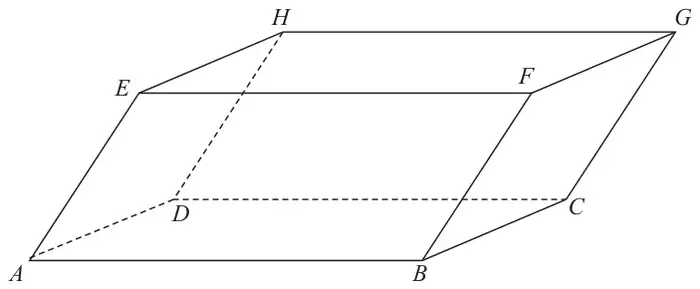
9. The parallelogram \(P\) has vertices \(E\), \(F\), \(G\) and \(H\), with coordinates
\[E(10, -1, -6) \quad F(7, -2, 7) \quad G(10, 2, 9) \quad H(13, 3, -4)\]The line \(l\) passes through \(E\) and is perpendicular to the plane containing \(P\)
Given that
- \(P\) is one face of a parallelepiped
- the opposite face of the parallelepiped lies in the plane \(\Pi\)
- the point \((25, -4, 13)\) lies in \(\Pi\)
| Scheme | Marks | AO |
|---|---|---|
| e.g. \(\overrightarrow{EF} = (7 - 10)\mathbf{i} + (-2 + 1)\mathbf{j} + (7 + 6)\mathbf{k}\) \(\overrightarrow{EH} = (13 - 10)\mathbf{i} + (3 + 1)\mathbf{j} + (-4 + 6)\mathbf{k}\) | M1 | 3.1a |
| For example, \(\left|\overrightarrow{EF} \times \overrightarrow{EH}\right| = \left\|\begin{matrix}\mathbf{i} & \mathbf{j} & \mathbf{k}\\ -3 & -1 & 13\\ 3 & 4 & 2\end{matrix}\right\| = \left|-54\mathbf{i} + 45\mathbf{j} - 9\mathbf{k}\right| = \sqrt{54^2 + 45^2 + 9^2}\) | M1 | 2.1 |
| \(9\sqrt{62}\) cso | A1 | 1.1b |
| (3) |
Notes
M1: Adopts a correct strategy by finding 2 appropriate vectors that will enable the area to be calculated, not two parallel vectors. If no method seen then 2 correct values will imply this mark.
\(\overrightarrow{EF} = \overrightarrow{HG} = \begin{pmatrix}-3\\ -1\\ 13\end{pmatrix}, \overrightarrow{EH} = \overrightarrow{FG} = \begin{pmatrix}3\\ 4\\ 2\end{pmatrix}, \overrightarrow{EG} = \begin{pmatrix}0\\ 3\\ 15\end{pmatrix}, \overrightarrow{FH} = \begin{pmatrix}6\\ 5\\ -11\end{pmatrix},\)
M1: Forms the cross product of 2 non-parallel vectors and calculates the magnitude to find that required area. May split into two triangles and then add the areas. If uses the cross product of the diagonal vectors they would need to divide their answer by 2 to score this mark.
A1: Correct area cso, look out for correct signs
| Scheme | Marks | AO |
|---|---|---|
| \(\left(\mathbf{r} - (10\mathbf{i} - \mathbf{j} - 6\mathbf{k})\right) \times (6\mathbf{i} - 5\mathbf{j} + \mathbf{k}) = \mathbf{0}\) or \(\left(\mathbf{r} - \begin{pmatrix}10\\ -1\\ -6\end{pmatrix}\right) \times \begin{pmatrix}6\\ -5\\ 1\end{pmatrix} = \mathbf{0}\) o.e. Or \(\left(\mathbf{r} - (10\mathbf{i} - \mathbf{j} - 6\mathbf{k})\right) \times (54\mathbf{i} - 45\mathbf{j} + 9\mathbf{k}) = \mathbf{0}\) or \(\left(\mathbf{r} - \begin{pmatrix}10\\ -1\\ -6\end{pmatrix}\right) \times \begin{pmatrix}54\\ -45\\ 9\end{pmatrix} = \mathbf{0}\) o.e. | M1 A1ft | 1.1b 2.2a |
| (2) |
Notes
M1: Substitutes the position and direction vectors into the correct positions, condone the lack of brackets, and a sign slip and missing \(= 0\)
A1ft: Deduces the correct equation in the required form, follow through on their normal vector as long as both method marks scored in (a), must have correct bracketing and \(= 0\)
| Scheme | Marks | AO |
|---|---|---|
| \(6x - 5y + z = d \to d = 6 \times 25 - 5 \times (-4) + 13\) \(54x - 45y + 9z = d \to d = 54 \times 25 - 45 \times (-4) + 9 \times 13\) | M1 | 3.1a |
| \(6x - 5y + z = 183\) o.e. \(54x - 45y + 9z = 1647\) | A1 | 1.1b |
| \(6(10 + 6\lambda) - 5(-1 - 5\lambda) + \lambda - 6 = 183 \Rightarrow \lambda = \ldots(2)\) \(54(10 + 6\lambda) - 45(-1 - 5\lambda) + 9(\lambda - 6) = 1647 \Rightarrow \lambda = \ldots(2)\) Or \(6x - 5y + z = d \to d = 6 \times 10 - 5 \times (-1) - 6 \Rightarrow 6x - 5y + z = 59\) \(\dfrac{183}{\sqrt{6^2 + 5^2 + 1^2}} - \dfrac{59}{\sqrt{6^2 + 5^2 + 1^2}} = \ldots\) | M1 | 3.1a |
| \(\lambda = 2 \Rightarrow V = 9\sqrt{62} \times \left|2(6\mathbf{i} - 5\mathbf{j} + \mathbf{k})\right| = 9\sqrt{62} \times 2\sqrt{6^2 + 5^2 + 1} = \ldots\) or \(\lambda = 2 \Rightarrow V = \left|(-54\mathbf{i} + 45\mathbf{j} - 9\mathbf{k}) \bullet 2(6\mathbf{i} - 5\mathbf{j} + \mathbf{k})\right| = \ldots\) | dM1 | 3.1a |
| \(= 1116\) | A1 | 1.1b |
| (5) | ||
| (10 marks) |
Notes
M1: Recognises the requirement to find the equation of \(\Pi\) by forming the necessary scalar product
A1: Correct equation for \(\Pi\)
M1: Performs the key step of finding the value of the parameter that determines the required distance or vector that will allow the volume to be calculated
Alternatively find the equation of the plane containing \(P\) and then finds the shortest distance between the two planes
dM1: Completes the strategy by attempting the product of their answer to part (a) with the length of the relevant vector or attempts the magnitude of the scalar triple product using the relevant vectors
A1: Correct volume
(Corrected from the printed mark scheme: the second equation in the third row prints \(\lambda = \ldots(18)\); solving \(54(10 + 6\lambda) - 45(-1 - 5\lambda) + 9(\lambda - 6) = 1647\) gives \(\lambda = 2\).)
Alternative 1
| Scheme | Marks | AO |
|---|---|---|
| \(6x - 5y + z = d \to d = 6 \times 10 - 5 \times (-1) - 6\) \(54x - 45y + 9z = d \to d = 54 \times 10 - 45 \times (-1) + 9(-6)\) | M1 | 3.1a |
| \(6x - 5y + z = 59\) o.e. \(54x - 45y + 9z = 531\) | A1 | 1.1b |
| \(\dfrac{\left|(25 \times 6) + (-4 \times -5) + (13 \times 1) \pm 59\right|}{\sqrt{6^2 + 5^2 + 1^2}} = \ldots\left\{\dfrac{124}{\sqrt{62}}\right\}\) \(\dfrac{\left|(25 \times 54) + (-4 \times -45) + (13 \times 9) \pm 531\right|}{\sqrt{54^2 + 45^2 + 9^2}} = \ldots\left\{\dfrac{124}{\sqrt{62}}\right\}\) | M1 | 3.1a |
| \(V = 9\sqrt{62} \times \dfrac{124}{\sqrt{62}}\) | dM1 | 3.1a |
| \(= 1116\) | A1 | 1.1b |
| (5) |
M1: Recognises the requirement to find the equation of the plane containing the parallelogram \(P\) by forming the necessary scalar product
A1: Correct equation for the plane
M1: Finds the shortest distance between the point \((25, -4, 13)\) and the plane
dM1: Dependent on previous method. Finds the required volume by multiplying their answer to (a) multiplied by the shortest distance
A1: Correct volume
(Corrected from the printed mark scheme: the plane is printed as \(54x - 45y + 9z = -531\); the working above it gives \(d = 54 \times 10 - 45 \times (-1) + 9(-6) = 531\).)
Alternative 2
| Scheme | Marks | AO |
|---|---|---|
| \(\begin{pmatrix}25\\ -4\\ 13\end{pmatrix} - \begin{pmatrix}10\\ -1\\ -6\end{pmatrix} = \begin{pmatrix}15\\ -3\\ 19\end{pmatrix}\) | M1 A1 | 3.1a 1.1b |
| \(\dfrac{\left|\begin{pmatrix}15\\ -3\\ 19\end{pmatrix} \bullet \begin{pmatrix}6\\ -5\\ 1\end{pmatrix}\right|}{\sqrt{6^2 + 5^2 + 1^2}} = \ldots\) or \(\begin{vmatrix}3 & 4 & 2\\ -3 & -1 & 13\\ 15 & -3 & 19\end{vmatrix}\) or \(\begin{pmatrix}15\\ -3\\ 19\end{pmatrix} \bullet \begin{pmatrix}-54\\ 45\\ -9\end{pmatrix}\) | M1 | 3.1a |
| \(V = 9\sqrt{62} \times \dfrac{124}{\sqrt{62}}\) Or \(\begin{vmatrix}3 & 4 & 2\\ -3 & -1 & 13\\ 15 & -3 & 19\end{vmatrix} = 3(-19 + 39) - 4(-57 - 195) + 2(9 + 15)\) Or \(\begin{pmatrix}15\\ -3\\ 19\end{pmatrix} \bullet \begin{pmatrix}-54\\ 45\\ -9\end{pmatrix} = 15 \times -54 - 3 \times 45 + 19 \times -9\) | dM1 | 3.1a |
| \(= 1116\) | A1 | 1.1b |
M1: Find the vector between E and the position vector on \(\Pi\)
A1: Correct vector
M1: Finds the shortest distance between the planes or states determinant approach of 3 appropriate vectors for example \(\overrightarrow{EF}, \overrightarrow{EH}, \overrightarrow{EA}\) where \(A\) is \((25, -4, 13)\) or the triple scalar product
dM1: Finds the required volume by multiplying their answer to (a) by the shortest distance or uses the determinant approach of 3 appropriate vectors or attempts the triple scalar product.
If no working is seen the answer must be correct for their vectors.
Using \(\dfrac{1}{6}\) volume is dM0
A1: Correct volume