
A2 October 2021 Q4
4.
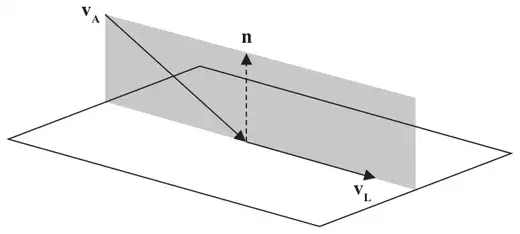
A small aircraft is landing in a field.
In a model for the landing the aircraft travels in different straight lines before and after it lands, as shown in Figure 2.
The vector \(\mathbf{v}_{\mathbf{A}}\) is in the direction of travel of the aircraft as it approaches the field.
The vector \(\mathbf{v}_{\mathbf{L}}\) is in the direction of travel of the aircraft after it lands.
With respect to a fixed origin, the field is modelled as the plane with equation
\[x - 2y + 25z = 0\]and
\[\mathbf{v}_{\mathbf{A}} = \begin{pmatrix}3\\ -2\\ -1\end{pmatrix}\]When the aircraft lands it remains in contact with the field and travels in the direction \(\mathbf{v}_{\mathbf{L}}\)
The vector \(\mathbf{v}_{\mathbf{L}}\) is in the same plane as both \(\mathbf{v}_{\mathbf{A}}\) and \(\mathbf{n}\) as shown in Figure 2.
| Scheme | Marks | AO |
|---|---|---|
| \(\mathbf{n} = \begin{pmatrix}1\\ -2\\ 25\end{pmatrix}\) or any non-zero scalar multiple thereof | B1 | 1.2 |
| (1) |
Notes
B1: Correct normal vector (any non-zero scalar multiple thereof is fine)
| Scheme | Marks | AO |
|---|---|---|
| \(\begin{vmatrix}\mathbf{i} & \mathbf{j} & \mathbf{k}\\ 1 & -2 & 25\\ 3 & -2 & -1\end{vmatrix} = \begin{pmatrix}(-2)(-1) - (-2)(25)\\ -\left((1)(-1) - (3)(25)\right)\\ (1)(-2) - (3)(-2)\end{pmatrix} = \ldots\) | M1 | 1.1b |
| \(= \begin{pmatrix}52\\ 76\\ 4\end{pmatrix} = 4\begin{pmatrix}13\\ 19\\ 1\end{pmatrix}\) (or correct multiple for their normal vector used) | A1 | 2.1 |
| (2) |
Notes
M1: Uses their \(\mathbf{n}\) and \(\mathbf{v}_{\mathbf{A}}\) in cross product formula. Allow slips in coordinates as long as the intent is clear.
A1: Correct work leading to a multiple of the required vector – may be a different multiple to the one shown if their \(\mathbf{n}\) was different.
| Scheme | Marks | AO |
|---|---|---|
| Landing direction is perpendicular to \(\mathbf{n} \times \mathbf{v}_{\mathbf{A}}\) and \(\mathbf{n}\) so required direction is given by \(\begin{pmatrix}13\\ 19\\ 1\end{pmatrix} \times \begin{pmatrix}1\\ -2\\ 25\end{pmatrix} = \ldots\) Alternatively recognises the recognises the landing direction is the line of intersection of the plane containing \(\mathbf{n}\) and \(\mathbf{v}_{\mathbf{A}}\) and the plane representing the field. Finds the equation of the plane containing \(\mathbf{n}\) and \(\mathbf{v}_{\mathbf{A}}\) \(\begin{pmatrix}x\\ y\\ z\end{pmatrix}.\begin{pmatrix}13\\ 19\\ 1\end{pmatrix} = \begin{pmatrix}3\\ -2\\ -1\end{pmatrix}.\begin{pmatrix}13\\ 19\\ 1\end{pmatrix}\) \(x - 2y + 25z = 0\) and \(13x + 19y + z = 0\) | M1 | 3.1b |
| \(= \begin{vmatrix}\mathbf{i} & \mathbf{j} & \mathbf{k}\\ 13 & 19 & 1\\ 1 & -2 & 25\end{vmatrix} = \begin{pmatrix}(19)(25) - (-2)(1)\\ -\left((13)(25) - (1)(1)\right)\\ (13)(-2) - (1)(19)\end{pmatrix} = \ldots\) Alternative Selects a value for either \(x\), \(y\) or \(z\) and solves simultaneously e.g \(z = -5\) leading to \(x - 2y = 125\) and \(13x + 19y = 5 \Rightarrow x = \ldots,\ y = \ldots\) | M1 | 3.4 |
| \(= \begin{pmatrix}477\\ -324\\ -45\end{pmatrix}\) or any positive multiple thereof, e.g \(\begin{pmatrix}53\\ -36\\ -5\end{pmatrix}\) or \(\begin{pmatrix}1908\\ -1296\\ -180\end{pmatrix}\) | A1 | 1.1b |
| (3) |
Notes
M1: Uses a correct strategy to find the direction, ie realises \(\mathbf{v}_{\mathbf{L}}\) must be perpendicular to both the vector from (b) and \(\mathbf{n}\) (corrected from the printed mark scheme, which has \(\mathbf{v}_{\mathbf{A}}\) here). Allow for vectors used either way round.
Other methods may be possible – e.g finds the plane containing \(\mathbf{n}\) and \(\mathbf{v}_{\mathbf{A}}\) and solves with the plane representing the field.
M1: Uses their answer to (b) with the normal vector to find a vector in the direction required. Allow for vectors either way round.
Alternative find the line of intersection of the plane containing \(\mathbf{n}\) and \(\mathbf{v}_{\mathbf{A}}\) and the field.
A1: A correct direction vector, as shown or any positive multiple. For this mark the direction should be correct – so order of vectors must have been correct, or adapted to correct direction if initially incorrect.
(The equation of the plane containing \(\mathbf{n}\) and \(\mathbf{v}_{\mathbf{A}}\) is garbled in the printed mark scheme; it is shown here as \(\begin{pmatrix}x\\ y\\ z\end{pmatrix}.\begin{pmatrix}13\\ 19\\ 1\end{pmatrix} = \begin{pmatrix}3\\ -2\\ -1\end{pmatrix}.\begin{pmatrix}13\\ 19\\ 1\end{pmatrix}\), which gives the equation \(13x + 19y + z = 0\) that follows it.)
| Scheme | Marks | AO |
|---|---|---|
Any acceptable reason e.g
| B1 | 3.5b |
| (1) | ||
| (7 marks) |
Notes
B1: Any correct limitation given. See scheme for examples.