
AS June 2025 Q3
3.
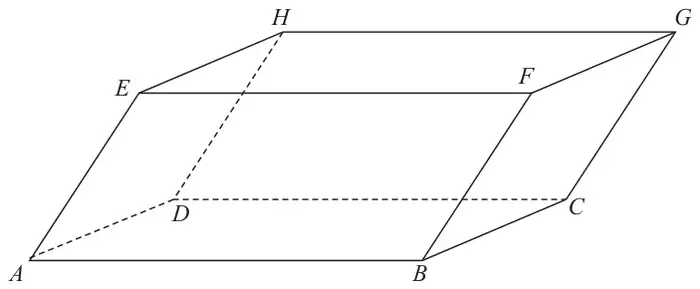
Figure 1 shows the parallelepiped \(ABCDHEFG\).
Relative to a fixed origin \(O\), the points \(A\), \(B\), \(D\) and \(E\) have coordinates \((3, 2, 7)\), \((4, 4, 3)\), \((4, 1, t)\) and \((t, -1, 10)\) respectively, where \(t\) is a constant.
Given that the volume of the parallelepiped is 9
| Scheme | Marks | AO |
|---|---|---|
| \(\overrightarrow{AB} = \begin{pmatrix}1\\ 2\\ -4\end{pmatrix},\ \overrightarrow{AD} = \begin{pmatrix}1\\ -1\\ t - 7\end{pmatrix}\) | M1 | 1.1b |
| \(\overrightarrow{AB} \times \overrightarrow{AD} = \begin{vmatrix}\mathbf{i} & \mathbf{j} & \mathbf{k}\\ 1 & 2 & -4\\ 1 & -1 & t - 7\end{vmatrix} = \begin{pmatrix}2t - 14 - 4\\ -(t - 7 + 4)\\ -1 - 2\end{pmatrix}\) | dM1 | 1.1b |
| \(\begin{pmatrix}2t - 18\\ 3 - t\\ -3\end{pmatrix}\) or \((2t - 18)\mathbf{i} - (t - 3)\mathbf{j} - \mathbf{k}\) | A1 | 2.2a |
| (3) |
Notes
M1: Attempts to find both vectors by subtraction. Allow either direction. If no method shown then two correct values is sufficient.
dM1: Uses the correct process of the vector product. May be implied by 2 correct components if working not shown.
A1: Correct vector from correct work, isw
| Scheme | Marks | AO |
|---|---|---|
| \(\overrightarrow{AE} = \begin{pmatrix}t - 3\\ -3\\ 3\end{pmatrix} \Rightarrow V = \begin{pmatrix}2t - 18\\ 3 - t\\ -3\end{pmatrix} \cdot \begin{pmatrix}t - 3\\ -3\\ 3\end{pmatrix} = 2t^2 - 6t - 18t + 54 - 9 + 3t - 9\) Or \(\begin{vmatrix}t - 3 & -3 & 3\\ 1 & 2 & -4\\ 1 & -1 & t - 7\end{vmatrix}\) \(= (t - 3)[2(t - 7) - 4] + 3[t - 7 + 4] + 3[-1 - 2]\) | M1 A1 | 1.1b 1.1b |
| \(2t^2 - 21t + 36 = 9 \Rightarrow t = \ldots\) or \(2t^2 - 21t + 36 = -9 \Rightarrow t = \ldots\) | dM1 | 1.1b |
| \(2t^2 - 21t + 36 = 9 \Rightarrow t = \ldots\) and \(2t^2 - 21t + 36 = -9 \Rightarrow t = \ldots\) | M1 | 1.1b |
| \(t = 9,\ \dfrac{3}{2}\) or \(t = 3,\ \dfrac{15}{2}\) | A1 | 1.1b |
| \(t = 9,\ \dfrac{3}{2}\) and \(t = 3,\ \dfrac{15}{2}\) | A1 | 2.2a |
| (6) | ||
| (9 marks) |
Notes
M1: Attempts \(\pm\overrightarrow{AE}\) and the scalar triple product using their vector from part (a). Alternatively uses determinant approach
A1: Correct expression in any form, may be unsimplified
dM1: Sets their triple product \(= 9\) or \(-9\) and attempts to solve 3TQ using a correct method
M1: Sets their triple product \(= 9\) and \(-9\) and attempts to solve both 3TQ’s using a correct method
A1: One correct pair of values or any 2 correct values
A1: All 4 values correct