
AS June 2022 Q5
5.
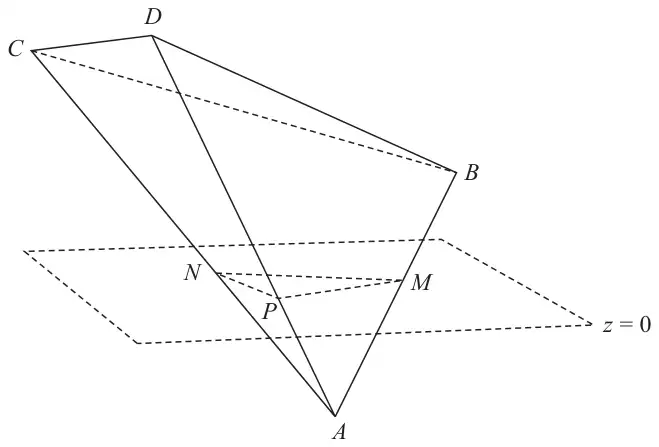
The points \(A(3, 2, -4)\), \(B(9, -4, 2)\), \(C(-6, -10, 8)\) and \(D(-4, -5, 10)\) are the vertices of a tetrahedron.
The plane with equation \(z = 0\) cuts the tetrahedron into two pieces, one on each side of the plane.
The edges \(AB\), \(AC\) and \(AD\) of the tetrahedron intersect the plane at the points \(M\), \(N\) and \(P\) respectively, as shown in Figure 1.
Determine
| Scheme | Marks | AO |
|---|---|---|
| A correct method to find one coordinates of \(M\), \(N\) or \(P\) For example \(\overrightarrow{AB} = \begin{pmatrix}6\\ -6\\ 6\end{pmatrix}\) so \(\overrightarrow{OM} = \begin{pmatrix}3\\ 2\\ -4\end{pmatrix} + \dfrac{4}{6}\begin{pmatrix}6\\ -6\\ 6\end{pmatrix} = \ldots\) \(\overrightarrow{AC} = \begin{pmatrix}-9\\ -12\\ 12\end{pmatrix}\) so \(\overrightarrow{ON} = \begin{pmatrix}3\\ 2\\ -4\end{pmatrix} + \dfrac{4}{12}\begin{pmatrix}-9\\ -12\\ 12\end{pmatrix} = \ldots\) \(\overrightarrow{AD} = \begin{pmatrix}-7\\ -7\\ 14\end{pmatrix}\) so \(\overrightarrow{OP} = \begin{pmatrix}3\\ 2\\ -4\end{pmatrix} + \dfrac{4}{14}\begin{pmatrix}-7\\ -7\\ 14\end{pmatrix} = \ldots\) | M1 | 3.1a |
| One of \((M =)(7, -2, 0)\), \((N =)(0, -2, 0)\) or \((P =)(1, 0, 0)\) | A1 | 1.1b |
| All of \((M =)(7, -2, 0)\), \((N =)(0, -2, 0)\) and \((P =)(1, 0, 0)\) | A1 | 1.1b |
| (3) |
Notes
M1: Correct method for finding at least one of the three points. Allow one slip in coordinates but should have correct fraction to make the value of \(z\) to be 0.
A1: Any one of the three points correct, ignoring the labelling.
A1: All three points correct, ignoring the labelling
| Scheme | Marks | AO |
|---|---|---|
| Correct method, e.g. realises \(MN\) is parallel to \(x\) axis, so base is 7 and height 2, hence area of intersection is \(\dfrac{1}{2} \times 7 \times 2 = \ldots\) Alternatively using \(\dfrac{1}{2}|a \times b|\) \(\overrightarrow{PM} = \pm\begin{pmatrix}6\\ -2\\ 0\end{pmatrix}\quad \overrightarrow{PN} = \pm\begin{pmatrix}-1\\ -2\\ 0\end{pmatrix}\quad \overrightarrow{NM} = \pm\begin{pmatrix}7\\ 0\\ 0\end{pmatrix}\) For example \(\dfrac{1}{2}\left|\overrightarrow{MP} \times \overrightarrow{PN}\right| = \dfrac{1}{2}\begin{vmatrix}\mathbf{i} & \mathbf{j} & \mathbf{k}\\ 6 & -2 & 0\\ -1 & -2 & 0\end{vmatrix} = \dfrac{1}{2}\left|\begin{pmatrix}0\\ 0\\ -14\end{pmatrix}\right| = \ldots\) | M1 | 1.1b |
| \(= 7\) cso | A1 | 1.1b |
| (2) |
Notes
M1: Correct method for finding the area of the triangle, e.g realises that \(MN\) is parallel to the \(x\)-axis so uses \(\dfrac{1}{2}bh\) with \(b = MN\) and \(h\) is distance of \(MN\) from axis.
Alternative using \(\dfrac{1}{2}|a \times b|\) with vectors \(\overrightarrow{PM} = \pm\begin{pmatrix}6\\ -2\\ 0\end{pmatrix}\quad \overrightarrow{PN} = \pm\begin{pmatrix}-1\\ -2\\ 0\end{pmatrix}\quad \overrightarrow{NM} = \pm\begin{pmatrix}7\\ 0\\ 0\end{pmatrix}\) follow through on their answers in part (a). Condone sign slips except they must be using \(-\mathbf{j}\) in the cross product
For example \(\dfrac{1}{2}\left|\overrightarrow{MP} \times \overrightarrow{PN}\right| = \dfrac{1}{2}\begin{vmatrix}\mathbf{i} & \mathbf{j} & \mathbf{k}\\ 6 & -2 & 0\\ -1 & -2 & 0\end{vmatrix} = \dfrac{1}{2}\left|\begin{pmatrix}0\\ 0\\ -14\end{pmatrix}\right| = \ldots\)
\(\dfrac{1}{2}\left|\overrightarrow{PN} \times \overrightarrow{NM}\right| = \dfrac{1}{2}\begin{vmatrix}\mathbf{i} & \mathbf{j} & \mathbf{k}\\ -1 & -2 & 0\\ 7 & 0 & 0\end{vmatrix} = \dfrac{1}{2}\left|\begin{pmatrix}0\\ 0\\ 14\end{pmatrix}\right| = \ldots\)
\(\dfrac{1}{2}\left|\overrightarrow{PM} \times \overrightarrow{NM}\right| = \dfrac{1}{2}\begin{vmatrix}\mathbf{i} & \mathbf{j} & \mathbf{k}\\ 6 & -2 & 0\\ 7 & 0 & 0\end{vmatrix} = \dfrac{1}{2}\left|\begin{pmatrix}0\\ 0\\ 14\end{pmatrix}\right| = \ldots\)
or attempting to find an angle using dot product or cosine rule followed by \(\dfrac{1}{2}ab\sin C\).
A1: Correct area of 7 from correct vectors
| Scheme | Marks | AO |
|---|---|---|
| Vol \(NMPA = \dfrac{1}{3}A_b h = \dfrac{1}{3} \times 7 \times 4 = \dfrac{28}{3}\) Or using triple scalar product \(NMPA = \dfrac{1}{6}\left|\overrightarrow{AM} \cdot \left(\overrightarrow{AN} \times \overrightarrow{AP}\right)\right| = \dfrac{1}{6}\left|\begin{pmatrix}4\\ -4\\ 4\end{pmatrix} \cdot \left(\begin{pmatrix}-3\\ -4\\ 4\end{pmatrix} \times \begin{pmatrix}-2\\ -2\\ 4\end{pmatrix}\right)\right|\) \(= \dfrac{1}{6}\left|\begin{pmatrix}4\\ -4\\ 4\end{pmatrix} \cdot \begin{pmatrix}-8\\ 4\\ -2\end{pmatrix}\right| = \dfrac{28}{3}\) | M1 A1 | 3.1a 1.1b |
| Vol \(ABCD = \dfrac{1}{6}\left|\overrightarrow{AB} \cdot \left(\overrightarrow{AC} \times \overrightarrow{AD}\right)\right| = \ldots\) \(= \dfrac{1}{6}\left|\begin{pmatrix}6\\ -6\\ 6\end{pmatrix} \cdot \left(\begin{pmatrix}-9\\ -12\\ 12\end{pmatrix} \times \begin{pmatrix}-7\\ -7\\ 14\end{pmatrix}\right)\right| = \dfrac{1}{6}\left|\begin{pmatrix}6\\ -6\\ 6\end{pmatrix} \cdot \begin{pmatrix}-84\\ 42\\ -21\end{pmatrix}\right| = \ldots\) | M1 | 1.1b |
| \(= 147\) | A1 | 1.1b |
| So volume required is \(\text{'}147\text{'} - \dfrac{\text{'}28\text{'}}{3} = \ldots\) | M1 | 3.1a |
| \(= \dfrac{413}{3}\) | A1 | 1.1b |
| (6) | ||
| (11 marks) |
Notes
(c) On ePen this is M1 A1 M1 M1 M1 A1
M1: Formulates a correct method to find the volume of \(NMPA\). May use method shown, or e.g. \(\dfrac{1}{6}\left|\overrightarrow{AM} \cdot \left(\overrightarrow{AN} \times \overrightarrow{AP}\right)\right|\) or equivalent method.
A1: For \(\dfrac{28}{3}\).
Note there are many ways to find the required volume of \(AMNP\) applying the triple scalar product to a combination of the following vectors
\(\overrightarrow{AM} = \begin{pmatrix}4\\ -4\\ 4\end{pmatrix}\ \overrightarrow{AN} = \begin{pmatrix}-3\\ -4\\ 4\end{pmatrix}\ \overrightarrow{AP} = \begin{pmatrix}-2\\ -2\\ 4\end{pmatrix}\ \overrightarrow{NA} = \begin{pmatrix}3\\ 4\\ -4\end{pmatrix}\ \overrightarrow{NM} = \begin{pmatrix}7\\ 0\\ 0\end{pmatrix}\ \overrightarrow{NP} = \begin{pmatrix}1\\ 2\\ 0\end{pmatrix}\)
\(\overrightarrow{MA} = \begin{pmatrix}-4\\ 4\\ -4\end{pmatrix}\ \overrightarrow{MN} = \begin{pmatrix}-7\\ 0\\ 0\end{pmatrix}\ \overrightarrow{MP} = \begin{pmatrix}-6\\ 2\\ 0\end{pmatrix}\ \overrightarrow{PA} = \begin{pmatrix}2\\ 2\\ -4\end{pmatrix}\ \overrightarrow{PM} = \begin{pmatrix}6\\ -2\\ 0\end{pmatrix}\ \overrightarrow{PN} = \begin{pmatrix}-1\\ -2\\ 0\end{pmatrix}\)
For example
\(\dfrac{1}{6}\left|\overrightarrow{AM} \cdot \left(\overrightarrow{AN} \times \overrightarrow{AP}\right)\right| = \dfrac{1}{6}\left|\begin{pmatrix}4\\ -4\\ 4\end{pmatrix} \cdot \left(\begin{pmatrix}-3\\ -4\\ 4\end{pmatrix} \times \begin{pmatrix}-2\\ -2\\ 4\end{pmatrix}\right)\right| = \dfrac{1}{6}\left|\begin{pmatrix}4\\ -4\\ 4\end{pmatrix} \cdot \begin{pmatrix}-8\\ 4\\ -2\end{pmatrix}\right| = \dfrac{1}{6} \times 56\)
\(\dfrac{1}{6}\left|\overrightarrow{NA} \cdot \left(\overrightarrow{NM} \times \overrightarrow{NP}\right)\right| = \dfrac{1}{6}\left|\begin{pmatrix}3\\ 4\\ -4\end{pmatrix} \cdot \left(\begin{pmatrix}7\\ 0\\ 0\end{pmatrix} \times \begin{pmatrix}1\\ 2\\ 0\end{pmatrix}\right)\right| = \dfrac{1}{6}\left|\begin{pmatrix}3\\ 4\\ -4\end{pmatrix} \cdot \begin{pmatrix}0\\ 0\\ 14\end{pmatrix}\right| = \dfrac{1}{6} \times 56\)
\(\dfrac{1}{6}\left|\overrightarrow{MA} \cdot \left(\overrightarrow{MN} \times \overrightarrow{MP}\right)\right| = \dfrac{1}{6}\left|\begin{pmatrix}-4\\ 4\\ -4\end{pmatrix} \cdot \left(\begin{pmatrix}-7\\ 0\\ 0\end{pmatrix} \times \begin{pmatrix}-6\\ 2\\ 0\end{pmatrix}\right)\right| = \dfrac{1}{6}\left|\begin{pmatrix}-4\\ 4\\ -4\end{pmatrix} \cdot \begin{pmatrix}0\\ 0\\ -14\end{pmatrix}\right| = \dfrac{1}{6} \times 56\)
\(\dfrac{1}{6}\left|\overrightarrow{PA} \cdot \left(\overrightarrow{PM} \times \overrightarrow{PN}\right)\right| = \dfrac{1}{6}\left|\begin{pmatrix}2\\ 2\\ -4\end{pmatrix} \cdot \left(\begin{pmatrix}6\\ -2\\ 0\end{pmatrix} \times \begin{pmatrix}-1\\ -2\\ 0\end{pmatrix}\right)\right| = \dfrac{1}{6}\left|\begin{pmatrix}2\\ 2\\ -4\end{pmatrix} \cdot \begin{pmatrix}0\\ 0\\ -14\end{pmatrix}\right| = \dfrac{1}{6} \times 56\)
Note candidates may write as \(\dfrac{1}{6}\begin{vmatrix}4 & -4 & 4\\ -3 & -4 & 4\\ -2 & -2 & 4\end{vmatrix} = \dfrac{1}{6}\left|4(-16 + 8) + 4(-12 + 8) + 4(6 - 8)\right| = \dfrac{1}{6}|-56| = \dfrac{28}{3}\)
M1: A complete attempt at the volume of \(ABCD\), with correct method for cross product (oe in other methods). Condone sign slips except they must be using \(-\mathbf{j}\) in the cross product
A1 (M1 on ePen): 147
M1: Finds difference of the two volumes must have used a correct method to find the volumes.
A1: \(\dfrac{413}{3}\)
Note there are many ways to find the required volume of \(ABCD\) applying the triple scalar product to a combination of the following vectors
\(\overrightarrow{AB} = \begin{pmatrix}6\\ -6\\ 6\end{pmatrix}\ \overrightarrow{AC} = \begin{pmatrix}-9\\ -12\\ 12\end{pmatrix}\ \overrightarrow{AD} = \begin{pmatrix}-7\\ -7\\ 14\end{pmatrix}\ \overrightarrow{BA} = \begin{pmatrix}-6\\ 6\\ -6\end{pmatrix}\ \overrightarrow{BC} = \begin{pmatrix}-15\\ -6\\ 6\end{pmatrix}\ \overrightarrow{BD} = \begin{pmatrix}-13\\ -1\\ 8\end{pmatrix}\)
\(\overrightarrow{CA} = \begin{pmatrix}9\\ 12\\ -12\end{pmatrix}\ \overrightarrow{CB} = \begin{pmatrix}15\\ 6\\ -6\end{pmatrix}\ \overrightarrow{CD} = \begin{pmatrix}2\\ 5\\ 2\end{pmatrix}\ \overrightarrow{DA} = \begin{pmatrix}7\\ 7\\ -14\end{pmatrix}\ \overrightarrow{DB} = \begin{pmatrix}13\\ 1\\ -8\end{pmatrix}\ \overrightarrow{DC} = \begin{pmatrix}-2\\ -5\\ -2\end{pmatrix}\)
For example
\(\dfrac{1}{6}\left|\overrightarrow{AB} \cdot \left(\overrightarrow{AC} \times \overrightarrow{AD}\right)\right| = \dfrac{1}{6}\left|\begin{pmatrix}6\\ -6\\ 6\end{pmatrix} \cdot \left(\begin{pmatrix}-9\\ -12\\ 12\end{pmatrix} \times \begin{pmatrix}-7\\ -7\\ 14\end{pmatrix}\right)\right| = \dfrac{1}{6}\left|\begin{pmatrix}6\\ -6\\ 6\end{pmatrix} \cdot \begin{pmatrix}-84\\ 42\\ -21\end{pmatrix}\right| = \dfrac{1}{6} \times 882 = 147\)
\(\dfrac{1}{6}\left|\overrightarrow{BA} \cdot \left(\overrightarrow{BC} \times \overrightarrow{BD}\right)\right| = \dfrac{1}{6}\left|\begin{pmatrix}-6\\ 6\\ -6\end{pmatrix} \cdot \left(\begin{pmatrix}-15\\ -6\\ 6\end{pmatrix} \times \begin{pmatrix}-13\\ -1\\ 8\end{pmatrix}\right)\right| = \dfrac{1}{6}\left|\begin{pmatrix}-6\\ 6\\ -6\end{pmatrix} \cdot \begin{pmatrix}-42\\ 42\\ -63\end{pmatrix}\right| = \dfrac{1}{6} \times 882 = 147\)
\(\dfrac{1}{6}\left|\overrightarrow{CA} \cdot \left(\overrightarrow{CD} \times \overrightarrow{CB}\right)\right| = \dfrac{1}{6}\left|\begin{pmatrix}9\\ 12\\ -12\end{pmatrix} \cdot \left(\begin{pmatrix}2\\ 5\\ 2\end{pmatrix} \times \begin{pmatrix}15\\ 6\\ -6\end{pmatrix}\right)\right| = \dfrac{1}{6}\left|\begin{pmatrix}9\\ 12\\ -12\end{pmatrix} \cdot \begin{pmatrix}-42\\ 42\\ -63\end{pmatrix}\right| = \dfrac{1}{6} \times 882 = 147\)
\(\dfrac{1}{6}\left|\overrightarrow{DA} \cdot \left(\overrightarrow{DB} \times \overrightarrow{DC}\right)\right| = \dfrac{1}{6}\left|\begin{pmatrix}7\\ 7\\ -14\end{pmatrix} \cdot \left(\begin{pmatrix}13\\ 1\\ -8\end{pmatrix} \times \begin{pmatrix}-2\\ -5\\ -2\end{pmatrix}\right)\right| = \dfrac{1}{6}\left|\begin{pmatrix}7\\ 7\\ -14\end{pmatrix} \cdot \begin{pmatrix}-42\\ 42\\ -63\end{pmatrix}\right| = \dfrac{1}{6} \times 882 = 147\)
Note candidates may write as \(\dfrac{1}{6}\begin{vmatrix}6 & -6 & 6\\ -9 & -12 & 12\\ -7 & -7 & 14\end{vmatrix} = \dfrac{1}{6}\left|6(-168 + 84) + 6(-126 + 84) + 6(63 - 84)\right| = \dfrac{1}{6}|-882| = 147\)
(Corrected from the printed mark scheme, in these reference lists: \(\overrightarrow{BC}\) is printed as \(\begin{pmatrix}15\\ -6\\ 6\end{pmatrix}\), \(\overrightarrow{CB}\) as \(\begin{pmatrix}-15\\ 6\\ -6\end{pmatrix}\) and \(\overrightarrow{DC}\) as \(\begin{pmatrix}-2\\ -5\\ 2\end{pmatrix}\); in the worked lines \(\overrightarrow{PM}\) is printed as \(\begin{pmatrix}6\\ 2\\ 0\end{pmatrix}\), \(\overrightarrow{MN} \times \overrightarrow{MP}\) is printed as \(\begin{pmatrix}0\\ 0\\ 14\end{pmatrix}\) and \(\overrightarrow{DB} \times \overrightarrow{DC}\) as \(\begin{pmatrix}42\\ -42\\ 63\end{pmatrix}\). The volumes are unchanged.)