Conic Sections

From an AS paper

Edexcel

Edexcel · Old spec

A2 June 2025 Q8

EdexcelCurrent spec7 marksConic Sections

8. The ellipse \(E\) has equation

\[\frac{x^2}{64} + \frac{y^2}{36} = 1\]

The line \(l\) has equation \(y = mx + c\) where \(m\) and \(c\) are constants.

(a) Show that the \(x\) coordinates of the points of intersection of \(E\) and \(l\) satisfy the equation\[\left(16m^2 + 9\right)x^2 + 32cmx + 16c^2 + k = 0\]where \(k\) is a constant to be determined. (2)

Hence, given that the line \(l\)

  • is a tangent to \(E\)
  • passes through the point \((10, 20)\)
(b) determine the possible equations of \(l\) (5)

AS June 2025 Q5

EdexcelAS paperCurrent spec9 marksConic Sections

5. The parabola \(C\) has equation \(y^2 = 16x\)

The point \(P(4t^2, 8t)\) lies on \(C\).

(a) Show that an equation for the tangent to \(C\) at \(P\) is\[yt - x = 4t^2\] (3)

The line \(l\) passes through the origin and is perpendicular to the tangent to \(C\) at \(P\).
The line \(l\) and the tangent to \(C\) at \(P\) intersect at the point \(Q\).

(b) Determine, in simplest form in terms of \(t\), the coordinates of \(Q\). (3)
(c) Hence show that, as \(t\) varies, the point \(Q\) lies on the curve with equation\[y^2 = \frac{Ax^3}{x + B}\]where \(A\) and \(B\) are integers to be determined. (3)

A2 June 2024 Q8

EdexcelCurrent spec8 marksConic Sections

8. The parabola \(P\) has equation \(y^2 = 4ax\), where \(a\) is a positive constant.

The point \(A\left(at^2, 2at\right)\), where \(t \neq 0\), lies on \(P\).

(a) Use calculus to show that an equation of the tangent to \(P\) at \(A\) is\[yt = x + at^2\] (3)

The point \(B\left(2k^2, 4k\right)\) and the point \(C\left(2k^2, -4k\right)\), where \(k\) is a constant, lie on \(P\).

The tangent to \(P\) at \(B\) and the tangent to \(P\) at \(C\) intersect at the point \(D\).

Given that the area of the triangle \(BCD\) is 432

(b) determine the coordinates of \(B\) and the coordinates of \(C\). (5)

A2 June 2024 Q6

EdexcelCurrent spec6 marksConic Sections

6. The ellipse \(E\) has equation

\[\frac{x^2}{25} + \frac{y^2}{9} = 1\]

The hyperbola \(H\) has equation

\[\frac{x^2}{a^2} - \frac{y^2}{b^2} = 1\]

where \(a\) and \(b\) are positive constants.

Given that

  • the eccentricity of \(H\) is the reciprocal of the eccentricity of \(E\)
  • the coordinates of the foci of \(H\) are the same as the coordinates of the foci of \(E\)

determine

(i) the value of \(a\)
(ii) the value of \(b\)

(6)

AS June 2024 Q5

EdexcelAS paperCurrent spec9 marksConic Sections

5. The parabola \(C\) has equation \(y^2 = 16x\)

The point \(P\) on \(C\) has \(y\) coordinate \(p\), where \(p\) is a positive constant.

(a) Show that an equation of the tangent to \(C\) at \(P\) is given by\[2py = 16x + p^2\]\[\left[\text{You may quote without proof that for the general parabola } y^2 = 4ax,\ \frac{\mathrm{d}y}{\mathrm{d}x} = \frac{2a}{y}\right]\] (2)
(b) Write down the equation of the directrix of \(C\). (1)

The line \(l\) is the reflection of the tangent to \(C\) at \(P\) in the directrix of \(C\).

Given that \(l\) passes through the focus of \(C\),

(c) determine the exact value of \(p\). (6)

AS June 2023 Q6

EdexcelAS paperCurrent spec8 marksConic Sections

6. The parabola \(C\) has equation \(y^2 = 4ax\) where \(a\) is a positive constant.

The point \(P(at^2, 2at)\), \(t \neq 0\), lies on \(C\)

The normal to \(C\) at \(P\) is parallel to the line with equation \(y = 2x\)

(a) For the point \(P\), show that \(t = -2\) (3)

The normal to \(C\) at \(P\) intersects \(C\) again when \(x = 9\)

(b) Determine the value of \(a\), giving a reason for your answer. (5)

A2 June 2023 Q4

EdexcelCurrent spec12 marksConic Sections

4. The ellipse \(E\) has equation

\[\frac{x^2}{16} + \frac{y^2}{9} = 1\]
(a) Determine the exact value of the eccentricity of \(E\) (2)

The points \(P(4\cos\theta, 3\sin\theta)\) and \(Q(4\cos\theta, -3\sin\theta)\) lie on \(E\) where \(0 \lt \theta \lt \dfrac{\pi}{2}\)

The line \(l_1\) is the normal to \(E\) at the point \(P\)

(b) Use calculus to show that \(l_1\) has equation\[4x\sin\theta - 3y\cos\theta = 7\sin\theta\cos\theta\] (4)

The line \(l_2\) passes through the origin and the point \(Q\)

The lines \(l_1\) and \(l_2\) intersect at the point \(R\)

(c) Determine, in simplest form, the coordinates of \(R\) (4)
(d) Hence show that, as \(\theta\) varies, \(R\) lies on an ellipse which has the same eccentricity as ellipse \(E\) (2)

AS June 2023 Q3

EdexcelAS paperCurrent spec5 marksConic Sections

3. The rectangular hyperbola \(H\) has equation \(xy = c^2\) where \(c\) is a positive constant.

The line \(l\) has equation \(x - 2y = c\)

The points \(P\) and \(Q\) are the points of intersection of \(H\) and \(l\)

(a) Determine, in terms of \(c\), the coordinates of \(P\) and the coordinates of \(Q\) (3)

The point \(R\) is the midpoint of \(PQ\)

(b) Show that, as \(c\) varies, the coordinates of \(R\) satisfy the equation\[xy = -\frac{c^2}{a}\]where \(a\) is a constant to be determined. (2)

A2 June 2022 Q5

EdexcelCurrent spec9 marksConic Sections

5. The rectangular hyperbola \(H\) has equation \(xy = 36\)

(a) Use calculus to show that the equation of the tangent to \(H\) at the point \(P\left(6t, \dfrac{6}{t}\right)\) is\[yt^2 + x = 12t\] (3)

The point \(Q\left(12t, \dfrac{3}{t}\right)\) also lies on \(H\).

(b) Find the equation of the tangent to \(H\) at the point \(Q\). (2)

The tangent at \(P\) and the tangent at \(Q\) meet at the point \(R\).

(c) Show that as \(t\) varies the locus of \(R\) is also a rectangular hyperbola. (4)

AS June 2022 Q4

EdexcelAS paperCurrent spec9 marksConic Sections

4. The parabola \(C\) has equation \(y^2 = 10x\)

The point \(F\) is the focus of \(C\).

(a) Write down the coordinates of \(F\). (1)

The point \(P\) on \(C\) has \(y\) coordinate \(q\), where \(q \gt 0\)

(b) Show that an equation for the tangent to \(C\) at \(P\) is given by\[10x - 2qy + q^2 = 0\] (3)

The tangent to \(C\) at \(P\) intersects the directrix of \(C\) at the point \(A\).

The point \(B\) lies on the directrix such that \(PB\) is parallel to the \(x\)-axis.

(c) Show that the point of intersection of the diagonals of quadrilateral \(PBAF\) always lies on the \(y\)-axis. (5)

A2 June 2022 Q1

EdexcelCurrent spec7 marksConic Sections

1. An ellipse has equation \(\dfrac{x^2}{16} + \dfrac{y^2}{4} = 1\) and eccentricity \(e_1\)

A hyperbola has equation \(\dfrac{x^2}{a^2} - \dfrac{y^2}{b^2} = 1\) and eccentricity \(e_2\)

Given that \(e_1 \times e_2 = 1\)

(a) show that \(a^2 = 3b^2\) (4)

Given also that the coordinates of the foci of the ellipse are the same as the coordinates of the foci of the hyperbola,

(b) determine the equation of the hyperbola. (3)

A2 October 2021 Q5

EdexcelCurrent spec9 marksConic Sections

5. The parabola \(C\) has equation

\[y^2 = 32x\]

and the hyperbola \(H\) has equation

\[\frac{x^2}{36} - \frac{y^2}{9} = 1\]
(a) Write down the equations of the asymptotes of \(H\). (1)

The line \(l_1\) is normal to \(C\) and parallel to the asymptote of \(H\) with positive gradient.

The line \(l_2\) is normal to \(C\) and parallel to the asymptote of \(H\) with negative gradient.

(b) Determine
(i) an equation for \(l_1\)
(ii) an equation for \(l_2\) (4)

The lines \(l_1\) and \(l_2\) meet \(H\) at the points \(P\) and \(Q\) respectively.

(c) Find the area of the triangle \(OPQ\), where \(O\) is the origin. (4)

A2 October 2021 Q1

EdexcelCurrent spec5 marksConic Sections

1. The ellipse \(E\) has equation

\[\frac{x^2}{36} + \frac{y^2}{20} = 1\]

Find

(a) the coordinates of the foci of \(E\), (3)
(b) the equations of the directrices of \(E\). (2)

A2 October 2020 Q7

EdexcelCurrent spec14 marksConic Sections

7. The points \(P(9p^2, 18p)\) and \(Q(9q^2, 18q)\), \(p \neq q\), lie on the parabola \(C\) with equation

\[y^2 = 36x\]

The line \(l\) passes through the points \(P\) and \(Q\)

(a) Show that an equation for the line \(l\) is \[(p + q)y = 2(x + 9pq)\] (3)

The normal to \(C\) at \(P\) and the normal to \(C\) at \(Q\) meet at the point \(A\).

(b) Show that the coordinates of \(A\) are \[\left(9(p^2 + q^2 + pq + 2),\ -9pq(p + q)\right)\] (7)

Given that the points \(P\) and \(Q\) vary such that \(l\) always passes through the point \((12, 0)\)

(c) find, in the form \(y^2 = \mathrm{f}(x)\), an equation for the locus of \(A\), giving \(\mathrm{f}(x)\) in simplest form. (4)

A2 October 2020 Q5

EdexcelCurrent spec7 marksConic Sections

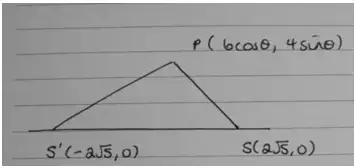
5. The ellipse \(E\) has equation

\[\frac{x^2}{36} + \frac{y^2}{16} = 1\]

The points \(S\) and \(S^{\prime}\) are the foci of \(E\).

(a) Find the coordinates of \(S\) and \(S^{\prime}\) (3)
(b) Show that for any point \(P\) on \(E\), the triangle \(PSS^{\prime}\) has constant perimeter and determine its value. (4)

AS October 2020 Q4

EdexcelAS paperCurrent spec7 marksConic Sections

4.

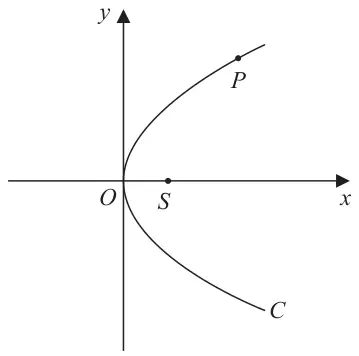
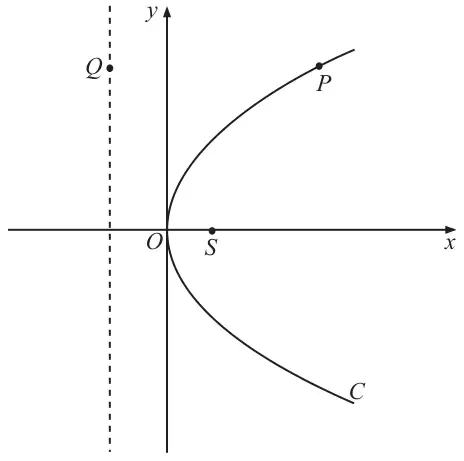
Figure 2: parabola C opening to the right with vertex at the origin O, focus S on the positive x-axis, and point P on the upper branch
Figure 2

Figure 2 shows a sketch of the parabola \(C\) with equation \(y^2 = 4ax\), where \(a\) is a positive constant. The point \(S\) is the focus of \(C\) and the point \(P(ap^2, 2ap)\) lies on \(C\) where \(p \gt 0\)

(a) Write down the coordinates of \(S\). (1)
(b) Write down the length of \(SP\) in terms of \(a\) and \(p\). (1)

The point \(Q(aq^2, 2aq)\), where \(p \neq q\), also lies on \(C\).
The point \(M\) is the midpoint of \(PQ\).

Given that \(pq = -1\)

(c) prove that, as \(P\) varies, the locus of \(M\) has equation\[y^2 = 2a(x - a)\] (5)

A2 June 2019 Q8

EdexcelCurrent spec14 marksConic Sections

8. The hyperbola \(H\) has equation

\[\frac{x^2}{16} - \frac{y^2}{9} = 1\]

The line \(l_1\) is the tangent to \(H\) at the point \(P(4\cosh\theta, 3\sinh\theta)\).

The line \(l_1\) meets the \(x\)-axis at the point \(A\).

The line \(l_2\) is the tangent to \(H\) at the point \((4, 0)\).

The lines \(l_1\) and \(l_2\) meet at the point \(B\) and the midpoint of \(AB\) is the point \(M\).

(a) Show that, as \(\theta\) varies, a Cartesian equation for the locus of \(M\) is \[y^2 = \frac{9(4 - x)}{4x} \qquad p \lt x \lt q\] where \(p\) and \(q\) are values to be determined. (11)

Let \(S\) be the focus of \(H\) that lies on the positive \(x\)-axis.

(b) Show that the distance from \(M\) to \(S\) is greater than 1 (3)

AS June 2019 Q5

EdexcelAS paperCurrent spec10 marksConic Sections

5.

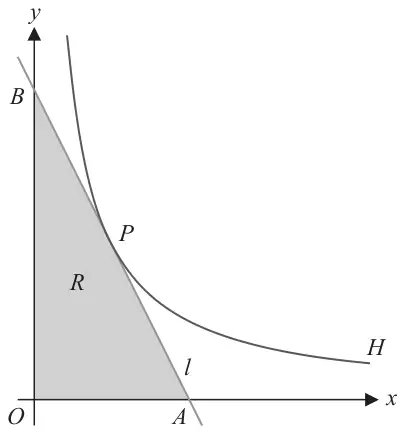
Figure 2: branch of the rectangular hyperbola H in the first quadrant, with the tangent l at P meeting the y-axis at B and the x-axis at A; the triangle OAB, region R, is shaded
Figure 2

Figure 2 shows a sketch of part of the rectangular hyperbola \(H\) with equation

\[xy = c^2 \qquad x \gt 0\]

where \(c\) is a positive constant.
The point \(P\left(ct, \dfrac{c}{t}\right)\) lies on \(H\).
The line \(l\) is the tangent to \(H\) at the point \(P\).

The line \(l\) crosses the \(x\)-axis at the point \(A\) and crosses the \(y\)-axis at the point \(B\).

The region \(R\), shown shaded in Figure 2, is bounded by the \(x\)-axis, the \(y\)-axis and the line \(l\).

Given that the length \(OB\) is twice the length of \(OA\), where \(O\) is the origin, and that the area of \(R\) is 32, find the exact coordinates of the point \(P\).

(10)

A2 June 2019 Q4

EdexcelCurrent spec8 marksConic Sections

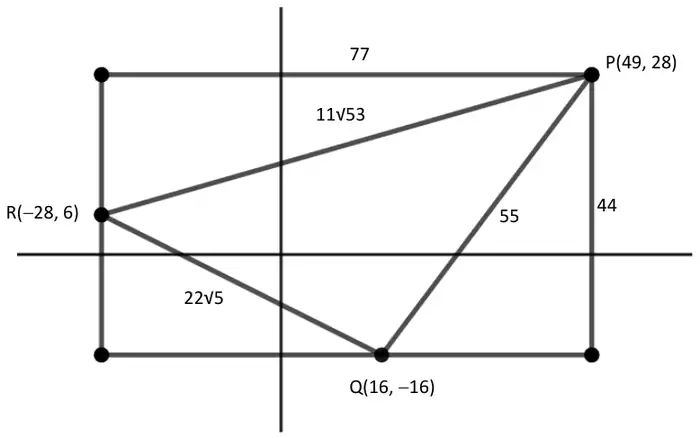
4. The parabola \(C\) has equation

\[y^2 = 16x\]

The distinct points \(P(p^2, 4p)\) and \(Q(q^2, 4q)\) lie on \(C\), where \(p \neq 0\), \(q \neq 0\)

The tangent to \(C\) at \(P\) and the tangent to \(C\) at \(Q\) meet at the point \(R(-28, 6)\).

Show that the area of triangle \(PQR\) is 1331

(8)

AS June 2018 Q5

EdexcelAS paperCurrent spec10 marksConic Sections

5. The rectangular hyperbola \(H\) has equation \(xy = c^2\), where \(c\) is a non-zero constant.

The point \(P\left(cp, \dfrac{c}{p}\right)\), where \(p \neq 0\), lies on \(H\).

(a) Use calculus to show that an equation of the normal to \(H\) at \(P\) is\[p^3x - py + c(1 - p^4) = 0\] (4)

The normal to \(H\) at the point \(P\) meets \(H\) again at the point \(Q\).

(b) Find the coordinates of the midpoint of \(PQ\) in terms of \(c\) and \(p\), simplifying your answer where possible. (6)

FP3 June 2018 Q7

EdexcelOld spec15 marksConic Sections

7. The ellipse \(E\) has foci at the points \((\pm 3, 0)\) and has directrices with equations \(x = \pm\dfrac{25}{3}\)

(a) Find a cartesian equation for the ellipse \(E\). (5)

The straight line \(l\) has equation \(y = mx + c\), where \(m\) and \(c\) are positive constants.

(b) Show that the \(x\) coordinates of any points of intersection of \(l\) and \(E\) satisfy the equation \[(16 + 25m^2)x^2 + 50mcx + 25(c^2 - 16) = 0\] (2)

Given that the line \(l\) is a tangent to \(E\),

(c) show that \(c^2 = pm^2 + q\), where \(p\) and \(q\) are constants to be found. (3)

The line \(l\) intersects the \(x\)-axis at the point \(A\) and intersects the \(y\)-axis at the point \(B\).

(d) Show that the area of triangle \(OAB\), where \(O\) is the origin, is \[\frac{25m^2 + 16}{2m}\] (3)
(e) Find the minimum area of triangle \(OAB\). (2)

FP1 June 2018 Q7

EdexcelOld spec8 marksConic Sections

7. The parabola \(C\) has equation \(y^2 = 4ax\), where \(a\) is a positive constant.
The point \(S\) is the focus of \(C\).

The straight line \(l\) passes through the point \(S\) and meets the directrix of \(C\) at the point \(D\).

Given that the \(y\) coordinate of \(D\) is \(\dfrac{24a}{5}\),

(a) show that an equation of the line \(l\) is \[12x + 5y = 12a\] (2)

The point \(P(ak^2, 2ak)\), where \(k\) is a positive constant, lies on the parabola \(C\).

Given that the line segment \(SP\) is perpendicular to \(l\),

(b) find, in terms of \(a\), the coordinates of the point \(P\). (6)

FP1 June 2018 Q5

EdexcelOld spec9 marksConic Sections

5. The rectangular hyperbola \(H\) has equation \(xy = c^2\), where \(c\) is a positive constant.

Given that \(P\left(ct, \dfrac{c}{t}\right)\), \(t \neq 0\), is a general point on \(H\),

(a) use calculus to show that the equation of the tangent to \(H\) at \(P\) can be written as \[t^2y + x = 2ct\] (4)

The points \(A\) and \(B\) lie on \(H\).

The tangent to \(H\) at \(A\) and the tangent to \(H\) at \(B\) meet at the point \(\left(-\dfrac{8c}{5}, \dfrac{3c}{5}\right)\).

Given that the \(x\) coordinate of \(A\) is positive,

(b) find, in terms of \(c\), the coordinates of \(A\) and the coordinates of \(B\). (5)

FP1 June 2017 Q7

EdexcelOld spec10 marksConic Sections

7. The parabola \(C\) has equation \(y^2 = 4ax\), where \(a\) is a constant and \(a > 0\)
The point \(Q(aq^2, 2aq)\), \(q > 0\), lies on the parabola \(C\).

(a) Show that an equation of the tangent to \(C\) at \(Q\) is \[qy = x + aq^2\] (4)

The tangent to \(C\) at the point \(Q\) meets the \(x\)-axis at the point \(X\left(-\dfrac{1}{4}a, 0\right)\) and meets the directrix of \(C\) at the point \(D\).

(b) Find, in terms of \(a\), the coordinates of \(D\). (4)

Given that the point \(F\) is the focus of the parabola \(C\),

(c) find the area, in terms of \(a\), of the triangle \(FXD\), giving your answer in its simplest form. (2)

FP1 June 2017 Q3

EdexcelOld spec7 marksConic Sections

3. The rectangular hyperbola \(H\) has parametric equations \[x = 4t, \quad y = \frac{4}{t} \qquad t \neq 0\]

The points \(P\) and \(Q\) on this hyperbola have parameters \(t = \dfrac{1}{4}\) and \(t = 2\) respectively.

The line \(l\) passes through the origin \(O\) and is perpendicular to the line \(PQ\).

(a) Find an equation for \(l\). (3)
(b) Find a cartesian equation for \(H\). (1)
(c) Find the exact coordinates of the two points where \(l\) intersects \(H\).
Give your answers in their simplest form. (3)

FP3 June 2017 Q2

EdexcelOld spec9 marksConic Sections

2. The ellipse \(E\) has equation \[\frac{x^2}{36} + \frac{y^2}{25} = 1\]

The line \(l\) is the normal to \(E\) at the point \(P\,(6\cos\theta, 5\sin\theta)\), where \(0 < \theta < \dfrac{\pi}{2}\)

(a) Use calculus to show that an equation of \(l\) is \[6x\sin\theta - 5y\cos\theta = 11\sin\theta\cos\theta\] (5)

The line \(l\) meets the \(x\)-axis at the point \(Q\).

The point \(R\) is the foot of the perpendicular from \(P\) to the \(x\)-axis.

(b) Show that \(\dfrac{OQ}{OR} = e^2\), where \(e\) is the eccentricity of the ellipse \(E\). (4)

FP1 June 2016 Q9

EdexcelOld spec11 marksConic Sections

9. The rectangular hyperbola, \(H\), has cartesian equation \(xy = 25\)

(a) Show that an equation of the normal to \(H\) at the point \(P\left(5p, \dfrac{5}{p}\right)\), \(p \neq 0\), is \[y - p^2x = \frac{5}{p} - 5p^3\] (5)

This normal meets the line with equation \(y = -x\) at the point \(A\).

(b) Show that the coordinates of \(A\) are \[\left(-\frac{5}{p} + 5p, \frac{5}{p} - 5p\right)\] (3)

The point \(M\) is the midpoint of the line segment \(AP\).
Given that \(M\) lies on the positive \(x\)-axis,

(c) find the exact value of the \(x\) coordinate of point \(M\). (3)

FP3 June 2016 Q5

EdexcelOld spec11 marksConic Sections

5. The hyperbola \(H\) has equation \[\frac{x^2}{16} - \frac{y^2}{9} = 1\]

The point \(P\,(4\sec\theta, 3\tan\theta)\), \(0 < \theta < \dfrac{\pi}{2}\), lies on \(H\).

(a) Show that an equation of the normal to \(H\) at the point \(P\) is \[3y + 4x\sin\theta = 25\tan\theta\] (5)

The line \(l\) is the directrix of \(H\) for which \(x > 0\)

The normal to \(H\) at \(P\) crosses the line \(l\) at the point \(Q\). Given that \(\theta = \dfrac{\pi}{4}\)

(b) find the \(y\) coordinate of \(Q\), giving your answer in the form \(a + b\sqrt{2}\), where \(a\) and \(b\) are rational numbers to be found. (6)

FP1 June 2016 Q5

EdexcelOld spec10 marksConic Sections

5. Points \(P(ap^2, 2ap)\) and \(Q(aq^2, 2aq)\), where \(p^2 \neq q^2\), lie on the parabola \(y^2 = 4ax\).

(a) Show that the chord \(PQ\) has equation \[y(p + q) = 2x + 2apq\] (5)

Given that this chord passes through the focus of the parabola,

(b) show that \(pq = -1\) (1)
(c) Using calculus find the gradient of the tangent to the parabola at \(P\). (2)
(d) Show that the tangent to the parabola at \(P\) and the tangent to the parabola at \(Q\) are perpendicular. (2)

FP3 June 2015 Q8

EdexcelOld spec14 marksConic Sections

8. The ellipse \(E\) has equation \(x^2 + 4y^2 = 4\)

(a)
(i) Find the coordinates of the foci, \(F_1\) and \(F_2\), of \(E\).
(ii) Write down the equations of the directrices of \(E\). (4)
(b) Given that the point \(P\) lies on the ellipse, show that \[\left|PF_1\right| + \left|PF_2\right| = 4\] (4)

A chord of an ellipse is a line segment joining two points on the ellipse.

The set of midpoints of the parallel chords of \(E\) with gradient \(m\), where \(m\) is a constant, lie on a straight line \(l\).

(c) Find an equation of \(l\). (6)

FP1 June 2015 Q8

EdexcelOld spec14 marksConic Sections

8. The point \(P(3p^2, 6p)\) lies on the parabola with equation \(y^2 = 12x\) and the point \(S\) is the focus of this parabola.

(a) Prove that \(SP = 3(1 + p^2)\) (3)

The point \(Q(3q^2, 6q)\), \(p \neq q\), also lies on this parabola.

The tangent to the parabola at the point \(P\) and the tangent to the parabola at the point \(Q\) meet at the point \(R\).

(b) Find the equations of these two tangents and hence find the coordinates of the point \(R\), giving the coordinates in their simplest form. (8)
(c) Prove that \(SR^2 = SP.SQ\) (3)

FP3 June 2015 Q6

EdexcelOld spec10 marksConic Sections

6. The hyperbola \(H\) is given by the equation \(x^2 - y^2 = 1\)

(a) Write down the equations of the two asymptotes of \(H\). (1)
(b) Show that an equation of the tangent to \(H\) at the point \(P\,(\cosh t, \sinh t)\) is \[y\sinh t = x\cosh t - 1\] (3)

The tangent at \(P\) meets the asymptotes of \(H\) at the points \(Q\) and \(R\).

(c) Show that \(P\) is the midpoint of \(QR\). (3)
(d) Show that the area of the triangle \(OQR\), where \(O\) is the origin, is independent of \(t\). (3)

FP1 June 2015 Q5

EdexcelOld spec9 marksConic Sections

5. The rectangular hyperbola \(H\) has equation \(xy = 9\)

The point \(A\) on \(H\) has coordinates \(\left(6, \dfrac{3}{2}\right)\).

(a) Show that the normal to \(H\) at the point \(A\) has equation \[2y - 8x + 45 = 0\] (5)

The normal at \(A\) meets \(H\) again at the point \(B\).

(b) Find the coordinates of \(B\). (4)

FP1 June 2014 (R) Q8

EdexcelOld spec5 marksConic Sections

8. The rectangular hyperbola \(H\) has equation \(xy = c^2\), where \(c\) is a positive constant.

The point \(P\left(ct, \dfrac{c}{t}\right)\), \(t \neq 0\), is a general point on \(H\).

An equation for the tangent to \(H\) at \(P\) is given by \[y = -\frac{1}{t^2}x + \frac{2c}{t}\]

The points \(A\) and \(B\) lie on \(H\).

The tangent to \(H\) at \(A\) and the tangent to \(H\) at \(B\) meet at the point \(\left(-\dfrac{6}{7}c, \dfrac{12}{7}c\right)\).

Find, in terms of \(c\), the coordinates of \(A\) and the coordinates of \(B\). (5)

FP1 June 2014 (R) Q7

EdexcelOld spec11 marksConic Sections

7. The parabola \(C\) has cartesian equation \(y^2 = 4ax\), \(a > 0\)

The points \(P(ap^2, 2ap)\) and \(P^{\prime}(ap^2, -2ap)\) lie on \(C\).

(a) Show that an equation of the normal to \(C\) at the point \(P\) is \[y + px = 2ap + ap^3\] (5)
(b) Write down an equation of the normal to \(C\) at the point \(P^{\prime}\). (1)

The normal to \(C\) at \(P\) meets the normal to \(C\) at \(P^{\prime}\) at the point \(Q\).

(c) Find, in terms of \(a\) and \(p\), the coordinates of \(Q\). (2)

Given that \(S\) is the focus of the parabola,

(d) find the area of the quadrilateral \(SPQP^{\prime}\). (3)

FP3 June 2014 (R) Q5

EdexcelOld spec11 marksConic Sections

5. The ellipse \(E\) has equation \[x^2 + 9y^2 = 9\]

The point \(P(a\cos\theta, b\sin\theta)\) is a general point on the ellipse \(E\).

(a) Write down the value of \(a\) and the value of \(b\). (1)

The line \(L\) is a tangent to \(E\) at the point \(P\).

(b) Show that an equation of the line \(L\) is given by \[3y\sin\theta + x\cos\theta = 3\] (3)

The line \(L\) meets the \(x\)-axis at the point \(Q\) and meets the \(y\)-axis at the point \(R\).

(c) Show that the area of the triangle \(OQR\), where \(O\) is the origin, is given by \[k\,\mathrm{cosec}\,2\theta\] where \(k\) is a constant to be found. (3)

The point \(M\) is the midpoint of \(QR\).

(d) Find a cartesian equation of the locus of \(M\), giving your answer in the form \(y^2 = \mathrm{f}(x)\). (4)

FP1 June 2014 Q8

EdexcelOld spec11 marksConic Sections

8. The points \(P(4k^2, 8k)\) and \(Q(k^2, 4k)\), where \(k\) is a constant, lie on the parabola \(C\) with equation \(y^2 = 16x\).

The straight line \(l_1\) passes through the points \(P\) and \(Q\).

(a) Show that an equation of the line \(l_1\) is given by \[3ky - 4x = 8k^2\] (4)

The line \(l_2\) is perpendicular to the line \(l_1\) and passes through the focus of the parabola \(C\). The line \(l_2\) meets the directrix of \(C\) at the point \(R\).

(b) Find, in terms of \(k\), the \(y\) coordinate of the point \(R\). (7)

FP3 June 2014 Q6

EdexcelOld spec10 marksConic Sections

6. [In this question you may use the appropriate trigonometric identities of the pink Mathematical Formulae and Statistical Tables.]

The points \(P(3\cos\alpha, 2\sin\alpha)\) and \(Q(3\cos\beta, 2\sin\beta)\), where \(\alpha \neq \beta\), lie on the ellipse with equation \[\frac{x^2}{9} + \frac{y^2}{4} = 1\]

(a) Show the equation of the chord \(PQ\) is \[\frac{x}{3}\cos\frac{(\alpha + \beta)}{2} + \frac{y}{2}\sin\frac{(\alpha + \beta)}{2} = \cos\frac{(\alpha - \beta)}{2}\] (4)
(b) Write down the coordinates of the mid-point of \(PQ\). (1)

Given that the gradient, \(m\), of the chord \(PQ\) is a constant,

(c) show that the centre of the chord lies on a line \[y = -kx\] expressing \(k\) in terms of \(m\). (5)

FP1 June 2014 Q6

EdexcelOld spec9 marksConic Sections

6. The rectangular hyperbola \(H\) has cartesian equation \(xy = c^2\).

The point \(P\left(ct, \dfrac{c}{t}\right)\), \(t > 0\), is a general point on \(H\).

(a) Show that an equation of the tangent to \(H\) at the point \(P\) is \[t^2y + x = 2ct\] (4)

An equation of the normal to \(H\) at the point \(P\) is \(t^3x - ty = ct^4 - c\)

Given that the normal to \(H\) at \(P\) meets the \(x\)-axis at the point \(A\) and the tangent to \(H\) at \(P\) meets the \(x\)-axis at the point \(B\),

(b) find, in terms of \(c\) and \(t\), the coordinates of \(A\) and the coordinates of \(B\). (2)

Given that \(c = 4\),

(c) find, in terms of \(t\), the area of the triangle \(APB\). Give your answer in its simplest form. (3)

FP1 June 2013 (R) Q7

EdexcelOld spec8 marksConic Sections

7. The parabola \(C\) has equation \(y^2 = 4ax\), where \(a\) is a positive constant.

The point \(P(at^2, 2at)\) is a general point on \(C\).

(a) Show that the equation of the tangent to \(C\) at \(P(at^2, 2at)\) is \[ty = x + at^2\] (4)

The tangent to \(C\) at \(P\) meets the \(y\)-axis at a point \(Q\).

(b) Find the coordinates of \(Q\). (1)

Given that the point \(S\) is the focus of \(C\),

(c) show that \(PQ\) is perpendicular to \(SQ\). (3)

FP1 June 2013 (R) Q5

EdexcelOld spec8 marksConic Sections

5.

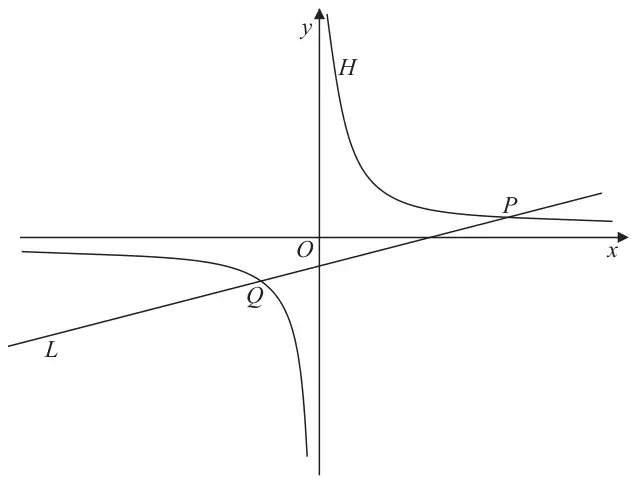
Figure 1: the rectangular hyperbola H with branches in the first and third quadrants, and the line L crossing H at P in the first quadrant and at Q in the third quadrant
Figure 1

Figure 1 shows a rectangular hyperbola \(H\) with parametric equations \[x = 3t, \quad y = \frac{3}{t}, \quad t \neq 0\]

The line \(L\) with equation \(6y = 4x - 15\) intersects \(H\) at the point \(P\) and at the point \(Q\) as shown in Figure 1.

(a) Show that \(L\) intersects \(H\) where \(4t^2 - 5t - 6 = 0\) (3)
(b) Hence, or otherwise, find the coordinates of points \(P\) and \(Q\). (5)

FP3 June 2013 (R) Q3

EdexcelOld spec8 marksConic Sections

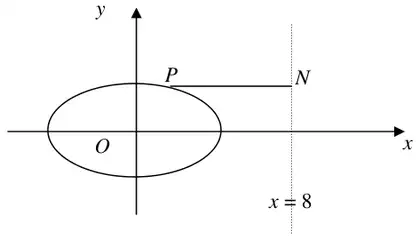
3. The point \(P\) lies on the ellipse \(E\) with equation \[\frac{x^2}{36} + \frac{y^2}{9} = 1\]

\(N\) is the foot of the perpendicular from point \(P\) to the line \(x = 8\)

\(M\) is the midpoint of \(PN\).

(a) Sketch the graph of the ellipse \(E\), showing also the line \(x = 8\) and a possible position for the line \(PN\). (1)
(b) Find an equation of the locus of \(M\) as \(P\) moves around the ellipse. (4)
(c) Show that this locus is a circle and state its centre and radius. (3)

FP3 June 2013 (R) Q1

EdexcelOld spec7 marksConic Sections

1. The hyperbola \(H\) has foci at \((5, 0)\) and \((-5, 0)\) and directrices with equations \[x = \frac{9}{5} \text{ and } x = -\frac{9}{5}.\]

Find a cartesian equation for \(H\). (7)

FP3 June 2013 Q7

EdexcelOld spec12 marksConic Sections

7. The ellipse \(E\) has equation \[\frac{x^2}{a^2} + \frac{y^2}{b^2} = 1, \qquad a > b > 0\]

The line \(l\) is a normal to \(E\) at a point \(P(a\cos\theta, b\sin\theta)\), \(\ 0 < \theta < \dfrac{\pi}{2}\)

(a) Using calculus, show that an equation for \(l\) is \[ax\sin\theta - by\cos\theta = (a^2 - b^2)\sin\theta\cos\theta\] (5)

The line \(l\) meets the \(x\)-axis at \(A\) and the \(y\)-axis at \(B\).

(b) Show that the area of the triangle \(OAB\), where \(O\) is the origin, may be written as \(k\sin 2\theta\), giving the value of the constant \(k\) in terms of \(a\) and \(b\). (4)
(c) Find, in terms of \(a\) and \(b\), the exact coordinates of the point \(P\), for which the area of the triangle \(OAB\) is a maximum. (3)

FP1 June 2013 Q6

EdexcelOld spec11 marksConic Sections

6. A parabola \(C\) has equation \(y^2 = 4ax,\quad a > 0\)

The points \(P(ap^2,\ 2ap)\) and \(Q(aq^2,\ 2aq)\) lie on \(C\), where \(p \neq 0\), \(q \neq 0\), \(p \neq q\).

(a) Show that an equation of the tangent to the parabola at \(P\) is \[py - x = ap^2\] (4)
(b) Write down the equation of the tangent at \(Q\). (1)

The tangent at \(P\) meets the tangent at \(Q\) at the point \(R\).

(c) Find, in terms of \(p\) and \(q\), the coordinates of \(R\), giving your answers in their simplest form. (4)

Given that \(R\) lies on the directrix of \(C\),

(d) find the value of \(pq\). (2)

FP1 June 2013 Q4

EdexcelOld spec9 marksConic Sections

4. The rectangular hyperbola \(H\) has Cartesian equation \(xy = 4\)

The point \(P\left(2t,\ \dfrac{2}{t}\right)\) lies on \(H\), where \(t \neq 0\)

(a) Show that an equation of the normal to \(H\) at the point \(P\) is \[ty - t^3x = 2 - 2t^4\] (5)

The normal to \(H\) at the point where \(t = -\dfrac{1}{2}\) meets \(H\) again at the point \(Q\).

(b) Find the coordinates of the point \(Q\). (4)

FP3 June 2013 Q1

EdexcelOld spec6 marksConic Sections

1. A hyperbola \(H\) has equation \[\frac{x^2}{a^2} - \frac{y^2}{25} = 1, \qquad \text{where } a \text{ is a positive constant.}\]

The foci of \(H\) are at the points with coordinates \((13, 0)\) and \((-13, 0)\).

Find

(a) the value of the constant \(a\), (3)
(b) the equations of the directrices of \(H\). (3)

FP1 January 2013 Q9

EdexcelOld spec9 marksConic Sections

9.

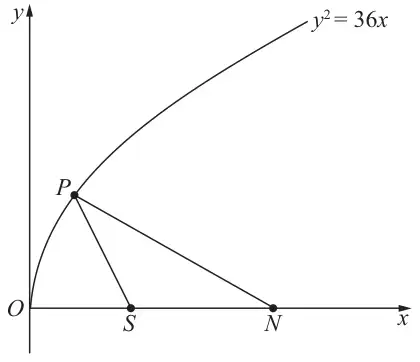
Figure 1: part of the parabola y squared = 36x from O, point P on the curve joined to the focus S and to N on the x-axis
Figure 1

Figure 1 shows a sketch of part of the parabola with equation \(y^2 = 36x\).

The point \(P\ (4,\ 12)\) lies on the parabola.

(a) Find an equation for the normal to the parabola at \(P\). (5)

This normal meets the \(x\)-axis at the point \(N\) and \(S\) is the focus of the parabola, as shown in Figure 1.

(b) Find the area of triangle \(PSN\). (4)

FP1 January 2013 Q7

EdexcelOld spec14 marksConic Sections

7. The rectangular hyperbola, \(H\), has cartesian equation \(xy = 25\)

The point \(P\left(5p,\ \dfrac{5}{p}\right)\), and the point \(Q\left(5q,\ \dfrac{5}{q}\right)\), where \(p, q \neq 0\), \(p \neq q\), are points on the rectangular hyperbola \(H\).

(a) Show that the equation of the tangent at point \(P\) is \[p^2y + x = 10p\] (4)
(b) Write down the equation of the tangent at point \(Q\). (1)

The tangents at \(P\) and \(Q\) meet at the point \(N\).

Given \(p + q \neq 0\),

(c) show that point \(N\) has coordinates \(\left(\dfrac{10pq}{p + q},\ \dfrac{10}{p + q}\right)\). (4)

The line joining \(N\) to the origin is perpendicular to the line \(PQ\).

(d) Find the value of \(p^2q^2\). (5)

FP1 June 2012 Q8

EdexcelOld spec8 marksConic Sections

8. The rectangular hyperbola \(H\) has equation \(xy = c^2\), where \(c\) is a positive constant.

The point \(P\left(ct,\ \dfrac{c}{t}\right)\), \(t \neq 0\), is a general point on \(H\).

(a) Show that an equation for the tangent to \(H\) at \(P\) is \[x + t^2y = 2ct\] (4)

The tangent to \(H\) at the point \(P\) meets the \(x\)-axis at the point \(A\) and the \(y\)-axis at the point \(B\).

Given that the area of the triangle \(OAB\), where \(O\) is the origin, is 36,

(b) find the exact value of \(c\), expressing your answer in the form \(k\sqrt{2}\), where \(k\) is an integer. (4)

FP3 June 2012 Q6

EdexcelOld spec11 marksConic Sections

6. The ellipse \(E\) has equation \[\frac{x^2}{a^2} + \frac{y^2}{b^2} = 1\]

The line \(l_1\) is a tangent to \(E\) at the point \(P\ (a\cos\theta, b\sin\theta)\).

(a) Using calculus, show that an equation for \(l_1\) is \[\frac{x\cos\theta}{a} + \frac{y\sin\theta}{b} = 1\] (4)

The circle \(C\) has equation \[x^2 + y^2 = a^2\]

The line \(l_2\) is a tangent to \(C\) at the point \(Q\ (a\cos\theta, a\sin\theta)\).

(b) Find an equation for the line \(l_2\). (2)

Given that \(l_1\) and \(l_2\) meet at the point \(R\),

(c) find, in terms of \(a\), \(b\) and \(\theta\), the coordinates of \(R\). (3)
(d) Find the locus of \(R\), as \(\theta\) varies. (2)

FP1 June 2012 Q5

EdexcelOld spec7 marksConic Sections

5.

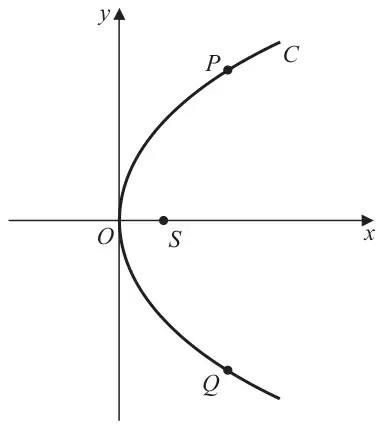
Figure 1: parabola C through O opening to the right, focus S on the x-axis, point P above and point Q below the x-axis on C
Figure 1

Figure 1 shows a sketch of the parabola \(C\) with equation \(y^2 = 8x\).
The point \(P\) lies on \(C\), where \(y > 0\), and the point \(Q\) lies on \(C\), where \(y < 0\)
The line segment \(PQ\) is parallel to the \(y\)-axis.

Given that the distance \(PQ\) is 12,

(a) write down the \(y\)-coordinate of \(P\), (1)
(b) find the \(x\)-coordinate of \(P\). (2)

Figure 1 shows the point \(S\) which is the focus of \(C\).
The line \(l\) passes through the point \(P\) and the point \(S\).

(c) Find an equation for \(l\) in the form \(ax + by + c = 0\), where \(a\), \(b\) and \(c\) are integers. (4)

FP3 June 2012 Q1

EdexcelOld spec5 marksConic Sections

1. The hyperbola \(H\) has equation \[\frac{x^2}{16} - \frac{y^2}{9} = 1\]

Find

(a) the coordinates of the foci of \(H\), (3)
(b) the equations of the directrices of \(H\). (2)

FP1 January 2012 Q9

EdexcelOld spec9 marksConic Sections

9. The rectangular hyperbola \(H\) has cartesian equation \(xy = 9\)

The points \(P\left(3p,\ \dfrac{3}{p}\right)\) and \(Q\left(3q,\ \dfrac{3}{q}\right)\) lie on \(H\), where \(p \neq \pm q\).

(a) Show that the equation of the tangent at \(P\) is \(x + p^2y = 6p\). (4)
(b) Write down the equation of the tangent at \(Q\). (1)

The tangent at the point \(P\) and the tangent at the point \(Q\) intersect at \(R\).

(c) Find, as single fractions in their simplest form, the coordinates of \(R\) in terms of \(p\) and \(q\). (4)

FP1 January 2012 Q3

EdexcelOld spec8 marksConic Sections

3. A parabola \(C\) has cartesian equation \(y^2 = 16x\). The point \(P(4t^2,\ 8t)\) is a general point on \(C\).

(a) Write down the coordinates of the focus \(F\) and the equation of the directrix of \(C\). (3)
(b) Show that the equation of the normal to \(C\) at \(P\) is \(y + tx = 8t + 4t^3\). (5)

FP3 June 2011 Q8

EdexcelOld spec14 marksConic Sections

8. The hyperbola \(H\) has equation \[\frac{x^2}{a^2} - \frac{y^2}{b^2} = 1\]

(a) Use calculus to show that the equation of the tangent to \(H\) at the point \((a\cosh\theta, b\sinh\theta)\) may be written in the form \[xb\cosh\theta - ya\sinh\theta = ab\] (4)

The line \(l_1\) is the tangent to \(H\) at the point \((a\cosh\theta, b\sinh\theta),\ \theta \neq 0\).
Given that \(l_1\) meets the \(x\)-axis at the point \(P\),

(b) find, in terms of \(a\) and \(\theta\), the coordinates of \(P\). (2)

The line \(l_2\) is the tangent to \(H\) at the point \((a, 0)\).
Given that \(l_1\) and \(l_2\) meet at the point \(Q\),

(c) find, in terms of \(a\), \(b\) and \(\theta\), the coordinates of \(Q\). (2)
(d) Show that, as \(\theta\) varies, the locus of the mid-point of \(PQ\) has equation \[x(4y^2 + b^2) = ab^2\] (6)

FP1 June 2011 Q8

EdexcelOld spec10 marksConic Sections

8. The parabola \(C\) has equation \(y^2 = 48x\).

The point \(P(12t^2,\ 24t)\) is a general point on \(C\).

(a) Find the equation of the directrix of \(C\). (2)
(b) Show that the equation of the tangent to \(C\) at \(P(12t^2,\ 24t)\) is \[x - ty + 12t^2 = 0\] (4)

The tangent to \(C\) at the point \((3,\ 12)\) meets the directrix of \(C\) at the point \(X\).

(c) Find the coordinates of \(X\). (4)

FP1 January 2011 Q10

EdexcelOld spec12 marksConic Sections

10. The point \(P\left(6t,\ \dfrac{6}{t}\right),\ t \neq 0\), lies on the rectangular hyperbola \(H\) with equation \(xy = 36\).

(a) Show that an equation for the tangent to \(H\) at \(P\) is \[y = -\frac{1}{t^2}x + \frac{12}{t}\] (5)

The tangent to \(H\) at the point \(A\) and the tangent to \(H\) at the point \(B\) meet at the point \((-9,\ 12)\).

(b) Find the coordinates of \(A\) and \(B\). (7)

FP1 January 2011 Q6

EdexcelOld spec8 marksConic Sections

6.

Figure 1: parabola C opening to the right from O, focus S on the positive x-axis, point P on the upper branch and point Q on the dashed directrix level with P
Figure 1

Figure 1 shows a sketch of the parabola \(C\) with equation \(y^2 = 36x\).
The point \(S\) is the focus of \(C\).

(a) Find the coordinates of \(S\). (1)
(b) Write down the equation of the directrix of \(C\). (1)

Figure 1 shows the point \(P\) which lies on \(C\), where \(y > 0\), and the point \(Q\) which lies on the directrix of \(C\). The line segment \(QP\) is parallel to the \(x\)-axis.

Given that the distance \(PS\) is 25,

(c) write down the distance \(QP\), (1)
(d) find the coordinates of \(P\), (3)
(e) find the area of the trapezium \(OSPQ\). (2)

FP3 June 2010 Q8

EdexcelOld spec13 marksConic Sections

8. The hyperbola \(H\) has equation \(\dfrac{x^2}{16} - \dfrac{y^2}{4} = 1\).

The line \(l_1\) is the tangent to \(H\) at the point \(P(4\sec t, 2\tan t)\).

(a) Use calculus to show that an equation of \(l_1\) is \[2y\sin t = x - 4\cos t\] (5)

The line \(l_2\) passes through the origin and is perpendicular to \(l_1\).

The lines \(l_1\) and \(l_2\) intersect at the point \(Q\).

(b) Show that, as \(t\) varies, an equation of the locus of \(Q\) is \[\left(x^2 + y^2\right)^2 = 16x^2 - 4y^2\] (8)

FP1 June 2010 Q8

EdexcelOld spec11 marksConic Sections

8. The rectangular hyperbola \(H\) has equation \(xy = c^2\), where c is a positive constant.

The point \(A\) on \(H\) has \(x\)-coordinate \(3c\).

(a) Write down the \(y\)-coordinate of \(A\). (1)
(b) Show that an equation of the normal to \(H\) at \(A\) is \[3y = 27x - 80c\] (5)

The normal to \(H\) at \(A\) meets \(H\) again at the point \(B\).

(c) Find, in terms of \(c\), the coordinates of \(B\). (5)

FP1 June 2010 Q5

EdexcelOld spec5 marksConic Sections

5. The parabola \(C\) has equation \(y^2 = 20x\).

(a) Verify that the point \(P(5t^2,\ 10t)\) is a general point on \(C\). (1)

The point \(A\) on \(C\) has parameter \(t = 4\).
The line \(l\) passes through \(A\) and also passes through the focus of \(C\).

(b) Find the gradient of \(l\). (4)

FP3 June 2010 Q1

EdexcelOld spec5 marksConic Sections

1. The line \(x = 8\) is a directrix of the ellipse with equation \[\frac{x^2}{a^2} + \frac{y^2}{b^2} = 1, \quad a > 0,\ b > 0,\]

and the point \((2, 0)\) is the corresponding focus.

Find the value of \(a\) and the value of \(b\). (5)

FP1 January 2010 Q7

EdexcelOld spec9 marksConic Sections

7. The rectangular hyperbola \(H\) has equation \(xy = c^2\), where \(c\) is a constant.

The point \(P\left(ct,\ \dfrac{c}{t}\right)\) is a general point on \(H\).

(a) Show that the tangent to \(H\) at \(P\) has equation \[t^2y + x = 2ct\] (4)

The tangents to \(H\) at the points \(A\) and \(B\) meet at the point \((15c,\ -c)\).

(b) Find, in terms of \(c\), the coordinates of \(A\) and \(B\). (5)

FP1 January 2010 Q4

EdexcelOld spec6 marksConic Sections

4.

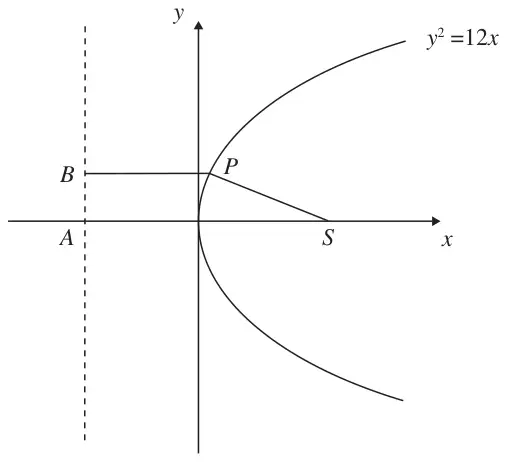
Figure 1: parabola y squared = 12x with focus S on the x-axis, dashed directrix through A on the x-axis, and horizontal line from B on the directrix to P on the parabola, P joined to S
Figure 1

Figure 1 shows a sketch of part of the parabola with equation \(y^2 = 12x\).

The point \(P\) on the parabola has \(x\)-coordinate \(\dfrac{1}{3}\).

The point \(S\) is the focus of the parabola.

(a) Write down the coordinates of \(S\). (1)

The points \(A\) and \(B\) lie on the directrix of the parabola.
The point \(A\) is on the \(x\)-axis and the \(y\)-coordinate of \(B\) is positive.

Given that \(ABPS\) is a trapezium,

(b) calculate the perimeter of \(ABPS\). (5)

FP3 June 2009 Q6

EdexcelOld spec11 marksConic Sections

6. The hyperbola \(H\) has equation \(\dfrac{x^2}{a^2} - \dfrac{y^2}{b^2} = 1\), where \(a\) and \(b\) are constants.

The line \(L\) has equation \(y = mx + c\), where \(m\) and \(c\) are constants.

(a) Given that \(L\) and \(H\) meet, show that the \(x\)-coordinates of the points of intersection are the roots of the equation \[(a^2m^2 - b^2)x^2 + 2a^2mcx + a^2(c^2 + b^2) = 0\] (2)

Hence, given that \(L\) is a tangent to \(H\),

(b) show that \(\quad a^2m^2 = b^2 + c^2\). (2)

The hyperbola \(H'\) has equation \(\dfrac{x^2}{25} - \dfrac{y^2}{16} = 1\).

(c) Find the equations of the tangents to \(H'\) which pass through the point \((1, 4)\). (7)

FP1 June 2009 Q6

EdexcelOld spec11 marksConic Sections

6. The parabola \(C\) has equation \(y^2 = 16x\).

(a) Verify that the point \(P(4t^2,\ 8t)\) is a general point on \(C\). (1)
(b) Write down the coordinates of the focus \(S\) of \(C\). (1)
(c) Show that the normal to \(C\) at \(P\) has equation \[y + tx = 8t + 4t^3\] (5)

The normal to \(C\) at \(P\) meets the \(x\)-axis at the point \(N\).

(d) Find the area of triangle \(PSN\) in terms of \(t\), giving your answer in its simplest form. (4)

FP1 January 2009 Q8

EdexcelOld spec10 marksConic Sections

8. A parabola has equation \(y^2 = 4ax,\ a > 0\). The point \(Q\,(aq^2,\ 2aq)\) lies on the parabola.

(a) Show that an equation of the tangent to the parabola at \(Q\) is \[yq = x + aq^2.\] (4)

This tangent meets the \(y\)-axis at the point \(R\).

(b) Find an equation of the line \(l\) which passes through \(R\) and is perpendicular to the tangent at \(Q\). (3)
(c) Show that \(l\) passes through the focus of the parabola. (1)
(d) Find the coordinates of the point where \(l\) meets the directrix of the parabola. (2)

FP1 January 2009 Q3

EdexcelOld spec4 marksConic Sections

3. The rectangular hyperbola, \(H\), has parametric equations \(x = 5t,\ y = \dfrac{5}{t},\ t \neq 0\).

(a) Write the cartesian equation of \(H\) in the form \(xy = c^2\). (1)

Points \(A\) and \(B\) on the hyperbola have parameters \(t = 1\) and \(t = 5\) respectively.

(b) Find the coordinates of the mid-point of \(AB\). (3)