
A2 October 2020 Q5
5. The ellipse \(E\) has equation
\[\frac{x^2}{36} + \frac{y^2}{16} = 1\]The points \(S\) and \(S^{\prime}\) are the foci of \(E\).
| Scheme | Marks | AO |
|---|---|---|
| \(b^2 = a^2(1 - e^2) \Rightarrow 16 = 36(1 - e^2) \Rightarrow e = \ldots\) | M1 | 1.1b |
| \(e^2 = \dfrac{20}{36}\) or \(\dfrac{5}{9}\) or \(e = \dfrac{\sqrt{5}}{3}\) | A1 | 1.1b |
| Foci are \(\left(\pm 2\sqrt{5}, 0\right)\) | A1 | 1.1b |
| (3) |
Notes
M1: Uses \(b^2 = a^2(1 - e^2)\) with \(a = 6\) and \(b = 4\) to find a value for \(e^2\) or \(e\).
A1: Correct value for \(e\) or \(e^2\)
A1: Correct foci
| Scheme | Marks | AO |
|---|---|---|
| Perimeter \(= PS + PS^{\prime} + SS^{\prime}\) where \(PS + PS^{\prime} = e(PM + PM^{\prime}) = \ldots\) | M1 | 3.1a |
| \(= e \times \dfrac{2a}{e} = \ldots\) | M1 | 2.2a |
| \(\ldots + 2 \times 2\sqrt{5}\) | B1ft | 1.1b |
| \(= 12 + 4\sqrt{5}\) hence perimeter is constant for any \(P\) on \(E\). * | A1* | 2.1 |
| (4) | ||
| (7 marks) |
Notes
M1: Forms a complete strategy to find the perimeter using general \(P\) and applies the focus directrix property to the sides \(PS\) and \(PS^{\prime}\)
M1: Deduces the length of the two sides adjacent to \(P\) is a constant
B1ft: Uses \(SS^{\prime}\) is twice their \(ae\) from (a)
A1*: Finds the value and makes conclusion that perimeter is constant for any \(P\) on \(E\)
Alternative
| Scheme | Marks | AO |
|---|---|---|
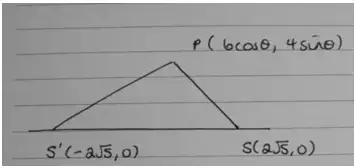 \(PS = \sqrt{\left(2\sqrt{5} - 6\cos\theta\right)^2 + (4\sin\theta)^2} = \ldots\left\{6 - 2\sqrt{5}\cos\theta\right\}\) \(PS^{\prime} = \sqrt{\left(2\sqrt{5} + 6\cos\theta\right)^2 + (4\sin\theta)^2} = \ldots\left\{6 + 2\sqrt{5}\cos\theta\right\}\) | M1 | 3.1a |
| \(PS + PS^{\prime} = \left(6 - 2\sqrt{5}\cos\theta\right) + \left(6 + 2\sqrt{5}\cos\theta\right) = 12\) | M1 | 2.2a |
| \(\ldots + 2 \times 2\sqrt{5}\) | B1ft | 1.1b |
| \(= 12 + 4\sqrt{5}\) hence perimeter is constant for any \(P\) on \(E\). * | A1* | 2.1 |
| (4) |
M1: Forms a complete strategy to find the perimeter using general \(P\). Finds the lengths of \(PS\) and \(PS^{\prime}\) using Pythagoras theorem and the general coordinate \((6\cos\theta, 4\sin\theta)\)
M1: Deduces the length of the two sides adjacent to \(P\) is a constant, using trig identities.
B1ft: Uses \(SS^{\prime}\) is twice their \(ae\) from (a)
A1*: Finds the value and makes conclusion that perimeter is constant for any \(P\) on \(E\)
(Corrected from the printed mark scheme: the second line of the alternative ends “\(= B\)”; the sum is \(12\).)
Note: Using the property that \(PS + PS^{\prime} = 2a\) both method marks may be awarded as long as a reason is given e.g. definition/property of an ellipse