
A2 June 2019 Q4
4. The parabola \(C\) has equation
\[y^2 = 16x\]The distinct points \(P(p^2, 4p)\) and \(Q(q^2, 4q)\) lie on \(C\), where \(p \neq 0\), \(q \neq 0\)
The tangent to \(C\) at \(P\) and the tangent to \(C\) at \(Q\) meet at the point \(R(-28, 6)\).
Show that the area of triangle \(PQR\) is 1331
(8)
| Scheme | Marks | AO |
|---|---|---|
| \(\begin{aligned}&y^2 = 16x \Rightarrow 2y\dfrac{\mathrm{d}y}{\mathrm{d}x} = 16 \Rightarrow \dfrac{\mathrm{d}y}{\mathrm{d}x} = \dfrac{8}{y} = \dfrac{8}{4p}\\[6pt] &\text{Requires } \alpha y\dfrac{\mathrm{d}y}{\mathrm{d}x} = \beta \Rightarrow \dfrac{\mathrm{d}y}{\mathrm{d}x} = \mathrm{f}(p \text{ or } q)\\[6pt] &y^2 = 16x \Rightarrow \dfrac{\mathrm{d}y}{\mathrm{d}x} = 2x^{-\frac{1}{2}} = 2\left(p^2\right)^{-\frac{1}{2}}\\[6pt] &\text{Requires } \dfrac{\mathrm{d}y}{\mathrm{d}x} = \alpha x^{-\frac{1}{2}} \Rightarrow \dfrac{\mathrm{d}y}{\mathrm{d}x} = \mathrm{f}(p \text{ or } q)\\[6pt] &\dfrac{\mathrm{d}y}{\mathrm{d}x} = \dfrac{\mathrm{d}y}{\mathrm{d}p}\dfrac{\mathrm{d}p}{\mathrm{d}x} = \dfrac{4}{2p}\\[6pt] &\text{Requires } \dfrac{\mathrm{d}y}{\mathrm{d}x} = \textit{their } \dfrac{\mathrm{d}y}{\mathrm{d}p} \div \textit{their } \dfrac{\mathrm{d}x}{\mathrm{d}p} \Rightarrow \dfrac{\mathrm{d}y}{\mathrm{d}x} = \mathrm{f}(p \text{ or } q)\end{aligned}\) | M1 | 3.1a |
| \(\dfrac{\mathrm{d}y}{\mathrm{d}x} = \dfrac{8}{4p} \Rightarrow y - 4p = \dfrac{2}{p}\left(x - p^2\right)\) or \(y - 4q = \dfrac{2}{q}\left(x - q^2\right)\) | M1 A1 | 3.1a 1.1b |
| Using \(x = -28\) and \(y = 6\), \(6p = -56 + 2p^2 \Rightarrow p = \ldots\) Alternative for 3rd Method mark: \(py = 2x + 2p^2,\ qy = 2x + 2q^2 \Rightarrow x = pq,\ y = 2(p + q)\) Using \(x = -28\) and \(y = 6 \Rightarrow p\,(\text{or } q) = \ldots\) | M1 | 3.1a |
| \(p\) (or \(q\)) \(= -4,\ 7\) | A1 | 1.1b |
| \((16, -16),\ (49, 28)\) | A1 | 2.2a |
| Way 1 \(\dfrac{1}{2}\begin{vmatrix}-28 & 16 & 49 & -28\\ 6 & -16 & 28 & 6\end{vmatrix} = \dfrac{1}{2}\left|448 + 448 + 294 - 96 + 784 + 784\right|\) Way 2 \(77 \times 44 - \dfrac{1}{2} \times 44 \times 22 - \dfrac{1}{2} \times 77 \times 22 - \dfrac{1}{2} \times 44 \times 33\) Way 3 \(\dfrac{1}{2}22\sqrt{5} \times 11\sqrt{53}\sin\left(\cos^{-1}\left(\dfrac{\left(11\sqrt{53}\right)^2 + \left(22\sqrt{5}\right)^2 - 55^2}{2 \times 11\sqrt{53} \times 22\sqrt{5}}\right)\right)\) NB angle at \(R\) is 42.5 (1dp) Way 4 \(\dfrac{1}{2}55 \times 11\sqrt{53}\sin\left(\cos^{-1}\left(\dfrac{\left(11\sqrt{53}\right)^2 + 55^2 - \left(22\sqrt{5}\right)^2}{2 \times 11\sqrt{53} \times 55}\right)\right)\) NB angle at \(P\) is 37.2 (1dp) Way 5 \(\dfrac{1}{2}55 \times 22\sqrt{5}\sin\left(\cos^{-1}\left(\dfrac{\left(22\sqrt{5}\right)^2 + 55^2 - \left(11\sqrt{53}\right)^2}{2 \times 22\sqrt{5} \times 55}\right)\right)\) NB angle at \(Q\) is 100.3 (1dp) Way 6 \(S = \dfrac{55 + 22\sqrt{5} + 11\sqrt{53}}{2} \Rightarrow A = \sqrt{S\left(S - 55\right)\left(S - 22\sqrt{5}\right)\left(S - 11\sqrt{53}\right)}\) Way 7 \(\begin{aligned}&\text{Line } PR\text{: } y - 28 = \dfrac{28 - 6}{49 + 28}\left(x - 49\right),\ x = 16 \Rightarrow y = \dfrac{130}{7}\\[6pt] &A = \dfrac{1}{2} \times \dfrac{242}{7}\left(28 + 16\right) + \dfrac{1}{2} \times \dfrac{242}{7}\left(49 - 16\right)\end{aligned}\) Way 8 \(\dfrac{1}{2}\left|RP \times QP\right| = \dfrac{1}{2}\left|\begin{pmatrix}77\\ 22\end{pmatrix} \times \begin{pmatrix}33\\ 44\end{pmatrix}\right| = \dfrac{1}{2}(2662)\) For such methods, a minimum of e.g. \(\dfrac{1}{2}(2662)\) must be seen | M1 | 3.1a |
| \(= 1331\) (units2) * | A1* | 1.1b |
| (8) | ||
| (8 marks) |
Notes
M1: Attempts to solve the problem by using differentiation to obtain an expression for \(\dfrac{\mathrm{d}y}{\mathrm{d}x}\) in terms of \(p\) or \(q\).
See scheme for requirements for this mark depending on the method chosen.
(Can be implied by a correct expression)
M1: Correct straight line method to find the equation of the tangent using \(P\) or \(Q\).
If using \(y = mx + c\), must reach as far as \(c = \ldots\)
A1: Obtains a correct general tangent at \(P\) or \(Q\) or both
Note that if a correct tangent equation is quoted, the first 3 marks are available
M1: Uses \(x = -28\) and \(y = 6\) with the values correctly placed in one of their tangent equations and attempts to solve the resulting 3TQ to obtain 2 values for \(p\) (or \(q\)).
An alternative approach for this mark is to obtain equations for both tangents and solve simultaneously to obtain the coordinates for the intersection and then to use \(x = -28\) and \(y = 6\) to find values for \(p\) and \(q\). Note that a calculator may be used for the simultaneous equations but answers must be correct for their equations if no working is shown.
A1: Correct values
A1: Deduces the correct coordinates of \(P\) and \(Q\)
M1: Completes the problem by using a suitable complete correct method for finding the area of \(PQR\) – See examples – there will be others – in general, score M1 for a correct triangle area method for their values
A1*: Correct area. Allow this mark even if the candidate reverts to decimals within their solution, providing all the working is correct.
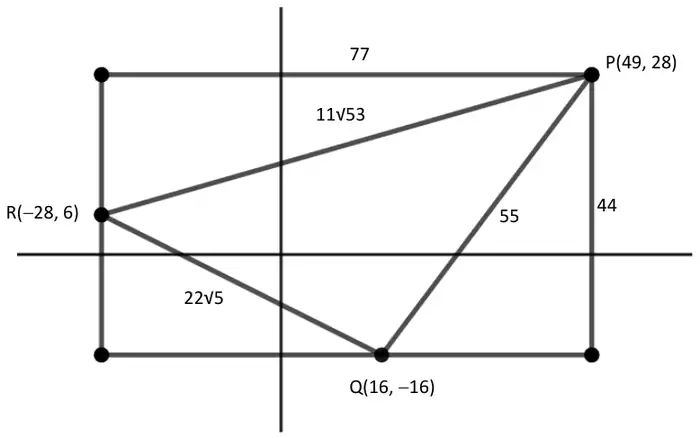
Generally, using midpoints of sides is unlikely to be successful, however, the line from \(R\) to the midpoint of \(PQ\) is horizontal so this is a correct approach:
Midpoint: \(\left(\dfrac{49 + 16}{2}, \dfrac{28 - 16}{2}\right) = \left(\dfrac{65}{2}, 6\right) \Rightarrow \text{Area} = \dfrac{1}{2}\left(\dfrac{65}{2} + 28\right) \times 44 = 1331\)