
AS June 2019 Q5
5.
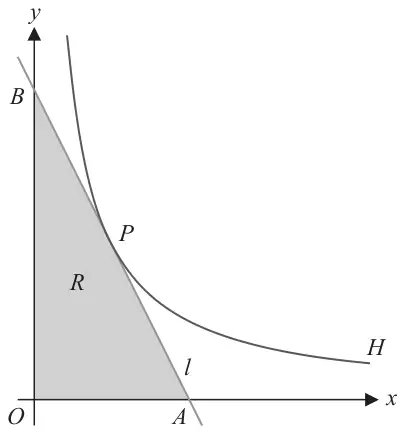
Figure 2 shows a sketch of part of the rectangular hyperbola \(H\) with equation
\[xy = c^2 \qquad x \gt 0\]where \(c\) is a positive constant.
The point \(P\left(ct, \dfrac{c}{t}\right)\) lies on \(H\).
The line \(l\) is the tangent to \(H\) at the point \(P\).
The line \(l\) crosses the \(x\)-axis at the point \(A\) and crosses the \(y\)-axis at the point \(B\).
The region \(R\), shown shaded in Figure 2, is bounded by the \(x\)-axis, the \(y\)-axis and the line \(l\).
Given that the length \(OB\) is twice the length of \(OA\), where \(O\) is the origin, and that the area of \(R\) is 32, find the exact coordinates of the point \(P\).
(10)
| Scheme | Marks | AO |
|---|---|---|
| \(H : xy = c^2,\ c \gt 0;\ P\left(ct, \dfrac{c}{t}\right)\) lies on \(H\); \(OB = 2OA\); \(\text{Area}(OAB) = 32\) | ||
| Way 1 Either \(y = \dfrac{c^2}{x} = c^2x^{-1} \Rightarrow \dfrac{\mathrm{d}y}{\mathrm{d}x} = -c^2x^{-2}\) or \(-\dfrac{c^2}{x^2}\) or \(xy = c^2 \Rightarrow x\dfrac{\mathrm{d}y}{\mathrm{d}x} + y = 0\) or \(x = cp,\ y = \dfrac{c}{p} \Rightarrow \dfrac{\mathrm{d}y}{\mathrm{d}x} = \dfrac{\mathrm{d}y}{\mathrm{d}p}.\dfrac{\mathrm{d}p}{\mathrm{d}x} = -\left(\dfrac{c}{p^2}\right)\left(\dfrac{1}{c}\right)\); condone \(t \equiv p\) and so, at \(P\left(ct, \dfrac{c}{t}\right)\), \(m_T = -\dfrac{1}{t^2}\) | M1 | 3.1a |
| \(y - \dfrac{c}{t} = \text{“}-\dfrac{1}{t^2}\text{”}(x - ct)\) or \(\dfrac{c}{t} = \text{“}-\dfrac{1}{t^2}\text{”}(ct) + b \Rightarrow y = \text{“}-\dfrac{1}{t^2}\text{”}x + \text{their } b \Rightarrow y = -\dfrac{1}{t^2}x + \dfrac{2c}{t}\) | M1 A1 | 1.1b 1.1b |
| \(y = 0 \Rightarrow x = 2ct\ \{\Rightarrow x_A = 2ct\},\ x = 0 \Rightarrow y = \dfrac{2c}{t}\ \left\{\Rightarrow y_B = \dfrac{2c}{t}\right\}\) | M1 A1 | 1.1b 1.1b |
| \(\{OB = 2OA \Rightarrow\}\ \dfrac{2c}{t} = 2(2ct) \Rightarrow t = \ldots\) | M1 | 2.1 |
| \(\left\{t^2 = \dfrac{1}{2} \Rightarrow\right\}\ t = \dfrac{1}{\sqrt{2}}\) or \(\dfrac{\sqrt{2}}{2}\) or awrt 0.707 | A1 | 1.1b |
| \(\{\text{Area } (OAB) = 32 \Rightarrow\}\ \dfrac{1}{2}(2ct)\left(\dfrac{2c}{t}\right) = 32 \Rightarrow c = \ldots\ \{\Rightarrow c = 4\}\) | M1 | 2.1 |
| Deduces the numerical value \(x_P\) and \(y_P\) using their values of \(t\) and \(c\) | M1 | 2.2a |
| \(P(2\sqrt{2}, 4\sqrt{2})\) or \(P(\text{awrt } 2.83, \text{awrt } 5.66)\) or \(x = 2\sqrt{2}\) and \(y = 4\sqrt{2}\) | A1 | 1.1b |
| (10) | ||
| (10 marks) |
Notes
Way 1
M1: Establishes the gradient of the tangent by differentiating \(xy = c^2\)
- to give \(\dfrac{\mathrm{d}y}{\mathrm{d}x} = \pm kx^{-2};\ k \neq 0\), or
- by the product rule to give \(\pm x\dfrac{\mathrm{d}y}{\mathrm{d}x} \pm y\), or
- by parametric differentiation to give \(\left(\text{their } \dfrac{\mathrm{d}y}{\mathrm{d}t}\right) \times \dfrac{1}{\left(\text{their } \dfrac{\mathrm{d}x}{\mathrm{d}t}\right)}\), condoning \(p \equiv t\)
and attempt to use \(P\left(ct, \dfrac{c}{t}\right)\) to write down the gradient of the tangent to the curve in terms of \(t\)
M1: Correct straight line method for an equation of a tangent where \(m_T\ (\neq m_N)\) is found by using calculus. Note: \(m_T\) must be a function of \(t\) for this mark
A1: Correct equation of the tangent which can be simplified or un-simplified
M1: Attempts to find either the \(x\)-coordinate of \(A\) or the \(y\)-coordinate of \(B\)
A1: Both {\(x\)-coordinate of \(A\) is} \(2ct\) and the {\(y\)-coordinate of \(B\) is} \(\dfrac{2c}{t}\)
M1: See scheme
A1: See scheme
M1: See scheme
M1: See scheme
A1: See scheme
For the final M1 mark in Way 1, Way 2, Way 3 and Way 4
Allow final M1 for a correct method which gives any of \(x_P = 2\sqrt{2}\) or \(y_P = 4\sqrt{2}\) or \(x_P = \text{awrt } 2.83\) or \(y_P = \text{awrt } 5.66\) o.e.
Way 2
| Scheme | Marks | AO |
|---|---|---|
| Same requirement as the 1st M mark in Way 1 | M1 | 3.1a |
| e.g. \(\left\{t = \dfrac{1}{\sqrt{2}} \Rightarrow P\left(\dfrac{c}{\sqrt{2}}, \sqrt{2}c\right) \Rightarrow\right\}\ y - \sqrt{2}c = -2\left(x - \dfrac{c}{\sqrt{2}}\right)\) using \(m_T = -2\) and their \(P\) which has been found by a correct method | M1 A1 | 1.1b 1.1b |
| \(y = 0 \Rightarrow x = \sqrt{2}c\ \{\Rightarrow x_A = \sqrt{2}c\},\ x = 0 \Rightarrow y = 2\sqrt{2}c\ \{\Rightarrow y_B = 2\sqrt{2}c\}\) | M1 A1 | 1.1b 1.1b |
| \(\{OB = 2OA \Rightarrow\}\ m_T = -2\) and their \(m_T = -\dfrac{1}{t^2} = -2 \Rightarrow t = \ldots\) | M1 | 2.1 |
| \(\left\{t^2 = \dfrac{1}{2} \Rightarrow\right\}\ t = \dfrac{1}{\sqrt{2}}\) or \(\dfrac{\sqrt{2}}{2}\) or awrt 0.707 \(\left\{\Rightarrow P\left(\dfrac{c}{\sqrt{2}}, \sqrt{2}c\right)\right\}\) | A1 | 1.1b |
| \(\{\text{Area } (OAB) = 32 \Rightarrow\}\ \dfrac{1}{2}\sqrt{2}c\left(2\sqrt{2}c\right) = 32 \Rightarrow c = \ldots\ \{\Rightarrow c = 4\}\) | M1 | 2.1 |
| Deduces the numerical value \(x_P\) and \(y_P\) using their values of \(t\) and \(c\) | M1 | 2.2a |
| \(P(2\sqrt{2}, 4\sqrt{2})\) or \(P(\text{awrt } 2.83, \text{awrt } 5.66)\) or \(x = 2\sqrt{2}\) and \(y = 4\sqrt{2}\) | A1 | 1.1b |
| (10) |
M1: Same description as the 1st M mark in Way 1
M1: See scheme
A1: Correct equation of the tangent which can be simplified or un-simplified
M1: Attempts to find either the \(x\)-coordinate of \(A\) or the \(y\)-coordinate of \(B\)
A1: Both {\(x\)-coordinate of \(A\) is} \(\sqrt{2}c\) and the {\(y\)-coordinate of \(B\) is} \(2\sqrt{2}c\)
M1: Recognising that the gradient of the tangent is \(-2\) and puts this equal to their \(\dfrac{\mathrm{d}y}{\mathrm{d}x}\) and finds \(t = \ldots\)
A1: See scheme
M1: See scheme
M1: See scheme
A1: See scheme
Way 3
| Scheme | Marks | AO |
|---|---|---|
| Same requirement as the 1st M mark in Way 1 | M1 | 3.1a |
| e.g. \(y - 8\sqrt{2} = -2(x - 0)\) or \(y - 0 = -2(x - 4\sqrt{2})\) using \(m_T = -2\) and either their \(A(4\sqrt{2}, 0)\) or their \(B(0, 8\sqrt{2})\) which have been found by a correct method | M1 A1 | 1.1b 1.1b |
| \(\{\text{Area } (OAB) = 32,\ OB = 2OA \Rightarrow\}\ \dfrac{1}{2}(x)(2x) = 32 \Rightarrow x = \ldots\) | M1 | 2.1 |
| \(x = 4\sqrt{2}\ \{\Rightarrow x_A = 4\sqrt{2}\}\) or \(y = 8\sqrt{2}\ \{\Rightarrow y_B = 8\sqrt{2}\}\) | A1 | 1.1b |
| \(\{OB = 2OA \Rightarrow\}\ m_T = -2\) and their \(m_T = -\dfrac{1}{t^2} = -2 \Rightarrow t = \ldots\) | M1 | 2.1 |
| \(\left\{t^2 = \dfrac{1}{2} \Rightarrow\right\}\ t = \dfrac{1}{\sqrt{2}}\) or \(\dfrac{\sqrt{2}}{2}\) or awrt 0.707 \(\left\{\Rightarrow P\left(\dfrac{c}{\sqrt{2}}, \sqrt{2}c\right)\right\}\) | A1 | 1.1b |
| \(\sqrt{2}c - 8\sqrt{2} = -2\left(\dfrac{c}{\sqrt{2}} - 0\right) \Rightarrow c = \ldots\ \{\Rightarrow c = 4\}\) | M1 | 1.1b |
| Deduces the numerical value \(x_P\) and \(y_P\) using their values of \(t\) and \(c\) | M1 | 2.2a |
| \(P(2\sqrt{2}, 4\sqrt{2})\) or \(P(\text{awrt } 2.83, \text{awrt } 5.66)\) or \(x = 2\sqrt{2}\) and \(y = 4\sqrt{2}\) | A1 | 1.1b |
| (10) |
M1: Same description as the 1st M mark in Way 1
M1: See scheme
A1: Correct equation of the tangent which can be simplified or un-simplified
M1: Uses \(y = 2x\) and Area \((OAB) = 32\) to find either \(x_A\) or \(y_B\)
A1: Either {\(x\)-coordinate of \(A\) is} \(4\sqrt{2}\) or the {\(y\)-coordinate of \(B\) is} \(8\sqrt{2}\)
M1: Recognising that the gradient of the tangent is \(-2\) and puts this equal to their \(\dfrac{\mathrm{d}y}{\mathrm{d}x}\) and finds \(t = \ldots\)
A1: See scheme
M1: Substitutes their \(P\) (which is in terms of \(c\), and has come from a correct method) into the equation of the tangent and finds \(c = \ldots\)
M1: See scheme
A1: See scheme
Way 4
| Scheme | Marks | AO |
|---|---|---|
| Complete process substituting their \(y - 8\sqrt{2} = -2(x - 0)\) or \(y - 0 = -2(x - 4\sqrt{2})\) into \(xy = c^2\) and applying \(b^2 - 4ac = 0\) to their resulting \(2x^2 - 8\sqrt{2}x + c^2 = 0\) | M1 | 3.1a |
| e.g. \(y - 8\sqrt{2} = -2(x - 0)\) or \(y - 0 = -2(x - 4\sqrt{2})\) using \(m_T = -2\) and either their \(A(4\sqrt{2}, 0)\) or their \(B(0, 8\sqrt{2})\) which have been found by a correct method | M1 A1 | 1.1b 1.1b |
| \(\{\text{Area } (OAB) = 32,\ OB = 2OA \Rightarrow\}\ \dfrac{1}{2}(x)(2x) = 32 \Rightarrow x = \ldots\) | M1 | 2.1 |
| \(x = 4\sqrt{2}\ \{\Rightarrow x_A = 4\sqrt{2}\}\) or \(y = 8\sqrt{2}\ \{\Rightarrow y_B = 8\sqrt{2}\}\) | A1 | 1.1b |
| dependent on 2nd M mark \(\{xy = c^2 \Rightarrow\}\ x(-2x + 8\sqrt{2}) = c^2\ \{\Rightarrow 2x^2 - 8\sqrt{2}x + c^2 = 0\}\) or \(\{xy = c^2 \Rightarrow\}\ \dfrac{1}{2}\left(8\sqrt{2} - y\right)y = c^2\ \{\Rightarrow y^2 - 8\sqrt{2}y + 2c^2 = 0\}\) | dM1 A1 | 2.1 1.1b |
| \(\{b^2 - 4ac = 0 \Rightarrow\}\ (8\sqrt{2})^2 - 4(2)(c^2) = 0 \Rightarrow c = \ldots\ \{\Rightarrow c = 4\}\) | M1 | 1.1b |
| Deduces the numerical value \(x_P\) and \(y_P\) using their value of \(c\) | M1 | 2.2a |
| \(P(2\sqrt{2}, 4\sqrt{2})\) or \(P(\text{awrt } 2.83, \text{awrt } 5.66)\) or \(x = 2\sqrt{2}\) and \(y = 4\sqrt{2}\) | A1 | 1.1b |
| (10) |
M1: See scheme
M1: See scheme
A1: Correct equation of the tangent which can be simplified or un-simplified
M1: Uses \(y = 2x\) and Area \((OAB) = 32\) to find either \(x_A\) or \(y_B\)
A1: Either {\(x\)-coordinate of \(A\) is} \(4\sqrt{2}\) or the {\(y\)-coordinate of \(B\) is} \(8\sqrt{2}\)
M1: See scheme
A1: See scheme
M1: See scheme
M1: See scheme
A1: See scheme