
FP1 June 2013 (R) Q5
5.
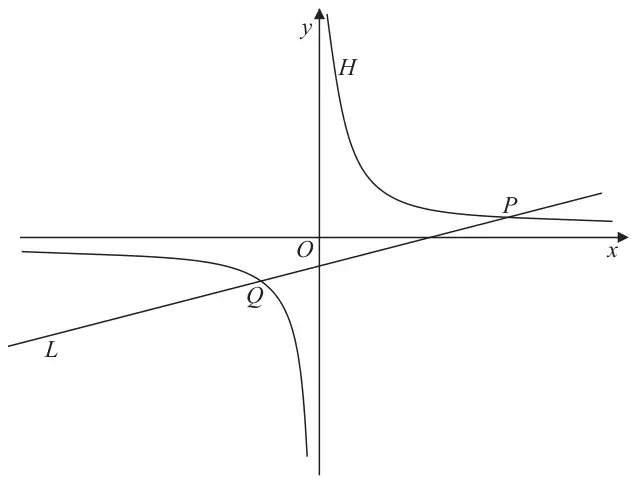
Figure 1 shows a rectangular hyperbola \(H\) with parametric equations \[x = 3t, \quad y = \frac{3}{t}, \quad t \neq 0\]
The line \(L\) with equation \(6y = 4x - 15\) intersects \(H\) at the point \(P\) and at the point \(Q\) as shown in Figure 1.
Ignore part labels and mark part (a) and part (b) together
| Scheme | Marks |
|---|---|
| \(H: x = 3t, y = \dfrac{3}{t}, \quad L: 6y = 4x - 15\) | |
| \(H = L \Rightarrow 6\left(\dfrac{3}{t}\right) = 4(3t) - 15\) An attempt to substitute \(x = 3t\) and \(y = \dfrac{3}{t}\) into \(L\) Correct equation in \(t\). | M1 A1 |
| \(\Rightarrow 18 = 12t^2 - 15t \Rightarrow 12t^2 - 15t - 18 = 0\) | |
| \(\Rightarrow 4t^2 - 5t - 6 = 0\) * Correct solution only, involving at least one intermediate step to given answer. | A1 cso |
| (3) |
| Scheme | Marks |
|---|---|
| \((t - 2)(4t + 3)\ \{= 0\}\) A valid attempt at solving the quadratic. | M1 |
| \(\Rightarrow t = 2, -\tfrac{3}{4}\) Both \(t = 2\) and \(t = -\tfrac{3}{4}\) | A1 |
| When \(t = 2\), \(x = 3(2) = 6,\ y = \dfrac{3}{2} \Rightarrow \left(6, \dfrac{3}{2}\right)\) An attempt to use one of their \(t\)-values to find one of either \(x\) or \(y\). | M1 |
| When \(t = -\dfrac{3}{4}\), One set of coordinates correct or both \(x\)-values are correct. | A1 |
| \(x = 3\left(-\dfrac{3}{4}\right) = -\dfrac{9}{4},\ y = \dfrac{3}{\left(-\frac{3}{4}\right)} = -4 \Rightarrow \left(-\dfrac{9}{4}, -4\right)\) Both sets of values correct. | A1 |
| (5) | |
| (8 marks) |
Notes
Alt Method: An attempt to eliminate either \(x\) or \(y\) from \(xy = 9\) and \(6y = 4x - 15\)
1st M1: A full method to obtain a quadratic equation in either \(x\) or \(y\).
1st A1: For either \(4x^2 - 15x - 54 = 0\) or \(6y^2 + 15y - 36 = 0\) or equivalent.
2nd M1: A valid attempt at solving the quadratic.
2nd A1: For either \(x = 6, -\dfrac{9}{4}\) or \(y = \dfrac{3}{2}, -4\)
3rd A1: Both \(\left(6, \dfrac{3}{2}\right)\) and \(\left(-\dfrac{9}{4}, -4\right)\).