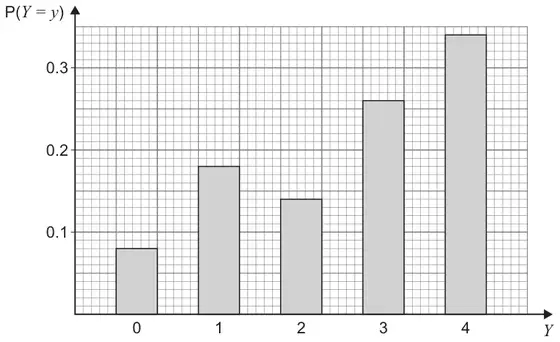
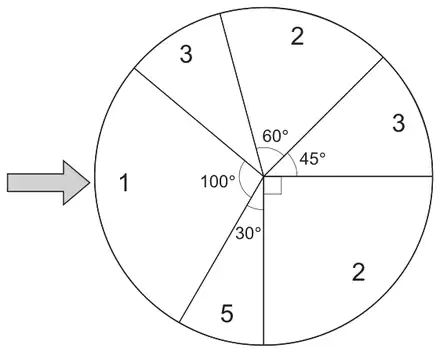
Realising require sequence: \(\overline{7},\ \overline{7},\ 7\) may see \(0.8 \times 0.8 \times 0.2\) o.e.
M1
3.4
\(=\) 0.128 *
A1*
1.1b
(2)
Notes
M1 for evidence that a correct sequence has been applied allow a clear list of all 9 possibilities e.g. (6,6,7), (6,8,7), (6,10,7), (8,6,7), (8,8,7), (8,10,7), (10,6,7), (10,8,7), (10,10,7) or e.g. 0.5×0.5×0.2[=0.05] + 4(0.5×0.15×0.2[=0.015]) + 4(0.15×0.15×0.2[=0.0045])
A1* for 0.128 from a correct expression with no incorrect working seen
B1 for a correct sample space for \(S\) (e.g. first row of table) condone any letter for B1 if any other values for \(S\) are stated they must be attached to a probability of 0
1st M1 for using the given model to find both values of \(\mathrm{P}(S = 1)\) and \(\mathrm{P}(S = 2)\)
2nd M1 for a correct method to find \(\mathrm{P}(S = 4)\) or use of \(\mathrm{P}(S = 4) = 1 - (\mathrm{P}(S = 1) + \mathrm{P}(S = 2) + 0.128)\) i.e. their \(\mathrm{P}(S = 1) + \mathrm{P}(S = 2) + \mathrm{P}(S = 4) = 0.872\)
A1 for a fully correct probability distribution, in table or listed separately must be in terms of \(S\) for this mark to be scored
B1: identifying that \(X\) can only take on the values 0, 1 and 2 (may be seen at end of tree diagram). If other values stated, they must be associated with a probability of 0.
M1: correct expression for \(\mathrm{P}(X = 0)\)
M1: correct expression for either \(\mathrm{P}(X = 1)\) or \(\mathrm{P}(X = 2)\)
A1: one correct probability Watch out for \(\dfrac{6}{8} \times \dfrac{5}{7} = \dfrac{15}{28}\) which is an incorrect attempt at \(\mathrm{P}(X = 0)\) and scores M0A0
A1: complete probability distribution, need not be in a table, but each value of \(x\) must be associated with its probability. Allow awrt 0.357, awrt 0.536, awrt 0.107
M1: identifying that the B(inomial) distribution with \(n = 10\) is appropriate here. If distribution not stated, may be implied by use of \((10\mathrm{C}r)p^r(1 - p)^{10 - r}\) or 0.981(57...)
M1: writing or using a correct probability statement
5. Manon has two biased spinners, one red and one green.
The random variable \(R\) represents the score when the red spinner is spun. The random variable \(G\) represents the score when the green spinner is spun.
The probability distributions for \(R\) and \(G\) are given below.
\(r\)
2
3
\(\mathrm{P}(R = r)\)
\(\dfrac{1}{4}\)
\(\dfrac{3}{4}\)
\(g\)
1
4
\(\mathrm{P}(G = g)\)
\(\dfrac{2}{3}\)
\(\dfrac{1}{3}\)
Manon spins each spinner once and adds the two scores.
(a) Find the probability that
(i) the sum of the two scores is 7
(ii) the sum of the two scores is less than 4 (3)
The random variable \(X = mR + nG\) where \(m\) and \(n\) are integers.
(b) Find the value of \(m\) and the value of \(n\) (5)
Mark scheme (a)
Scheme
Marks
AO
(i) Require \(R = 3\) and \(G = 4\) so probability is \(\dfrac{3}{4} \times \dfrac{1}{3}\)
M1
2.1
\(= \underline{\dfrac{1}{4}}\) or 0.25
A1
1.1b
(ii) [\(R\) must be 2 and \(G = 1\) so \(\dfrac{1}{4} \times \dfrac{2}{3}\)] \(= \underline{\dfrac{1}{6}}\)
A1
1.1b
(3)
Notes
(i) M1 for sight of \(\dfrac{3}{4} \times \dfrac{1}{3}\) or \(\dfrac{1}{4} \times \dfrac{2}{3}\) as a single product BUT allow e.g. \(\tfrac{3}{4}\times\tfrac{1}{3}+\tfrac{1}{3}\times\tfrac{3}{4}\) to score M1 However if the products are later added e.g. \(\tfrac{3}{4}\times\tfrac{1}{3}+\tfrac{1}{4}\times\tfrac{2}{3}\) it is M0 May be implied by one correct answer to (i) or (ii)
A1 for \(\dfrac{1}{4}\) or 0.25 or exact equivalent (allow 25%)
(ii) A1 for \(\dfrac{1}{6}\) or exact equivalent
Mark scheme (b)
Scheme
Marks
AO
\(\mathrm{P}(X = 50) = 0.25\) must mean \(R = 3\) and \(G = 4\) so \(3m + 4n = 50\)
M1 A1
3.1a 1.1b
\(\mathrm{P}(X = 20) = \tfrac{1}{6} \Rightarrow R = 2, G = 1\) so \(2m + n = 20\)
A1
2.1
Solving: \(3m + 4(20 - 2m) = 50\) (o.e.)
M1
1.1b
\(m = 6\) and \(n = 8\)
A1
3.2a
(5)
(8 marks)
Notes
For the 1st 4 marks condone incorrect labelling e.g. \(R\) for \(m\) or \(G\) for \(n\) if intention is clear
1st M1 for identifying either set of cases (\(R = 2, G = 1, X = 20\)) or (\(R = 3, G = 4, X = 50\)) Allow 1st M1 for \(\mathrm{P}(X = 20) = \tfrac{1}{4}\times\tfrac{2}{3}\) or \(\mathrm{P}(X = 50) = \tfrac{3}{4}\times\tfrac{1}{3}\) NOT just \(\mathrm{P}(X = 20) = \tfrac{1}{6}\) etc or \(\tfrac{1}{4}m + \tfrac{2}{3}n = 20\) or \(\tfrac{3}{4}m + \tfrac{1}{3}n = 50\) and might score 2nd M1 (answer is \(m = 64\), \(n = 6\)) or \(\tfrac{1}{4}m + \tfrac{2}{3}n = \tfrac{1}{6}\) or \(\tfrac{3}{4}m + \tfrac{1}{3}n = \tfrac{1}{4}\) and might score 2nd M1 (answer is \(m = \tfrac{4}{15}\), \(n = \tfrac{3}{20}\)) or \(2m + n = \tfrac{1}{6}\) or \(3m + 4n = \tfrac{1}{4}\) and might score 2nd M1 (answer is \(m = \tfrac{1}{12}\), \(n = 0\)) or \(2m + n = 50\) and \(3m + 4n = 20\) and might score 2nd M1 (answer is \(m = 36\), \(n = -22\))
1st A1 for one correct equation
2nd A1 for both correct equations and no incorrect equations, unless they attempt to solve the correct 2 equations only
2nd M1 for attempt to solve their two linear equations in \(m\) and \(n\) (reduce to an equation in one variable, condone one sign error). May be implied by \(m = 6\) and \(n = 8\).
Calc If they use one of the 4 sets of equations for 1st M1 and use a calculator to write down the answer, we will allow this mark for sight of the correct answers to those equations as given above.
3rd A1 \(m = 6\) and \(n = 8\) only (no incorrect labelling here) Correct answer by trial can score 5/5 if no incorrect working seen.
3. In a game, a player can score 0, 1, 2, 3 or 4 points each time the game is played.
The random variable \(S\), representing the player’s score, has the following probability distribution where \(a\), \(b\) and \(c\) are constants.
\(s\)
0
1
2
3
4
\(\mathrm{P}(S = s)\)
\(a\)
\(b\)
\(c\)
0.1
0.15
The probability of scoring less than 2 points is twice the probability of scoring at least 2 points.
Each game played is independent of previous games played.
John plays the game twice and adds the two scores together to get a total.
Calculate the probability that the total is 6 points.
(6)
Mark scheme
Scheme
Marks
AO
Overall method
M1
2.1
\(a + b = 2c + 0.5\) oe or \(a + b = 2(1 - a - b)\)
B1
2.2a
\(a + b + c = 0.75\) oe
B1
1.1b
\(3c = 0.25\quad \left[c = 0.0833\ldots \text{ or } \dfrac{1}{12}\right]\)
M1
1.1b
P(scoring 2,4 or 4,2 or 3,3) = \(2 \times \text{``}\dfrac{1}{12}\text{''} \times 0.15 + 0.1^2\)
M1
3.1b
= 0.035 oe
A1cso
1.1b
(6)
(6 marks)
Notes
M1: A fully correct method with all the required steps. For gaining 2 correct equations with at least one correct(allow if unsimplified). Attempting to solve to find a value of \(c\) followed by correct method to find the probability
B1: Forming a correct equation from the information given in the question
B1: A correct equation using the sum of the probabilities equals 1
M1: Correct method for solving 2 equations to find \(c\) Implied by \(c = \dfrac{1}{12}\)
M1: Recognising the ways to get a total of 6. Condone missing arrangments or repeats. Do not ignore extras written unless ignored in the calculation. May be implied by \(m \times \text{``}\dfrac{1}{12}\text{''} \times 0.15 + n \times 0.1^2\) where \(m\) and \(n\) are positive integers
(ii) \(\mathrm{P}(4 \leqslant X < 8) = \mathrm{P}(X \leqslant 7) - \mathrm{P}(X \leqslant 3)\ [= 0.818\ldots - 0.160\ldots]\)
M1
3.1b
awrt 0.658
A1
1.1b
(5)
(6 marks)
Notes
B1: for identifying correct model, \(\mathrm{B}(28, 0.2)\) allow B, bin or binomial may be implied by one correct answer or sight one correct probability i.e. awrt 0.678, awrt 0.818 or awrt 0.160 \(\mathrm{B}(0.2, 28)\) is B0 unless it is used correctly
(i)
M1: Writing or using \(1 - \mathrm{P}(X \leqslant 6)\) or \(1 - \mathrm{P}(X < 7)\)
A1: awrt 0.322 (correct answer only scores M1A1)
(ii)
M1: Writing or using \(\mathrm{P}(X \leqslant 7) - \mathrm{P}(X \leqslant 3)\) or \(\mathrm{P}(X < 8) - \mathrm{P}(X < 4)\) or \(\mathrm{P}(X = 4) + \mathrm{P}(X = 5) + \mathrm{P}(X = 6) + \mathrm{P}(X = 7)\) Condone \(\mathrm{P}(4)\) as \(\mathrm{P}(X = 4)\), etc.
5. A biased spinner can only land on one of the numbers 1, 2, 3 or 4. The random variable \(X\) represents the number that the spinner lands on after a single spin and \(\mathrm{P}(X = r) = \mathrm{P}(X = r + 2)\) for \(r = 1, 2\)
Given that \(\mathrm{P}(X = 2) = 0.35\)
(a) find the complete probability distribution of \(X\). (2)
Ambroh spins the spinner 60 times.
(b) Find the probability that more than half of the spins land on the number 4 Give your answer to 3 significant figures. (3)
\(\mathrm{P}(X = 1) = \mathrm{P}(X = 3)\) and \(\mathrm{P}(X = 1) + \mathrm{P}(X = 3) = 1 - 0.7\) So
\(x\)
1
2
3
4
\(\mathrm{P}(X = x)\)
0.15
0.35
0.15
[0.35]
A1
1.1b
(2)
Notes
M1 for using the given information to obtain \(\mathrm{P}(X = 4)\) Award for statement \(\mathrm{P}(X = 4) = \mathrm{P}(X = 2)\) or writing \(\mathrm{P}(X = 4) = 0.35\)
A1 for getting fully correct distribution (any form that clearly identifies probs) e.g. can be list \(\mathrm{P}(X = 1) = 0.15\), \(\mathrm{P}(X = 3) = \ldots\)etc or as a probability function \(\mathrm{P}(X = x) = \begin{cases} 0.15 & x = 1, 3 \\ 0.35 & x = 2, 4 \end{cases}\) [Condone missing \(\mathrm{P}(X = 2)\) as this is given in QP]
Mark scheme (b)
Scheme
Marks
AO
Let \(A =\) number of spins that land on 4 \(A \sim \mathrm{B}(60, \text{“}0.35\text{”})\)
B1 for selecting a suitable model, sight of B(60, their 0.35) o.e. in words f.t. their \(\mathrm{P}(X = 4)\) from part (a). Can be implied by \(\mathrm{P}(A \leqslant 30) =\) awrt 0.9941 or final answer = awrt 0.00589
M1 for using their model and interpreting “more than half” Need to see \(1 - \mathrm{P}(A \leqslant 30)\). Can be implied by awrt 0.00589 Can ignore incorrect LHS such as \(\mathrm{P}(A \geqslant 30)\)
A1 for awrt 0.00589
Mark scheme (c)
Scheme
Marks
AO
\(Y - X \leqslant 4 \Rightarrow \dfrac{12}{X} - X \leqslant 4\) or \(12 - X^2 \leqslant 4X\) (since \(X \gt 0\)) o.e.
M1
3.1a
i.e. \(0 \leqslant X^2 + 4X - 12 \Rightarrow 0 \leqslant (X + 6)(X - 2)\) so \(X \geqslant 2\)
1st M1 for translating the prob. problem into a correct mathematical inequality Just an inequality in 1 variable. May be inside a probability statement.
ALTTable of values:
\(X\)
1
2
3
4
\(Y\)
12
6
4
3
or values of \(Y - X = 11, 4, 1, -1\)
2nd M1 for solving the inequality leading to a range of values, allow 1 or 2 slips May be a quadratic or cubic but must lead to a set of values of \(X\) or \(Y - X\)
ALTTable or values: They must state clearly which values are required
Both Ms can be implied by a correct answer (or correct ft of their distb’n)
A1 for interpreting the inequality and solving the problem i.e. 0.85 cao
5. The score when a spinner is spun is given by the discrete random variable \(X\) with the following probability distribution, where \(a\) and \(b\) are probabilities.
\(x\)
\(-1\)
0
2
4
5
\(\mathrm{P}(X = x)\)
\(b\)
\(a\)
\(a\)
\(a\)
\(b\)
(a) Explain why \(\mathrm{E}(X) = 2\) (1)
(b) Find a linear equation in \(a\) and \(b\). (1)
Given that \(\mathrm{Var}(X) = 7.1\)
(c) find a second equation in \(a\) and \(b\) and simplify your answer. (3)
(d) Solve your two equations to find the value of \(a\) and the value of \(b\). (3)
The discrete random variable \(Y = 10 - 3X\)
(e) Find
(i) \(\mathrm{E}(Y)\)
(ii) \(\mathrm{Var}(Y)\) (3)
The spinner is spun once.
(f) Find \(\mathrm{P}(Y \gt X)\). (3)
Mark scheme (a)
Scheme
Marks
The distribution is symmetric about the value 2 (o.e.) [ “data” is B0]
B1 cso
(1)
Notes
B1 for argument using symmetry “distribution is symmetric” B1 “probs are symmetric” B0 “it is symmetric” is B0 or a correct expression (\(6a + 4b\)) and use of sum of probs = 1
Mark scheme (b)
Scheme
Marks
Sum of probs = 1 (or use of E(\(X\)) = 2) leading to \(3a + 2b = 1\)
B1
(1)
Notes
B1 for \(3a + 2b = 1\) (o.e.) (any equivalent correct equation, needn’t be simplified)
Mark scheme (c)
Scheme
Marks
\(\mathrm{E}(X^2) = (-1)^2 b + 2^2 a + 4^2 a + 5^2 b\) [\(= 20a + 26b\) …condone \(24b\)]
1st M1 for a full expression for E(\(X^2\)). Condone \(-1^2 b\) … or \(20a + 26b\) or \(20a + 24b\) Allow Var(\(X\)) called E(\(X^2\)). M0 for \(\frac{20a + 26b}{5}\) unless you see E(\(X^2\)) = \(20a + 26b\) (o.e.) first.
2nd M1 for use of the correct formula to form an equation for \(a\) and \(b\). ft their E(\(X^2\))
A1 for \(11.1 = 20a + 26b\) (or equivalent but must be only 3 non-zero terms)
Mark scheme (d)
Scheme
Marks
e.g. (b)\(\times 13\) and subtract (c) yielding: \(1.9 = 19a\)
M1
\(a = 0.1\) and \(b = 0.35\)
A1, A1
(3)
Notes
M1 for solving their 2 linear equations in \(a\) and \(b\) and reducing to an equ’n in one variable Condone 1 arithmetic or sign error
1st A1 for \(a = 0.10\) or an exact equivalent 2nd A1 for \(b = 0.35\) or an exact equivalent
Ans only One correct value scores M1 and the relevant A1 and both correct scores 3/3
(ii) \([\mathrm{Var}(Y)] = (-3)^2\,\mathrm{Var}(X)\)
M1
\(= \)63.9
A1
(3)
Notes
(ii) M1 for correct use of the Var(\(aX + b\)) formula. Condone \(-3^2\) if it later becomes +9 or [E(\(Y^2\))] = 79.9 and [Var(\(Y\))] = 79.9 – their (E(\(Y\)))\(^2\)
A1 for 63.9
Mark scheme (f)
Scheme
Marks
\(Y \gt X\) gives: \(10 - 3X \gt X\) leading to \(10 \gt 3X + X\) or \(X \lt 2.5\)
M1
\(X \lt 2.5\) means \(X = -1\), 0 and 2
A1
\(\mathrm{P}(Y \gt X) = 2a + b = \)0.55 or \(\frac{11}{20}\) (o.e.)
A1ft
(3)
(14 marks)
Notes
M1 for an attempt to solve the linear inequality leading to \(10 \gt 3X + X\) or \(Y \gt 2.5\) or \(Y \geqslant 4\)
A1 for the correct 3 values of \(X\) or prob. dist. for \(Y\) and \(y\) = 4, 10, 13 or P(\(X\) < 2.5) = \(2a + b\)
A1ft for an answer = their \(2a + b\) provided \(a\), \(b\) and \(2a + b\) are probabilities. Must be a value
NB(e/f)
\(x\)
\(-1\)
0
2
4
5
\(y\)
13
10
4
\(-2\)
\(-5\)
Correct answer only for their \(a\) and \(b\) is 3/3 BUT \(2a + b\) only is M0
1. The discrete random variable \(X\) has the following probability distribution
\(x\)
2
4
7
10
\(\mathrm{P}(X = x)\)
\(a\)
\(b\)
0.1
\(c\)
where \(a\), \(b\) and \(c\) are probabilities.
The cumulative distribution function of \(X\) is \(\mathrm{F}(x)\) and \(\mathrm{F}(3) = 0.2\) and \(\mathrm{F}(6) = 0.8\)
(a) Find the value of \(a\), the value of \(b\) and the value of \(c\). (3)
(b) Write down the value of \(\mathrm{F}(7)\). (1)
Mark scheme (a)
Scheme
Marks
\(\mathrm{F}(3) = \mathrm{P}(X = 2)\) so \(a = 0.2\)
B1
\(\mathrm{F}(6) = \mathrm{P}(X = 2) + \mathrm{P}(X = 4)\) so \(a + b = 0.8\) so \(b = 0.6\)
B1
Sum of probs = 1 implies \(c = 0.1\)
B1ft
(3)
Notes
1st B1 for \(a = 0.2\)
2nd B1 for \(b = 0.6\)
3rd B1 ft for \(c = 0.1\) or a value of \(c\) so that their \(a + b + c = 0.9\) provided \(a\), \(b\) and \(c\) are probabilities
The labels may not be explicit but it must be clear which is which
Mark scheme (b)
Scheme
Marks
\(\mathrm{F}(7) = \mathrm{F}(6) + 0.1\) or \(a + b + 0.1\) or \(1 - c\) = 0.9
B1
(1)
(4 marks)
Notes
B1 for 0.9 only (no ft) If their answer is based on their values of \(a\), \(b\) or \(c\), these values must be probabilities and have \(a + b = 0.8\) or \(c = 0.1\) Just stating 0.9 with no justification is B1
(c) Form a linear equation in \(p\) and show that \(p = \dfrac{1}{3}\) (3)
(d) Write down the probability distribution of \(Y\). (1)
Sam plays a game with the spinner and the coin. Each is spun once and Sam calculates his score, \(S\), as follows
if \(X = 0\) then \(S = Y^2\) if \(X \neq 0\) then \(S = XY\)
(e) Show that \(\mathrm{P}(S = 30) = \dfrac{1}{12}\) (2)
(f) Find the probability distribution of \(S\). (3)
(g) Find \(\mathrm{E}(S)\). (2)
Charlotte also plays the game with the spinner and the coin. Each is spun once and Charlotte ignores the score on the coin and just uses \(X^2\) as her score. Sam and Charlotte each play the game a large number of times.
(h) State, giving a reason, which of Sam and Charlotte should achieve the higher total score. (2)
\(d = a + b = \text{"}\tfrac{1}{3}\text{"} + \text{"}\tfrac{1}{4}\text{"}\) or \(d = \tfrac{5}{6} - \text{"}\tfrac{1}{4}\text{"}\) (o.e.) so \(d = \tfrac{7}{12}\)
B1ft
(5)
Notes
Probabilities not in [0, 1] score 0 for corresponding A or B marks Allow exact decimals or equivalent fractions
In part (a) you may see answers in the tables. If answers in the table and answers on the page disagree take the answers on the page. If jumbled working is followed by a list of answers on the page mark the list.
M1 for an equation for \(b\). Follow through their value of \(a\) and possibly \(c\) if both in [0,1] Must be seen as an equation with \(b\) the only unknown. NB \(b = d - a\) is not a suitable equation and use of this is M0
1st A1 for \(b = \frac{1}{4}\) or 0.25 (Correct answer only is 2/2)
3rd B1ft for \(d = \frac{7}{12}\) or their \(a\) + their \(b\) but their \(d\) must satisfy \(\frac{1}{3} \lt d \lt \frac{5}{6}\)
Mark scheme (b)
Scheme
Marks
\(\left[\mathrm{P}(X^2 = 1) = a + b =\right]\ \dfrac{7}{12}\)
B1ft
(1)
(6 marks)
Notes
B1ft for \(\frac{7}{12}\) or their \(a\) + their \(b\) or their \(d\)
6. A bag contains a large number of counters with one of the numbers 4, 6 or 8 written on each of them in the ratio 5 : 3 : 2 respectively.
A random sample of 2 counters is taken from the bag.
(a) List all the possible samples of size 2 that can be taken. (2)
The random variable \(M\) represents the mean value of the 2 counters. Given that \(\mathrm{P}(M = 4) = \dfrac{1}{4}\) and \(\mathrm{P}(M = 8) = \dfrac{1}{25}\)
(b) find the sampling distribution for \(M\). (5)
A sample of \(n\) sets of 2 counters is taken. The random variable \(Y\) represents the number of these \(n\) sets that have a mean of 8
(c) Calculate the minimum value of \(n\) such that \(\mathrm{P}(Y \geqslant 1) \gt 0.9\) (3)
Mark scheme (a)
Scheme
Marks
44, 46, 48, 66, 68, 88 NB 64 is the same as 46, 84 is the same as 48, 86 is the same as 68
B1B1
(2)
Notes
B1: At least 4 different pairs (ignore incorrect extras)
B1: Writing or using \(\mathrm{P}(X = 4) = \dfrac{1}{2}\), \(\mathrm{P}(X = 6) = \dfrac{3}{10}\) and \(\mathrm{P}(X = 8) = \dfrac{1}{5}\) May be seen in(a)
M1: A correct method for one of P(5), P(6) or P(7) may be implied by correct answer
M1: A correct method for two of P(5), P(6) or P(7) may be implied by correct answer
A1: fully correct table/list -need 4,5,6,7, 8 and their associated probabilities
Mark scheme (c)
Scheme
Marks
\(1 - \left(\dfrac{24}{25}\right)^n \gt 0.9\) or \(\left(\dfrac{24}{25}\right)^n \lt 0.1\) oe
M1
\(n \gt 56.4\)
A1
\(n = 57\)
A1
(3)
(10 marks)
Notes
M1: \(1 - \left(\dfrac{24}{25}\right)^n \gt 0.9\) or \(\left(\dfrac{24}{25}\right)^n \lt 0.1\) oe seen or used may use = or \(\leqslant\) instead of <, = or \(\geqslant\) instead of >. Do Not award \(\left(\dfrac{24}{25}\right)^n \gt 0.1\) oe
A1: Ignore any \(n \gt\), \(n \lt\), \(n =\) etc. Award if you see awrt 56.4 may be implied by \(n = 57\)
A1: cao \(n = 57\) or 57 on its own. Do not allow \(n \gt 57\) or \(n \lt 57\). Do not award if alternative values are given. You must check there is no incorrect working
Alternative – trial and error
Scheme
Marks
50
0.87
0.13
51
0.875
0.125
52
0.88
0.12
53
0.885
0.115
54
0.89
0.11
55
0.894
0.106
56
0.898
0.102
57
0.902
0.098
58
0.906
0.094
59
0.91
0.09
60
0.914
0.086
Allow awrt
M1 A1
\(n = 57\)
A1
M1 at least 2 trials for \(50 \leqslant n \leqslant 60\) shown with correct probabilities
A1 trial for \(n = 56\) and 57 shown with correct probabilities
A1: cao \(n = 57\) or 57 on its own. Do not allow \(n \gt 57\) or \(n \lt 57\). Do not award if alternative values are given
(corrected from the printed mark scheme: the table prints 0.865 for \(n = 51\) and 0.94 for \(n = 60\); \(1 - 0.96^{51} = 0.875\) and \(1 - 0.96^{60} = 0.914\))
1st M1 for correct values for \(R\), allow 1 error, and allow unsimplified. Condone no label if not used as probabilities. If seen in table on QP allow, but must be labelled. Just writing the sum \(\Sigma r\) is M0 but adding later can score 1st M1
2nd dM1 dependent on 1st M1 for an attempt at an expression based on E(\(R\)), ft \(p\) and \(q\), (if probabilities) ft their \(r\) values. At least 3 correct (or correct ft) products seen.
A1ft for 0.45 or ( 0.6 – their \(q\)) provided \(q\) is a probability
Answers for (f) must be clearly labelled or take 1st as (i) and 2nd as (ii)
(i) M1 for identifying the correct values of \(X\) A1ft for 0.475 or 0.3 + their \(p\) , provided answer is a probability
(ii) M1 for identifying the correct values of \(X\) or \(R\) A1ft for 0.375 or 0.2 + their \(p\) or 1 – their 0.475 – their \(q\), provided ans. is a probability
SC1 \(X_1, X_2\) They use two values of \(X\): (i) for \(\mathrm{P}(S \gt R) = 0.445\) (B1) (ii) for \(\mathrm{P}(R \gt S) = 0.4625\) (B1). No ft
SC2 swap Answers wrong way round: (i) \(\mathrm{P}(S \gt R) = 0.375\) and (ii) \(\mathrm{P}(R \gt S) = 0.475\) (B1) No ft
EpenOn epen record SC1 as: (i) M0A1 (ii) M0A1 and SC2 as M0A0M0A1
B1: using \(\mathrm{P}(10) = 0.2\ (p)\), \(\mathrm{P}(20) = 0.4\ (q)\) and \(\mathrm{P}(50) = 0.4\ (r)\) may be seen in calculations or implied by a correct probability.
B1: three correct medians and no extras.
P(Median 10): M1: allow if \((p + q + r) = 1\) and use \(p^3 + 3\times p^2\times q + 3\times p^2\times r\) or \(p^3 + 3\times p^2\times(q + r)\) look for \(\dfrac{1}{125} + \dfrac{6}{125} + \dfrac{6}{125}\)
P(Median 50): M1: allow if \((p + q + r) = 1\) and use \(r^3 + 3\times r^2\times p + 3\times r^2\times q\) or \(r^3 + 3\times r^2\times(p + q)\) Look for \(\dfrac{8}{125} + \dfrac{12}{125} + \dfrac{24}{125}\)
P(Median 20): M1: allow if \((p + q + r) = 1\) and use \(3\times p\times q^2 + 6\times p\times q\times r + q^3 + 3\times q^2\times r\) \(\dfrac{12}{125} + \dfrac{24}{125} + \dfrac{8}{125} + \dfrac{24}{125}\)
How to award the M marks – Allow the use of 1, 2 and 5 for the medians for the method marks M1 any correct calculation (implied by correct answer) for P(m = 10) or P(m = 20) or P(m = 50) M1 any 2 correct calculations (implied by 2 correct answers) P(m = 10) or P(m = 20) or P(m = 50) M1 any 3 correct calculations (implied by 3 correct answers) for P(m = 10) and P(m = 20) and P(m = 50) or 3 probabilities that add up to 1 providing it is 1 – their 2 other calculated probabilities. Do not allow \(\dfrac{1}{5}\ \dfrac{2}{5}\ \dfrac{2}{5}\) NB if they do not have a correct answer their working must be clear including the addition signs.
A1: awrt any 1 correct A2: awrt all 3 correct These do not need to be in a table as long as the correct probablity is with the correct median(10, 20 & 50) NB: Do Not allow the use of 1,2 and 5 for the medians for the A marks
5. In a quiz, a team gains 10 points for every question it answers correctly and loses 5 points for every question it does not answer correctly. The probability of answering a question correctly is 0.6 for each question. One round of the quiz consists of 3 questions.
The discrete random variable \(X\) represents the total number of points scored in one round. The table shows the incomplete probability distribution of \(X\)
\(x\)
30
15
0
\(-15\)
\(\mathrm{P}(X = x)\)
0.216
0.064
(a) Show that the probability of scoring 15 points in a round is 0.432 (2)
(b) Find the probability of scoring 0 points in a round. (1)
(c) Find the probability of scoring a total of 30 points in 2 rounds. (3)
(d) Find \(\mathrm{E}(X)\) (2)
(e) Find \(\mathrm{Var}(X)\) (3)
In a bonus round of 3 questions, a team gains 20 points for every question it answers correctly and loses 5 points for every question it does not answer correctly.
(f) Find the expected number of points scored in the bonus round. (3)
Mark scheme (a)
Scheme
Marks
To score 15 points, 2 correct and 1 not correct \([0.6 \times 0.6 \times 0.4] + [0.6 \times 0.4 \times 0.6] + [0.4 \times 0.6 \times 0.6]\) or \(3 \times (0.6 \times 0.6 \times 0.4)\)
M1
\(= 0.432\) (*)
A1cso
(2)
Notes
M1 for \(0.6^2 \times 0.4\) may be \(\Rightarrow\) by tree diagram with 0.6 & 0.4 but just \(3 \times 0.144\) or \(2 \times 0.216\) is M0
A1 cso for \(3 \times 0.6^2 \times 0.4\) (seen) and no incorrect working seen
M1 for a correct expression for E(\(X\)) (0 term not required, ft their (b)) NB alt: \(3 \times (10 \times 0.6 + (-5) \times 0.4)\). E(\(X\)) = 12 scores M1A1 if (b) is a probability.
1st M1 for correct expres’ for \(\mathrm{E}(X^2)\) (0 term not required, ft their(b))Condone \(-15^2\) Ignore label so Var(\(X\)) = [E(\(X^2\))] = 306 can score M1M0A0
2nd M1 for correct expression for \(\mathrm{Var}(X)\) (may follow through their values)
ALT 1st M1 for \([10^2 \times 0.6 + (-5)^2 \times 0.4 = 70]\) 2nd M1 for \(3 \times (70 - 4^2) = 54\) and A1 for 162
Mark scheme (f)
Scheme
Marks
Let \(Y\) = number of points scored in bonus round
1st M1 for correct distribution for \(Y\) (ft(b)) or \(20 \times 0.6 + (-5) \times 0.4\) or \(Y = \frac{5}{3}X + 10\)
2nd dM1 for correct expres’ for E(\(Y\)) or \(3 \times (20 \times 0.6 + (-5) \times 0.4)\) or \(\mathrm{E}(Y) = \frac{5}{3}\mathrm{E}(X) + 10\) Dep. on 1st M1 but can ft their (b) or their E(\(X\)). Correct expres’ (line 2) scores M1M1
A1 for 30 with at least 1 M mark scored. Answer only is 0/3 but 30 after M1 is 3/3
1. The discrete random variable \(X\) has probability distribution
\(x\)
\(-4\)
\(-2\)
1
3
5
\(\mathrm{P}(X = x)\)
0.4
\(p\)
0.05
0.15
\(p\)
(a) Show that \(p = 0.2\) (2)
Find
(b) \(\mathrm{E}(X)\) (2)
(c) \(\mathrm{F}(0)\) (1)
(d) \(\mathrm{P}(3X + 2 \gt 5)\) (2)
Given that \(\mathrm{Var}(X) = 13.35\)
(e) find the possible values of \(a\) such that \(\mathrm{Var}(aX + 3) = 53.4\) (2)
Mark scheme (a)
Scheme
Marks
\(0.4 + p + 0.05 + 0.15 + p = 1\) or verify \(0.4 + 0.2 + 0.05 + 0.15 + 0.2 = 1\)
M1
\(2p = 0.4\) \(p = 0.2\) (verify: conclusion \(p = 0.2\) must be stated)
A1cso
(2)
Notes
M1 for equating sum of all probabilities to 1 The minimum working required is: \(0.6 + 2p = 1\) but \(2p = 1 - 0.6\) or \(2p = 0.4\) is M0 BUT allow \(1 - 0.4 - 0.05 - 0.15 = 0.4\) followed by \(2p = 0.4\) or \(1 - 0.4 - 0.05 - 0.15 = 2p\) Since all of the probabilities are seen.
A1cso for a correct solution with no incorrect working seen (For verify method, they must conclude that \(p = 0.2\))
(b) Find the exact value of \(\mathrm{F}(5)\). (1)
(c) Find the exact value of \(\mathrm{E}(X)\). (2)
(d) Find the exact value of \(\mathrm{E}(X^2)\). (2)
(e) Calculate \(\mathrm{Var}(3 - 4X)\) giving your answer to 3 significant figures. (3)
Mark scheme (a)
Scheme
Marks
\(2k + 4k + 6k + k(8 - 2) = 1\) (commas instead of + or a table OK if \(18k = 1\) seen later)
M1
\(k = \frac{1}{18}\) (*)
A1cso
(2)
Notes
M1 for \(2k + 4k + 6k + k(8 - 2) = 1\) A1 for \(k = \dfrac{1}{18}\) NB cso so no incorrect working seen
or M1 for \(2\times\frac{1}{18} + 4\times\frac{1}{18} + 6\times\frac{1}{18} + \frac{1}{18}(8 - 2)\) A1 for =1 and “therefore \(k = \frac{1}{18}\)”
Mark scheme (b)
Scheme
Marks
\([2k + 4k] = \dfrac{6}{18} = \dfrac{1}{3}\) (\(\frac{1}{3}\) or any exact numerical equivalent)
B1
(1)
Notes
If in parts (c), (d) and (e) there is a correct expression worthy of M1 but later they incorrectly go on and multiply or divide by some number \(n\), then allow the M1 but mark their final answer (A0) Answers only in (b), (c), (d) and (e) score all the marks.
1st M1 for \(\mathrm{E}(X^2) - [\mathrm{E}(X)]^2\) ft their answers to (c) and (d). Must see values used correctly.
2nd M1 for statement “\(4^2\times\mathrm{Var}(X)\)”seen or for \(4^2\times\) their \(\mathrm{Var}(X)\) provided their \(\mathrm{Var}(X) \gt 0\). Do not allow for \(16\times\mathrm{E}(X^2)\) but can score M0M1. NB condone \(-4^2\times\mathrm{Var}(X)\) if the answer later becomes positive.
A1 for exact fraction (\(\frac{5120}{81}\) o.e.) or decimal approximation that is awrt 63.2
Beware: rounding to 3sf in (c) (5.78) and (d) (37.3) gives 62.3 which could be misread as 63.2
A table showing all 25 cases can only score M1 in (g) if the correct cases are indicated.
M1 for using independence (so multiplying) and attempting \(\mathrm{P}(S_2 \leqslant 4)\) e.g. \(0.2\times(0.2 + 0.2 + 0.1 + 0.3)\) or \(0.04 + 0.04 + 0.02 + 0.06\) score M1 BUT \(\frac{4}{25}\) (not from \(0.2\times 0.8\)) is M0A0
A1cso for a fully correct explanation leading to 0.16. Must come from \(0.2\times 0.8\) not \(\frac{4}{25}\)
M1 for \(\mathrm{P}(X = 1) = 0.4\) and evidence of a correct method for finding \(\mathrm{P}(X = 2)\) or \(\mathrm{P}(X = 3)\). Implied by correct ans.
2nd B1 for all 8 cases. No incorrect extras – condone repeats. Allow (1, 5, 5) (x 3) and (1, 1, 5) (x 3) instead of writing all three cases down
Mark scheme (b)
Scheme
Marks
\(r\): 0 and 4
B1
\(\mathrm{P}(R = 0) = \dfrac{9}{27}\) or \(\dfrac{1}{3}\) \(\mathrm{P}(R = 4) = \dfrac{18}{27}\) or \(\dfrac{2}{3}\)
M1d A1
(3)
(5 marks)
Notes
B1 for both values of \(r\)
M1 d dependent on previous B1. For an attempt to evaluate one of the probabilities for \(r\) correctly e.g. for \(r = 0\); \(\left(\dfrac{2}{3}\right)^3 + \left(\dfrac{1}{3}\right)^3\) and for \(r = 4\); \(3 \times \left(\dfrac{1}{3}\right)^2 \times \left(\dfrac{2}{3}\right) + 3 \times \left(\dfrac{1}{3}\right) \times \left(\dfrac{2}{3}\right)^2\) Working must be shown.
A1 for both values of \(r\) and their correct corresponding probabilities. Allow awrt 0.333 and 0.667
NB Correct answer with no working will gain B1M0A0
5. A biased die with six faces is rolled. The discrete random variable \(X\) represents the score on the uppermost face. The probability distribution of \(X\) is shown in the table below.
\(x\)
1
2
3
4
5
6
\(\mathrm{P}(X = x)\)
\(a\)
\(a\)
\(a\)
\(b\)
\(b\)
0.3
(a) Given that \(\mathrm{E}(X) = 4.2\) find the value of \(a\) and the value of \(b\). (5)
(b) Show that \(\mathrm{E}(X^2) = 20.4\) (1)
(c) Find \(\mathrm{Var}(5 - 3X)\) (3)
A biased die with five faces is rolled. The discrete random variable \(Y\) represents the score which is uppermost. The cumulative distribution function of \(Y\) is shown in the table below.
\(y\)
1
2
3
4
5
\(\mathrm{F}(y)\)
\(\dfrac{1}{10}\)
\(\dfrac{2}{10}\)
\(3k\)
\(4k\)
\(5k\)
(d) Find the value of \(k\). (1)
(e) Find the probability distribution of \(Y\). (3)
Each die is rolled once. The scores on the two dice are independent.
(f) Find the probability that the sum of the two scores equals 2 (2)
1st M1 for an attempt at a linear equation in \(a\) and \(b\) based on sum of probs. = 1
2nd M1 for an attempt at a second linear equation in \(a\) and \(b\) based on \(\mathrm{E}(X) = 4.2\) Allow one slip.
3rd M1 for an attempt to solve their 2 linear equations based on sum of probs and \(\mathrm{E}(X)\). Must reduce to a linear equation in one variable. 1st B1 for \(b\) and 2nd B1 for \(a\). Answers only score B1B1 only. The 3rd M1 may be implied if M2 is scored and both correct answers are given.
ALT B1B1 for stating \(b\) and \(a\). 1st M1 for showing that sum of probs. = 1 2nd M1 for showing that \(\mathrm{E}(X) = 4.2\) 3rd M1 for an overall comment “(therefore) \(a = \ldots\)and \(b = \ldots\)” No comment loses this mark.
B1cso for a fully correct expression (no incorrect work seen). E.g. allow \(14\times 0.1 + 41\times 0.2 + 36\times 0.3\) Or \(0.1 + 0.4 + 0.9 + 3.2 + 5 + 10.8\). Allow in a table (with 20.4) but without “+” explicitly seen.
\(= \underline{\mathbf{24.84}}\) or 24.8 (allow \(\frac{621}{25}\)) cao
A1
(3)
Notes
1st M1 for a correct expression for \(\mathrm{Var}(X)\). Must see \(-4.2^2\)
2nd M1 for \((-3)^2\,\mathrm{Var}(X)\) or better, no need for a value. Accept \(-3^2\) if it clearly is used as +9 later.
Mark scheme (d)
Scheme
Marks
\([5k = 1\) so] \(k = \underline{\mathbf{0.2}}\)
B1
(1)
Mark scheme (e)
Scheme
Marks
\(\mathrm{P}(Y = 1) = 0.1\)
B1
e.g. \(\mathrm{P}(Y = 2) = \mathrm{F}(2) - \mathrm{F}(1) = 0.1\)
M1
\(y\)
1
2
3
4
5
\(\mathrm{P}(Y = y)\)
0.1
0.1
0.4
0.2
0.2
Condone use of \(X(x)\) instead of \(Y(y)\) Ignore incorrect or no label if table fully correct
A1
(3)
Notes
B1 for \(\mathrm{P}(Y = 1) = 0.1\)
M1 for correct use of \(\mathrm{F}(y)\) to find one other prob. Can ft their \(k\) if finding \(\mathrm{P}(Y = y)\) for \(y \gt 2\). Can be implied by one other prob. correct or correct ft. Look out for \(\mathrm{P}(3) = 3k - 0.2\) or \(\mathrm{P}(4) = \mathrm{P}(5) = k\).
A1 for a fully correct probability distribution. Correct table only is 3/3
Mark scheme (f)
Scheme
Marks
\(\mathrm{P}(X = 1)\times\mathrm{P}(Y = 1)\) ,= 0.01 cao
M1, A1
(2)
(15 marks)
Notes
M1 for a correct expression or answer ft their \(\mathrm{P}(Y = 1)\) and their \(\mathrm{P}(X = 1)\)
A1 for 0.01 or exact equivalent only Don’t ISW here e.g. \(0.1\times 0.1 + 0.1\times 0.1\) or \(2\times 0.1\times 0.1\) are M0A0
B1 \(\left(\tfrac{3}{10}\right)^3\) or 0.027 oe. This can be a single term in a summation
M1 either “3” \(\times \tfrac{1}{2} \times \left(\tfrac{3}{10}\right)^2\) or “3” \(\times \tfrac{1}{5} \times \left(\tfrac{3}{10}\right)^2\) oe. May omit the \(3 \times\) or have another positive integer in place of the 3. These may be seen as a single term in a summation
1st M1 correct calculation for \(\mathrm{P}(M = 1)\) or \(\mathrm{P}(M = 2)\), working must be shown and not implied by a correct answer.
1st A1 either \(\mathrm{P}(M = 1)\) or \(\mathrm{P}(M = 2)\) correct
2nd M1 correct calculation for both \(\mathrm{P}(M = 1)\) and \(\mathrm{P}(M = 2)\), or their probabilities adding up to 1, but do not allow probabilities of 0.5, 0.2 and 0.3
2nd A1 both \(\mathrm{P}(M = 1)\) and \(\mathrm{P}(M = 2)\) correct
3rd A1dep on both M marks awarded. All three values written down with their correct probabilities. They must be in part (c) but they do not need to be in a table.
NB A fully correct table with no working will get M0 A0 M1 A1 A0.
6. A fair blue die has faces numbered 1, 1, 3, 3, 5 and 5. The random variable \(B\) represents the score when the blue die is rolled.
(a) Write down the probability distribution for \(B\). (2)
(b) State the name of this probability distribution. (1)
(c) Write down the value of \(\mathrm{E}(B)\). (1)
A second die is red and the random variable \(R\) represents the score when the red die is rolled.
The probability distribution of \(R\) is
\(r\)
2
4
6
\(\mathrm{P}(R = r)\)
\(\dfrac{2}{3}\)
\(\dfrac{1}{6}\)
\(\dfrac{1}{6}\)
(d) Find \(\mathrm{E}(R)\). (2)
(e) Find \(\mathrm{Var}(R)\). (3)
Tom invites Avisha to play a game with these dice.
Tom spins a fair coin with one side labelled 2 and the other side labelled 5. When Avisha sees the number showing on the coin she then chooses one of the dice and rolls it. If the number showing on the die is greater than the number showing on the coin, Avisha wins, otherwise Tom wins.
Avisha chooses the die which gives her the best chance of winning each time Tom spins the coin.
(f) Find the probability that Avisha wins the game, stating clearly which die she should use in each case. (4)
Mark scheme (a)
Scheme
Marks
\(b\)
1
3
5
\(\mathrm{P}(B = b)\)
\(\dfrac{1}{3}\)
\(\dfrac{1}{3}\)
\(\dfrac{1}{3}\)
Also allow \(b\) values 1,1,3,3,5,5 and probabilities all \(\frac{1}{6}\)
B1 B1
(2)
Notes
1st B1 for correctly identifying values of \(b\) as 1, 3, 5 or 1,1,3,3,5,5
2nd B1 for probabilities all \(= \frac{1}{3}\) or exact equivalent (or of course 6 cases of \(\frac{1}{6}\))
Any correct probability distribution or probability function is 2/2. Must be in part (a)
Mark scheme (b)
Scheme
Marks
Discrete Uniform {distribution}
B1
(1)
Notes
B1 for "Discrete Uniform". Both words required.
Mark scheme (c)
Scheme
Marks
\([\mathrm{E}(B) =]\ 3\) (by symmetry)
B1
(1)
Notes
B1 for answer of 3 o.e. Accept \(\mathrm{E}(X) = 3\)
\([\mathrm{Var}(R) =]\ \dfrac{34}{3} - 3^2 = \dfrac{7}{3}\) (or any exact equivalent. NB 2.33 is A0)
dM1, A1
(3)
Notes
1st M1 for a correct attempt at \(\mathrm{E}(R^2)\). At least 2 correct products seen. Condone \(\mathrm{Var}(R) =\) etc. May be implied by sight of \(\frac{34}{3}\) or 11.3 or better.
2nd dM1 Dep. on 1st M1 for clear attempt at \(\mathrm{E}(R^2) - [\mathrm{E}(R)]^2\). Must see their values used. NB \(\mathrm{Var}(R) = \mathrm{E}(R^2) - [\mathrm{E}(R)]^2 = \text{"}\tfrac{34}{3}\text{"} - \text{"}3\text{"}\) is M1M0A0 since do not use their \([\mathrm{E}(R)]^2\)
Mark scheme (f)
Scheme
Marks
Coin lands on 2, choose blue die; coin lands on 5 choose red die
B2/1/0 Both correct B1B1, one correct B1B0. Do not use B0B1[e.g. always red or RR is B1B0] NB Allow other descriptions of the die e.g. 1st or fair for blue, 2nd for red if they are clear.
M1 for evaluating correct probabilities i.e. only \(\frac{1}{3}, \frac{1}{12}\) seen or if incorrect choice made: M1 for an answer of : if choose RR (\(\frac{1}{4}\)), if choose BB (\(\frac{1}{3}\)), if choose RB (\(\frac{1}{6}\))
NB \(\frac{5}{12}\) as answer scores M1A1. Need to see choices of die stated for B marks.
M1 for use of \(\mathrm{F}(3) = 1\). Attempt at \(\dfrac{3^3 + k}{40} = 1\) must be seen \(27 + k = 40\) without reference to \(\mathrm{F}(3) = 1\) is M0
A1cso for no incorrect working seen and M1 scored.
Verify Allow M1 for \(\dfrac{3^3 + 13}{40} = 1\) but the A1 requires an explicit comment such as “so \(k = 13\)”
Mark scheme (b)
Scheme
Marks
\(\mathrm{P}(X = 1) = \dfrac{14}{40}\) or 0.35 (o.e.)
B1
Use of \(\mathrm{P}(X = 2) = \mathrm{F}(2) - \mathrm{F}(1)\) or \(\mathrm{P}(X = 3) = \mathrm{F}(3) - \mathrm{F}(2)\)
M1
\(\mathrm{P}(X = 2) = \dfrac{7}{40}\) or 0.175, \(\mathrm{P}(X = 3) = \dfrac{19}{40}\) or 0.475
A1, A1
(4)
Notes
If a table such as this is seen then award B1M1A1A1. Ignore labels on 2nd row
1
2
3
\(\frac{7}{20}\) or 0.35
\(\frac{7}{40}\) or 0.175
\(\frac{19}{40}\) or 0.475
Otherwise apply the following:
B1 for \(\dfrac{14}{40}\) or 0.35 or any exact equivalent. Can be labelled \(\mathrm{F}(1)\), \(\mathrm{P}(X = 1)\) or \(\mathrm{p}(x)\) and associated with \(x = 1\) or given in a table but must have a label.
M1 for clear method showing how to obtain \(\mathrm{P}(X = \ldots)\) from \(\mathrm{F}(x)\). M1 can be implied if either \(\mathrm{P}(X = 2)\) or \(\mathrm{P}(X = 3)\) is correct
1st A1 for \(\mathrm{P}(X = 2) = \dfrac{7}{40}\) or 0.175 or exact equivalent
2nd A1 for \(\mathrm{P}(X = 3) = \dfrac{19}{40}\) or 0.475 or exact equivalent
Mark scheme (c)
Scheme
Marks
\(\mathrm{Var}(4X - 5) = 4^2\,\mathrm{Var}(X)\)
M1
So \(\mathrm{Var}(4X - 5) = \dfrac{259}{20}\) or 12.95
A1
(2)
(8 marks)
Notes
M1 for correct use of the variance formula (\(4^2\mathrm{Var}(X)\) alone secures M1). A value for \(\mathrm{Var}(X)\) is not required for this M1
A1 for any exact equivalent to 12.95 Correct answer only is 2/2
(c) Show that \(\mathrm{E}(X^2) = \dfrac{4}{3}\) (2)
(d) Find \(\mathrm{Var}(1 - 3X)\) (3)
Mark scheme (a)
Scheme
Marks
\(x\)
\(-1\)
0
1
2
\(\mathrm{P}(X = x)\)
\(4k\)
\(k\)
0
\(k\)
M1
\(4k + k + (0) + k = 1\) (Allow verify approach)
A1
\(6k = 1 \;\Rightarrow\; k = \dfrac{1}{6}\) (*)
A1cso
(3)
Notes
M1 for attempt at \(\mathrm{P}(X = x)\) with at least 2 correct. Do not give for 4, 1, etc but \(\frac{4}{6}, \frac{1}{6}\) are OK
1st A1 for at least \(4k + k + k = 1\) seen. Allow \(\frac{4}{6} + \frac{1}{6} + \frac{1}{6} = 1\) [Must see = 1]
2nd A1cso provided previous 2 marks are scored and no incorrect working seen. It’s not essential to see \(\mathrm{P}(X = -1) = 4k\) etc but if wrongly assigned probabilities such as \(\mathrm{P}(X = 2) = 4k\) and \(\mathrm{P}(X = -1) = k\) are seen then the final A1 is lost.
Verify To score final A1cso there must be a comment such as “therefore \(k = \frac{1}{6}\)”
Division by 4 (or any other \(n\)) in (b), (c) or (d) is M0. Do not apply ISW
Mark scheme (b)
Scheme
Marks
\([\mathrm{E}(X)] = -4k\ (+ 0 + 0) + 2k\) or \(-2k\) or \(-1\times\dfrac{4}{6} + 2\times\dfrac{1}{6}\)
M1
\(= -\dfrac{1}{3}\) (or \(-0.\dot{3}\))
A1
(2)
Notes
M1 for a full correct expression for \(\mathrm{E}(X)\), ft their probabilities. Allow in terms of \(k\).
A1 for \(-\dfrac{1}{3}\) or exact equivalent only. Just \(-\dfrac{1}{3}\) scores M1A1
Mark scheme (c)
Scheme
Marks
\(\left[\mathrm{E}\left(X^2\right)\right] = (-1)^2\times 4k + (0 + 0) + 2^2k\) or \(4k + 4k\) or \((-1)^2\times\dfrac{4}{6} + 2^2\times\dfrac{1}{6}\) (o.e.)
M1
\(= \dfrac{4}{3}\) (*)
A1cso
(2)
Notes
M1 for evidence of both non-zero terms seen. May be simplified but 2 terms needed.
A1cso for M1 seen leading to \(\dfrac{4}{3}\) or any exact equivalent. Condone \(-1^2\times 4k\) but not \(-4k\)
\(\mathrm{Var}(1 - 3X) = (-3)^2\,\mathrm{Var}(X)\) or \(9\mathrm{Var}(X)\)
M1
\(= 11\)
A1 cao
(3)
(10 marks)
Notes
1st M1 for correct attempt at \(\mathrm{Var}(X)\) - follow through their \(\mathrm{E}(X)\) and allow in terms of \(k\). Award if a correct formula is seen and some correct substitution made.
2nd M1 for correct use of \(\mathrm{Var}(aX + b)\). Condone \(-3^2\,\mathrm{Var}(X)\) if it eventually yields \(9\mathrm{Var}(X)\)
\(\dfrac{12 + 3k}{21} = 1\) \(k = 3\) * AG required for both methods
A1
(2)
Notes
M1 Award for verification. Sub in k=3 and show \(\sum \mathrm{P}(X = x) = 1\). Require at least three correct terms seen or line 2 of scheme. (corrected from the printed mark scheme: \(\sum x\mathrm{P}(X = x) = 1\)) A1 Correct solution only including verification.
M1 At least two correct terms required for method. M0 if probability is squared. Correct answer only, award M1 A1. Accept exact equivalent of 14 for A1.
\(= 1\dfrac{257}{441}\) or \(\dfrac{698}{441}\) or awrt 1.6
A1
\(\mathrm{Var}(7X - 5) = 7^2\,\mathrm{Var}(X)\)
M1
\(= 77\dfrac{5}{9}\) or \(\dfrac{698}{9}\) or awrt 77.6
A1
(4)
(11 marks)
Notes
M1 for use of correct formula in both. 1.6 can be implied by correct final answer. Working needs to be clearly labelled to award first method mark without second stage of calculation. If a new table for values of 7X – 5 is used, so Y = 7X – 5 \(\mathrm{E}(Y^2) = \dfrac{9751}{21}\) ; \(\mathrm{Var}(Y) = 77\dfrac{5}{9}\) or \(\dfrac{698}{9}\) or awrt 77.6 Award M1A1; M1A1 If any attempt to divide by 4 seen as part of working award M0 for that part.
8. A spinner is designed so that the score \(S\) is given by the following probability distribution.
\(s\)
0
1
2
4
5
\(\mathrm{P}(S = s)\)
\(p\)
0.25
0.25
0.20
0.20
(a) Find the value of \(p\). (2)
(b) Find \(\mathrm{E}(S)\). (2)
(c) Show that \(\mathrm{E}(S^2) = 9.45\) (2)
(d) Find \(\mathrm{Var}(S)\). (2)
Tom and Jess play a game with this spinner. The spinner is spun repeatedly and \(S\) counters are awarded on the outcome of each spin. If \(S\) is even then Tom receives the counters and if \(S\) is odd then Jess receives them. The first player to collect 10 or more counters is the winner.
(e) Find the probability that Jess wins after 2 spins. (2)
(f) Find the probability that Tom wins after exactly 3 spins. (4)
(g) Find the probability that Jess wins after exactly 3 spins. (3)
Mark scheme (a)
Scheme
Marks
\(1 = p + (0.25 + 0.25 + 0.2 + 0.2),\ \Rightarrow p = \underline{\tfrac{1}{10} \text{ or } 0.1}\)
M1, A1
(2)
Notes
M1 for clear attempt to use sum of probabilities = 1 (fractions or decimals) Ans only 2/2
M1 for at least 3 correct, non-zero terms of the expression seen, allow decimals. A1cso for the full expression (with 9.45) seen. Must be cso but can ignore wrong \(p\).
M1 for a correct expression (9.45 seen), can ft their E(\(S\)). May see \(\sum (x - \text{"}2.55\text{"})^2 \times \mathrm{P}(X = x)\) A1 accept awrt 2.95 Answer only can score M1 for correct ft and A1 for awrt 2.95
Answer only in (e) and (f) is full marks, in (g) is no marks
Mark scheme (e)
Scheme
Marks
P(5 and 5 ) = \(\left(\tfrac{1}{5}\right)^2\), = \(\tfrac{1}{25}\) or 0.04
M1, A1
(2)
Notes
M1 for \(\left(\tfrac{1}{5}\right)^2\) Condone \(\mathrm{P}(5) \times \mathrm{P}(5) = 0.25 \times 0.25\). [Beware 0.4 is A0]
P(4, 4, 4) = \(\left(\tfrac{1}{5}\right)^3\) ( = 0.008 or \(\tfrac{1}{125}\))
B1
P(Tom wins in 3 spins) = 0.038
A1
(4)
Notes
1st M1 for \(\left(\tfrac{1}{5}\right)^2 \times \tfrac{1}{4}\) or 0.01 seen 2nd M1 for multiplying a \(p^2q\) probability by 3(\(p, q \in (0,1)\) ). B1 for \((0.2)^3\) or better seen
1st M1 for \(\tfrac{4}{5} \times \left(\tfrac{1}{5}\right)^2\) or all cases considered and correct attempt at probabilities. 2nd M1 for multiplying a \(p^2(1 - p)\) probability by 2. Beware \((0.4)^3\) = 0.064 is M0M0A0
\(b\) = F(2) - \(a\) = 0.5 - 0.1 or \(a + b = 0.5\)
M1
\(b\) = 0.4
A1
\(c\) = 1 - F(3) or 1 - (\(a + b\) + 0.3) or \(a + b + c = 0.7\) \(c\) = 0.2
A1
(5)
Notes
Correct answers with no (or irrelevant) working score full marks
1st B1 for \(a\) = 0.1 2nd B1 for F(3) = 0.8 or \(d\) = 0.8 M1 for a method for \(b\) or \(c\). E.g. sight of \(a + b = 0.5\) or \(a + b + c = 0.7\) If their values satisfy one of these equations then score M1 provided their values are genuine probabilities (i.e. \(0 \lt p \lt 1\)) This M1 may be implied by a correct answer for \(b\) or \(c\) 1st A1 for \(b\) or P(2) = 0.4 2nd A1 for \(c\) or P(4) = 0.2 (corrected from the printed mark scheme: P(3) = 0.2)
M1 for rearranging to P(\(Y \geqslant 2\)) or 1 - P(\(Y \leqslant 1\)) or selecting cases \(Y\) = 2, 3 and 4 A1ft for 0.3 + their \(b\) + their \(c\) or 1 - their \(a\), provided final answer < 1 and their values are probabilities.
1. A factory produces components. Each component has a unique identity number and it is assumed that 2% of the components are faulty. On a particular day, a quality control manager wishes to take a random sample of 50 components.
(a) Identify a sampling frame. (1)
The statistic \(F\) represents the number of faulty components in the random sample of size 50.
(b) Specify the sampling distribution of \(F\). (2)
Mark scheme (a)
Scheme
Marks
The list of ID numbers
B1
(1)
Notes
B1 for idea of list/register/database and identity numbers
NB B0 if referring to the sample or 50 or only part of the population.
Mark scheme (b)
Scheme
Marks
\(F \sim \mathrm{B}(50, 0.02)\)
B1 B1
(2)
(3 marks)
Notes
These must be in part (b) to gain the marks 1st B1 for Binomial distribution 2nd B1 for \(n = 50\) and \(p = 0.02\) or (50,0.02) NB (0.02, 50) is B0 Po(1) alone is B0B0
For a probability table 1st B1 Use of B(50,0.02) NB \(\mathrm{P}(X = 0) = 0.3642\) 2nd B1 Table must have all 50 values and their probabilities.
M1 for a completely correct expression. May be implied by correct answer of 10 or \(100k\) A1 for 10 only. [ For \(\mathrm{E}(X^2) = 0.1 + 0.8 + 2.7 + 6.4 - 9 = 1\) scores M0A0 but accept this as Var(\(X\)) in (d)]
1st M1 for using Var(\(X\)) = \(\mathrm{E}(X^2) - \mathrm{E}(X)^2\), f.t their values from (b) and (c) Allow this mark for Var(\(X\)) = 10−9 or better. May be implied if this is seen in (c). 2nd M1 for \(5^2\,\mathrm{Var}(X)\) or 25Var(\(X\)) can f.t. their Var(\(X\)). Allow \(-5^2\) if it later becomes +25 A1 for 25 only. Dependent upon both Ms Forming distribution for \(Y\) =2-5\(X\) gets M1 for \(\mathrm{E}(Y^2)\)=194 then M1A1 for 194-169=25
M1 for correctly identifying (1, 3) or (3, 1) and (2, 2) as required cases (\(3k^2 + 4k^2\) or better) A1 cso for 0.1 only but must see evidence for M1
Mark scheme (f)
Scheme
Marks
\(X_1 + X_2\)
2
3
4
5
6
7
8
\(p\)
0.01
0.04
0.1
0.2
0.25
0.24
0.16
B1 B1
(2)
Notes
1st B1 for 0.2 correctly assigned. May be in table. 2nd B1 for 0.16 correctly assigned. May be in table
Mark scheme (g)
Scheme
Marks
\(\mathrm{P}(2) + \mathrm{P}(3) = 0.05\)
M1A1
(2)
(14 marks)
Notes
M1 for P(2) + P(3). May be implied by correct answer of 0.05 A1 for 0.05 only.
Correct answer only can score full marks in parts (b), (c), (f) and (g)
\(\mathrm{Var}(X) = 3.1 - 1^2\), = 2.1 or \(\dfrac{21}{10}\) oe
M1 A1
(3)
Notes
1st M1 for attempting \(\sum x^2\mathrm{P}(X = x)\) at least two terms correct. Can follow through.
2nd M1 for attempting \(\mathrm{E}(X^2) - [\mathrm{E}(X)]^2\) or allow subtracting 1 from their attempt at \(\mathrm{E}(X^2)\) provided no incorrect formula seen. Correct answer only 3/3.
Mark scheme (d)
Scheme
Marks
\(\mathrm{Var}(Y) = (-2)^2\,\mathrm{Var}(X)\), = 8.4 or \(\dfrac{42}{5}\) oe
M1 A1
(2)
Notes
M1 for \((-2)^2\,\mathrm{Var}(X)\) or \(4\mathrm{Var}(X)\) Condone missing brackets provided final answer correct for their Var(\(X\)). Correct answer only 2/2.
Allow M1 for distribution of \(Y = 6 - 2X\) and correct attempt at \(\mathrm{E}(Y^2) - [\mathrm{E}(Y)]^2\) (this note is printed under (e) in the mark scheme)
Mark scheme (e)
Scheme
Marks
\(X \geqslant Y\) when \(X\) = 3 or 2, so probability = “\(\tfrac{1}{4}\)” + \(\tfrac{1}{5}\)
M1 A1ft
\(= \tfrac{9}{20}\) oe
A1
(3)
(11 marks)
Notes
M1 for identifying \(X\) = 2, 3 1st A1ft for attempting to find their P(\(X\)=2) + P(\(X\) = 3) 2nd A1 for \(\tfrac{9}{20}\) or 0.45
A researcher took a sample of 100 voters from a certain town and asked them who they would vote for in an election. The proportion who said they would vote for Dr Smith was 35%.
(c) State the population and the statistic in this case. (2)
(d) Explain what you understand by the sampling distribution of this statistic. (1)
Mark scheme (a)
Scheme
Marks
A population is collection of all items
B1
(1)
Notes
B1 – collection/group all items – need to have /imply all eg entire/complete/every
Mark scheme (b)
Scheme
Marks
(A random variable) that is a function of the sample which contains no unknown quantities/parameters.
B1
(1)
Notes
B1 – needs function/calculation(o.e.) of the sample/random variables/observationsandno unknown quantities/parameters(o.e.) NB do not allow unknown variables
e.g. “A calculation based solely on observations from a given sample.” B1 “A calculation based only on known data from a sample” B1 “A calculation based on known observations from a sample” B0
Solely/only imply no unknown quantities
Mark scheme (c)
Scheme
Marks
The voters in the town
B1
Percentage/proportion voting for Dr Smith
B1
(2)
Notes
B1 – Voters Do not allow 100 voters.
B1 – percentage/ proportion voting (for Dr Smith) the number of people voting (for Dr Smith) Allow 35% of people voting (for Dr Smith) Allow 35 people voting (for Dr Smith) Do not allow 35% or 35 alone
Mark scheme (d)
Scheme
Marks
Probability Distribution of those voting for Dr Smith from all possible samples (of size 100)
B1
(1)
(5 marks)
Notes
B1 – answers must include all three of these features (i) All possible samples, (ii) their associated probabilities, (iii) context of voting for Dr Smith.
e.g “It is all possible values of the percentage and their associated probabilities.” B0 no context
1st B1 4 correct means (allow repeats) 1st M1 for \(p^3\) for either of the ends 1st A1 for 1/64or awrt 0.016 and 27/64 or awrt 0.422 2nd M1 \(3 \times p^2(1 - p)\) for either of the middle two \(0 \lt p \lt 1\) May be awarded for finding the probability of the 3 samples with mean of either 4/3 or 5/3. 2nd A1 for 9/64 (or 3/64 three times) and 27/64 (or 9/64 three times) accept awrt 3dp. 3rd A1 fully correct table, accept awrt 3dp.
\(= 1 - k = \dfrac{13}{14}\) or 0.92857... awrt 0.929
A1
(2)
Notes
M1 for 1- \(\mathrm{P}(X \leqslant 1)\) or \(\mathrm{P}(X = 2) + \mathrm{P}(X = 3)\)
A1 for awrt 0.929. Answer only scores 2/2
Mark scheme (c)
Scheme
Marks
\(\mathrm{E}(X) = 1 \times k + 2 \times k \times 4 + 3 \times k \times 9\) or \(36k\)
M1
\(= \dfrac{36}{14} = \dfrac{18}{7}\) or \(2\dfrac{4}{7}\) (or exact equivalent)
A1
(2)
Notes
M1 for a full expression for \(\mathrm{E}(X)\) with at least two terms correct. NB If there is evidence of division (usually by 3) then score M0
A1 for any exact equivalent - answer only scores 2/2
Mark scheme (d)
Scheme
Marks
\(\mathrm{Var}(X) = 1 \times k + 4 \times k \times 4 + 9 \times k \times 9, \ -\left(\dfrac{18}{7}\right)^2\)
M1 M1
\(\mathrm{Var}(1 - X) = \mathrm{Var}(X)\)
M1
\(= \dfrac{19}{49}\) or 0.387755... awrt 0.388
A1
(4)
(10 marks)
Notes
1st M1 for clear attempt at \(\mathrm{E}(X^2)\), need at least 2 terms correct in \(1 \times k + 4 \times 4k + 9 \times 9k\) or \(\mathrm{E}(X^2) = 7\)
2nd M1 for their \(\mathrm{E}(X^2) - (\text{their } \mu)^2\)
3rd M1 for clearly stating that Var(1 - \(X\)) = Var(\(X\)), wherever seen
A1 accept awrt 0.388. All 3 M marks are required. Allow 4/4 for correct answer only but must be for Var(1 – \(X\)).
3. A random sample \(X_1, X_2, \ldots X_n\) is taken from a population with unknown mean \(\mu\) and unknown variance \(\sigma^2\). A statistic \(Y\) is based on this sample.
(a) Explain what you understand by the statistic \(Y\). (2)
(b) Explain what you understand by the sampling distribution of \(Y\). (1)
(c) State, giving a reason which of the following is not a statistic based on this sample.
(i) \(\displaystyle\sum_{i=1}^{n}\dfrac{(X_i - \bar{X})^2}{n}\) (ii) \(\displaystyle\sum_{i=1}^{n}\left(\dfrac{X_i - \mu}{\sigma}\right)^2\) (iii) \(\displaystyle\sum_{i=1}^{n}X_i^2\)
(2)
Mark scheme (a)
Scheme
Marks
A statistic is a function of \(X_1, X_2, \ldots X_n\)
B1
that does not contain any unknown parameters
B1
(2)
Notes
Examples of other acceptable wording:
B1 e.g. is a function of the sample or the data / is a quantity calculated from the sample or the data / is a random variable calculated from the sample or the data
B1 e.g. does not contain any unknown parameters/quantities contains only known parameters/quantities only contains values of the sample
\(Y\) is a function of \(X_1, X_2, \ldots X_n\) that does not contain any unknown parameters
B1B1
is a function of the values of a sample with no unknowns
B1B1
is a function of the sample values
B1B0
is a function of all the data values
B1B0
A random variable calculated from the sample
B1B0
A random variable consisting of any function
B0B0
A function of a value of the sample
B1B0
A function of the sample which contains no other values/ parameters
B1B0
Mark scheme (b)
Scheme
Marks
The probability distribution of \(Y\) or the distribution of all possible values of \(Y\) (o.e.)
B1
(1)
Notes
Examples of other acceptable wording
All possible values of the statistic together with their associated probabilities
Mark scheme (c)
Scheme
Marks
Identify (ii) as not a statistic
B1
Since it contains unknown parameters \(\mu\) and \(\sigma\).
dB1
(2)
(5 marks)
Notes
1st B1 for selecting only (ii)
2nd B1 for a reason. This is dependent upon the first B1. Need to mention at least one of mu (mean) or sigma (standard deviation or variance) or unknown parameters.
Examples since it contains mu B1 since it contains sigma B1 since it contains unknown parameters/quantities B1 since it contains unknowns B0
N.B. Part (a) doesn’t have to be in a table, could be a list \(\mathrm{P}(X = 1) = \ldots\)etc
1stB1 for \(x = 1, \ldots 6\) and at least one correct probability N.B. \(\tfrac{3}{36} = \tfrac{1}{12}\) and \(\tfrac{9}{36} = \tfrac{1}{4}\)
2ndB1 for at least 3 correct probabilities
3rdB1 for a fully correct probability distribution.
Mark scheme (b)
Scheme
Marks
\(\mathrm{P}(3) + \mathrm{P}(4) + \mathrm{P}(5) =, \ \underline{\dfrac{21}{36} \text{ or } \dfrac{7}{12}}\) or awrt 0.583
M1, A1
(2)
Notes
M1 for attempt to add the correct three probabilities, ft their probability distribution
Mark scheme (c)
Scheme
Marks
\(\mathrm{E}(X) = \dfrac{1}{36} + 2 \times \dfrac{3}{36} + \ldots, = \dfrac{161}{36}\) or \(4.47\dot{2}\) or \(4\tfrac{17}{36}\)
M1, A1
(2)
Notes
M1 for a correct attempt at \(\mathrm{E}(X)\). Minimum is as printed. Exact answer only scores M1A1. [Division by 6 at any point scores M0, no ISW. Non-exact answers with no working score M0.]
Mark scheme (d)
Scheme
Marks
\(\mathrm{E}(X^2) = \dfrac{1}{36} + 2^2 \times \dfrac{3}{36} + \ldots, = \dfrac{791}{36}\) or full expression or \(21\tfrac{35}{36}\) or awrt 21.97
(a) Write down two reasons for using statistical models. (2)
(b) Give an example of a random variable that could be modelled by
(i) a normal distribution,
(ii) a discrete uniform distribution. (2)
Mark scheme (a)
Scheme
Marks
To simplify a real world problem To improve understanding / describe / analyse a real world problem Quicker and cheaper than using real thing To predict possible future outcomes Refine model / change parameters possible
B1B1
(2)
Notes
B1B1 Any 2
Mark scheme (b)
Scheme
Marks
(i) e.g.s height, weight (ii) score on a face after tossing a fair die
16 The table shows the probability distribution for a discrete random variable \(X\)
\(x\)
0
1
2
3
4
\(\mathrm{P}(X = x)\)
\(0.2 - p\)
\(0.05 + 3p\)
\(4p\)
\(2p\)
\(2p\)
Find the value of the constant \(p\) [2 marks]
Mark scheme
Scheme
Marks
AO
Sums the probabilities and equates to 1. Allow one slip in the summing of the probabilities or the omission of one of the probabilities. PI by correct answer
(i) Identifies independence or defines independence in context Or Identifies that the plants must be representative of the population. Do not accept assumption probabilities staying the same
E1
3.2b
(1)
(ii) Allow argument both ways with a valid contextualised reason from their assumption of independence from (c)(i) E.g. Could be independent as the plants are chosen randomly from a large batch, not dependent on each other for production of flowers Dependent because grown in the same soil, compete for resources, same batch of seeds. Or As plants are from a large batch, they are likely to be representative of the population
E1
2.2b
(1)
(7 marks)
Typical solution
(i)
The number of flowers that grow on one plant must be independent of the number that grow on any other plant
(ii)
The plants may be grown in identical conditions and therefore the number of flowers that grow on each plant may not be independent.
16 The discrete random variable \(X\) has probability distribution
\(x\)
1
2
3
4
5
6
\(\mathrm{P}(X = x)\)
0.3
0.1
0.2
0.1
0.1
0.2
The discrete random variable \(Y\) has probability distribution
\(y\)
2
3
4
5
6
7
\(\mathrm{P}(Y = y)\)
0.3
\(p\)
0.2
0.1
\(p\)
\(3p + 0.05\)
It is claimed that \(\mathrm{P}(X \geqslant 3)\) is greater than \(\mathrm{P}(Y \leqslant 4)\)
Determine if this claim is correct.
Fully justify your answer. [4 marks]
Mark scheme
Scheme
Marks
AO
Obtains at least one of \(\mathbf{P}(\boldsymbol{X} \geqslant \mathbf{3}) = 0.6\) Or \(\mathbf{P}(\boldsymbol{Y} \leqslant \mathbf{4}) = 0.5 + p\) PI by 0.57
B1
1.1b
Sums the \(y\) probabilities and compares to 1 Allow one slip Or Sets up a correct inequality for \(p\) \(\mathrm{P}(X \geqslant 3) \gt \mathrm{P}(Y \leqslant 4)\) PI by \(p \lt 0.1\)
ACF
M1
3.1a
Obtains the correct value for \(p\) Or Obtains \(p \lt 0.1\)
ACF
A1
1.1b
Obtains 0.6 for \(\mathrm{P}(X \geqslant 3)\) and 0.57 for \(\mathrm{P}(Y \leqslant 4)\), and shows that the claim is correct. Or States that if the claim is correct then \(p \lt 0.1\), and uses a value of \(p = 0.1\) to show that the sum of the probabilities for \(Y\) is greater than 1 and concludes that the claim is correct.
Condone \(\mathrm{P}(X \geqslant 3)\) is greater than \(\mathrm{P}(Y \leqslant 4)\) for ‘claim’
15 The discrete random variable \(X\) is modelled by the probability distribution defined by:\[\mathrm{P}(X = x) = \begin{cases} cx & x = 1, 2 \\ kx^2 & x = 3, 4 \\ 0 & \text{otherwise} \end{cases}\]
where \(k\) and \(c\) are constants.
(a) State, in terms of \(k\), the probability that \(X = 3\) [1 mark]
(b) Given that \(\mathrm{P}(X \geqslant 3) = 3 \times \mathrm{P}(X \leqslant 2)\)
Find the exact value of \(k\) and the exact value of \(c\). [4 marks]
Mark scheme (a)
Scheme
Marks
AO
Obtains \(9k\)
B1
1.1b
(1)
Typical solution
\[9k\]
Mark scheme (b)
Scheme
Marks
AO
Uses probabilities \(c\), \(2c\), \(9k\), \(16k\)
B1
1.1b
Uses \(\Sigma p = 1\) to obtain an equation in \(k\) and \(c\), at least one term in \(k\) or \(c\) correct or Uses ratio of 1:3(:4) to obtain an equation either in \(c\) related to 0.25 or in \(k\) related to 0.75. At least one term in \(k\) or \(c\) correct [\(c + 2c = 0.25\); \(9k + 16k = 0.75\)]
M1
3.1a
Uses ratio of 1:3 to find an equation in \(k\) and \(c\), at least one term in \(k\) or \(c\) correct or Obtains a second equation in \(k\) or \(c\) using the ratio of 1:3(:4), at least one term in \(k\) or \(c\) correct
M1
1.1a
Obtains correct exact values for \(k\) and \(c\) (ACF but must be exact)
Substitutes \(x\) values into formula at least 3 terms correct in terms of \(c\) ACF NB No need for addition of terms to be seen or Uses \(c = \frac{1}{10}\) and shows the addition of the correct four probabilities summing to 1 Max mark M1R0
M1
3.1a
Equates sum to 1 and shows convincingly that \(c = \frac{1}{10}\)
11 A spinner has sides numbered 1, 2, 3, 4. When the spinner is spun the score is given by the number of the side on which it lands. The spinner is biased, as shown in the table.
Score
1
2
3
4
Probability
\(\dfrac{1}{8}\)
\(\dfrac{3}{8}\)
\(\dfrac{1}{6}\)
\(\dfrac{1}{3}\)
In a fairground game, each player has two spins. They win a prize if the total of the scores on the two spins is greater than 5.
Zayn says, “If I play, it’s more likely that I’ll win a prize than I won’t win a prize.”
M2: M2 for all 20 products M1 for 8 correct products
Mark scheme (b)
Scheme
Marks
AO
Basic scheme: Must refer to some aspect of the model that makes \(\approx 3\) goals per match unlikely Must mention or imply \(\approx 3\) goals per match EG: Current model seems to underestimate probabilities of higher numbers of goals
Or about 3 goals per match, but mean in the model is \(\lt 3\) Or about 3 goals per match, but mean \(= 2\) or median \(= 2\) Or model suggests more matches \(\lt\) than 3 than \(\gt 3\) Or model suggests \(\lt 3\) goals per match
B1
3.5a
[1]
Notes
oe. Or eg \(\mathrm{P}(X \gt 4)\) should be more than 0 or model suggests impossible to score more than 4 goals or model says P(3 or more) \(= 0.36\) which is small
NOT \(\approx 3\) goals per match, but \(\mathrm{P}(X = 3) = \frac{7}{25}\), too small. NOT \(\approx 3\) goals per match, but \(\left(\frac{7}{25}\right)^{10}\) is tiny NOT \(\approx 3\) goals per match unlikely given this model NOT 3 is not the most likely number of goals NOT Highest probability is 2
11In this question you must show detailed reasoning.
A biased four-sided spinner has edges numbered 1, 2, 3, 4. When the spinner is spun, the probability that it will land on the edge numbered \(X\) is given by
3. The probability distribution of a discrete random variable \(X\) is given below.
\(x\)
4
8
16
\(\text{P}(X=x)\)
0·3
0·5
0·2
Two independent values of \(X\) are generated. Find the probability that the first value of \(X\) is less than or equal to the second value of \(X\). [4]
2. A card is selected at random from a pack of 20 cards numbered 1 to 20. What distribution models the number on the card? Give a reason for your answer. [2]
Mark scheme
Scheme
Marks
Comments
(Discrete) uniform (distribution).
B1
Continuous uniform earns B0.
Because each card has the same probability (1/20) of being selected.
E1
B0E1 is possible for correct reason E0 for the probability is constant. Must refer to each card.
We'd like to use Google Analytics cookies to count visits and see which pages help most. They're optional, and the site works exactly the same either way. Privacy policy