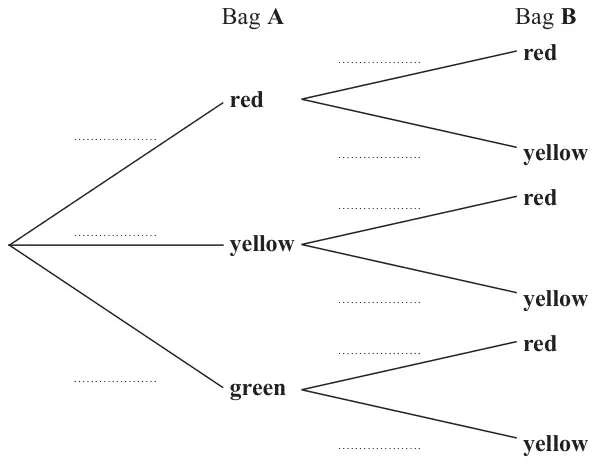
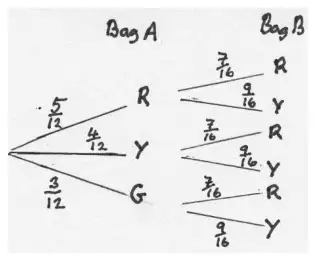
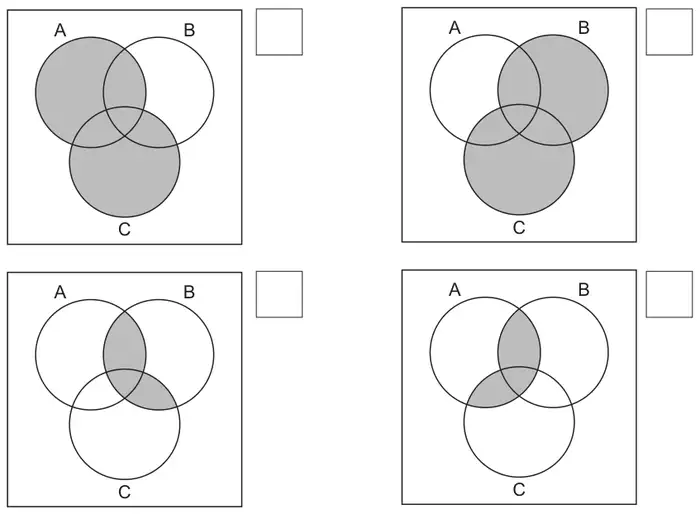
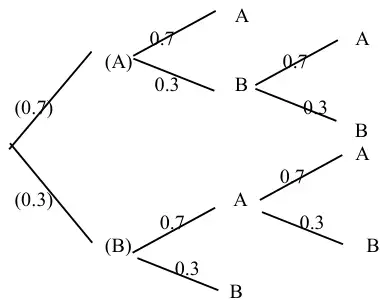
M1: for selection of all correct cases (including the \(1 -\) if required). Don’t need P(… may be implied by correct probability products seen (ft their tree diagram)
A1ft: for a correct complete probability expression (ft their tree diagram) or awrt 0.708 Must see product pairs (for ft) or implied by correct values e.g. \(\frac{15}{64} + \frac{7}{48} + \frac{3}{16} + \frac{9}{64}\) May see \(1 - \mathrm{P}\left(\bar{Y}\,\bar{Y}\right)\) (M1) and \(1 - \dfrac{2}{3} \times \dfrac{\text{``}7\text{''}}{\text{``}16\text{''}}\) (A1ft)
A1: for an exact answer …fraction needn’t be simplified but decimal must have \(\ldots\dot{3}\)
Acc:If scored 2nd A0 in (b) for 0.708 (or better) then allow A1 in (c) for awrt 0.199
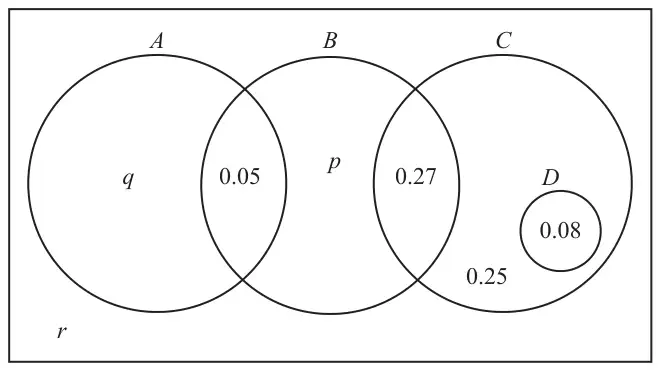
(f) Use set notation to write an expression for the event with probability \(p\) (1)
Mark scheme (a)
Scheme
Marks
AO
\(A, C\) or \(A, D\) or \(B, D\) [Allow things like \(A \cap D\)]
B1
1.2
(1)
Notes
B1 for a correct pair. If more than one pair is given then all must be correct. \(\mathrm{P}(A)\) and \(\mathrm{P}(C)\) etc is B0 \(\mathrm{P}(A \cap C) = 0\) is B0 but condone things like \(A \cap C = \varnothing\)
Mark scheme (b)
Scheme
Marks
AO
\(\mathrm{P}(C) = 0.6\) and \(\mathrm{P}(B) = p + 0.32\) and \(\mathrm{P}(B \cap C) = 0.27\) or \((0.08 + 0.25 + 0.27) \times (0.27 + 0.05 + p) = 0.27\) or \(0.27 + 0.05 + p = \tfrac{0.27}{0.6} = 0.45\)
Since \(r \geqslant 0\) the greatest value of \(q\) is “0.22” so \(\mathrm{P}(A \mid B^{\prime}) \leqslant \underline{\mathbf{0.4}}\) or \(\underline{\tfrac{2}{5}}\)
A1
2.2a
(3)
Notes
In parts (b) – (d) we will condone poor notation and mark equations/expressions
In parts (c) and (d) they can use letter \(p\) or we ft their value for \(p\) provided a probability
1st M1 for a correct method for \(\mathrm{P}(A \mid B^{\prime})\) in \(q\) (and \(r\)) ft their \(p\). May be done in stages e.g. find correct expression for \(\mathrm{P}(B^{\prime})\), simplify incorrectly then use \(q\) over this
2nd M1 for a correct equation for \(q + r\) (o.e.)(ft their \(p\)) Can accept \(r = 0\) and \(q = 0.22\) NB sight of \(\tfrac{0.22}{0.55}\) will score M1M1
A1 for 0.4 i.e. deducing the maximum value of \(\mathrm{P}(A \mid B^{\prime})\). Allow \(\leqslant 0.4\) or \(\mathrm{P}(A \mid B^{\prime}) = 0.4\) Can award 3/3 for \(\mathrm{P}(A \mid B^{\prime}) = 0.4\) but not 0.4 alone as it can come from e.g \(\mathrm{P}(C^{\prime})\)
In parts (b) – (d) we will condone poor notation and mark equations/expressions
In parts (c) and (d) they can use letter \(p\) or we ft their value for \(p\) provided a probability
M1 for a correct equation for \(r\) (or \(q\)) only can have \(p\) or ft their value for \(p\). May be in stages e.g. find \(\mathrm{P}(A^{\prime}) = 0.27 + 0.25 + 0.08 + p + r\) but make a slip in getting 0.6 then use this.
1st A1 for \(r = 0.07\) or \(q = 0.15\)
2nd A1ft for \(r = 0.07\) and \(q = 0.15\) or values giving \(q + r = 0.22\) provided both \(q\) and \(r\) are probabilities. Obviously, 2nd A1ft is dependent on the M1
5. The records for a school athletics club show that the height, \(H\) metres, achieved by students in the high jump is normally distributed with mean 1.4 metres and standard deviation 0.15 metres.
(a) Find the proportion of these students achieving a height of more than 1.6 metres. (1)
The records also show that the time, \(T\) seconds, to run 1500 metres is normally distributed with mean 330 seconds and standard deviation 26 seconds.
The school’s Head would like to use these distributions to estimate the proportion of students from the school athletics club who can jump higher than 1.6 metres and can run 1500 metres in less than 5 minutes.
(b) State a necessary assumption about \(H\) and \(T\) for the Head to calculate an estimate of this proportion. (1)
(c) Find the Head’s estimate of this proportion. (3)
Students in the school athletics club also throw the discus.
The random variable \(D \sim \mathrm{N}\left(\mu, \sigma^2\right)\) represents the distance, in metres, that a student can throw the discus.
Given that \(\mathrm{P}(D \lt 16.3) = 0.30\) and \(\mathrm{P}(D \gt 29.0) = 0.10\)
(d) calculate the value of \(\mu\) and the value of \(\sigma\) (5)
Need \(H\) and \(T\) to be independent or events \(\{H \gt 1.6\}\) and \(\{T \lt 300\}\) are independent
B1
2.4
(1)
Notes
B1 for a suitable reason mentioning or implying \(H\) and \(T\) are independent Allow: e.g. “they”/ “each event”/ “\(\mathrm{P}(H)\) and \(\mathrm{P}(T)\)”/ “the variables” and “independent” B0 for “the results” / “the values” are independent. Ignore other comments that are not incorrect or contradictory.
Prob both is: \(\text{``}0.0912\ldots\text{''} \times \text{``}0.124\ldots\text{''}\)
M1
1.1b
\(= 0.011335\ldots =\) awrt 0.0113
A1
1.1b
(3)
Notes
1st M1 for using model for \(T\) to attempt to find \(\mathrm{P}(T \lt 300)\) e.g. sight of 0.124 or better or sight of \(\pm\left(\dfrac{300 - 330}{26}\right)\) or \(\pm\left(\dfrac{5 - 5.5}{0.433\ldots}\right)\) or \(Z = \pm\,1.15(3\ldots)\)
2nd M1 for multiplying their two probabilities together ft part (a) and their \(\mathrm{P}(T \lt 300)\) provided both values are probabilities. NB M0M1 is possible here
A1 for awrt 0.0113 [Correct answer with no incorrect working 3/3]
1st M1 for standardising 16.3 and setting equal to \(z\) value where \(0.5 \lt |z| \lt 0.6\)
2nd M1 for standardising 29 and setting equal to \(z\) value where \(1 \lt |z| \lt 1.5\)
3rd M1 dep on 1st or 2nd M1 for solving their two linear eq’ns – reach an eq’n in one variable May be implied by sight of \(\sigma = 7\) (or better) or \(\mu = 20\) (or better)
For 1st A mark we must also see one of \(-0.5244\) or 1.2816 (or better) used in their equ’ns OR both \(z\) values correct to 3dp i.e. \(-0.524\) and 1.282
1st A1 for \(\sigma =\) awrt 7.03 (but see 3rd case below)
2nd A1 for \(\mu =\) in [19.95, 20.0] (i.e shouldn’t see something rounding down to 20.0) Allow 20 from equations with suitable \(z\) values (see examples below)
NB Use of \(-0.524\) and 1.28 [would give 7.0399… and 19.988…] and scores M3A0A1 Use of \(-0.524\) and 1.2816 [would give 7.033… and 19.99…] and scores M3A1A1 Use of \(-0.5244\) and 1.28 [would give 7.038… and 19.99 …] and scores M3A1A1
Both \(z\) values correct to 3dp i.e. \(-0.524\) and 1.282 [should give 7.032 and 19.984] scores A1A1
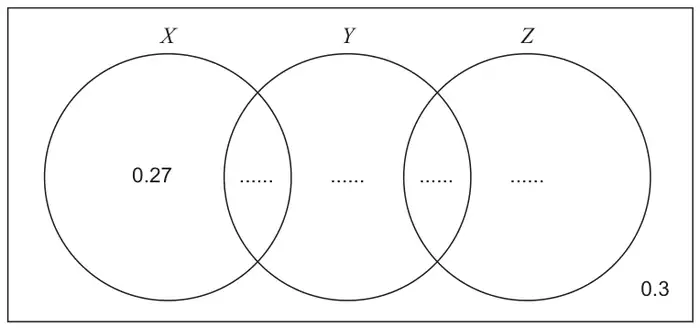
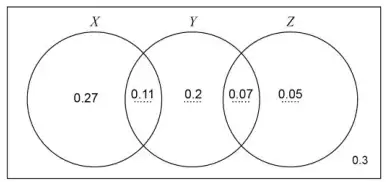
(e) Show that the events \(Y\) and \(Z\) are not independent of each other. [2 marks]
Mark scheme (a)
Scheme
Marks
AO
Obtains 0.12
B1
1.1a
(1)
Typical solution
0.12
Mark scheme (b)
Scheme
Marks
AO
Obtains at least one of 0.11 or 0.2 or 0.07 or 0.05 in the correct place
M1
1.1a
Obtains at least two of 0.11 or 0.2 or 0.07 or 0.05 in the correct place
M1
1.1a
Completes the Venn diagram correctly
A1
1.1b
(3)
Typical solution
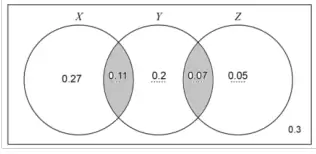
Mark scheme (c)
Scheme
Marks
AO
States their 0.11 + their 0.07 PI by correct answer
M1
1.1a
Obtains 0.18 FT their values provided the final positive answer is <0.38
A1F
1.1b
(2)
Typical solution
\[0.11 + 0.07 = 0.18\]
Mark scheme (d)
Scheme
Marks
AO
States \(\mathrm{P}(Y^\prime \mid Z^\prime) = \dfrac{P(Y^\prime \cap Z^\prime)}{P(Z^\prime)}\) OE Condone missing \(\mathrm{P}(Y^\prime \mid Z^\prime)\) or calculates \(\mathrm{P}(Y^\prime \cap Z^\prime)\) PI by 0.57 seen on numerator or calculates 1 − their \(\mathrm{P}(Z)\) from part 19(a) PI by 0.88 seen on denominator PI by correct answer
States their \(\mathrm{P}(Z)\) from part 19(a) \(\times\) 0.38 or compares their \(\mathrm{P}(Y \mid Z)\) with 0.38 or compares their \(\mathrm{P}(Z \mid Y)\) with their \(\mathrm{P}(Z)\) from part 19(a) or any other valid comparison with one correct probability to at least 2 sf
M1
1.1a
Completes a reasoned argument with correct values and concludes that \(Y\) and \(Z\) are not independent
(b) Determine whether the events \(G\) and \(H\) are independent.
Fully justify your answer. [2 marks]
Mark scheme (a)
Scheme
Marks
AO
(i) Obtains 0.39
B1
1.1b
(1)
(ii) States or calculates \(1 - \mathrm{P}(G \cap H)\) or states 0.07 + 0.18 + 0.54 PI by correct answer
M1
1.1a
Obtains 0.79
A1
1.1b
(2)
(iii) States \(\mathrm{P}(H \mid G^{\prime}) = \dfrac{\mathrm{P}(H \cap G^{\prime})}{\mathrm{P}(G^{\prime})}\) Condone missing \(\mathrm{P}(H \mid G^{\prime})\) or states \(\mathrm{P}(H \cap G^{\prime}) = 0.07\) or \(\dfrac{0.07}{k}\) seen or states 0.07 + 0.54 or 0.61 or \(\dfrac{k}{0.07 + 0.54}\) seen PI by correct answer
States their \(\mathrm{P}(G)\) from part 18(a)(i) × 0.28 or compares their \(\mathrm{P}(G)\) from part 18(a)(i) with 0.75 or compares their \(\mathrm{P}(H \mid G)\) with 0.28 or compares their \(\mathrm{P}(H \mid G^{\prime})\) from part 18(a)(iii) with 0.28 or any other valid comparison with one correct probability to at least 2 sf
M1
3.1b
Completes a reasoned argument and concludes that \(G\) and \(H\) are not independent
16 A sample of 240 households were asked which, if any, of the following animals they own as pets:
cats (\(C\))
dogs (\(D\))
tortoises (\(T\))
The results are shown in the table below.
Types of pet
\(C\)
\(D\)
\(T\)
\(C\) and \(D\)
\(C\) and \(T\)
\(D\) and \(T\)
\(C\), \(D\) and \(T\)
Number of households
153
70
45
48
21
32
17
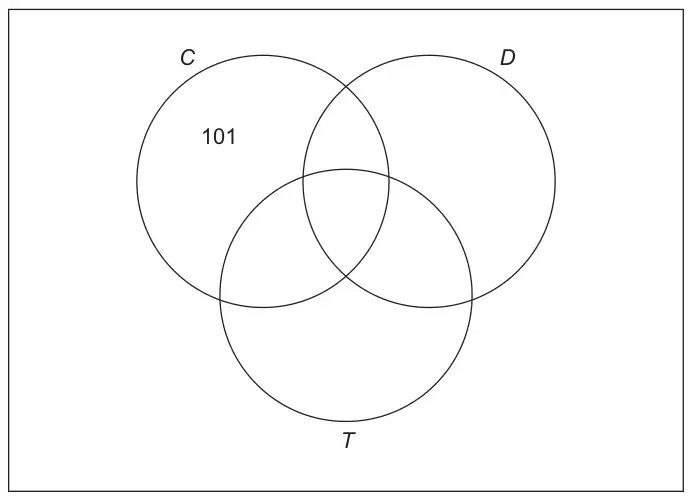
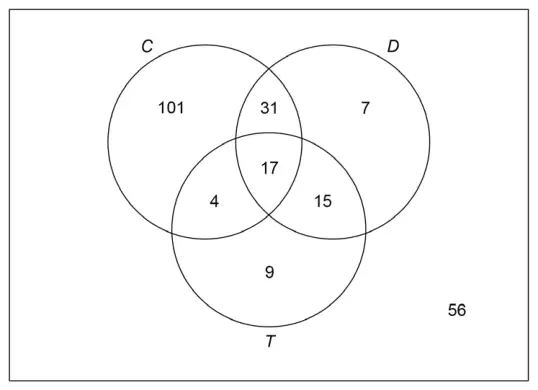
(a) Represent this information by fully completing the Venn diagram below. [3 marks]
(b) A household is chosen at random from the sample.
(i) Find the probability that the household owns a cat only. [1 mark]
(ii) Find the probability that the household owns at least two of the three types of pet. [2 marks]
(iii) Find the probability that the household owns a cat or a dog or both, given that the household does not own a tortoise. [2 marks]
(c) Determine whether a household owning a cat and a household owning a tortoise are independent of each other.
Fully justify your answer. [2 marks]
Mark scheme (a)
Scheme
Marks
AO
Writes at least two of 4, 15, 17 or 31 in the correct place
M1
1.1a
Obtains either 7 or 9 in the correct place
A1
1.1b
Completes the Venn diagram fully correctly including 56
A1
1.1b
(3)
Typical solution
Mark scheme (b)
Scheme
Marks
AO
(i) Obtains the correct probability AWFW [0.42, 0.421] Ignore subsequent incorrect simplification once correct fraction or decimals obtained
B1
1.1b
(1)
(ii) Adds their 4 + 15 + 17 + 31PI by correct answer OE The total is not required at this stage
M1
1.1a
Obtains the correct probability AWFW [0.279, 0.28] Ignore subsequent incorrect simplification once correct fraction or decimals obtained
A1
1.1b
(2)
(iii) Adds their 101 + 31 + 7PI by correct answer OE The total is not required at this stage
M1
1.1a
Obtains the correct probability AWFW [0.71, 0.713] Ignore subsequent incorrect simplification once correct fraction or decimals obtained
A1
1.1b
(2)
Typical solution
(i)
\[\frac{101}{240}\]
(ii)
\[4 + 15 + 17 + 31 = 67\]\[\frac{67}{240}\]
(iii)
\[101 + 31 + 7 = 139\]\[\frac{139}{195}\]
Mark scheme (c)
Scheme
Marks
AO
Finds correct \(P(C) \times P(T)\) or uses correct conditional probability eg \(P(T \mid C) = \dfrac{21}{153}\) OE All figures must be correct
M1
3.1b
Compares \(P(C \cap T) = \dfrac{21}{240}\) with \(\dfrac{153}{1280}\) and concludes owning a cat and owning a tortoise are not independent
eg \(\dfrac{21}{240} \ne \dfrac{153}{1280}\) so not independent or compares conditional probability eg \(\dfrac{21}{153} \ne \dfrac{45}{240}\) so not independent
M1: May be implied by first A1 (which is implied by use of 4 correct probabilities).
A1: Soi
M1: FT their probabilities, dep \(\Sigma p = 1\) Allow M1 if \(\times 2\) omitted or \(2 \times\) an additional term. Allow this mark for \(44p^3\) May see e.g.
Leading to an expression of the form given (3 or 4 terms each comprised of 3 of their probabilities multiplied together).
A1: Correct value from correct working implies all 4 marks (i.e. if candidates write \(44p^3\) and \(p = \frac{1}{15} \Rightarrow \mathrm{P}(\ldots) = \frac{44}{3375}\) then score 4/4) Accept awrt 0.0130 (3sf)
M1*: Forming this equation in \(p\), must be fully correct with \(= 1\) soi
M1 dep*: Rearrange their equation to solvable form \(ap^2 + bp + c = 0\) and attempt to solve (may be implied by one or both correct roots)
B1: For sight of \(p = -\frac{3}{2}\) oe provided this root not used in subsequent working. Condone “the other root is negative” or “\(p \gt 0\)”
A1: These values are likely to be seen in, and may be implied by, subsequent working. Note that a correct numerical denominator or final answer also implies this mark.
M1: Either numerator or denominator attempted (correct form with 2 terms in the numerator or 6 terms in the denominator). FT their probabilities. May be implied by any of: • a correct expression for one of the numerator or denominator either in \(p\) or with their probabilities • a correct final answer
M1: Division attempted with a 2-term numerator and 6-term denominator soi either in \(p\) or with their probabilities (may see numerator and denominator computed separately and then an attempt to divide)
12 Ryan has to choose one student at random from a group of 11 students. Ryan makes the choice using a single throw of two fair, six-sided dice, together with the following table.
Total score on the two dice
2
3
4
5
6
7
8
9
10
11
12
Student chosen
A
B
C
D
E
F
G
H
I
J
K
(a) Show that this sampling method is not random. [2]
Sasha suggests making the choice using a single throw of two fair, six-sided dice, together with the following table.
Scores on the two dice
1, 1
1, 2
2, 1
1, 3
3, 1
1, 4
4, 1
1, 5
5, 1
1, 6
6, 1
Student chosen
A
B
C
D
E
F
G
H
I
J
K
Ryan says that a further instruction is needed to complete the method.
(b)
(i) Write a suitable further instruction. [1]
(ii) Using Sasha’s method, state the probability of choosing student E. [1]
Mark scheme (a)
Scheme
Marks
AO
Two correct, unequal probabilities: e.g. \(\mathrm{P}(2) = \frac{1}{36},\ \mathrm{P}(3) = \frac{2}{36}\)
M1
2.4
Probabilities not equal (and hence not random).
A1
3.5b
[2]
Notes
M1: Must be seen. Condone a correct statement e.g. “The probability of obtaining 2 is not the same as the probability of getting 3” – must refer to specific scores, need not compute probabilities (but if given these must be correct).
A1: A generalised conclusion must be present:
Allow “probabilities are not the same”
May come at the beginning e.g. “the chance of each student being chosen is not equal because…”
Alternative using combinations
Scheme
Marks
Demonstrate that there are more ways of obtaining one answer than another e.g. “there are more ways of obtaining 4 than 2”
M1
(Hence student C is more likely to be chosen than student A) and therefore the probabilities are not equal (and hence not random).
A1
M1: Must be seen. Must refer to specific scores but need not compute the number of combinations/ways (but if given these must be correct).
A1: A generalised conclusion must be present:
Accept “student __ is more likely to be chosen than student __, therefore it is not random”
Accept “some scores are more likely than others”
Mark scheme (b)
Scheme
Marks
AO
(i) Throw repeatedly until one of these pairs is obtained
B1
3.5c
[1]
(ii) \(\dfrac{1}{11}\)
B1
3.4
[1]
Notes
(b)(i)B1: Any valid correction to the method, e.g.:
“If obtain a pair not included, throw again.”
“make the two dice distinguishable” (because 1,3 and 3,1 have different students) or “throw in order”
Condone extending to the entire sample space (e.g. “assign a further 2 pairs to each student and the remaining 3 to ‘throw again’”) but the method must remain random.
14In this question you must show detailed reasoning.
A disease that affects trees shows no visible evidence for the first few years after the tree is infected.
A test has been developed to determine whether a particular tree has the disease. A positive result to the test suggests that the tree has the disease. However, the test is not 100% reliable, and a researcher uses the following model.
If the tree has the disease, the probability of a positive result is 0.95.
If the tree does not have the disease, the probability of a positive result is 0.1.
(a) It is known that in a certain county, \(A\), 35% of the trees have the disease. A tree in county \(A\) is chosen at random and is tested. Given that the result is positive, determine the probability that this tree has the disease. [3]
A forestry company wants to determine what proportion of trees in another county, \(B\), have the disease. They choose a large random sample of trees in county \(B\).
Each tree in the sample is tested and it is found that the result is positive for 43% of these trees.
(b) By carrying out a calculation, determine an estimate of the proportion of trees in county \(B\) that have the disease. [4]
M1: Attempting this calculation, allow wrong values but for this mark must be a fraction with a product in the numerator and a sum of two products in the denominator.
A1: Fully correct expression
A1: Or 133/159 or 0.8365 (4sf) (0.836477…)
Mark scheme (b)
Scheme
Marks
AO
(Let proportion having the disease \(= p\)) \(p \times 0.95 + (1 - p) \times 0.1\)
The number of students who study both History and English is 3.
The number of students who study neither History nor English is 14.
The number of students who study History but not English is three times the number who study English but not History.
(a)
Show this information on a Venn diagram.
Determine the probability that a student selected at random studies English. [4]
Two different students from the class are chosen at random.
(b) Given that exactly one of the two students studies English, determine the probability that exactly one of the two students studies History. [6]
Mark scheme (a)
Scheme
Marks
AO
Single Venn diagram drawn showing 3, 14, \(x\) and \(3x\) correctly placed
B1
3.1a
\(3 + 14 + x + 3x = 25\) oe or \(x = 2\)
M1
1.1a
Number who study English \(= \text{“}2\text{”} + 3\) or 5
M1
1.1
\(\mathrm{P}(E) = \dfrac{5}{25}\) or \(\dfrac{1}{5}\) or 0.2
A1
1.1
[4]
Notes
B1: or showing 3, 14, 2 and 6 correctly placed Allow omission of rectangle, so long as 14 seen outside Allow probabilities in the diagram
M1: May be implied, eg by 2 seen in correct place in diagram
M1: Their \(x + 3\). May be implied by answer
If \(x\) is total English, giving \(x = 5\), use an equivalent scheme.
Alternative (incorrect) method for H \(\leftrightarrow\) E
Scheme
Marks
Diagram
B0
\(3 + 14 + x + 3x = 25\) oe or \(x = 2\)
M1
Number who study English \(= \text{“}6\text{”} + 3\) or 9
M1
\(\mathrm{P}(E) = \dfrac{9}{25}\)
A1
M1: Or implied in diagram, History only = 2, or total History = 5
M1: Their \(3x + 3\). May be implied by answer
A1: If \(x\) is total History, giving \(x = 5\), use an equivalent scheme
Mark scheme (b)
Scheme
Marks
AO
P(exactly one English) \(= \dfrac{5}{25} \times \dfrac{20}{24} \times 2\) oe
M1
1.1
\(= \dfrac{1}{3}\) or 0.333 (3sf)
A1
1.1
P(exactly one E and exactly one H) = \(\mathrm{P}(HE' \text{ and } H'E) + \mathrm{P}(EH \text{ and } E'H')\) \(= \left(\dfrac{6}{25} \times \dfrac{2}{24} + \dfrac{3}{25} \times \dfrac{14}{24}\right) \times 2\) oe \(\left(= \dfrac{9}{50} \text{ or } 0.18\right)\)
M2
3.1b 2.4
\(\dfrac{\mathrm{P}(\text{exactly one E and exactly one H})}{\mathrm{P}(\text{exactly one E})}\) \(\left(= \dfrac{9}{50} \div \dfrac{1}{3}\right)\)
M1
1.1
\(= \dfrac{27}{50}\) or 0.54 (3 sf) cao
A1
1.1
[6]
Notes
M1: Allow omit \(\times 2\). Allow \(\dfrac{5}{25} \times \dfrac{20}{25}\) or 0.16 or 0.32. Allow + ….
A1: NB No ft from (a) in (b)
M2: M1 for one of \(\frac{6}{25} \times \frac{2}{24}\) or \(\frac{3}{25} \times \frac{14}{24}\) oe OR \(\frac{6}{25} \times \frac{2}{25} + \frac{3}{25} \times \frac{14}{25}\) (both terms) OR \(\frac{6}{25} \times \frac{a}{24} + \frac{3}{25} \times \frac{b}{24}\) or \(\frac{2}{25} \times \frac{a}{24} + \frac{14}{25} \times \frac{b}{24}\) (\(a\), \(b\) integer \(\lt 24\)) Allow any of the above + extras for M1
M1: Divide attempted probs of correct events dep \(\geqslant\) M1M1
A1: Careful!! SCs for correct answer by incorrect methods: “×2” omitted throughout: \(\dfrac{9}{100} \div \dfrac{1}{6} = \dfrac{27}{50}\): M1A0M1M0M1A1 (Total 4) Denominator 25×25 instead of 25×24: \(\dfrac{54}{625} \div \dfrac{4}{25} = \dfrac{27}{50}\): M1A0M1M0M1A1 (Total 4) Both the above \(\dfrac{27}{625} \div \dfrac{2}{25} = \dfrac{27}{50}\): M1A0M1M0M1A1
Alternative method 1
Scheme
Marks
n(exactly one English) \(= \mathrm{n}(E) \times \mathrm{n}(E')\)
M1
\(= 5 \times 20 = 100\)
A1
n(exactly one E and exactly one H) \(= \mathrm{n}(EH') \times \mathrm{n}(E'H) + \mathrm{n}(EH) \times \mathrm{n}(E'H')\) \(= 2 \times 6 + 3 \times 14\) \((= 54)\)
M1 M1
Attempt \(\dfrac{\mathrm{n}(\text{exactly one E and exactly one H})}{\mathrm{n}(\text{exactly one E})}\) \(\left(= \dfrac{54}{100}\right)\)
M1
\(= \dfrac{27}{50}\) oe or 0.54 (3 sf) cao
A1
M1M1: M1 for one of 2×6 or 3×14 or M1 for \(2 \times a + 3 \times b\) (\(a\), \(b\) integers, \(a \lt 23\), \(b \lt 22\))
M3: M2 for one of these products \(6/20 \times 2/5\) or \(3/5 \times 14/20\) or M1 for \(a/20 \times 2/5 + 3/5 \times b/20\) or M1 for \(6/a \times 2/5 + 3/5 \times 14/b\)
Alternative (incorrect) method for H \(\leftrightarrow\) E
Scheme
Marks
P(exactly one English) \(= \dfrac{9}{25} \times \dfrac{16}{24}\) (×2)
M1
\(= \dfrac{6}{25}\)
A0
P(exactly one E and exactly one H) = \(\mathrm{P}(HE' \text{ and } H'E) + \mathrm{P}(EH \text{ and } E'H')\) Same as main scheme \(\left(= \dfrac{9}{50} \text{ or } 0.18\right)\)
M1 M1
\(\dfrac{\mathrm{P}(\text{exactly one E and exactly one H})}{\mathrm{P}(\text{exactly one E})}\) \(\left(= \dfrac{9}{50} \div \dfrac{6}{25}\right)\)
M1
\(= \dfrac{3}{4}\) or 0.75 (3 sf)
A0
M1: Allow without ×2. Allow \(\dfrac{9}{25} \times \dfrac{16}{25}\) or 0.230 or 0.461.
M1: Attempt divide attempted probabilities of correct events dep at least M1M1
A0: SC answer \(\dfrac{3}{4}\), but omit ×2 and/or denominator of 25, M1A0M1M0M1A1
(b) Show in a table the values of \(X\) and their probabilities. [1]
(c) The values of three independent observations of \(X\) are denoted by \(X_1\), \(X_2\) and \(X_3\). Find \(\mathrm{P}(X_1 \gt X_2 + X_3)\). [3]
In a game, a player notes the values of successive independent observations of \(X\) and keeps a running total. The aim of the game is to reach a total of exactly 7.
(d) Determine the probability that a total of exactly 7 is first reached on the 5th observation. [5]
B1B1 for both sets in any order, without extras. Both soi. B1 for both sets in any order, with extras.
M1: \(\left(\frac{12}{25}\right)^4 \times \frac{4}{25}\) or \(\left(\frac{12}{25}\right)^3 \times \left(\frac{6}{25}\right)^2\) oe seen. Ignore coeffs. ft their table
A1: For either \(\left(\frac{12}{25}\right)^4 \times \frac{4}{25} \times 5\) or \(\left(\frac{12}{25}\right)^3 \times \left(\frac{6}{25}\right)^2 \times {}^5\mathrm{C}_2\) oe ft their table
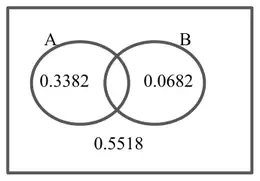
\(\mathrm{P}(A|B) = 0.38 = \mathrm{P}(A)\) so independent
A1
M1: value for \(\mathrm{P}(\mathrm{A} \cap \mathrm{B})\) found; allow M1 for 0.0418 unsupported allow if seen in part (a) on diagram
M1: may be implied by 0.11 or may be implied by 0.38
A1:or \(\mathrm{P}(B|A) = \dfrac{0.0418}{(0.3382 + 0.0418)} = 0.11\); allow eg \(\mathrm{P}(A|B) = \dfrac{\mathrm{P}(\mathrm{A}\cap\mathrm{B})}{\mathrm{P}(\mathrm{B})} = 0.38\) if P(B) = 0.11 and \(\mathrm{P}(\mathrm{A}\cap\mathrm{B}) = 0.0418\) seen elsewhere
A1:or \(\mathrm{P}(B|A) = 0.11 = \mathrm{P}(B)\) so independent
Mark scheme (c)
Scheme
Marks
AO
\(\mathrm{P}(\mathrm{A} \cap \mathrm{B}) \neq 0\) so not mutually exclusive
or \(1 - 0.5518 \neq\) their 0.11 + their 0.38 so \(\mathrm{P}(A \cup B) \neq \mathrm{P}(A) + \mathrm{P}(B)\) so not mutually exclusive
B1
2.4
[1]
Notes
B1: allow \(\mathrm{P}(\mathrm{A} \cap \mathrm{B}) =\) their 0.0418 so not mutually exclusive; must refer to probability; do not allow eg they have an intersection; eg the intersection is 0.0418
5 \(M\) is the event that an A-level student selected at random studies mathematics.
\(C\) is the event that an A-level student selected at random studies chemistry.
You are given that \(\mathrm{P}(M) = 0.42\), \(\mathrm{P}(C) = 0.36\) and \(\mathrm{P}(M \text{ and } C) = 0.24\). These probabilities are shown in the two-way table below.
\(M\)
\(M^{\prime}\)
Total
\(C\)
0.24
0.36
\(C^{\prime}\)
Total
0.42
1
(a) In the Printed Answer Booklet, complete the copy of the two-way table. [2]
(b) Calculate the probability that an A-level student selected at random does not study chemistry given that they do not study mathematics. [2]
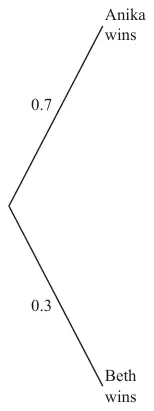
16 Research conducted by social scientists has shown that 16% of young adults smoke cigarettes.
Two young adults are selected at random.
(a) Determine the probability that one smokes cigarettes and the other doesn’t. [2]
The same research has also shown that
75% of young adults drink alcohol.
66% of young adults drink alcohol, but do not smoke cigarettes.
(b) Determine the probability that a young adult selected at random does smoke cigarettes, but does not drink alcohol. [2]
(c) A young adult who drinks alcohol is selected at random. Determine the probability that this young adult smokes cigarettes. [2]
(d) Using your answer to part (c), explain whether the event that a young adult selected at random smokes cigarettes is independent of the event that a young adult selected at random drinks alcohol. [2]
Mark scheme (a)
Scheme
Marks
AO
\(0.16 \times 0.84 \times 2\) or B(2, 0.16) or B(2, 0.84) seen or \(1 - (0.84^2 + 0.16^2)\)
M1
1.1
\(\frac{168}{625}\) or 0.2688 or 0.269 or 0.27 cao
A1
1.1
[2]
Notes
M1: condone omission of 2 allow recovery from bracket error
A1: mark the final answer allow SC1 for correct answer unsupported
Mark scheme (b)
Scheme
Marks
AO
\(0.75 - 0.66 = 0.09\)
M1
3.1a
\([0.16 - 0.09 =]\ 0.07\) isw
A1
1.1
[2]
Notes
M1: allow 0.09 embedded in correct place in Venn diagram or contingency table; allow M1 for 9%
A1: allow SC1 for correct answer unsupported
Mark scheme (c)
Scheme
Marks
AO
\(\frac{0.09}{0.75}\)
M1
3.1a
0.12
A1
1.1
[2]
Notes
M1:M0 for 0.12 from wrong working
A1: allow SC1 for correct answer unsupported
Mark scheme (d)
Scheme
Marks
AO
\(0.12 \neq 0.16\)
M1
2.1
so not independent
A1
2.2a
[2]
Notes
A1: if M0 allow SCB1 for \(0.16 \times 0.75 \neq 0.09\) so not independent
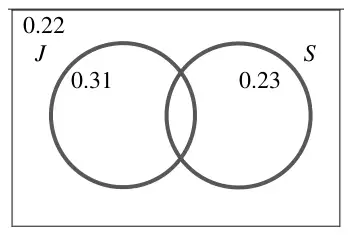
31% have a part-time job but do not play competitive sport.
23% play competitive sport but do not have a part-time job.
22% do not play competitive sport and do not have a part-time job.
(a) Show this information on a Venn diagram. [2]
A student is selected at random.
(b) Determine the probability that the student plays competitive sport and has a part-time job. [2]
Mark scheme (a)
Scheme
Marks
AO
M1 A1
1.1 1.1
[2]
Notes
M1: Venn diagram with 2 overlapping regions and 0.22 correctly placed; condone incorrect or no labelling
A1: all probabilities or percentages correctly placed and correctly labelled; ignore values in intersection allow if no box drawn if labels are eg \(A\) and \(B\), \(A\) and \(B\) need to be defined