Moments

Edexcel

AQA

OCR A

OCR MEI

June 2025 Paper 3 Mechanics Q6

EdexcelCurrent spec11 marksMomentsResolving Forces

6.

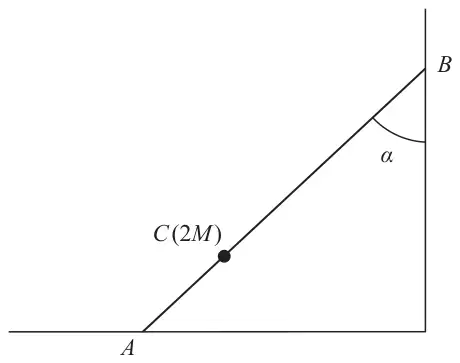
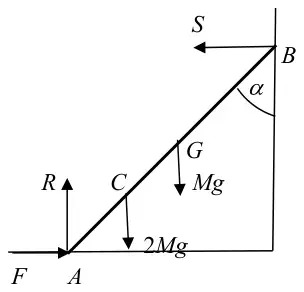
Figure 4: rod AB with end A on horizontal ground and end B against a vertical wall, at angle alpha to the wall, with a particle C of mass 2M on the rod
Figure 4

A uniform rod \(AB\) has mass \(M\) and length \(2a\).

A particle of mass \(2M\) is attached to the rod at the point \(C\), where \(AC = 0.5a\)

The rod rests with end \(A\) on rough horizontal ground and end \(B\) against a vertical wall.

The rod lies in a vertical plane which is perpendicular to the wall.

The rod is in equilibrium at an angle \(\alpha\) to the wall, as shown in Figure 4.

In an initial model

  • the vertical wall is modelled as being smooth
  • the magnitude of the normal reaction of the ground on the rod at \(A\) is \(R\)
  • the magnitude of the force exerted on the rod by the wall at \(B\) is \(S\)

Using the model,

(a) find \(R\) in terms of \(M\) and \(g\) (1)
(b) show that \(S = Mg\tan\alpha\) (3)

In a refined model

  • the vertical wall is modelled as being rough
  • the magnitude of the normal reaction of the ground on the rod at \(A\) is \(R_1\)
(c) State which is greater, \(R\) or \(R_1\), giving a reason for your answer. (1)
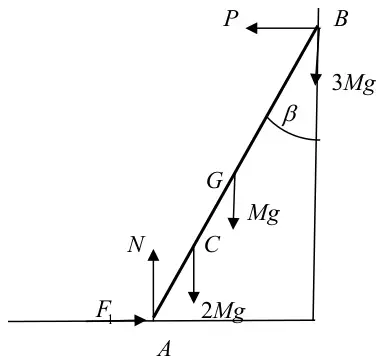
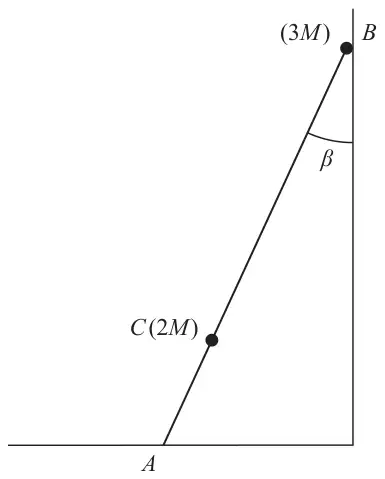
Figure 5: the rod AB, now with a particle of mass 3M at B as well as the particle C of mass 2M, with end A on the ground and end B against the wall, at angle beta to the wall
Figure 5

A second particle of mass \(3M\) is now attached to the rod at \(B\).

The rod again rests with end \(A\) on rough horizontal ground and end \(B\) against the vertical wall.

The rod lies in a vertical plane which is perpendicular to the wall.

The rod is now in limiting equilibrium at an angle \(\beta\) to the wall, as shown in Figure 5.

The vertical wall is again modelled as being smooth.

The coefficient of friction between the rod and the ground is \(\mu\)

Given that \(\tan\beta = \dfrac{1}{2}\)

(d) use the model to show that \(\mu = \dfrac{1}{3}\) (6)

June 2024 Paper 3 Mechanics Q6

EdexcelCurrent spec9 marksMomentsResolving Forces

6.

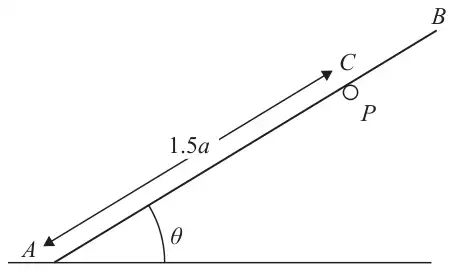
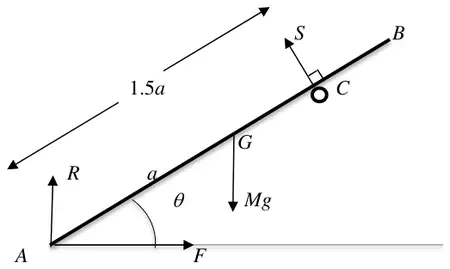
Figure 5: rod AB with end A on horizontal ground at angle theta, resting on a peg P at point C where AC = 1.5a
Figure 5

Figure 5 shows a uniform rod \(AB\) of mass \(M\) and length \(2a\).

  • the rod has its end \(A\) on rough horizontal ground
  • the rod rests in equilibrium against a small smooth fixed horizontal peg \(P\)
  • the point \(C\) on the rod, where \(AC = 1.5a\), is the point of contact between the rod and the peg
  • the rod is at an angle \(\theta\) to the ground, where \(\tan\theta = \dfrac{4}{3}\)

The rod lies in a vertical plane perpendicular to the peg.

The magnitude of the normal reaction of the peg on the rod at \(C\) is \(S\).

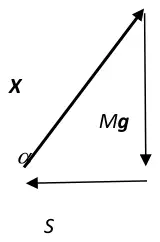
(a) Show that \(S = \dfrac{2}{5}Mg\) (3)

The coefficient of friction between the rod and the ground is \(\mu\).

Given that the rod is in limiting equilibrium,

(b) find the value of \(\mu\). (6)

June 2023 Paper 3 Mechanics Q6

EdexcelCurrent spec13 marksMomentsResolving Forces

6.

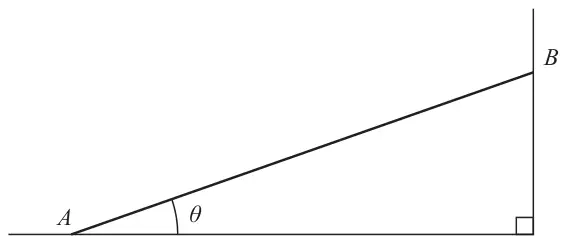
Figure 3: rod AB with end A on horizontal ground and end B against a vertical wall, making angle theta with the ground
Figure 3

A rod \(AB\) has mass \(M\) and length \(2a\).

The rod has its end \(A\) on rough horizontal ground and its end \(B\) against a smooth vertical wall.

The rod makes an angle \(\theta\) with the ground, as shown in Figure 3.

The rod is at rest in limiting equilibrium.

(a) State the direction (left or right on Figure 3 above) of the frictional force acting on the rod at \(A\). Give a reason for your answer. (1)

The magnitude of the normal reaction of the wall on the rod at \(B\) is \(S\).

In an initial model, the rod is modelled as being uniform.

Use this initial model to answer parts (b), (c) and (d).

(b) By taking moments about \(A\), show that\[S = \frac{1}{2}Mg\cot\theta\] (3)

The coefficient of friction between the rod and the ground is \(\mu\)

Given that \(\tan\theta = \dfrac{3}{4}\)

(c) find the value of \(\mu\) (5)
(d) find, in terms of \(M\) and \(g\), the magnitude of the resultant force acting on the rod at \(A\). (3)

In a new model, the rod is modelled as being non-uniform, with its centre of mass closer to \(B\) than it is to \(A\).

A new value for \(S\) is calculated using this new model, with \(\tan\theta = \dfrac{3}{4}\)

(e) State whether this new value for \(S\) is larger, smaller or equal to the value that \(S\) would take using the initial model. Give a reason for your answer. (1)

June 2022 Paper 3 Mechanics Q4

EdexcelCurrent spec11 marksMomentsResolving Forces

4.

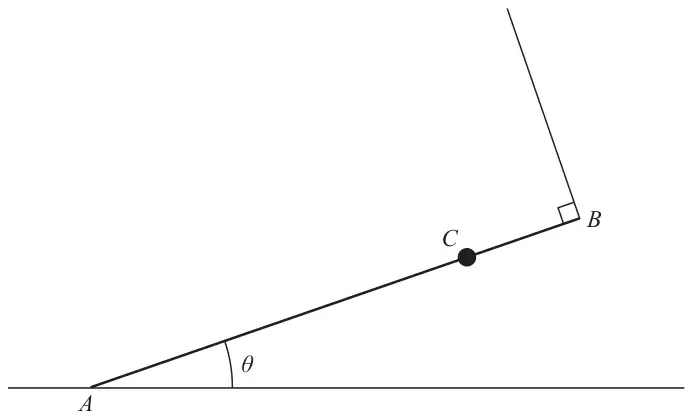
Figure 2: rod AB with end A on horizontal ground at angle theta, particle at C on the rod, and a string attached at B perpendicular to the rod
Figure 2

A uniform rod \(AB\) has mass \(M\) and length \(2a\)

A particle of mass \(2M\) is attached to the rod at the point \(C\), where \(AC = 1.5a\)

The rod rests with its end \(A\) on rough horizontal ground.

The rod is held in equilibrium at an angle \(\theta\) to the ground by a light string that is attached to the end \(B\) of the rod.

The string is perpendicular to the rod, as shown in Figure 2.

(a) Explain why the frictional force acting on the rod at \(A\) acts horizontally to the right on the diagram. (1)

The tension in the string is \(T\)

(b) Show that \(T = 2Mg\cos\theta\) (3)

Given that \(\cos\theta = \dfrac{3}{5}\)

(c) show that the magnitude of the vertical force exerted by the ground on the rod at \(A\) is \(\dfrac{57Mg}{25}\) (3)

The coefficient of friction between the rod and the ground is \(\mu\)

Given that the rod is in limiting equilibrium,

(d) show that \(\mu = \dfrac{8}{19}\) (4)

October 2021 Paper 3 Mechanics Q3

EdexcelCurrent spec10 marksMomentsResolving Forces

3.

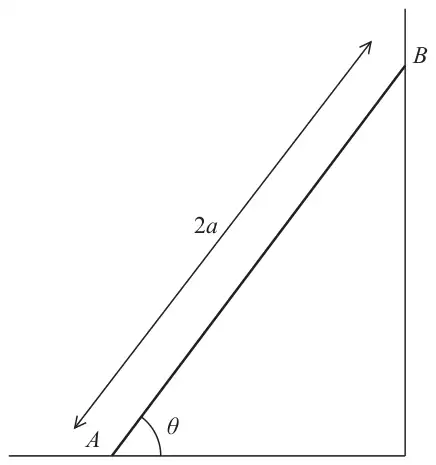
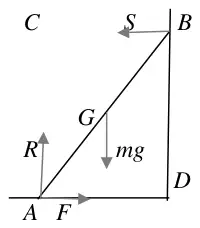
Figure 2: beam AB of length 2a with A on horizontal ground and B against a vertical wall, inclined at angle theta to the horizontal
Figure 2

A beam \(AB\) has mass \(m\) and length \(2a\).

The beam rests in equilibrium with \(A\) on rough horizontal ground and with \(B\) against a smooth vertical wall.

The beam is inclined to the horizontal at an angle \(\theta\), as shown in Figure 2.

The coefficient of friction between the beam and the ground is \(\mu\)

The beam is modelled as a uniform rod resting in a vertical plane that is perpendicular to the wall.

Using the model,

(a) show that \(\mu \geqslant \dfrac{1}{2}\cot\theta\) (5)

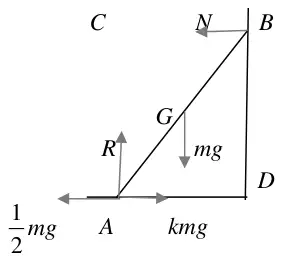
A horizontal force of magnitude \(kmg\), where \(k\) is a constant, is now applied to the beam at \(A\).

This force acts in a direction that is perpendicular to the wall and towards the wall.

Given that \(\tan\theta = \dfrac{5}{4}\), \(\mu = \dfrac{1}{2}\) and the beam is now in limiting equilibrium,

(b) use the model to find the value of \(k\). (5)

October 2020 Paper 3 Mechanics Q4

EdexcelCurrent spec10 marksMomentsResolving Forces

4.

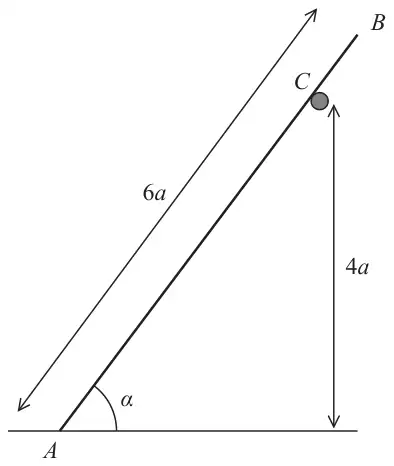
Figure 1: ladder AB of length 6a with A on horizontal ground, resting on a rail at C which is at height 4a above the ground, ladder inclined at angle alpha to the horizontal
Figure 1

A ladder \(AB\) has mass \(M\) and length \(6a\).

The end \(A\) of the ladder is on rough horizontal ground.

The ladder rests against a fixed smooth horizontal rail at the point \(C\).

The point \(C\) is at a vertical height \(4a\) above the ground.

The vertical plane containing \(AB\) is perpendicular to the rail.

The ladder is inclined to the horizontal at an angle \(\alpha\), where \(\sin\alpha = \dfrac{4}{5}\), as shown in Figure 1.

The coefficient of friction between the ladder and the ground is \(\mu\).

The ladder rests in limiting equilibrium.

The ladder is modelled as a uniform rod.

Using the model,

(a) show that the magnitude of the force exerted on the ladder by the rail at \(C\) is \(\dfrac{9Mg}{25}\) (3)
(b) Hence, or otherwise, find the value of \(\mu\). (7)

June 2019 Paper 3 Mechanics Q4

EdexcelCurrent spec11 marksMomentsResolving Forces

4.

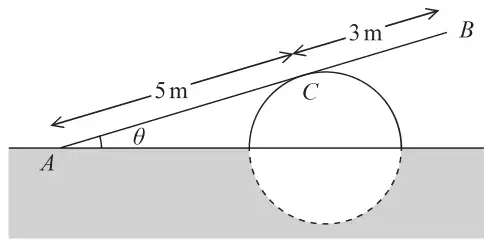
Figure 2: ramp AB with end A on horizontal ground at angle theta, resting on a cylindrical drum partly under the ground at C, where AC = 5 m and CB = 3 m
Figure 2

A ramp, \(AB\), of length 8 m and mass 20 kg, rests in equilibrium with the end \(A\) on rough horizontal ground.

The ramp rests on a smooth solid cylindrical drum which is partly under the ground. The drum is fixed with its axis at the same horizontal level as \(A\).

The point of contact between the ramp and the drum is \(C\), where \(AC = 5\) m, as shown in Figure 2.

The ramp is resting in a vertical plane which is perpendicular to the axis of the drum, at an angle \(\theta\) to the horizontal, where \(\tan\theta = \dfrac{7}{24}\)

The ramp is modelled as a uniform rod.

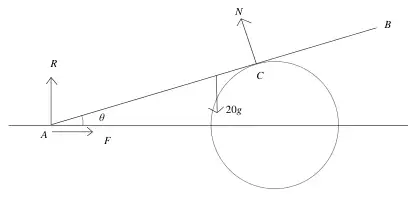
(a) Explain why the reaction from the drum on the ramp at point \(C\) acts in a direction which is perpendicular to the ramp. (1)
(b) Find the magnitude of the resultant force acting on the ramp at \(A\). (9)

The ramp is still in equilibrium in the position shown in Figure 2 but the ramp is not now modelled as being uniform.

Given that the centre of mass of the ramp is assumed to be closer to \(A\) than to \(B\),

(c) state how this would affect the magnitude of the normal reaction between the ramp and the drum at \(C\). (1)

June 2025 Paper 2 Q18

AQACurrent spec6 marksMoments

18 In this question use \(g = 9.81\ \text{m s}^{-2}\)

A uniform platform \(AD\) has length 2.5 metres and weight 400 newtons.

The platform is attached to a chain at \(A\). The other end of the chain is fixed to the floor.

The platform rests on a support at a point \(B\) which is 0.6 metres from \(A\)

The support exerts an upwards reaction force on the platform.

A child of mass 30 kilograms stands at a point \(C\)

The point \(C\) is 0.2 metres from \(D\), as shown in the diagram.

A horizontal platform AD; a chain at A goes down to the floor, a support under B, and point C is 0.2 m from the end D

The system is in equilibrium with the platform resting horizontally.

(a) By taking moments about \(A\), find the reaction force at \(B\) [4 marks]
(b)
(i) The child moves from \(C\) to \(B\)

State what happens to the reaction force at \(B\) during this movement.

[1 mark]
(ii) Having reached \(B\), the child steps off the platform.

State what happens to the tension in the chain during this movement.

[1 mark]

June 2024 Paper 2 Q17

AQACurrent spec4 marksMoments

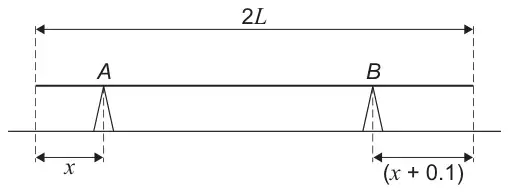
17 A uniform rod is resting on two fixed supports at points \(A\) and \(B\).

\(A\) lies at a distance \(x\) metres from one end of the rod.

\(B\) lies at a distance \((x + 0.1)\) metres from the other end of the rod.

The rod has length \(2L\) metres and mass \(m\) kilograms.

The rod lies horizontally in equilibrium as shown in the diagram below.

Horizontal rod of length 2L on two supports: A at distance x from the left end, B at distance (x + 0.1) from the right end

The reaction force of the support on the rod at \(B\) is twice the reaction force of the support on the rod at \(A\).

Show that

\[L - x = k\]

where \(k\) is a constant to be found. [4 marks]

June 2023 Paper 2 Q17

AQACurrent spec6 marksMoments

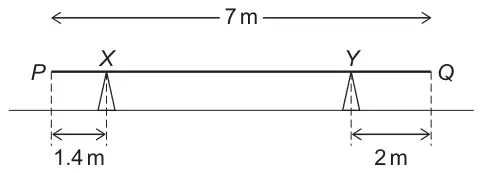
17 A uniform plank \(PQ\), of length 7 metres, lies horizontally at rest, in equilibrium, on two fixed supports at points \(X\) and \(Y\)

The distance \(PX\) is 1.4 metres and the distance \(QY\) is 2 metres as shown in the diagram below.

Horizontal plank PQ of length 7 m resting on supports at X and Y, with PX = 1.4 m and QY = 2 m
(a) The reaction force on the plank at \(X\) is \(4g\) newtons.
(i) Show that the mass of the plank is 9.6 kilograms. [2 marks]
(ii) Find the reaction force, in terms of \(g\), on the plank at \(Y\) [2 marks]
(b) The support at \(Y\) is moved so that the distance \(QY = 1.4\) metres.

The plank remains horizontally at rest in equilibrium.

It is claimed that the reaction force at \(Y\) remains unchanged.

Explain, with a reason, whether this claim is correct. [2 marks]

June 2022 Paper 2 Q14

AQACurrent spec4 marksMoments

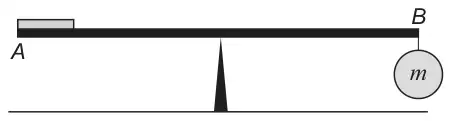
14 A £2 coin has a diameter of 28 mm and a mass of 12 grams.

A uniform rod \(AB\) of length 160 mm and a fixed load of mass \(m\) grams are used to check that a £2 coin has the correct mass.

The rod rests with its midpoint on a support.

A £2 coin is placed face down on the rod with part of its curved edge directly above \(A\).

The fixed load is hung by a light inextensible string from a point directly below the other end of the rod at \(B\), as shown in the diagram.

Horizontal rod AB resting at its midpoint on a triangular support; a flat coin lies on the rod at end A; a circular load of mass m hangs from a string below end B
(a) Given that the rod is horizontal and rests in equilibrium, find \(m\). [3 marks]
(b) State an assumption you have made about the £2 coin to answer part (a). [1 mark]

June 2025 Paper 3 Q10

OCR ACurrent spec8 marksMomentsResolving Forces

10

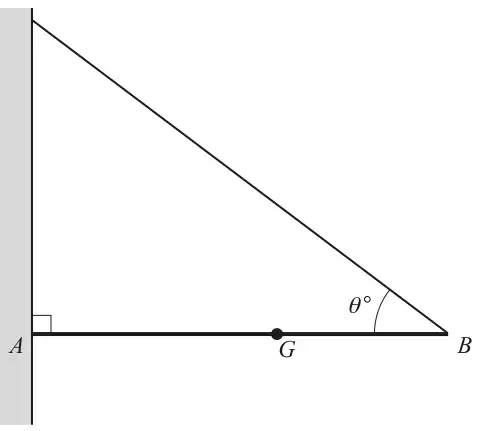
Horizontal rod AB with end A against a vertical wall, right angle at A; G marked on AB; a string from B to a point on the wall above A makes angle theta degrees with the rod at B

The diagram shows a non-uniform rod \(AB\) of mass 4 kg and length 2 m. The end \(A\) of the rod rests against a rough vertical wall. The rod is held in a horizontal position, perpendicular to the wall, by a light inextensible string attached to the rod at \(B\). The other end of the string is attached to the wall at a point vertically above \(A\). The string is inclined at an angle of \(\theta^\circ\) to the horizontal, where \(\sin\theta = \frac{4}{5}\).

The rod rests in equilibrium in a vertical plane perpendicular to the wall. The rod’s weight acts at the point \(G\) on \(AB\).

You are given that the magnitude of the moment of the rod’s weight about \(A\) is 47.04 N m.

(a) Show that the distance \(AG\) is 1.2 m. [1]
(b) Find the tension in the string. [2]
(c) Determine the magnitude of the contact force exerted on the rod by the wall at \(A\). [5]

June 2024 Paper 3 Q11

OCR ACurrent spec7 marksMomentsResolving Forces

11

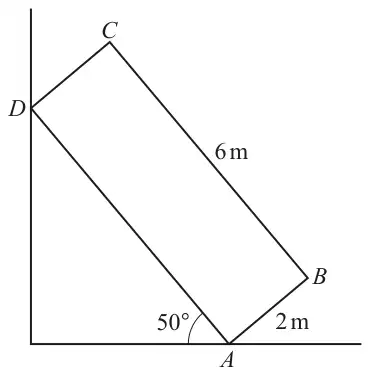
Rectangle ABCD leaning with corner A on horizontal ground and corner D against a vertical wall; AD makes an angle of 50 degrees with the ground, AB = 2 m and BC = 6 m

A uniform rectangular lamina \(ABCD\) has a mass of 0.5 kg. The length of \(AB\) is 2 m, and the length of \(BC\) is 6 m. The lamina is in limiting equilibrium with corner \(A\) in contact with rough horizontal ground and corner \(D\) in contact with a smooth vertical wall. The lamina rests in a vertical plane that is perpendicular to the wall, with \(AD\) inclined at 50° to the horizontal (see diagram).

(a) By taking moments, show that the magnitude of the normal contact force between the lamina and the wall is 1.24 N, correct to 3 significant figures. [4]
(b) Determine the coefficient of friction between the lamina and the ground. [3]

June 2023 Paper 3 Q11

OCR ACurrent spec8 marksMomentsResolving Forces

11

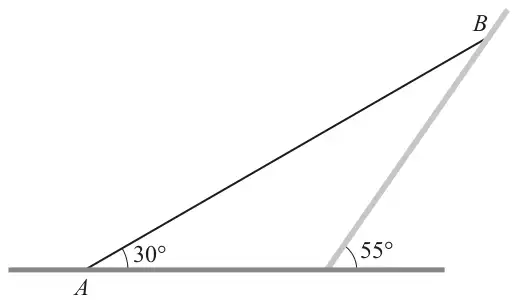
A rod AB with end A on horizontal ground, inclined at 30 degrees to the horizontal; end B rests against a wall that makes an angle of 55 degrees with the ground

A uniform rod \(AB\), of weight \(20\,\mathrm{N}\) and length \(2.8\,\mathrm{m}\), rests in equilibrium with the end \(A\) in contact with rough horizontal ground and the end \(B\) resting against a smooth wall inclined at \(55^\circ\) to the horizontal. The rod, which rests in a vertical plane that is perpendicular to the wall, is inclined at \(30^\circ\) to the horizontal (see diagram).

(a) Show that the magnitude of the force acting on the rod at \(B\) is \(9.56\,\mathrm{N}\), correct to 3 significant figures. [3]
(b) Determine the magnitude of the contact force between the rod and the ground. Give your answer correct to 3 significant figures. [5]

June 2022 Paper 3 Q11

OCR ACurrent spec7 marksMomentsResolving Forces

11

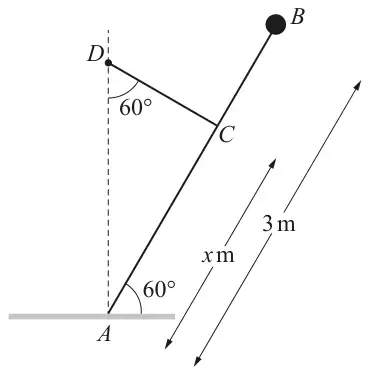
Rod AB, 3 m long, with A on horizontal ground, making 60° with the ground, with a particle at B; a string from point C on the rod, x m from A, goes to point D vertically above A, with angle 60° between DC and the vertical

A uniform rod \(AB\) of mass 4 kg and length 3 m rests in a vertical plane with \(A\) on rough horizontal ground.

A particle of mass 1 kg is attached to the rod at \(B\). The rod makes an angle of 60° with the horizontal and is held in limiting equilibrium by a light inextensible string \(CD\). \(D\) is a fixed point vertically above \(A\) and \(CD\) makes an angle of 60° with the vertical. The distance \(AC\) is \(x\) m (see diagram).

(a) Find, in terms of \(g\) and \(x\), the tension in the string. [3]

The coefficient of friction between the rod and the ground is \(\dfrac{9\sqrt{3}}{35}\).

(b) Determine the value of \(x\). [4]

October 2021 Paper 3 Q12

OCR ACurrent spec7 marksMoments

12

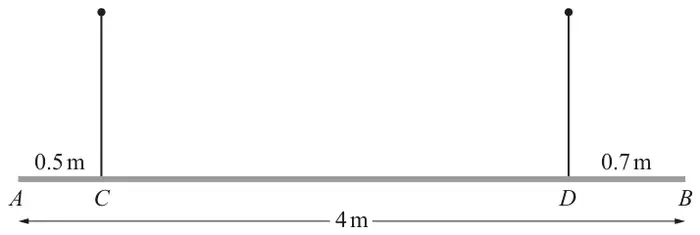
Horizontal beam AB of length 4 m hanging from two vertical ropes attached at C and D; AC = 0.5 m and DB = 0.7 m

A beam, \(AB\), has length \(4\,\mathrm{m}\) and mass \(20\,\mathrm{kg}\). The beam is suspended horizontally by two vertical ropes. One rope is attached to the beam at \(C\), where \(AC = 0.5\,\mathrm{m}\). The other rope is attached to the beam at \(D\), where \(DB = 0.7\,\mathrm{m}\) (see diagram).

The beam is modelled as a non-uniform rod and the ropes as light inextensible strings.

It is given that the tension in the rope at \(C\) is three times the tension in the rope at \(D\).

(a) Determine the distance of the centre of mass of the beam from \(A\). [5]

A particle of mass \(m\,\mathrm{kg}\) is now placed on the beam at a point where the magnitude of the moment of the particle's weight about \(C\) is \(3.5mg\,\mathrm{N\,m}\). The beam remains horizontal and in equilibrium.

(b) Determine the largest possible value of \(m\). [2]

June 2025 Paper 1 Q5

OCR MEICurrent spec3 marksMoments

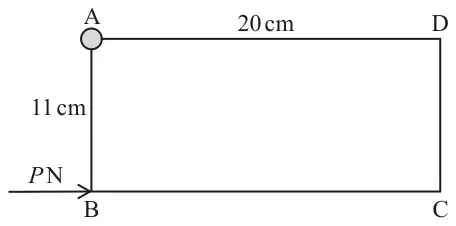
5 A uniform rectangular lamina ABCD has a mass of 0.12 kg. Length AB is 11 cm and length AD is 20 cm.

The lamina ABCD is held by a smooth hinge at A.

A horizontal force of magnitude \(P\) N is applied at B so that the lamina is in equilibrium in a vertical plane with AD horizontal as shown in the diagram.

Rectangle ABCD with A top left (hinge), D top right, AD = 20 cm, AB = 11 cm vertical, horizontal force P N acting at B

Show that \(P\) is 1.07 to 3 significant figures. [3]

June 2024 Paper 1 Q7

OCR MEICurrent spec7 marksMoments

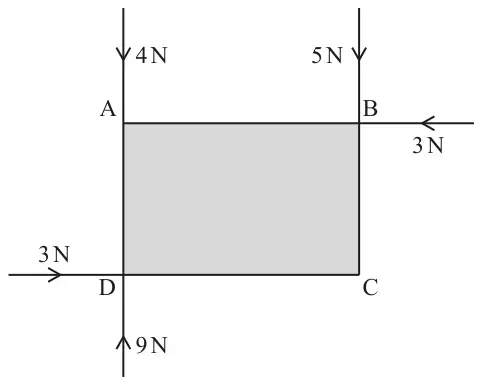
7 A rectangular book ABCD rests on a smooth horizontal table. The length of AB is 28 cm and the length of AD is 18 cm. The following five forces act on the book, as shown in the diagram.

  • 4 N at A in the direction AD
  • 5 N at B in the direction BC
  • 3 N at B in the direction BA
  • 9 N at D in the direction DA
  • 3 N at D in the direction DC
Rectangle ABCD with A top left, B top right, C bottom right, D bottom left; 4 N down at A, 5 N down at B, 3 N leftwards at B, 3 N rightwards at D and 9 N up at D
(a) Show that the resultant of the forces acting on the book has zero magnitude. [2]
(b) Find the total moment of the forces about the centre of the book. Give your answer in N m. [3]
(c) Describe how the book will move under the action of these forces. [2]

June 2023 Paper 1 Q4

OCR MEICurrent spec4 marksMoments

4 A ruler PQRS is a uniform rectangular lamina with mass 20 grams. The length of PQ is 30 cm and the length of PS is 4 cm. The ruler is attached at P to a smooth hinge and held with S vertically below P by a horizontal force of magnitude \(F\) N as shown in the diagram.

Rectangle PQRS with PQ horizontal at the top, hinge at P, S vertically below P, horizontal force F N acting at S
(a) Calculate the value of \(F\). [3]
(b) Explain what would happen to the lamina if the force at S were removed. [1]

June 2022 Paper 1 Q6

OCR MEICurrent spec9 marksMoments

6 A shelf consists of a horizontal uniform plank AB of length 0.8 m and mass 5 kg with light inextensible vertical strings attached at each end. A stack of bricks each of mass 2.3 kg is placed on the plank as shown in the diagram.

Horizontal plank AB hanging from vertical strings at A and B, with a stack of bricks standing on the plank to the right of its centre
(a) Explain the meaning of each of the following modelling assumptions.
  • The stack of bricks is modelled as a particle.
  • The plank is modelled as uniform.
[2]

Either of the strings will break if the tension exceeds 75 N.

(b) Find the greatest number of bricks that can be placed at the centre of the plank without breaking the strings. [2]
(c) Find an expression for the moment about A of the weight of a stack of \(n\) bricks when the stack is at a distance of \(x\) m from A. State the units for your answer. [2]
(d) Calculate the greatest distance from A that the largest stack of bricks can be placed without a string breaking. [3]

October 2021 Paper 1 Q5

OCR MEICurrent spec5 marksMoments

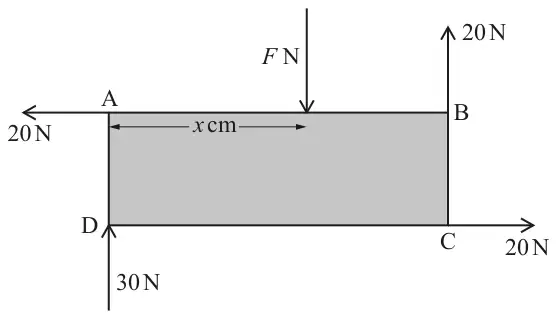
5 ABCD is a rectangular lamina in which AB is 30 cm and AD is 10 cm.

Three forces of 20 N and one force of 30 N act along the sides of the lamina as shown in the diagram.

Rectangle ABCD with AB along the top: 20 N acts to the left at A along BA extended, 20 N acts upwards at B, 20 N acts to the right at C along DC extended, 30 N acts upwards at D; a force F N acts downwards on AB at a point x cm from A

An additional force \(F\) N is also applied at right angles to AB to a point on the edge AB \(x\) cm from A.

(a) Given that the lamina is in equilibrium, calculate the values of \(F\) and \(x\). [3]

The point of application of the force \(F\) N is now moved to B, but the magnitude and direction of the force remain the same.

(b) Explain the effect of the new system of forces on the lamina. [2]

October 2020 Paper 1 Q6

OCR MEICurrent spec4 marksMoments

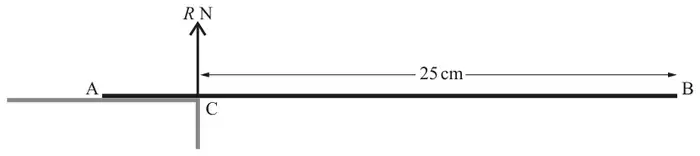
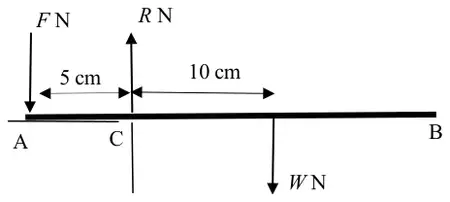
6 A uniform ruler AB has mass 28 g and length 30 cm. As shown in Fig. 6, the ruler is placed on a horizontal table so that it overhangs a point C at the edge of the table by 25 cm.

A downward force of \(F\) N is applied at A. This force just holds the ruler in equilibrium so that the contact force between the table and the ruler acts through C.

Fig. 6: ruler AB on a table, with A on the table and the edge of the table at C; CB = 25 cm overhangs the edge
Fig. 6
(a) Complete the force diagram in the Printed Answer Booklet, labelling the forces and all relevant distances.
Force diagram from the Printed Answer Booklet: ruler AB on the table edge C, with CB = 25 cm and the upward force R N drawn at C
[2]
(b) Calculate the value of \(F\). [2]