
June 2025 Paper 3 Mechanics Q6
6.
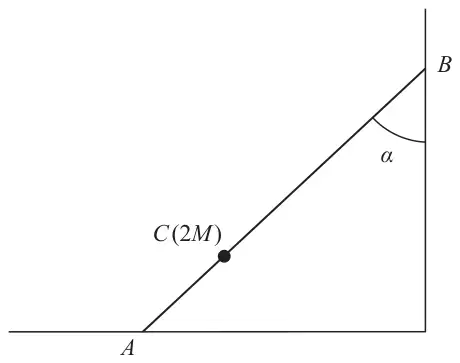
A uniform rod \(AB\) has mass \(M\) and length \(2a\).
A particle of mass \(2M\) is attached to the rod at the point \(C\), where \(AC = 0.5a\)
The rod rests with end \(A\) on rough horizontal ground and end \(B\) against a vertical wall.
The rod lies in a vertical plane which is perpendicular to the wall.
The rod is in equilibrium at an angle \(\alpha\) to the wall, as shown in Figure 4.
In an initial model
- the vertical wall is modelled as being smooth
- the magnitude of the normal reaction of the ground on the rod at \(A\) is \(R\)
- the magnitude of the force exerted on the rod by the wall at \(B\) is \(S\)
Using the model,
In a refined model
- the vertical wall is modelled as being rough
- the magnitude of the normal reaction of the ground on the rod at \(A\) is \(R_1\)
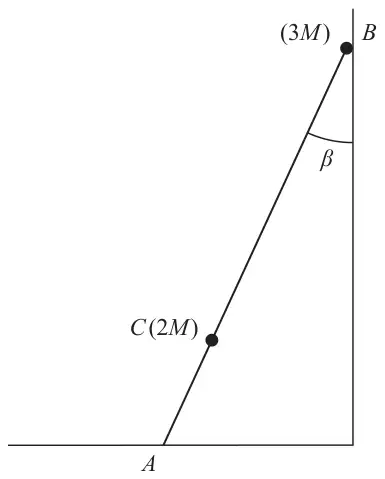
A second particle of mass \(3M\) is now attached to the rod at \(B\).
The rod again rests with end \(A\) on rough horizontal ground and end \(B\) against the vertical wall.
The rod lies in a vertical plane which is perpendicular to the wall.
The rod is now in limiting equilibrium at an angle \(\beta\) to the wall, as shown in Figure 5.
The vertical wall is again modelled as being smooth.
The coefficient of friction between the rod and the ground is \(\mu\)
Given that \(\tan\beta = \dfrac{1}{2}\)
| Scheme | Marks | AO |
|---|---|---|
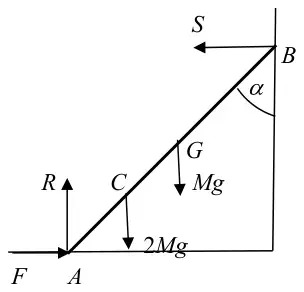 | ||
| \((\uparrow)\): \((R =)\ 3Mg\) | B1 | 3.4 |
| (1) |
Notes
B1: Cao. Must be in terms of \(M\) and \(g\).
| Scheme | Marks | AO |
|---|---|---|
| ||
| N.B. Allow consistent use of a different letter for the angle in the working but must be \(\alpha\) in the final answer. BOD if their \(a\)'s and \(\alpha\)'s look the same. | ||
| EITHER: | ||
| Obtain an equation in \(S\), \(M\), \(a\) and \(\alpha\) only, by taking moments about \(A\) | M1 | 3.1a |
| M(\(A\)): \(S \times 2a\cos\alpha = Mga\sin\alpha + 2Mg \times 0.5a\sin\alpha\) | A1 | 1.1b |
| OR | ||
| Obtain an equation in \(S\), \(M\), \(a\) and \(\alpha\) only, by taking moments about \(B\), \(C\) or \(G\) and resolving once and eliminating \(F\) and \(R\) (N.B. \(R = 3Mg\) from (a)) | M1 | 3.1a |
| Correct equation in \(S\), \(M\), \(a\) and \(\alpha\) only | A1 | 1.1b |
| Possible Moments equations: M(\(B\)): \(R \times 2a\sin\alpha = Mga\sin\alpha + 2Mg \times 1.5a\sin\alpha + F \times 2a\cos\alpha\) or M(\(C\)): \(F \times 0.5a\cos\alpha + S \times 1.5a\cos\alpha = R \times 0.5a\sin\alpha + Mg \times 0.5a\sin\alpha\) or M(\(G\)): \(Sa\cos\alpha + Fa\cos\alpha + 2Mg \times 0.5a\sin\alpha = Ra\sin\alpha\) Possible resolution equations: \((\rightarrow)\): \(F = S\) or \((\nearrow)\): \(R\cos\alpha + F\sin\alpha = S\sin\alpha + (2Mg + Mg)\cos\alpha\) or \((\nwarrow)\): \(R\sin\alpha + S\cos\alpha = (2Mg + Mg)\sin\alpha + F\cos\alpha\) | ||
| \(S = Mg\tan\alpha\) * | A1* | 2.2a |
| (3) |
Notes
M1: M(\(A\)): Correct no. of terms, dim correct, condone sin/cos confusion and sign errors
A1: Correct equation in \(S\), \(M\), \(a\) and \(\alpha\) only.
N.B. Must see use of \(0.5a\)
A1*: Given answer correctly obtained. (Must be in \(\alpha\) but allow a different angle used in the equations).
Penalise incorrect use of brackets. e.g. if they use \((90^\circ - \alpha)\), penalise missing brackets.
N.B. Must see at least one line of intermediate working which will involve: like terms collected, division by \(\cos\alpha\), which does not need to be seen explicitly, division by 2 in some order.
N.B. Allow the order of the terms on the RHS to be different and allow \(m\) for \(M\).
OR
M1: M(\(B\)) or M(\(C\)) or M(\(G\)) and a resolution and elimination of \(F\) and \(R\).
Both equations used must have correct no. of terms, dim correct, condone sin/cos confusion and sign errors
A1: Correct equation in \(S\), \(M\), \(a\) and \(\alpha\) only
A1*: Given answer correctly obtained.
N.B. Must see at least one line of intermediate working which will involve: like terms collected and division by \(\cos\alpha\)
| Scheme | Marks | AO |
|---|---|---|
| The friction force at \(B\) will provide an extra upward (not just vertical) force so \(R_1\) will be less i.e. \(R\) will be greater. \(R\) (is greater than \(R_1\)) as the friction act against the weight of the rod. \(R\) (is greater) as the friction acts in the same direction as \(R_1\) \(R\) (is greater) as the friction holds the rod up as well. \(R = 3Mg = R_1 + F\) so \(R\) will be greater N.B. Allow \(R_1\) will be smaller with a correct reason. B0 \(R\) is greater as there is no friction from the wall. | B1 | 3.5a |
| (1) |
Notes
B1: Correct explanation
B0 if any incorrect extras
| Scheme | Marks | AO |
|---|---|---|
| N.B. Allow consistent use of a different letter for the angle and could score FULL marks. | ||
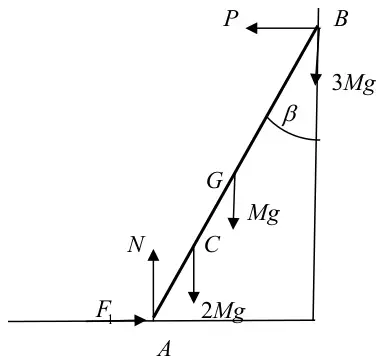 | ||
| EITHER: Moments about \(B\) or \(D\), the intersection of the normals | M1 | 3.4 |
| M(\(B\)): \(N \times 2a\sin\beta = Mga\sin\beta + 2Mg \times 1.5a\sin\beta + F_1 \times 2a\cos\beta\) | A1 | 1.1b |
| or M(\(D\)): \(F_1 \times 2a\cos\beta = Mga\sin\beta + 2Mg \times 0.5a\sin\beta + 3Mg \times 2a\sin\beta\) | A1 | 1.1b |
| and resolve vertically: \((\uparrow)\ N = Mg + 2Mg + 3Mg\) | B1 | 3.3 |
| OR: Moments about \(A\) or \(C\) or \(G\) | M1 | 3.4 |
| A correct moments equation. | A1 | 1.1b |
| A correct resolution (N.B. Treat as a B mark so M0A0A1 is a possible score) | A1 | 1.1b |
| A correct second resolution or a correct second moments equation | B1 | 3.3 |
| Possible Moments equations: M(\(A\)): \(2Mg \times 0.5a\sin\beta + Mga\sin\beta + 3Mg \times 2a\sin\beta = P \times 2a\cos\beta\) N.B. (You may see the first 2 terms collected as a single term) or M(\(C\)): \(0.5aF_1\cos\beta + 1.5Pa\cos\beta = 0.5Na\sin\beta + 0.5Mga\sin\beta + 3Mg \times 1.5a\sin\beta\) or M(\(G\)): \(F_1a\cos\beta + Pa\cos\beta + 2Mg \times 0.5a\sin\beta = Na\sin\beta + 3Mga\sin\beta\) Possible resolution equations: \((\uparrow)\): \(N = Mg + 2Mg + 3Mg\) \((\rightarrow)\): \(F_1 = P\) (or \(P = \mu N\)) \((\nearrow)\): \(F_1\sin\beta + N\cos\beta = P\sin\beta + (3Mg + Mg + 2Mg)\cos\beta\) \((\nwarrow)\): \(N\sin\beta + P\cos\beta = (3Mg + Mg + 2Mg)\sin\beta + F_1\cos\beta\) | ||
| (N.B. \(F_1 = P = 2Mg\)) | ||
| Use of \(F_1 = \mu N\), their equations (which must be correct) and \(\tan\beta = \dfrac{1}{2}\), to obtain an equation in \(\mu\) only. N.B. This mark is only available if the previous 4 marks have all been earned. | dM1 | 3.1a |
| \(\mu = \dfrac{1}{3}\) * | A1* | 2.2a |
| (6) | ||
| (11 marks) |
Notes
N.B. If there is a combination of the two alternatives, mark both and award the higher mark.
If there are errors in their equations for both methods and the total mark out of 4 is the same, enter the first 4 marks on ePEN for whichever of the 2 methods they use to try to find \(\mu\).
If they don’t try and find \(\mu\), enter marks for the EITHER method.
EITHER
M1: M(\(B\)) or M(\(D\)): Correct no. of terms, dim correct, condone sin/cos confusion and sign errors, allow use of a different letter, \(\theta\) say, for \(\beta\).
(\(\theta\) could even be \(\alpha\))
N.B. Condone consistent missing \(a\)’s
N.B. M0 if they are clearly using \(R\) from part (a) for \(N\).
A1: Correct equation with at most one error
A1: Correct equation
B1: Correct vertical resolution
OR
M1: M(\(A\) or \(C\) or \(G\)): Correct no. of terms, dim correct, condone sin/cos confusion and sign errors, allow use of a different letter, \(\theta\) say, for \(\beta\).
(\(\theta\) could even be \(\alpha\))
N.B. Condone consistent missing \(a\)’s
N.B. M0 if they are clearly using \(S\) from part (b) for \(P\)
A1: Correct equation
A1: This is treated as a B mark for a correct resolution, seen or implied.
B1: For another correct resolution or another correct moments equation (NOT about \(B\)) seen or implied.
N.B. when entering marks on ePEN for the two resolutions, if only ONE is correct enter as A1 B0.
dM1: Dependent for using \(F_1 = \mu N\) and their correct equations, to produce an equation in \(\mu\) only.
N.B. Allow if they use \(F_1 \leqslant \mu N\)
A1*: Given answer correctly obtained