
June 2023 Paper 3 Mechanics Q6
6.
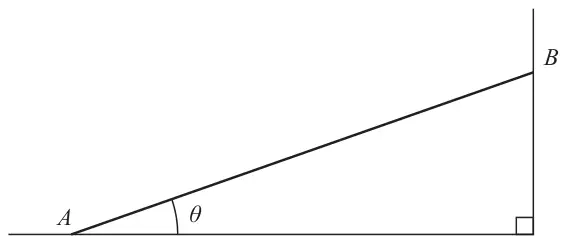
A rod \(AB\) has mass \(M\) and length \(2a\).
The rod has its end \(A\) on rough horizontal ground and its end \(B\) against a smooth vertical wall.
The rod makes an angle \(\theta\) with the ground, as shown in Figure 3.
The rod is at rest in limiting equilibrium.
The magnitude of the normal reaction of the wall on the rod at \(B\) is \(S\).
In an initial model, the rod is modelled as being uniform.
Use this initial model to answer parts (b), (c) and (d).
The coefficient of friction between the rod and the ground is \(\mu\)
Given that \(\tan\theta = \dfrac{3}{4}\)
In a new model, the rod is modelled as being non-uniform, with its centre of mass closer to \(B\) than it is to \(A\).
A new value for \(S\) is calculated using this new model, with \(\tan\theta = \dfrac{3}{4}\)
| Scheme | Marks | AO |
|---|---|---|
| The normal reaction at \(B\) is acting to the left so it must act to the right, right as it needs to balance (oppose, counter) the force at \(B\), right as it prevents the rod from sliding (slipping, falling), right as the weight (mass) of the rod will mean the rod tends to slip left, mass or weight will be pushing the rod to the left so friction will oppose that. N.B. You may see an arrow on the diagram at \(A\), instead of ‘right’. B0 if they say the rod is moving oe Accept towards the wall instead of to the right. | B1 | 2.4 |
| (1) |
Notes
B1: Any equivalent appropriate statement.
| Scheme | Marks | AO |
|---|---|---|
| Take moments about \(A\) | M1 | 3.4 |
| \(S \times 2a\sin\theta = Mga\cos\theta\) | A1 | 1.1b |
| \(S = \dfrac{1}{2}Mg\cot\theta\) * | A1* | 2.2a |
| (3) |
Notes
M1: Correct no. of terms, dimensionally correct, condone sin/cos confusion and sign errors.
N.B. If \(a\)’s never appear, M0
A1: Correct equation
A1*: Correct given answer correctly obtained, with no wrong working seen.
Allow \(\dfrac{1}{2}Mg\cot\theta = S\) or \(S = \dfrac{Mg\cot\theta}{2}\) or \(\dfrac{Mg\cot\theta}{2} = S\) or \(S = \dfrac{Mg}{2}\cot\theta\) or similar
but NOT \(S = \dfrac{1}{2}\cot\theta\,\text{Mg}\) or similar
N.B. Allow \(m\) instead of \(M\)
Must be \(\theta\) in final answer but allow a different angle in the working.
| Scheme | Marks | AO |
|---|---|---|
| Resolve vertically, \(R = Mg\) | B1 | 3.3 |
| Resolve horizontally, \(F = S\) | B1 | 3.3 |
| Other possible equations: Resolve along the rod, \(F\cos\theta + R\sin\theta = S\cos\theta + Mg\sin\theta\) Resolve perp to the rod, \(R\cos\theta + S\sin\theta = F\sin\theta + Mg\cos\theta\) M(\(B\)), \(R \times 2a\cos\theta = F \times 2a\sin\theta + Mga\cos\theta\) M(\(G\)), \(Ra\cos\theta = Fa\sin\theta + Sa\sin\theta\) N.B. When entering these two B marks on ePEN, First B1 is for a vertical resolution, second B1 is for a horizontal resolution, and if either is replaced by a different equation, enter appropriately. If both are replaced by other equations, enter in the order in which they appear in their working. | ||
| \(F = \mu R\) | B1 | 1.2 |
| \(\dfrac{1}{2}Mg \times \dfrac{4}{3} = \mu Mg\) | dM1 | 2.1 |
| \(\mu = \dfrac{2}{3}\) oe Accept 0.67 or better | A1 | 2.2a |
| S.C. For \(F \leqslant \mu R\), B0 \(\dfrac{1}{2}Mg \times \dfrac{4}{3} \leqslant \mu Mg\) M1 \(\dfrac{2}{3} \leqslant \mu\) A0 N.B. If \(\mu = \dfrac{2}{3}\) follows this, they could score all the marks. | ||
| (5) |
Notes
B1: cao
B1: cao
B1: Seen anywhere, e.g. on the diagram
dM1: Using \(F = \mu R\), their two equations and substitute for trig (not necessarily correctly) to produce an equation in \(\mu\) only.
This mark is dependent on the 3 previous B marks.
A1: Accept 0.67 or better
| Scheme | Marks | AO |
|---|---|---|
| \(\sqrt{F^2 + R^2}\) | M1 | 3.1a |
| \(\sqrt{\left(\dfrac{2}{3}Mg\right)^2 + (Mg)^2}\) | M1 | 1.1b |
| \(\dfrac{1}{3}Mg\sqrt{13}\) or \(1.2Mg\) or better | A1 | 2.2a |
| (3) |
Notes
M1: Use of Pythagoras with square root to find the required magnitude, but \(F\) and \(R\) do not need to be substituted
M1: Substitute for their \(F\) and their \(R\) in terms of \(Mg\) and take square root to obtain magnitude in terms of \(M\) and \(g\) only.
N.B. Must be using Pythagoras
Alternative
ALTERNATIVE: Using trig on triangle of forces
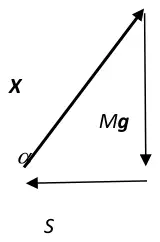
M1: \(X = \dfrac{Mg}{\sin\alpha}\) or \(\dfrac{S}{\cos\alpha}\)
M1: substitute for \(\sin\alpha\) or \(\cos\alpha\) and \(S\), where \(\tan\alpha = \dfrac{Mg}{S}\ \left(= \dfrac{3}{2}\right)\), to obtain \(X\) in terms of \(M\) and \(g\) only.
A1: Any equivalent surd form or \(1.2Mg\) or better
Must be in terms of \(M\) and \(g\)
| Scheme | Marks | AO |
|---|---|---|
| New value of \(S\) would be larger as the moment of the weight about A would be larger | B1 | 3.5a |
| (1) | ||
| (13 marks) |
Notes
B1: Correct answer and any equivalent appropriate statement.