
June 2023 Paper 2 Q17
17 A uniform plank \(PQ\), of length 7 metres, lies horizontally at rest, in equilibrium, on two fixed supports at points \(X\) and \(Y\)
The distance \(PX\) is 1.4 metres and the distance \(QY\) is 2 metres as shown in the diagram below.
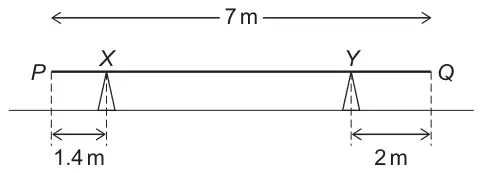
(a) The reaction force on the plank at \(X\) is \(4g\) newtons.
(i) Show that the mass of the plank is 9.6 kilograms. [2 marks]
(ii) Find the reaction force, in terms of \(g\), on the plank at \(Y\) [2 marks]
(b) The support at \(Y\) is moved so that the distance \(QY = 1.4\) metres.
The plank remains horizontally at rest in equilibrium.
It is claimed that the reaction force at \(Y\) remains unchanged.
Explain, with a reason, whether this claim is correct. [2 marks]
| Scheme | Marks | AO |
|---|---|---|
| (i) Forms a moments equation by taking moments about \(Y\) with one term correct. or Forms two correct moments equations by taking moments about \(P\) and \(Q\) Must clearly use force \(\times\) distance for every term. For example: Moments about \(P\) \(3.5mg = (1.4)(4g) + 5R\) Moments about \(Q\) \(3.5mg = (5.6)(4g) + 2R\) Moments about the centre \(1.5(Yg) = (2.1)(4g)\) | M1 | 3.1b |
| Completes reasoned argument with at least one intermediate step to obtain 9.6 kilograms AG Condone 9.6 | R1 | 2.1 |
| (2) | ||
| (ii) Resolves vertically to find \(R\) or Forms a moments equation about any point other than about \(Y\) with the correct number of terms and at least one term correct. For example: Moments about \(X\) \((2.1)(9.6g) = 3.6R\) Moments about midpoint of plank \((2.1)(4g) = 1.5R\) PI by \(5.6g\) | M1 | 3.3 |
| Obtains \(5.6g\) N Condone missing units. | A1 | 1.1b |
| (2) |
Typical solution
(i)
Taking moments about \(Y\)
\[1.5mg = (3.6)(4g)\]\[m = \frac{(3.6)(4g)}{1.5g}\]\(m = 9.6\) kilograms
(ii)
Resolving vertical forces:
\[4g + R = 9.6g\]\[R = 5.6g\text{ N}\]| Scheme | Marks | AO |
|---|---|---|
| Obtains \(4.8g\) or States that the two supports are equidistant from the centre/the ends of the plank or Refers to symmetry | B1 | 3.1b |
States one of the following:
| E1 | 2.4 |
| (2) | ||
| (6 marks) |
Typical solution
\(X\) and \(Y\) are the same distance from the midpoint, so their reaction forces are equal.
The reaction force at \(Y\) decreases.
Therefore, the claim is wrong.