
June 2017 Paper 2 Q21
21 Here is a sketch of \(\quad y = (x + 2)(4 - x)\)
The graph intersects the axes at \(A\) (\(-2\), 0), \(B\) (4, 0) and \(C\).
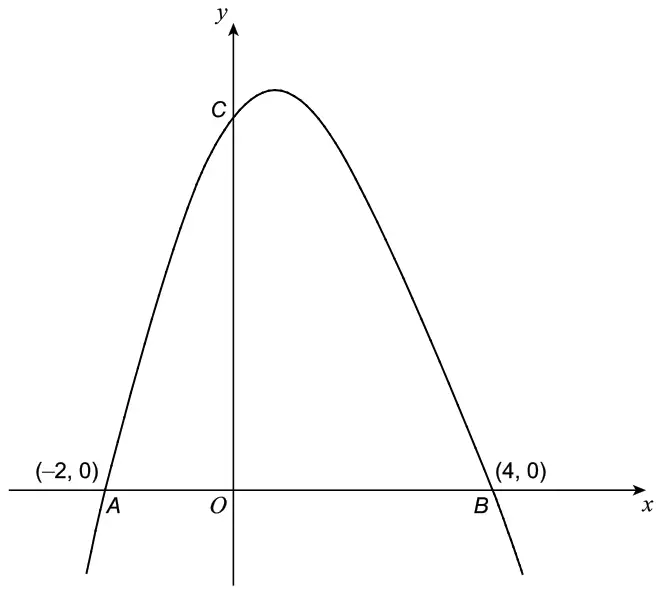
Not drawn accurately
(a) Work out the coordinates of \(C\). [1 mark]
(b) Work out the gradient function of the curve. [3 marks]
(c) The normal to the curve at \(C\) intersects the \(x\)-axis at \(D\).
Show that \(\qquad\) length \(BD = 2 \times\) length \(AB\) [5 marks]
| Answer | Mark | Comments |
|---|---|---|
| (0, 8) | B1 |
Additional guidance
| Answer line takes precedence over working lines and diagram | |
| Answer line blank with \(C\) labelled (0, 8) on diagram | B1 |
| Answer line blank with 8 written next to \(C\) on diagram | B0 |
| (8, 0) | B0 |
| Answer 8 | B0 |
| Answer | Mark | Comments |
|---|---|---|
| \(-x^2 - 2x + 4x + 8\) | M1 | Allow one error but no omission Must have an \(x^2\) term Terms may be seen in a grid Implied by \(-x^2 + 2x + k \quad k \neq 0\) or \(ax^2 + 2x + 8 \quad a \neq 0\) |
| \(-x^2 - 2x + 4x + 8\) or \(-x^2 + 2x + 8\) | A1 | \(-x^2 - 2x + 4x + 8\) but an error in any collection of terms is M1A0 |
| \(-2x - 2 + 4\) or \(-2x + 2\) or \(-2(x - 1)\) or \(2(1 - x)\) | A1ft | oe ft their quadratic in \(x\) with M1 awarded |
Additional guidance
| \(2 - 2x\) with final answer 2 (from substituting in \(x = 0\)) | M1A1A0 |
| Condone \(y = 2 - 2x\) or \(\mathrm{f}(x) = 2 - 2x\) in working for M1A1 If (\(\dfrac{\mathrm{d}y}{\mathrm{d}x}\) or \(\mathrm{f}'(x)\) =) \(2 - 2x\) on answer line also award final A1 | |
| \(y = 2 - 2x\) or \(\mathrm{f}(x) = 2 - 2x\) on answer line | M1A1A0 |
| When marking (b), a maximum of M1A1A0 can be awarded from an expansion seen on the previous page if not contradicted by an expansion in (b) The final A1 must be seen in (b) eg1 (b) no expansion seen with an answer of \(2x + 2\) At top of previous page \(\ -x^2 + 2x + 8\) eg2 (b) no expansion seen with an answer of \(-2x + 6\) In (a) \(\ -x^2 + 2x + 4x + 8 = -x^2 + 6x + 8\) | M1A1A0 M1A0A1ft |
| Correct use of product rule and gradient function \(= -2x + 2\) | 3 marks |
| Answer | Mark | Comments |
|---|---|---|
| Alternative method 1 | ||
| (gradient of curve at \(C\) =) 2 | B1ft | Correct or ft their (b) when \(x = 0\) May be implied |
| \(-\dfrac{1}{\text{their } 2}\) or \(-\dfrac{1}{2}\) | M1 | oe ft their 2 Only ft a non-zero numerical value (gradient of normal =) \(-\dfrac{1}{2}\) is B1M1 |
| \(y = \left(\text{their } -\dfrac{1}{2}\right)x +\) their 8 or \(y -\) their \(8 =\) their \(-\dfrac{1}{2}(x - 0)\) | M1dep | Must have used gradient of normal not gradient of tangent Correct or ft their 8 from (a) in the form (0, \(k\)) |
| \(0 = \left(\text{their } -\dfrac{1}{2}\right)x +\) their 8 or \(0 -\) their \(8 =\) their \(-\dfrac{1}{2}(x - 0)\) or \(x = 16\) | M1dep | Correct or ft their 8 from (a) in the form (0, \(k\)) |
| \(x = 16\) and \(BD = 12\) and \(AB = 6\) with correct method seen | A1 | oe |
| Alternative method 2 | ||
| (gradient of curve at \(C\) =) 2 | B1ft | Correct or ft their (b) when \(x = 0\) May be implied |
| \(-\dfrac{1}{\text{their } 2}\) or \(-\dfrac{1}{2}\) | M1 | oe ft their 2 Only ft a non-zero numerical value (gradient of normal =) \(-\dfrac{1}{2}\) is B1M1 |
| \(\dfrac{0 - \text{their } 8}{x - 0} =\) their \(-\dfrac{1}{2}\) or \(x = -\)their \(8 \div\) their \(-\dfrac{1}{2}\) or \(x = 16\) | M2dep | oe Correct or ft their 8 from (a) in the form (0, \(k\)) |
| \(x = 16\) and \(BD = 12\) and \(AB = 6\) with correct method seen | A1 | oe |