
June 2017 Paper 1 Q15
15 The continuous curve \(\ y = \mathrm{f}(x)\) has exactly three stationary points.
The three stationary points are
- a minimum point \(P\) at \((a, b)\) where \(a \lt 0\) and \(b \lt 0\)
- a point of inflection \(Q\) at (0, 3)
- a maximum point \(R\) at \((c, d)\) where \(c \gt 0\) and \(d \gt 3\)
The curve cuts the \(x\)-axis at three distinct points.
On the axes below, sketch the curve.
Label the points \(P\), \(Q\) and \(R\) on your sketch. [4 marks]
| Answer | Mark | Comments |
|---|---|---|
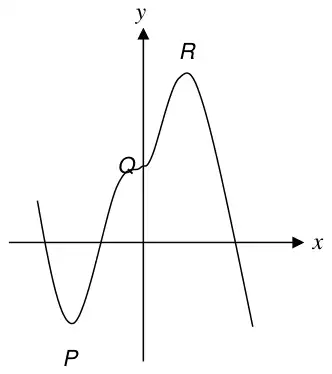 | B4 | There are five features ... minimum point in correct region ie the 3rd quadrant maximum point in correct region, ie the 1st quadrant, with \(y\)-coordinate \(\gt 3\) point of inflection on positive \(y\)-axis with attempt to show decreasing then increasing gradient three distinct \(x\)-axis crossing points, a continuous curve and no more than three stationary points their minimum and maximum points (which need not be stationary points) labelled \(P\) and \(R\) B4 for all five features B3 for four features B2 for three features B1 for two features |
Additional guidance
Accept \((a, b)\) and \((c, d)\) instead of \(P\) and \(R\) respectively.
Condone actual values suggested for the coordinates of \(P\) and \(R\).
SC2 for a completely correct shaped sketch, with all features, BUT a reflection of the correct graph in the \(y\)-axis