Disregard errors due to premature rounding provided there is evidence.
•4 and •5 are only available for:
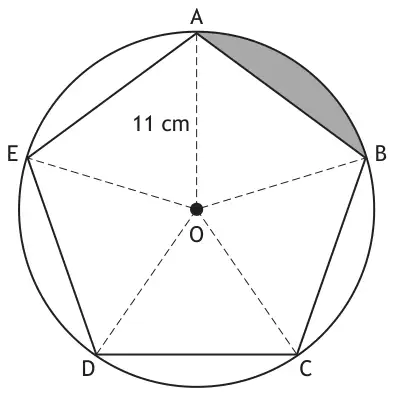
Method 1: calculating the sum or difference of the area of a sector and the area of a triangle, where the area of a triangle is calculated using trigonometry.
Method 2: calculating the sum or difference of the area of a circle and the area of a pentagon, where the area of a triangle is calculated using trigonometry.
See CORs 5 and 6.
•2 is available for using \(A=\dfrac{1}{2}bh\) where \(h\) is calculated following a valid trigonometric method.
Inappropriate use of RAD or GRAD should only be penalised once in Q2, Q7, Q8 or Q10. (a) 15.356…, 60.67… (RAD). (b) 54.74…, 21.28… (GRAD).
For the award of •2 accept an incorrect acute angle substituted into the area of a triangle formula eg \(\dfrac{1}{2}\times11\times11\times\sin60\).
Where the sine rule or area of triangle formula is used. award 0/3
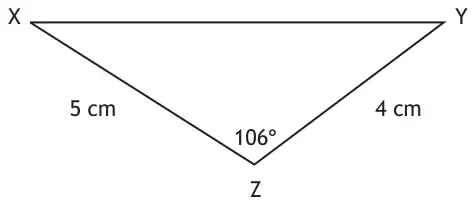
Disregard errors due to premature rounding provided there is evidence. (a) \(4^2+5^2-2\times4\times5\times\cos106\to4^2+5^2-2\times4\times5\times(-0.28)\to52.2\to7.22\) (cm). award 3/3 (b) \(4^2+5^2-2\times4\times5\times\cos106\to4^2+5^2-2\times4\times5\times(-0.3)\to53\to7.28\) (cm). award 3/3
Inappropriate use of RAD or GRAD may only be penalised once in Q2, Q7, Q8 or Q10. (a) 3.67… or 3.7 RAD. (b) 6.69… or 6.7 GRAD.
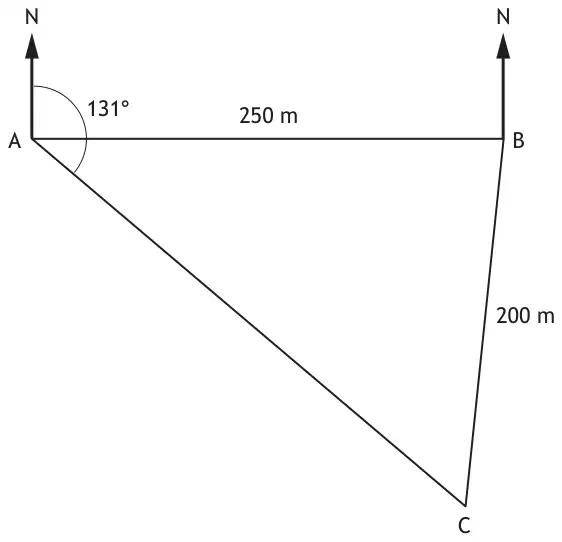
•4 is only available where trigonometry has been used to find angle ACB.
•4 is not available where a candidate uses 131 in the calculation. eg (a) \(\dfrac{250}{\sin\text{C}}=\dfrac{200}{\sin131}\to\sin\text{C}=\dfrac{250\times\sin131}{200}\to\text{C}=71\;(\to\text{B}=68)\to\text{bearing}=202\) award 2/4 ✗✓1✓1✗ (b) \(\dfrac{250}{\sin131}=\dfrac{200}{\sin\text{C}}\to\sin\text{C}=\dfrac{200\times\sin131}{250}\to\text{C}=37\;(\to\text{B}=12)\to\text{bearing}=258\) award 2/4 ✗✓1✓1✗
Disregard premature rounding provided that angle ACB can be rounded to 55. eg (a) \(\sin\text{C}=\dfrac{250\times0.656}{200}=0.82\to\text{C}=55.08\ldots\to\text{bearing}=186\) award 4/4 (b) \(\sin\text{C}=\dfrac{250\times0.66}{200}=0.825\to\text{C}=55.58\ldots\to\text{bearing}=187\) award 3/4 ✓✓✗✓1
Inappropriate use of GRAD or RAD should only be penalised once in either Q12 or Q14. (a) \(\sin\text{C}=0.7505\ldots\to\text{C}=54.0398\ldots\;(\to\text{B}=85)\to\text{bearing}=185\) (GRAD). (b) \(\sin\text{C}=-0.1982\ldots\to\text{C}=-0.1996\ldots\;(\to\text{B}=139)\to\text{bearing}=131\) (RAD). (but in this case •4 is unavailable since angle \(\text{ACB}\lt0\)).
Where a candidate has started with: (a) the cosine rule. (b) Pythagoras’ theorem. (c) invalid right angled trigonometry. award 0/4 (Take \(\sin90\) in a sine rule calculation as evidence of invalid use of right angled trigonometry
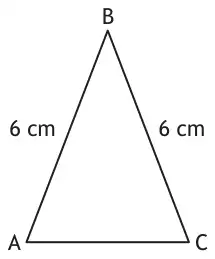
(a) \(\dfrac{1}{2}\times6\times6\times\cancel{\sin}\,\dfrac{2}{3}=18\times\cancel{\sin}\,\dfrac{2}{3}=12\) where \(\sin\) is scored out in each line of working. award 2/2 (b) \(\dfrac{1}{2}\times6\times6\times\sin\dfrac{2}{3}=12\) award 1/2 ✗✓ (c) \(\dfrac{1}{2}\times6\times6\times\sin\dfrac{2}{3}\) award 0/2 ✗^
Do not award •2 for a correct substitution of \(\dfrac{2}{3}\) converted to a decimal approximation or truncation. eg (a) \(\dfrac{1}{2}\times6\times6\times\dfrac{2}{3}\to\dfrac{1}{2}\times6\times6\times0.66\ldots=12\) award 2/2 (b) \(\dfrac{1}{2}\times6\times6\times\dfrac{2}{3}\to\dfrac{1}{2}\times6\times6\times0.67=12.06\) award 1/2 ✓✗
Do not award •1 for a decimal approximation or truncation of \(\dfrac{2}{3}\). However •2 can be awarded for a consistent calculation provided given answer rounds to 12. eg (a) (i) \(\dfrac{1}{2}\times6\times6\times0.67=12.06\) award 1/2 ✗✓1 (a) (ii) \(\dfrac{1}{2}\times6\times6\times0.66=11.88\) award 1/2 ✗✓1 (b) (i) \(\dfrac{1}{2}\times6\times6\times0.7=12.6\) award 0/2 (b) (ii) \(\dfrac{1}{2}\times6\times6\times0.6=10.8\) award 0/2
Commonly Observed Responses:
\(\dfrac{1}{2}\times6\times6\times\sin\dfrac{2}{3}\to\sin12\) award 0/2 ✗✗
\(\dfrac{1}{2}\times6\times\dfrac{2}{3}\to2\) award 1/2 ✗✓1
\(\dfrac{1}{2}\times6\times6=18\) award 0/2 ✗✗
\(\dfrac{1}{2}\times6\times6\times0.66\ldots=12\) or \(\dfrac{1}{2}\times6\times6\times0.\dot{6}=12\) award 2/2
\(\dfrac{1}{2}ab\sin\dfrac{2}{3}\to\dfrac{1}{2}\times6\times6\times\dfrac{2}{3}\to12\) award 2/2
consistent substitution into appropriate trig formula
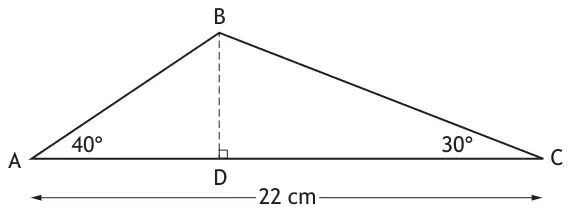
\(\sin30=\dfrac{\text{BD}}{15.0\ldots}\) or \(\dfrac{\text{BD}}{\sin30}=\dfrac{15.0\ldots}{\sin90}\)
•5
calculate BD
7.5 (cm)
Method 2
•1
correct substitution into sine rule
\(\dfrac{\text{AB}}{\sin30}=\dfrac{22}{\sin110}\)
•2
re-arrange formula
\(\dfrac{22\sin30}{\sin110}\)
•3
calculate AB
\(11.7\ldots\)
•4
consistent substitution into appropriate trig formula
\(\sin40=\dfrac{\text{BD}}{11.7\ldots}\) or \(\dfrac{\text{BD}}{\sin40}=\dfrac{11.7\ldots}{\sin90}\)
•5
calculate BD
7.5 (cm)
(5)
Notes:
Correct answer without working award 0/5
Do not penalise omission of degree signs.
Disregard errors due to premature rounding provided there is evidence. However, do not accept sin40 or sin110 rounded to less than 2 decimal places. eg \(\text{BC}=\dfrac{22\sin40}{\sin110}=\dfrac{22\times0.6}{0.9}=\dfrac{13.2}{0.9}=14.7\to\text{BD}=14.7\sin30=7.35\) award 4/5 ✓✓✗✓1✓1
(a) Where both AB and BC are calculated correctly and there is no further working award 3/5 ✓✓✓✗✗ (b) Where both AB and BC are calculated but one is calculated incorrectly, if there is: (i) further working, then apply the MIs based on the length used to calculate BD (ii) no further working, disregard incorrect length ie award 3/5 ✓✓✓✗✗
Alternative strategies for •4 eg (a) •4 \(\sin60=\dfrac{\text{DC}}{15.0\ldots}\ (\text{DC}=12.99\ldots)\to\sqrt{(15.0\ldots)^2-\text{DC}^2}\) (b) •4 \(\text{Area}=\dfrac{1}{2}\times22\times15(.048\ldots)\times\sin30\ (\text{Area}=82.768\ldots)\to\dfrac{1}{2}\times22\times\text{BD}=\text{Area}\)
Inappropriate use of GRAD or RAD should only be penalised once in Qu3, Qu11 or Qu13 (a) 6 or 5.9(4…) (GRAD) (b) (RAD) (i) \(\text{AB}=491\to\text{BD}=366\) (ii) \(\text{BC}=\pm371\to\text{BD}=366\) but •3 is not available due to the negative length of BC
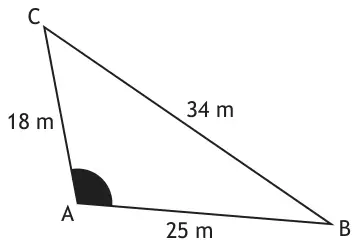
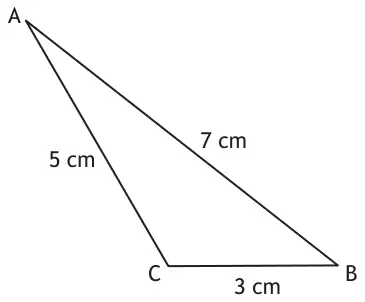
\(\dfrac{18^2+25^2-34^2}{2\times18\times25}\) stated or implied by •2
•2
evaluate \(\cos\text{A}\)
\(-\dfrac{23}{100}\) or \(\dfrac{-207}{900}\) or \(-0.23\)
•3
calculate angle
\(103(.29\ldots)\)
(3)
Notes:
Correct answer without working award 0/3
Degree sign is not required.
For the award of •1 accept eg \(34^2=18^2+25^2-2\times18\times25\times\cos\text{A}\)
For the award of •3 accept \(\cos\text{A}=103(.29\ldots)\)
Where wrong angle has been calculated correctly (a) \(\dfrac{34^2+25^2-18^2}{2\times34\times25}=\dfrac{1457}{1700}\to31(.01\ldots)\) award 2/3 ✗✓1✓1 (b) \(\dfrac{34^2+18^2-25^2}{2\times34\times18}=\dfrac{855}{1224}\to46\) or \(45.69\ldots\) award 2/3 ✗✓1✓1
BEWARE \(180-(18+25+34)=103\) award 0/3
Where more than one final angle is stated, •3 is not available eg \(\dfrac{18^2+25^2-34^2}{2\times18\times25}\to-0.23\to103.3\) and \(256.7\) award 2/3 ✓✓✗
Inappropriate use of RAD or GRAD should only be penalised once in Qu3, Qu11 or Qu13 (a) 2 or 1.80… RAD (b) 115 or 114.77… GRAD
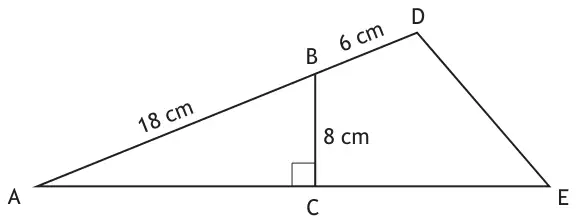
For the award of •1 accept \(\sin\text{A}=\dfrac{8\sin90}{18}\) or A = 26 (.38…) using a valid strategy involving a trigonometric calculation
Premature rounding must be to at least 2 significant figures eg (a) \(\dfrac{1}{2}\times24\times\text{AE}\times\sin26=160\to30(.41\ldots)\) award 4/4 (b) \(\dfrac{1}{2}\times24\times\text{AE}\times\dfrac{8}{18}=160\to5.3\times\text{AE}=160\to30(.18\ldots)\) award 4/4 (c) \(\dfrac{1}{2}\times24\times\text{AE}\times0.4=160\to4.8\times\text{AE}=160\to33(.33\ldots)\) award 3/4 ✓✓✓✓2
Do not penalise incorrect rounding in the final answer
For subsequent incorrect working, the final mark is not available
Where candidate estimates the size of angle BAC, •3 is only available if the angle is acute (a) \(\dfrac{1}{2}\times24\times\text{AE}\times\sin30=160\to26.6(6\ldots)\) award 2/4 ✗✗✓1✓1 (b) \(\dfrac{1}{2}\times24\times\text{AE}\times\sin90=160\to13.3(3\ldots)\) award 1/4 ✗✗✗✓1
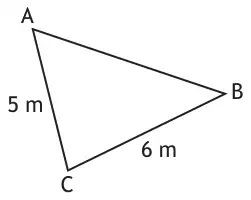
(a) \(6^2+5^2-2\times6\times5\times\cancel{\cos}\,\dfrac{1}{5}=61-60\times\cancel{\cos}\,\dfrac{1}{5}=49\to7\) where \(\cos\) is scored out in each line of working award 3/3 (b) For \(6^2+5^2-2\times6\times5\times\cos\dfrac{1}{5}=49\to7\) award 2/3 ✗✓✓
For the award of •1 accept eg \(\dfrac{1}{5}=\dfrac{6^2+5^2-\text{AB}^2}{2\times6\times5}\)
•3 is only available where AB2 has been obtained from a cosine rule calculation by: (a) calculating the square root of a perfect square (>4) OR (b) expressing a surd in its simplest form.
Where sine rule or area of triangle formula is used award 0/3
Commonly Observed Responses:
\(6^2+5^2+2\times6\times5\times\dfrac{1}{5}\to\sqrt{73}\) award 1/3 ✗✓1✗
(a) \(\sqrt{6^2+5^2}=\sqrt{61}\) award 0/3 (b) \(\sqrt{6^2-5^2}=\sqrt{11}\) award 0/3
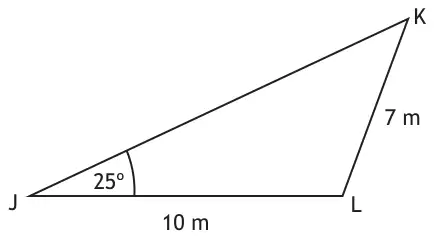
\(\dfrac{\sin\text{K}}{10}=\dfrac{\sin25}{7}\) or \(\dfrac{10}{\sin\text{K}}=\dfrac{7}{\sin25}\)
•2
rearrange equation
\(\sin\text{K}=\dfrac{10\sin25}{7}\)
•3
calculate angle JKL
37 (.1…)
(3)
Notes:
Correct answer without working award 0/3
Do not penalise omission of degrees sign.
Disregard premature rounding provided the final answer can be rounded to 37. eg (a) \(\sin\text{K}=\dfrac{10\sin25}{7}=0.6\to36.869\ldots\) award 3/3 (b) \(\sin\text{K}=\dfrac{10\sin25}{7}=\dfrac{10\times0.4}{7}\to34.849\ldots\) award 2/3 ✓✓✗
Where cosine rule or area of triangle formula is used award 0/3
Inappropriate use of GRAD or RAD should only be penalised once in Qu’s 4, 8, 11 or 15 (a) \(36(.8\ldots)\) (GRAD) (b) However, where RAD is used, \(\dfrac{10\sin25}{7}=\)\(-0.189\ldots\), so •3 is unavailable
The board's marking instructions printed “\(\dfrac{10\sin25}{7}=-0.190\ldots\)”. Changed to “\(-0.189\ldots\)” because with the calculator in radians, \(10\sin 25\div 7=-0.18907\ldots\), so it starts \(-0.189\). The point of the note (the value is negative, so •3 is unavailable) is unchanged.
Original: see the board's marking instructions PDF (link above).
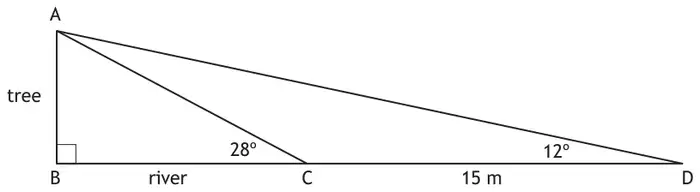
14. The width of a river is represented by BC in the diagram below.
AB represents a tree on the river bank.
From C, the angle of elevation to A is 28°.
From D, the angle of elevation to A is 12°.
The distance from C to D is 15 metres.
BCD is a straight line.
Calculate BC, the width of the river. [5]
Marking instructions
Mark
Generic scheme
Illustrative scheme
Method 1
•1
correct substitution into sine rule to calculate AC
\(\dfrac{\text{AC}}{\sin12}=\dfrac{15}{\sin16}\)
•2
rearrange equation
\(\dfrac{15\sin12}{\sin16}\)
•3
calculate AC
\(\text{AC}=11.3(\ldots)\)
•4
valid strategy to calculate BC
eg \(\cos28=\dfrac{\text{BC}}{11.3\ldots}\) or \(\sin62=\dfrac{\text{BC}}{11.3\ldots}\)
•5
calculate BC
9.99 (m)
Method 2
•1
correct substitution into sine rule to calculate AD
\(\dfrac{\text{AD}}{\sin152}=\dfrac{15}{\sin16}\)
•2
rearrange equation
\(\dfrac{15\sin152}{\sin16}\)
•3
calculate AD
\(\text{AD}=25.5(\ldots)\)
•4
valid strategy to calculate BD
eg \(\cos12=\dfrac{\textbf{BD}}{25.5\ldots}\) or \(\sin78=\dfrac{\textbf{BD}}{25.5\ldots}\)
•5
calculate BC ie BD − 15
9.99 (m)
(5)
Notes:
Correct answer without working award 0/5
Accept 10 with relevant working
Where intermediate calculations are shown, disregard premature rounding provided: (a) trigonometric values are rounded to at least 3 decimal places (b) lengths are rounded to at least 1 decimal place
For the award of •5 accept truncated or correctly rounded final answer eg method 1 leading to \(\cos28=\dfrac{\text{BC}}{11.3}\to9.97\)
Where both AC and AD are calculated but one is calculated incorrectly, if there is (a) further working, then apply the MIs based on length used to calculate BC (b) no further working, disregard the incorrect length award 3/5 ✓✓✓^^
Inappropriate use of GRAD or RAD should only be penalised once in Q6,9 or 14: If already penalised, the following marks should be awarded:
GRAD
RAD
Method 1
\(\text{AC}=11.3(\ldots)\to\text{BC}=10.2(\ldots)\) Award 5/5
\(\text{AC}=27.9(5\ldots)\to\text{BC}=\pm26.9(\ldots)\) Award 4/5 ✓✓✓✓✓2 (•5 is not available due to the negative length)
Method 2
\(\text{AD}=41.2(\ldots)\to\text{BC}=40.5(5\ldots)\) Award 5/5
\(\text{AD}=\pm48.6(\ldots)\to\text{BC}=41.0(\ldots)\) Award 3/5 ✓✓✓2✓✓2 (•3 and •5 are not available due to the negative length)
Commonly Observed Responses:
1. Method 2 leading to \(\cos12=\dfrac{\textbf{BD}}{25.5\ldots}\to24.99\)
award 4/5 ✓✓✓✓✗
2. Method 2 leading to \(\cos12=\dfrac{\textbf{BC}}{25.5\ldots}\to24.99\)
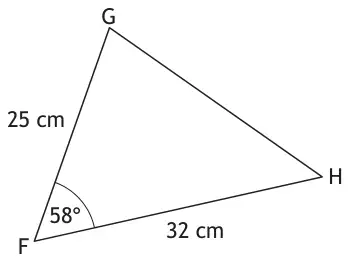
correct substitution into area of triangle formula
\(\dfrac{1}{2}\times25\times32\times\sin58\)
•2
calculate area
\(339(.21\ldots)\) \((\text{cm}^2)\)
(2)
Notes:
Correct answer without working award 2/2
For \(25\times32\times\sin58=678(.438\ldots)\) award 1/2 ✗✓1
Inappropriate use of RAD or GRAD should only be penalised once in Qu 6, 9 or 14 (a) \(397(.149\ldots)\) [RAD] (no working necessary) award 1/2 ✓✗ (b) \(316(.062\ldots)\) [GRAD] (no working necessary) award 1/2 ✓✗
We'd like to use Google Analytics cookies to count visits and see which pages help most. They're optional, and the site works exactly the same either way. Privacy policy