
May 2023 Paper 2 Q4
4. The diagram shows triangle JKL.
- Angle KJL = 25°
- JL = 10 metres
- KL = 7 metres
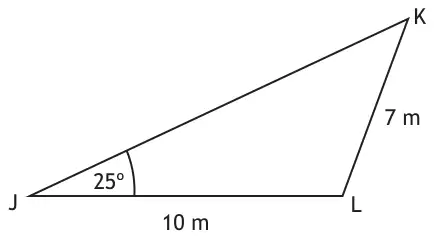
Calculate the size of angle JKL. [3]
| Mark | Generic scheme | Illustrative scheme |
|---|---|---|
| •1 | correct substitution into sine rule | \(\dfrac{\sin\text{K}}{10}=\dfrac{\sin25}{7}\) or \(\dfrac{10}{\sin\text{K}}=\dfrac{7}{\sin25}\) |
| •2 | rearrange equation | \(\sin\text{K}=\dfrac{10\sin25}{7}\) |
| •3 | calculate angle JKL | 37 (.1…) |
| (3) |
Notes:
- Correct answer without working award 0/3
- Do not penalise omission of degrees sign.
- Disregard premature rounding provided the final answer can be rounded to 37.
eg
(a) \(\sin\text{K}=\dfrac{10\sin25}{7}=0.6\to36.869\ldots\) award 3/3
(b) \(\sin\text{K}=\dfrac{10\sin25}{7}=\dfrac{10\times0.4}{7}\to34.849\ldots\) award 2/3 ✓✓✗ - Where cosine rule or area of triangle formula is used award 0/3
- Inappropriate use of GRAD or RAD should only be penalised once in Qu’s 4, 8, 11 or 15
(a) \(36(.8\ldots)\) (GRAD)
(b) However, where RAD is used, \(\dfrac{10\sin25}{7}=\)\(-0.189\ldots\), so •3 is unavailable
Commonly Observed Responses:
| 1. \(\dfrac{\text{K}}{\sin10}=\dfrac{25}{\sin7}\to\text{K}=\dfrac{25\sin10}{\sin7}\to35.6\ldots\) | award 1/3 ✗✓1✓2 |
| 2. \(\dfrac{10}{\sin\text{K}}=\dfrac{7}{\sin25}\to\sin\text{K}=\dfrac{7\times10}{\sin25}\to165.6\ldots\) | award 1/3 ✓✗✗ |
| 3. \(\dfrac{10}{\text{K}}=\dfrac{7}{25}\to\text{K}=\dfrac{25\times10}{7}\to35.71\ldots\) | award 0/3 ✗✓2✓2 |
| 4. (a) \(\dfrac{10}{\sin\text{K}}=\dfrac{7}{\sin25}\to\dfrac{10\sin25}{7}\to37(.1\ldots)\) | award 3/3 |
| (b) \(\dfrac{10}{\sin\text{K}}=\dfrac{7}{\sin25}\to\text{K}=\dfrac{10\sin25}{7}\to37(.1\ldots)\) | award 3/3 |
| (c) \(\dfrac{10}{\sin\text{K}}=\dfrac{7}{\sin25}\to\text{K}=\dfrac{7\sin25}{10}\to17(.2\ldots)\) | award 2/3 ✓✗✓1 |
| (d) \(\dfrac{10}{\sin\text{K}}=\dfrac{7}{\sin25}\to\text{K}=\dfrac{10\sin25}{7}\to0.6(03\ldots)\) | award 1/3 ✓✗✗ |
Corrected by Westie's Workshop
- The board's marking instructions printed “\(\dfrac{10\sin25}{7}=-0.190\ldots\)”. Changed to “\(-0.189\ldots\)” because with the calculator in radians, \(10\sin 25\div 7=-0.18907\ldots\), so it starts \(-0.189\). The point of the note (the value is negative, so •3 is unavailable) is unchanged.
Original: see the board's marking instructions PDF (link above).