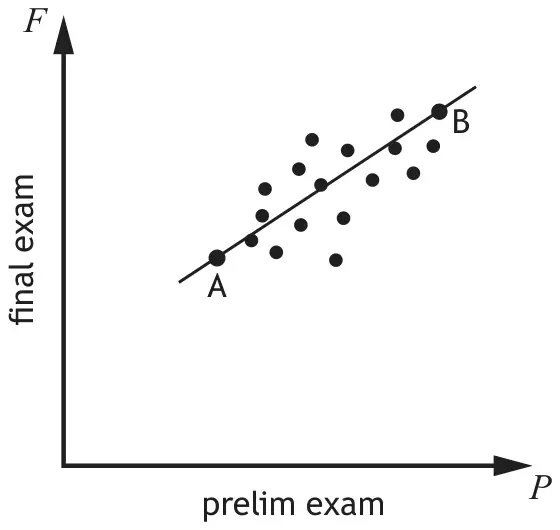
6. A teacher records the marks scored by the pupils in her class for the prelim exam and the final exam.
The scattergraph shows the relationship between the marks scored in the prelim exam, \(P\), and the final exam, \(F\).
A line of best fit is drawn.
Point A represents a pupil who scored 30 in the prelim exam and 54 in the final exam.
Point B represents a pupil who scored 90 in the prelim exam and 94 in the final exam.
(a) Find the equation of the line of best fit in terms of \(F\) and \(P\). Give the equation in its simplest form. [3]
A pupil scored 33 marks in the prelim exam.
(b) Use your equation from part (a) to estimate their mark in the final exam. [1]
Marking instructions (a)
Mark
Generic scheme
Illustrative scheme
Method 1
Method 1
•1
calculate gradient
\(\dfrac{40}{60}\) or equivalent
•2
substitute gradient and a point into \(y-b=m(x-a)\)
\(y-54=\dfrac{40}{60}(x-30)\) or \(y-94=\dfrac{40}{60}(x-90)\)
•3
state equation in terms of \(F\) and \(P\) and in simplest form (remove any brackets and collect constants)
\(F=\dfrac{2}{3}P+34\) or \(3F=2P+102\)
Method 2
Method 2
•1
calculate gradient
\(\dfrac{40}{60}\) or equivalent
•2
substitute gradient and a point into \(y=mx+c\)
\(54=\dfrac{40}{60}\times30+c\) or \(94=\dfrac{40}{60}\times90+c\)
•3
state equation in terms of \(F\) and \(P\) and in simplest form
\(F=\dfrac{2}{3}P+34\) or \(3F=2P+102\)
(3)
Notes:
Correct answer without working. award 0/3
For an incorrect simplification of a gradient, a mark is not awarded at the point where the simplification occurs eg (a) \(\dfrac{40}{60}\left(=\dfrac{3}{2}\right)\to54=\dfrac{3}{2}\times30+c\to F=\dfrac{3}{2}P+9\). award 2/3 ✓✗✓1 (b) \(\dfrac{40}{60}\to54=\dfrac{40}{60}\times30+c\to F=\dfrac{3}{2}P+9\). award 2/3 ✓✓✗
For subsequent incorrect working, •3 is not available.
For •3 do not penalise a gradient which has been simplified to an integer.
Commonly Observed Responses:
(a) \(\dfrac{60}{40}\to54=\dfrac{3}{2}\times30+c\to F=\dfrac{3}{2}P+9\) award 2/3 ✗✓1✓1 (b) \(\dfrac{60}{40}\to30=\dfrac{3}{2}\times54+c\to F=\dfrac{3}{2}P-51\) award 2/3 ✗✓1✓1
(a) \(y-b=m(x+a)\to y-54=\dfrac{40}{60}(x+30)\to F=\dfrac{2}{3}P+74\) award 2/3 ✓✗✓1 (b) \(y-b=m(x+a)\to y-94=\dfrac{40}{60}(x+90)\to F=\dfrac{2}{3}P+154\) award 2/3 ✓✗✓1
Marking instructions (b)
Mark
Generic scheme
Illustrative scheme
•4
calculate mark
56
(1)
Notes:
Consistent answer without working. award 1/1
•4 is available for using the candidate’s equation from part (a) with an integer gradient unless the gradient is \(\pm1\).
Disregard use of % symbol.
Commonly Observed Responses:
(a) \(F=\dfrac{3}{2}P-51\to-1.5\) award 1/1 ✓1 (b) \(F=\dfrac{3}{2}P-51\to-1.5\to1.5\) award 1/1 ✓1 (c) \(F=\dfrac{3}{2}P-51\to1.5\) award 0/1
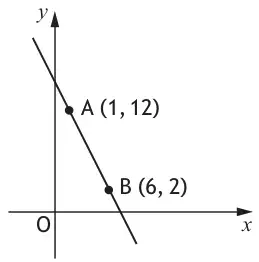
6. The diagram shows the straight line passing through points A and B.
Find the equation of the line AB.
Give the equation in its simplest form. [3]
Marking instructions
Mark
Generic scheme
Illustrative scheme
Method 1: \(y-b=m(x-a)\)
•1
calculate gradient
\(-\dfrac{10}{5}\) or equivalent
•2
substitute gradient and a point into \(y-b=m(x-a)\)
eg \(y-12=-\dfrac{10}{5}(x-1)\) OR \(y-2=-\dfrac{10}{5}(x-6)\)
•3
state equation in simplest form
\(y=-2x+14\) or equivalent
Method 2: \(y=mx+c\)
•1
calculate gradient
\(-\dfrac{10}{5}\) or equivalent
•2
substitute gradient and a point into \(y=mx+c\)
eg \(12=\left(-\dfrac{10}{5}\right)\times1+c\) OR \(2=\left(-\dfrac{10}{5}\right)\times6+c\)
•3
state equation in simplest form
\(y=-2x+14\) or equivalent
(3)
Notes:
Correct answer without working. award 0/3
For an incorrect simplification of a gradient, a mark is not awarded at the point where the error occurs. eg (a) \(-\dfrac{10}{5}(=2)\to12=2\times1+c\to y=2x+10\) award 2/3 ✓✗✓1 (b) \(-\dfrac{10}{5}\to12=-\dfrac{10}{5}\times1+c\to y=2x+10\) award 2/3 ✓✓✗
For subsequent incorrect working, •3 is not available.
Commonly Observed Responses:
\(\left(-\dfrac{5}{10}=\right)-\dfrac{1}{2}\to1=\left(-\dfrac{1}{2}\right)\times12+c\to y=-\dfrac{1}{2}x+7\) award 2/3 ✗✓1✓1
\(\left(-\dfrac{10}{5}=\right)-2\to12=-2\times1+c\to y=-2x+10\) or \(y=-2x-10\) award 2/3 ✓✓✗
\(y-b=m(x+a)\to y-2=-\dfrac{10}{5}(x+6)\to y=-2x-10\) award 2/3 ✓✗✓1
eg \(4y=-x+24\) or \(x-24=-4y\) or \(\dfrac{1}{4}x+y-\dfrac{24}{4}=0\)
•2
state gradient explicitly
\(-\dfrac{1}{4}\) or \(-0.25\)
(2)
Notes:
Correct answer without working award 2/2
For the award of •2: (a) accept \(\dfrac{-1}{4}\) or \(\dfrac{1}{-4}\) (b) do not accept \(x=-\dfrac{1}{4}\) or \(y=-\dfrac{1}{4}\) (c) do not penalise incorrect or no simplification of constant term eg (i) \(4y=-x+24\to y=-\dfrac{1}{4}x+8\to-\dfrac{1}{4}\) award 2/2 (ii) \(4y=-x+24\to y=-\dfrac{1}{4}x+24\to-\dfrac{1}{4}\) award 2/2
Where gradient formula is used with two points which (a) lie on the line \(x+4y-24=0\), (i) award •1 for correct substitution into gradient formula. (ii) award •2 for correct calculation of gradient. (b) do not lie on the line \(x+4y-24=0\) award 0/2
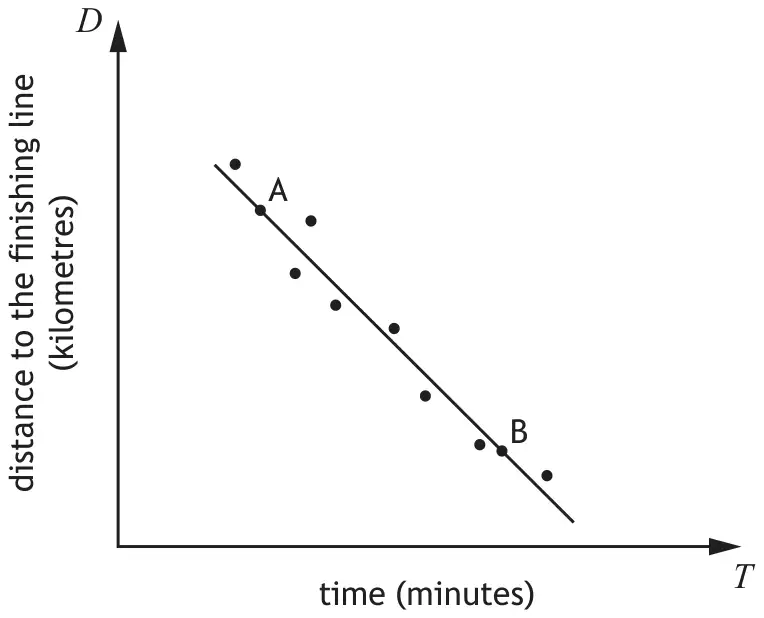
9. In a car rally, competitors start at different times.
The scattergraph shows the relationship between the length of time they have been driving, \(T\) minutes, and the distance to the finishing line, \(D\) kilometres.
A line of best fit has been drawn.
Point A represents a competitor who has been driving for 3 minutes and is 26 kilometres from the finishing line.
Point B represents a competitor who has been driving for 10 minutes and is 12 kilometres from the finishing line.
(a) Find the equation of the line of best fit in terms of \(D\) and \(T\). Give the equation in its simplest form. [3]
Another competitor has been driving for 7 minutes.
(b) Use your equation from part (a) to estimate the distance the competitor is from the finishing line. [1]
Marking instructions (a)
Mark
Generic scheme
Illustrative scheme
Method 1
Method 1
•1
find gradient
\(-2\)
•2
substitute gradient and a point into \(y-b=m(x-a)\)
\(y-26=-2(x-3)\) or \(y-12=-2(x-10)\)
•3
state equation in terms of \(D\) and \(T\) in simplest form (remove brackets and collect constants)
\(D=-2T+32\) or equivalent
Method 2
Method 2
•1
find gradient
\(-2\)
•2
substitute gradient and a point into \(y=mx+c\)
\(26=-2\times3+c\) or \(12=-2\times10+c\)
•3
state equation in terms of \(D\) and \(T\) in simplest form (remove brackets and collect constants)
\(D=-2T+32\) or equivalent
(3)
Notes:
Correct answer without working award 0/3
(a) For the award of •1 accept \(-\dfrac{14}{7}\). However see Note 3(a). (b) BEWARE •1 is not available for \(\dfrac{26-12}{3-10}=\dfrac{-14}{7}=-2\) or \(\dfrac{12-26}{10-3}=\dfrac{14}{-7}=-2\)
For an incorrect simplification of a gradient, a mark is not awarded at the point where the error occurs eg (a) \(-\dfrac{14}{7}=2\to26=2\times3+c\to D=2T+20\) award 2/3 ✗✓1✓1 (b) \(-\dfrac{14}{7}\to26=2\times3+c\to D=2T+20\) award 2/3 ✓✗✓1 (c) \(-\dfrac{14}{7}\to26=-\dfrac{14}{7}\times3+c\to D=2T+20\) award 2/3 ✓✓✗
Commonly Observed Responses:
Working must be shown
\(y=-2x+32\) award 2/3 ✓✓✓2
\(D=-\dfrac{2}{1}T+32\) award 2/3 ✓✓✓2
\(-\dfrac{7}{14}\to y-26=-\dfrac{7}{14}(x-3)\to D=-\dfrac{1}{2}T+27.5\) award 2/3 ✗✓1✓1
\(\dfrac{7}{14}\to y-26=\dfrac{7}{14}(x-3)\to D=\dfrac{1}{2}T+24.5\) award 2/3 ✗✓1✓1
Marking instructions (b)
Mark
Generic scheme
Illustrative scheme
•4
calculate distance remaining
18 (km)
(1)
Notes:
Consistent answer without working award 1/1
•4 is not available if the gradient is \(\pm1\).
Commonly Observed Responses:
No working necessary
\(D=2T-8\) in part (a) leading to \(2\times7-8=6\) (km) award 1/1 ✓1
(a) \(D=-2T-8\) in part (a) leading to \(-2\times7-8=-22\) (km) award 1/1 ✓1 (b) \(D=-2T-8\) in part (a) leading to \(-2\times7-8=-22\to22\) (km) award 1/1 ✓1 (c) \(D=-2T-8\) in part (a) leading to \(-2\times7-8=22\) (km) award 0/1 ✗
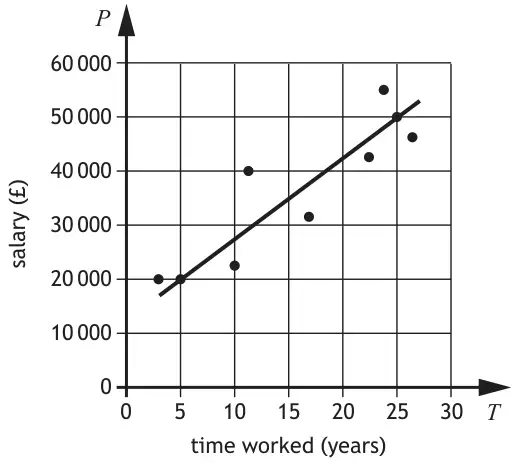
7. A business recorded the salaries of a sample of its employees and the length of time they have worked for the business.
The scattergraph shows the relationship between their salary, \(P\) pounds, and the length of time, \(T\) years, they have worked.
A line of the best fit has been drawn.
(a) Find the equation of the line of best fit in terms of \(P\) and \(T\). Give the equation in its simplest form. [3]
(b) Use your equation from part (a) to estimate the salary of an employee who has worked for the business for 8 years. [1]
Marking instructions (a)
Mark
Generic scheme
Illustrative scheme
Method 1
Method 1
•1
calculate gradient
1500
•2
substitute gradient and a point into \(y-b=m(x-a)\)
eg \(y-20000=1500(x-5)\)
•3
determine the equation of the line in terms of \(P\) and \(T\) in simplest form
\(P=1500T+12500\)
Method 2
Method 2
•1
calculate gradient
1500
•2
substitute gradient and a point into \(y=mx+c\)
eg \(20000=1500\times5+c\)
•3
determine the equation of the line in terms of \(P\) and \(T\) in simplest form
\(P=1500T+12500\)
(3)
Notes:
Correct answer without working award 0/3
Accept \(\dfrac{30000}{20}\) or equivalent for the award of •1.
•1 is not available for using points other than (5, 20 000), (15, 35 000) and (25, 50 000) to find the gradient.
For an incorrect simplification of a gradient, a mark is not awarded at the point where the error occurs, eg (a) \(\dfrac{30000}{20}=15000\to y-20000=15000(x-5)\to P=15000T-55000\) award 2/3 ✗✓1✓1 (b) \(\dfrac{30000}{20}\to y-20000=15000(x-5)\to P=15000T-55000\) award 2/3 ✓✗✓1 (c) \(\dfrac{30000}{20}\to y-20000=\dfrac{30000}{20}(x-5)\to P=15000T-55000\) award 2/3 ✓✓✗
Commonly Observed Responses:
Working must be shown
\(P=\dfrac{1500}{1}T+12500\) award 2/3 ✓✓✗
Using (1,2) and (5,5): eg gradient = \(\dfrac{3}{4}\to2=\dfrac{3}{4}\times1+c\to P=\dfrac{3}{4}T+\dfrac{5}{4}\) award 2/3 ✗✓1✓1
Using (5,20) and (25, 50): eg gradient = \(\dfrac{3}{2}\to20=\dfrac{3}{2}\times5+c\to P=\dfrac{3}{2}T+\dfrac{25}{2}\) award 2/3 ✗✓1✓1
Marking instructions (b)
Mark
Generic scheme
Illustrative scheme
•4
calculate salary
(£)24,500
(1)
Notes:
Consistent answer without working (but see note 2) award 1/1
Where an incorrect answer in (a) is followed through, •4 is not available where the answer is: (a) negative (b) expressed in fraction form eg \(P=\dfrac{3}{4}T+\dfrac{5}{4}\to\dfrac{29}{4}\) (c) given to one decimal place or more than two decimal places \(P=1.5T+12.5\to24.5\)
Commonly Observed Responses:
\(P=\dfrac{3}{4}T+\dfrac{5}{4}\) in (a) leading to (£) 7.25 award 1/1
\(P=\dfrac{3}{2}T+\dfrac{25}{2}\) in (a) leading to (£) 24.50 award 1/1
6. Find the equation of the line passing through the points \((-3,-1)\) and \((-5,7)\).
Give the equation in its simplest form. [3]
Marking instructions
Mark
Generic scheme
Illustrative scheme
Method 1: \(y-b=m(x-a)\)
•1
calculate gradient
\(-4\) or equivalent
•2
substitute gradient and a point into \(y-b=m(x-a)\)
eg \(y-7=-4(x-(-5))\)
•3
determine the equation of the line in simplest form
\(y=-4x-13\) or equivalent
Method 2: \(y=mx+c\)
•1
calculate gradient
\(-4\) or equivalent
•2
substitute gradient and a point into \(y=mx+c\)
eg \(7=-4\times(-5)+c\)
•3
determine the equation of the line in simplest form
\(y=-4x-13\) or equivalent
(3)
Notes:
Correct answer without working award 0/3
(a) Accept \(-\dfrac{8}{2}\) for the award of •1 (b) BEWARE •1 is not available for \(\dfrac{7-(-1)}{-5-(-3)}=\dfrac{-8}{2}=-\dfrac{8}{2}\) or \(\dfrac{(-1)-7}{-3-(-5)}=\dfrac{8}{-2}=-\dfrac{8}{2}\)
For an incorrect simplification of a gradient, a mark is not awarded at the point where the error occurs eg (a) \(-\dfrac{8}{2}=4\to\ 7=4\times(-5)+c\to\ y=4x+27\) award 2/3 ✗✓1✓1 (b) \(-\dfrac{8}{2}\to\ 7=4\times(-5)+c\to\ y=4x+27\) award 2/3 ✓✗✓1 (c) \(-\dfrac{8}{2}\to\ 7=-\dfrac{8}{2}\times(-5)+c\to\ y=4x+27\) award 2/3 ✓✓✗
We'd like to use Google Analytics cookies to count visits and see which pages help most. They're optional, and the site works exactly the same either way. Privacy policy