\((5x\ldots2)(2x\ldots3)\) or \(5x(2x+3)-2(2x+3)\) or \(2x(5x-2)+3(5x-2)\)
•2
complete factorisation
\((5x-2)(2x+3)\)
•3
solve equation
\(\dfrac{2}{5},\ -\dfrac{3}{2}\)
(3)
Notes:
For the award of •1 and •2, where working is shown, every step must be mathematically consistent with the previous step eg \(10x^2+11x-6\to x^2+11x-60\to(x-4)(x+15)\to(5x-2)(2x+3)\to\dfrac{2}{5},-\dfrac{3}{2}\). award 1/3 ✗✗✓
Correct answer without working. award 0/3
•3 is only available for two non-integer roots eg \((10x+1)(x-6)\to x=-\dfrac{1}{10},\ x=6\). award 0/3
Where the quadratic formula is used, award 0/3 (method specified in question: see General Marking Principle (f)).
(a) Where the equation is multiplied by a scalar, this is mathematically equivalent: all three marks are available (see COR 2(a)). (b) Where the expression is multiplied by a scalar, this is not mathematically equivalent: only •3 is available (see COR 2(b)).
Commonly Observed Responses:
\(\dfrac{(10x-4)}{2}\dfrac{(10x+15)}{5}\left[\to(5x-2)(2x+3)\right]\to\dfrac{2}{5},-\dfrac{3}{2}\) award 3/3
(a) \((10x-4)(10x+15)=0\left[\to(5x-2)(2x+3)=0\right]\to\dfrac{2}{5},-\dfrac{3}{2}\) award 3/3 [Equated to 0 (mathematically equivalent)] (b) \((10x-4)(10x+15)\left[\to(5x-2)(2x+3)\right]\to\dfrac{2}{5},-\dfrac{3}{2}\) award 1/3 ✗✗✓ [Not equated to 0 (not mathematically equivalent)]
\(2x(5x-2)3(5x-2)\to(5x-2)(2x+3)\to\dfrac{2}{5},-\dfrac{3}{2}\) award 1/3 ✗✗✓
select correct value of \(x\), stated to 2 decimal places
0.46 (m)
(4)
Notes:
Correct answer without working. award 0/4
For a solution obtained by repeated substitution. award 0/4
•4, •5, •6 and •7 are available If solution to (c) appears in part (a) or (b). However, if a different value for \(x\) is stated in part (c) then •7 is not available. (General Marking Principle (l) should not be applied in this special case).
•4 and •5 are available for \(\dfrac{-5\pm\sqrt{35}}{2}\).
Where \(b^2-4ac\) is calculated incorrectly, •6 is only available if \(b^2-4ac\gt0\).
For: (a) \(\dfrac{-10+\sqrt{10^2-4\times2\times(-5)}}{2\times2}\to0.46\). award 4/4 (with explicit justification of why second root has not been calculated eg 2nd substitution leads to a negative solution) (b) \(\dfrac{-10+\sqrt{10^2-4\times2\times(-5)}}{2\times2}\to0.46\). award 1/4 ✗✓✗✗ (c) \(\dfrac{-10+\sqrt{10^2-4\times2\times(-5)}}{2\times2}\). award 0/4
•7 is not available if:
there is subsequent invalid working
premature rounding leads to an incorrect answer
Commonly Observed Responses:
1. \(\left(b^2-4ac=\right)140\)
award 1/4 ✗✓✗✗
2. (a) \(\dfrac{-10\pm\sqrt{10^2-4\times2\times(-5)}}{2\times2}\to\dfrac{-10\pm\sqrt{60}}{2\times2}\to-0.563\ldots\) or \(-4.436\ldots\)
award 2/4 ✓✗✓1✗
(b) \(\dfrac{-10\pm\sqrt{10^2-4\times2\times5}}{2\times2}\left(\to\dfrac{-10\pm\sqrt{60}}{2\times2}\right)\to-0.563\ldots\) or \(-4.436\ldots\)
award 2/4 ✗✓1✓1✗
3. (a) \(-10\pm\dfrac{\sqrt{10^2-4\times2\times(-5)}}{2\times2}\to-10\pm\dfrac{\sqrt{140}}{2\times2}\to0.458\ldots\) or \(-5.458\ldots\to0.46\)
award 4/4
(b) \(-10\pm\dfrac{\sqrt{10^2-4\times2\times(-5)}}{2\times2}\to-10\pm\dfrac{\sqrt{140}}{2\times2}\to-7.041\ldots\) or \(-12.958\ldots\)
award 2/4 ✗✓✓1✗
4. \(\dfrac{-10\pm\sqrt{10^2-4\times2\times5}}{2\times2}\to\dfrac{-10\pm\sqrt{140}}{2\times2}\left(\to-10\pm\dfrac{\sqrt{140}}{2\times2}\right)\to-7.041\ldots\) or \(-12.958\ldots\)
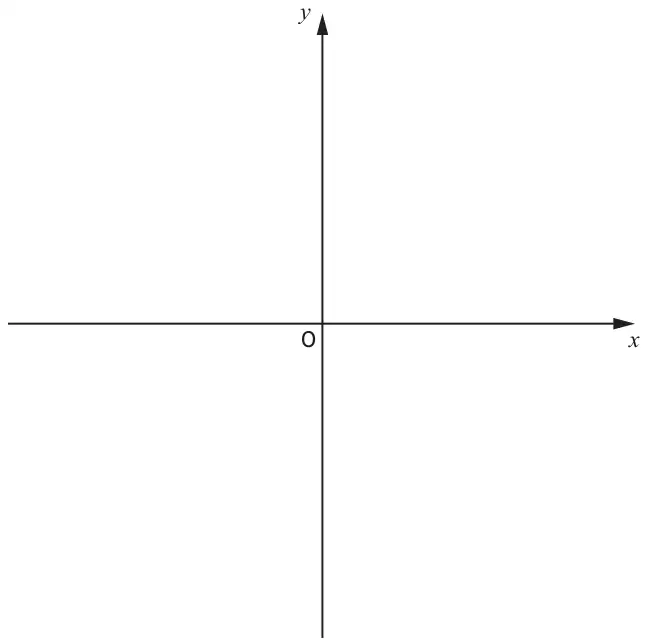
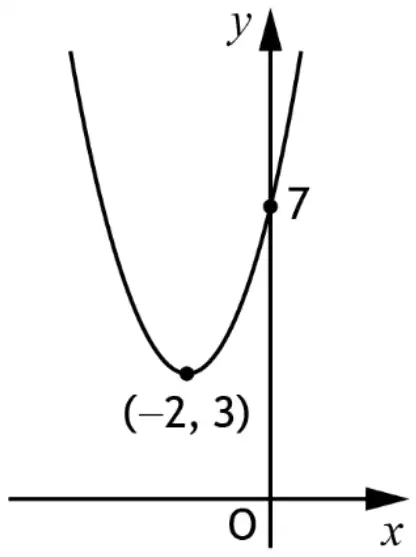
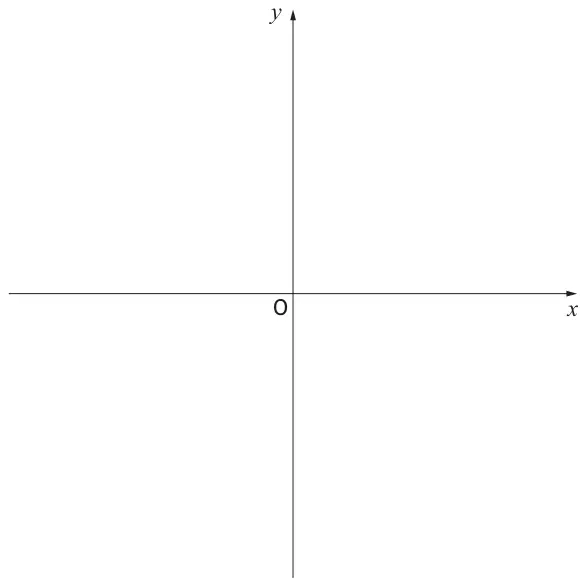
12. On the axes below, sketch the graph of \(y=(x+2)^2+3\).
On your sketch, show clearly the coordinates of the turning point and the point of intersection with the \(y\)-axis. [3]
Marking instructions
Mark
Generic scheme
Illustrative scheme
Method 1
Method 1
•1
correct coordinates of turning point
\((-2, 3)\)
•2
sketch parabola with minimum turning point consistent with •1
•3
correct \(y\)-intercept shown on sketch
Method 2
Method 2
•1
correct coordinates of turning point
\((-2, 3)\)
•2
state correct \(y\)-intercept
\((0, 7)\) or 7
•3
sketch parabola with minimum turning point and \(y\)-intercept consistent with •1 and •2
(3)
Notes:
Correct answer without working. award 3/3
Where the coordinates of the turning points are not stated elsewhere, then for a sketch of a parabola with minimum turning point \((-2,-3)\), \((2,\pm3)\) or \((\pm3,\pm2)\) •2 and •3 are still available. Otherwise •3 is only available where the minimum turning point indicated on the sketch is consistent with that stated elsewhere.
In method 1, the sketch of the parabola need not meet or cut the \(y\)-axis for the award of •2.
•3 is not available if the parabola has a maximum turning point.
•3 is not available if the minimum turning point is on the \(y\)-axis.
Award •3 where the \(y\)-intercept is calculated to be at \(y=7\) and is plotted on the diagram at \((0,7)\) but is annotated as \((7,0)\).
•2 and •3 are not available if the turning point and the \(y\)-intercept have the same \(y\)-coordinate.
•1 is available where a candidate sketches a parabola with a maximum turning point of \((-2,3)\) and the coordinates of the turning point are not stated elsewhere.
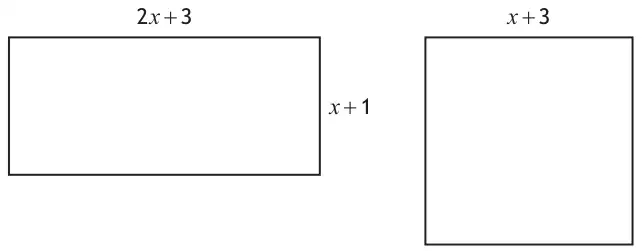
15. The diagrams of a rectangle and square are shown below.
All measurements are in centimetres.
(a) Find an expression for the area of the rectangle. [1]
(b) Given that the area of the rectangle is equal to the area of the square, show that \(x^2-x-6=0\). [2]
(c) Hence find, algebraically, the length and breadth of the rectangle. [3]
Marking instructions (a)
Mark
Generic scheme
Illustrative scheme
•1
find expression for area of rectangle
\((2x+3)(x+1)\) or equivalent
(1)
Notes:
If no expression is given in (a) but appears in (b) or (c). award 1/1
(a) accept \((2x+3)\times(x+1)\) or \(2x+3\times x+1\). (b) do NOT accept \(2x+3\times(x+1)\) or \((2x+3)\times x+1\) unless the correct expansion appears in parts (a), (b) or (c).
Do not penalise incorrect simplification or expansion of brackets in (a).
Marking instructions (b)
Mark
Generic scheme
Illustrative scheme
•2
equate required expressions and expand expression for area of square or rectangle within the equation
\(2x^2+2x+3x+3=(x+3)^2\) OR \((2x+3)(x+1)=x^2+3x+3x+9\)
•3
complete expansion and rearrange into required form
If solution to (b) appears in (a) or (c) then both marks are available.
Marking instructions (c)
Mark
Generic scheme
Illustrative scheme
•4
factorise \(x^2-x-6\)
\((x-3)(x+2)\)
•5
solve equation
\((x=)\,3,\ (x=)\,{-2}\)
•6
reject invalid value of \(x\) and state length and breadth of rectangle
9 (cm) and 4 (cm)
(3)
Notes:
Correct answer without working. award 0/3
If solution to (c) appears in (a) or (b) then all three marks are available. However, if a different value for \(x\) is stated in (c) then •6 is not available. (General Marking Principle (l) should not be applied in this special case.)
•4 is available for \(\dfrac{1\pm\sqrt{25}}{2}\).
For an answer obtained by repeated substitution. award 0/3
Commonly Observed Responses:
(a) \((2x+3)(x+1)=0\to x=-\dfrac{3}{2},\ x=-1\) award 1/3 ✗✓1✗ (b) \(x=-\dfrac{3}{2},\ x=-1\) without factorised quadratic equation stated award 0/3
11. Determine the nature of the roots of the function \(f(x)=3x^2+2x+1\). [2]
Marking instructions
Mark
Generic scheme
Illustrative scheme
•1
calculate discriminant
\(-8\)
•2
state nature of roots
no real roots
(2)
Notes:
Correct answer without working. award 0/2
(a) For \(4-12\lt0\to\) no real roots. award 2/2 (b) For \(4-12\to\) no real roots. award 0/2 ✗✗
For the award of •2 do not accept: (a) “No roots”. (b) “No distinct real roots” or “No distinct roots”. (c) “No equal real roots” or “No equal roots”.
Expected answers for the award of •2, when (a) \(b^2-4ac\gt0\): “2 distinct real roots” or “2 unequal real roots”. award 1/2 ✗✓1 (b) \(b^2-4ac=0\): “1 repeated real root” or “2 equal real roots”. award 1/2 ✗✓1
Accept \(\sqrt{-8}\) as evidence for •1 in a quadratic formula or alone.
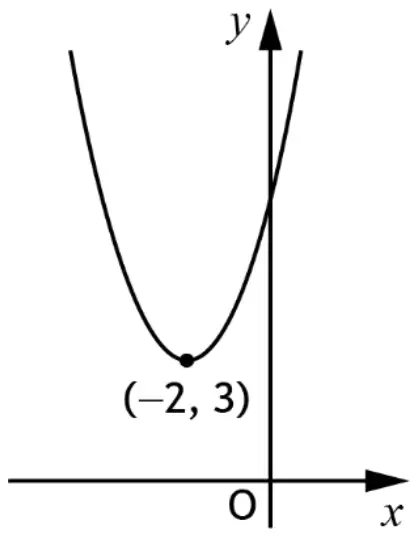
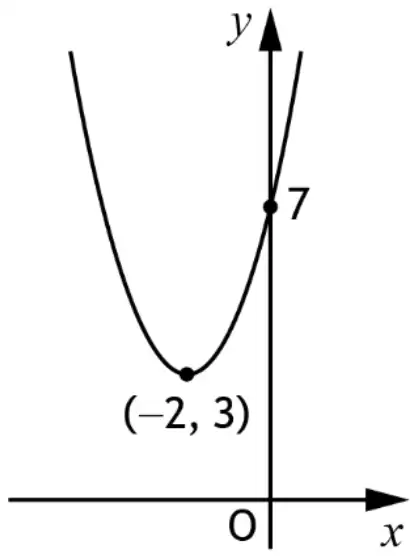
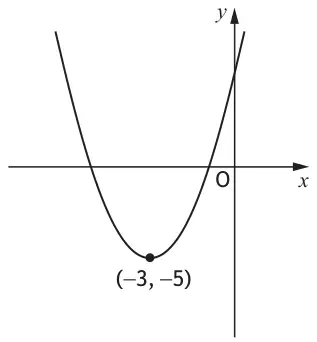
9. The diagram shows a parabola with equation of the form \(y=(x+a)^2+b\).
(a) State the value of \(a\). [1]
(b) State the value of \(b\). [1]
Marking instructions (a)
Mark
Generic scheme
Illustrative scheme
•1
state the value of \(a\)
3
(1)
Notes:
For \([y=](x+3)^2\ldots\). award 1/1 ✓
(a) Where a candidate states an incorrect equation and states \(a=3\). award 1/1 ✓ (b) Where a candidate states \([y=](x+3)^2\ldots\) and states an incorrect value of \(a\). award 0/1 ✗
If \([y=](x+3)^2\ldots\) appears in (b) award •1. However, do not award •1 if a different value for \(a\) is stated in (a).
Marking instructions (b)
Mark
Generic scheme
Illustrative scheme
•2
state the value of \(b\)
\(-5\)
(1)
Notes:
For \([y=](x\ldots)^2-5\). award 1/1 ✓
For an answer of \(a=-5\) in (a) and \(b=3\) in (b). award 0/1 for (a) ✗ and 1/1 for (b) ✓1
(a) Where a candidate states an incorrect equation and states \(b=-5\). award 1/1 ✓ (b) Where a candidate states \([y=](x\ldots)^2-5\) and states an incorrect value of \(b\). award 0/1 ✗
If \([y=](x\ldots)^2-5\) appears in (a) award •2. However, do not award •2 if a different value for \(b\) is stated in (b).
(a) Express \(x^2-6x+8\) in the form \((x-a)^2+b\). [2]
(b) Hence, or otherwise, state the coordinates of the turning point of the graph of \(y=x^2-6x+8\). [1]
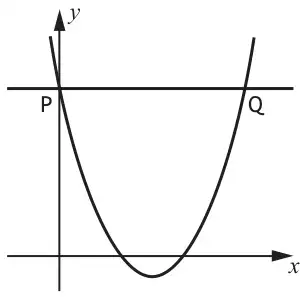
The diagram shows the graph of \(y=x^2-6x+8\).
A line PQ has been drawn parallel to the \(x\)-axis, where:
P lies on the \(y\)-axis
P and Q lie on the graph of \(y=x^2-6x+8\).
(c) Find the coordinates of Q. [2]
Marking instructions (a)
Mark
Generic scheme
Illustrative scheme
•1
correct bracket with square
\((x-3)^2\ldots\)
•2
complete process consistently
\((x-3)^2-1\)
(2)
Notes:
Correct answer without working award 2/2
Answer for •2 must be consistent with •1 eg (a) \((x+3)^2-1\) award 1/2 ✗✓1 (b) \((x\pm6)^2-28\) award 1/2 ✗✓1 (c) \((x\pm6)^2-1\) award 0/2
Commonly Observed Responses:
No working necessary.
Award 2/2 for (a) \((x-3)^2+-1\) or \((x-3)^2+(-1)\) (b) \((x-3)(x-3)-1\)
Award 1/2 ✗✓1 for (a) \(\left(x^2\pm3\right)-1\) (b) \(\left(x^2\pm3\right)^2-1\) (c) \((x\pm3x)^2-1\) (d) \(\left(x^2\pm3x\right)^2-1\)
Marking instructions (b)
Mark
Generic scheme
Illustrative scheme
•3
state coordinates of turning point
\((3,\,-1)\)
(1)
Notes:
Answer must be consistent with (a) unless candidate uses method in note 2.
Accept correct answer obtained by factorising, finding roots and using symmetry. ie \(x^2-6x+8=0\to(x-2)(x-4)=0\to x=2,4\to x=3\) (\(x\) coordinate of turning point) \(\to y=-1\)
Coordinates of turning point may appear on diagram or clearly labelled in part (c).
Accept \(x=3,\ y=-1\).
•3 is not available where brackets are omitted, unless answer is in the form shown in note 4 or omission of brackets has already been penalised in Qu4.
Marking instructions (c)
Mark
Generic scheme
Illustrative scheme
•4
find \(x\) coordinate
\((6,\ldots)\)
•5
find \(y\) coordinate
\((\ldots,8)\)
(2)
Notes:
Correct answer or answer consistent with part (b) without working award 2/2
Do not award •4 if: (a) the \(x\)-coordinate in (b) and (c) are the same. However, see Note 3. (b) the \(x\)-coordinate is less than the \(x\)-coordinate of the turning point.
For the award of •4 answer must be consistent with part (b) unless there is evidence of an alternative valid strategy in part (c) eg finding roots and using symmetry: \(x^2-6x+8=0\to(x-2)(x-4)=0\to x=2,4\to x_{\text{Q}}=6\)
Do not award •5 if the \(y\)-coordinate in (b) and (c) are the same unless there is evidence of an alternative valid strategy in part (c) eg \(y_{\text{Q}}=0^2-6\times0+8=8\)
•5 is not available where brackets are omitted, unless answer is in the form shown in note 6 or omission of brackets has already been penalised in Qu4 or Qu12(b).
Accept answer in the form \(x=\ldots,\ y=\ldots\).
Coordinates of Q may appear on diagram.
Commonly Observed Responses:
\((8,\,6)\) (coordinates in wrong order but consistent with part (b)) award 1/2 ✗✓1
For answers in parts (a), (b) and (c) award as follows: (a) \((x-3)^2-1\) award 2/2 ✓✓ (b) \((6,\,8)\) award 0/1 ✗ (c) \((12,\,8)\) in part (c) (no working) award 1/2 ✓1✗
For answers in parts (a), (b) and (c) award as follows: (a) \((x-6)^2-28\) award 1/2 ✗✓1 (b) \((6,\,8)\) award 0/1 ✗ (c) \((12,\,80)\) in part (c) (no working) award 2/2 ✓1✓1
For answers in parts (a), (b) and (c) award as follows: (a) \((x-6)^2+8\) award 0/2 ✗✗ (b) \((6,\,8)\) award 1/1 ✓1 (c) \(y_{\text{Q}}=0^2-6\times0+8=8\to(6,\,8)\) award 1/2 ✗✓
calculate both roots correct to two decimal places
\(-0.13,\ -2.54\)
(3)
Notes:
Correct answer without working award 0/3
For a solution obtained by repeated substitution award 0/3
•2 is available for \(\dfrac{-4\pm\sqrt{13}}{3}\)
For the award of •2 accept \(\pm0.131\ldots\) or \(\pm2.535\ldots\) (or rounded to two decimal places) as evidence of the discriminant.
•3 is only available when \(b^2-4ac\gt 0\) and the roots require rounding.
For subsequent incorrect working •3 is not available eg \(\dfrac{-8\pm\sqrt{8^2-4\times3\times1}}{2\times3}\to-0.13,\ -2.54\to\mathbf{0.13,}\,-2.54\) award 2/3 ✓✓✗
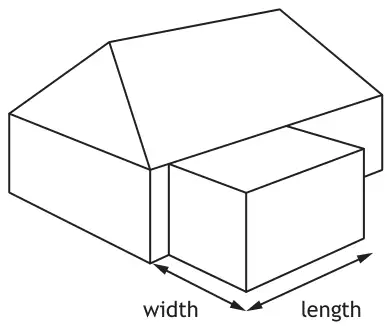
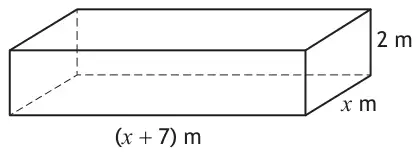
14. A storage unit, built in the shape of a cuboid, is shown.
It has length \((x+7)\) metres, breadth \(x\) metres and height 2 metres.
The volume of this unit is 45 cubic metres.
(a) Show that \(2x^2+14x-45=0\). [2]
(b) Calculate \(x\), the breadth of the storage unit. Give your answer correct to 1 decimal place. [4]
Marking instructions (a)
Mark
Generic scheme
Illustrative scheme
•1
use the dimensions of the cuboid to find an expression for the volume
\((x+7)\times x\times2\) or equivalent
•2
construct equation and rearrange into required form
\(2x^2+14x=45\Rightarrow2x^2+14x-45=0\)
(2)
Notes:
Correct answer without working award 0/2
If solution to part (a) appears in (b) then both marks are available.
For the award of •1 (a) accept \(x+7\times x\times2\) with further evidence of \((x+7)\times x\times2\) (b) do not accept \(x+7\times x\times2\) with no further evidence
Commonly Observed Responses:
1. \(2x^2+14x-45=0\Rightarrow2x(x+7)=45\)
award 0/2
Marking instructions (b)
Mark
Generic scheme
Illustrative scheme
•3
correct substitution into quadratic formula
\(\dfrac{-14\pm\sqrt{(14)^2-4(2)(-45)}}{2(2)}\)
•4
evaluate discriminant
556 (stated or implied by •5)
•5
solve for \(x\)
\(2.39(4\ldots)\) and \(-9.39(4\ldots)\)
•6
select correct value of \(x\), to one decimal place
2.4
(4)
Notes:
Correct answer without working award 0/4
For a solution obtained by guess and check award 0/4
•4 is available for \(\dfrac{-7\pm\sqrt{139}}{2}\)
•5 is only available when \(b^2-4ac\gt0\)
•6 is only available when the positive root is selected and it requires rounding.
If solution to part (b) appears in (a) then all four marks are available. However, if a different value of \(x\) is stated in (b) then •6 is not available. General marking principle (l) should not be applied in this special case.
For: (a) \(\dfrac{-14+\sqrt{(14)^2-4(2)(-45)}}{2(2)}\to2.4\) award 2/4 ✓✓✗✗ (b) \(\dfrac{-14+\sqrt{(14)^2-4(2)(-45)}}{2(2)}\to2.4;\) with explicit justification of why second root has not been calculated eg 2nd substitution leads to a negative solution award 4/4
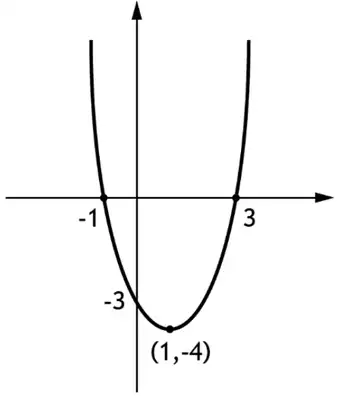
14. Sketch the graph of \(y=(x+1)(x-3)\) using the axes provided below.
On your sketch, show clearly the points of intersection with the \(x\)-axis and the \(y\)-axis, and the coordinates of the turning point. [3]
Marking instructions
Mark
Generic scheme
Illustrative scheme
•1
identify roots
\(-1\) AND \(3\)
•2
identify turning point OR \(y\)-intercept
\((1,-4)\) OR \(-3\)
•3
identify turning point AND \(y\)-intercept and sketch a consistently annotated parabola
\((1,-4)\) AND \(-3\) and a consistently annotated parabola (see note 2)
(3)
Notes:
•1 and •2 may be awarded for roots, and turning point or \(y\)-intercept indicated on the graph (no additional working required)
•3 is only available where the roots, turning point AND \(y\)-intercept are clearly marked and consistently annotated on the sketch
Accept correctly calculated roots and/or \(y\)-intercept marked as \((0,-1)\), \((0,3)\) and \((-3,0)\) as evidence for the award of •3 (treat as bad form)
•3 is not available if the graph is not a parabola eg roots \(-3\) and \(1\to\) turning point \((-1,0)\) or \(y\)-intercept \(-3\) award 1/3 ✗✓1✗
We'd like to use Google Analytics cookies to count visits and see which pages help most. They're optional, and the site works exactly the same either way. Privacy policy