
May 2024 Paper 1 Q12
12.
(a) Express \(x^2-6x+8\) in the form \((x-a)^2+b\). [2]
(b) Hence, or otherwise, state the coordinates of the turning point of the graph of \(y=x^2-6x+8\). [1]
The diagram shows the graph of \(y=x^2-6x+8\).
A line PQ has been drawn parallel to the \(x\)-axis, where:
- P lies on the \(y\)-axis
- P and Q lie on the graph of \(y=x^2-6x+8\).
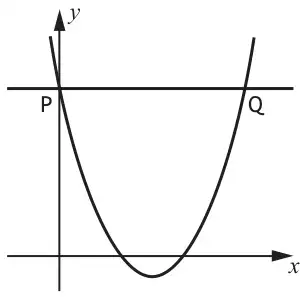
(c) Find the coordinates of Q. [2]
| Mark | Generic scheme | Illustrative scheme |
|---|---|---|
| •1 | correct bracket with square | \((x-3)^2\ldots\) |
| •2 | complete process consistently | \((x-3)^2-1\) |
| (2) |
Notes:
- Correct answer without working award 2/2
- Answer for •2 must be consistent with •1
eg (a) \((x+3)^2-1\) award 1/2 ✗✓1
(b) \((x\pm6)^2-28\) award 1/2 ✗✓1
(c) \((x\pm6)^2-1\) award 0/2
Commonly Observed Responses:
No working necessary.
- Award 2/2 for
(a) \((x-3)^2+-1\) or \((x-3)^2+(-1)\)
(b) \((x-3)(x-3)-1\) - Award 1/2 ✗✓1 for
(a) \(\left(x^2\pm3\right)-1\)
(b) \(\left(x^2\pm3\right)^2-1\)
(c) \((x\pm3x)^2-1\)
(d) \(\left(x^2\pm3x\right)^2-1\)
| Mark | Generic scheme | Illustrative scheme |
|---|---|---|
| •3 | state coordinates of turning point | \((3,\,-1)\) |
| (1) |
Notes:
- Answer must be consistent with (a) unless candidate uses method in note 2.
- Accept correct answer obtained by factorising, finding roots and using symmetry.
ie \(x^2-6x+8=0\to(x-2)(x-4)=0\to x=2,4\to x=3\) (\(x\) coordinate of turning point) \(\to y=-1\) - Coordinates of turning point may appear on diagram or clearly labelled in part (c).
- Accept \(x=3,\ y=-1\).
- •3 is not available where brackets are omitted, unless answer is in the form shown in note 4 or omission of brackets has already been penalised in Qu4.
| Mark | Generic scheme | Illustrative scheme |
|---|---|---|
| •4 | find \(x\) coordinate | \((6,\ldots)\) |
| •5 | find \(y\) coordinate | \((\ldots,8)\) |
| (2) |
Notes:
- Correct answer or answer consistent with part (b) without working award 2/2
- Do not award •4 if:
(a) the \(x\)-coordinate in (b) and (c) are the same. However, see Note 3.
(b) the \(x\)-coordinate is less than the \(x\)-coordinate of the turning point. - For the award of •4 answer must be consistent with part (b) unless there is evidence of an alternative valid strategy in part (c)
eg finding roots and using symmetry: \(x^2-6x+8=0\to(x-2)(x-4)=0\to x=2,4\to x_{\text{Q}}=6\) - Do not award •5 if the \(y\)-coordinate in (b) and (c) are the same unless there is evidence of an alternative valid strategy in part (c)
eg \(y_{\text{Q}}=0^2-6\times0+8=8\) - •5 is not available where brackets are omitted, unless answer is in the form shown in note 6 or omission of brackets has already been penalised in Qu4 or Qu12(b).
- Accept answer in the form \(x=\ldots,\ y=\ldots\).
- Coordinates of Q may appear on diagram.
Commonly Observed Responses:
- \((8,\,6)\) (coordinates in wrong order but consistent with part (b)) award 1/2 ✗✓1
- For answers in parts (a), (b) and (c) award as follows:
(a) \((x-3)^2-1\) award 2/2 ✓✓
(b) \((6,\,8)\) award 0/1 ✗
(c) \((12,\,8)\) in part (c) (no working) award 1/2 ✓1✗ - For answers in parts (a), (b) and (c) award as follows:
(a) \((x-6)^2-28\) award 1/2 ✗✓1
(b) \((6,\,8)\) award 0/1 ✗
(c) \((12,\,80)\) in part (c) (no working) award 2/2 ✓1✓1 - For answers in parts (a), (b) and (c) award as follows:
(a) \((x-6)^2+8\) award 0/2 ✗✗
(b) \((6,\,8)\) award 1/1 ✓1
(c) \(y_{\text{Q}}=0^2-6\times0+8=8\to(6,\,8)\) award 1/2 ✗✓