
C4 June 2014 (R) Q2
2.
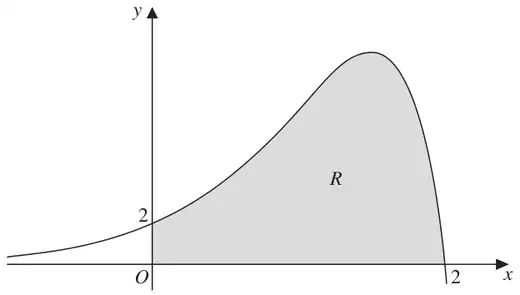
Figure 1 shows a sketch of part of the curve with equation \[y = (2 - x)\mathrm{e}^{2x}, \qquad x \in \mathbb{R}\]
The finite region \(R\), shown shaded in Figure 1, is bounded by the curve, the \(x\)-axis and the \(y\)-axis.
The table below shows corresponding values of \(x\) and \(y\) for \(y = (2 - x)\mathrm{e}^{2x}\)
| \(x\) | 0 | 0.5 | 1 | 1.5 | 2 |
|---|---|---|---|---|---|
| \(y\) | 2 | 4.077 | 7.389 | 10.043 | 0 |
| Scheme | Marks |
|---|---|
| \(\text{Area} \approx \dfrac{1}{2} \times 0.5;\ \times \left[2 + 2\left(4.077 + 7.389 + 10.043\right) + 0\right]\) | B1; M1 |
| \(= \dfrac{1}{4} \times 45.018 = 11.2545 = 11.25\) (2 dp) 11.25 | A1 cao |
| (3) |
Notes
B1: Outside brackets \(\dfrac{1}{2} \times 0.5\) or \(\dfrac{0.5}{2}\) or 0.25 or \(\dfrac{1}{4}\).
M1: For structure of trapezium rule \(\left[\ \ldots\ldots\ldots\ldots\ \right]\). Condone missing 0.
Note: No errors are allowed [eg. an omission of a \(y\)-ordinate or an extra \(y\)-ordinate or a repeated \(y\) ordinate].
A1: 11.25 cao
Note: Working must be seen to demonstrate the use of the trapezium rule. The actual area is 12.39953751…
Note: Award B1M1A1 for \(\dfrac{0.5}{2}(2 + 0) + \dfrac{1}{2}\left(4.077 + 7.389 + 10.043\right) = 11.25\)
Bracketing mistake: Unless the final answer implies that the calculation has been done correctly.
Award B1M0A0 for \(\dfrac{1}{2} \times 0.5 + 2 + 2\left(4.077 + 7.389 + 10.043\right) + 0\) (nb: answer of 45.268).
Alternative method for part (a): Adding individual trapezia
\(\text{Area} \approx 0.5 \times \left[\dfrac{2 + 4.077}{2} + \dfrac{4.077 + 7.389}{2} + \dfrac{7.389 + 10.043}{2} + \dfrac{10.043 + 0}{2}\right] = 11.2545 = 11.25\) (2 dp) cao
B1: 0.5 and a divisor of 2 on all terms inside brackets.
M1: First and last ordinates once and the middle ordinates twice inside brackets ignoring the 2.
A1: 11.25 cao
| Scheme | Marks |
|---|---|
Any one of
| B1 |
| (1) |
Notes
B0: Give B0 for
- smaller values of \(x\) and/or \(y\).
- use more decimal places
| Scheme | Marks |
|---|---|
| \(\left\{\displaystyle\int (2 - x)\mathrm{e}^{2x}\,\mathrm{d}x\right\},\ \left\{\begin{aligned} u &= 2 - x &\Rightarrow\ \dfrac{\mathrm{d}u}{\mathrm{d}x} &= -1\\ \dfrac{\mathrm{d}v}{\mathrm{d}x} &= \mathrm{e}^{2x} &\Rightarrow\ v &= \dfrac{1}{2}\mathrm{e}^{2x}\end{aligned}\right\}\) | |
| \(= \dfrac{1}{2}(2 - x)\mathrm{e}^{2x} - \displaystyle\int -\dfrac{1}{2}\mathrm{e}^{2x}\{\mathrm{d}x\}\) Either \((2 - x)\mathrm{e}^{2x} \to \pm\lambda(2 - x)\mathrm{e}^{2x} \pm \displaystyle\int \mu\mathrm{e}^{2x}\{\mathrm{d}x\}\) or \(\pm x\mathrm{e}^{2x} \to \pm\lambda x\mathrm{e}^{2x} \pm \displaystyle\int \mu\mathrm{e}^{2x}\{\mathrm{d}x\}\) \((2 - x)\mathrm{e}^{2x} \to \dfrac{1}{2}(2 - x)\mathrm{e}^{2x} - \displaystyle\int -\dfrac{1}{2}\mathrm{e}^{2x}\{\mathrm{d}x\}\) | M1 A1 |
| \(= \dfrac{1}{2}(2 - x)\mathrm{e}^{2x} + \dfrac{1}{4}\mathrm{e}^{2x}\) \(\dfrac{1}{2}(2 - x)\mathrm{e}^{2x} + \dfrac{1}{4}\mathrm{e}^{2x}\) | A1 oe |
| \(\text{Area} = \left\{\left[\dfrac{1}{2}(2 - x)\mathrm{e}^{2x} + \dfrac{1}{4}\mathrm{e}^{2x}\right]_0^2\right\}\) \(= \left(0 + \dfrac{1}{4}\mathrm{e}^4\right) - \left(\dfrac{1}{2}(2)\mathrm{e}^0 + \dfrac{1}{4}\mathrm{e}^0\right)\) Applies limits of 2 and 0 to all terms and subtracts the correct way round. | dM1 |
| \(= \dfrac{1}{4}\mathrm{e}^4 - \dfrac{5}{4}\) \(\dfrac{1}{4}\mathrm{e}^4 - \dfrac{5}{4}\) or \(\dfrac{\mathrm{e}^4 - 5}{4}\) cao | A1 oe |
| (5) | |
| (9 marks) |
Notes
M1: Either \((2 - x)\mathrm{e}^{2x} \to \pm\lambda(2 - x)\mathrm{e}^{2x} \pm \displaystyle\int \mu\mathrm{e}^{2x}\{\mathrm{d}x\}\) or \(\pm x\mathrm{e}^{2x} \to \pm\lambda x\mathrm{e}^{2x} \pm \displaystyle\int \mu\mathrm{e}^{2x}\{\mathrm{d}x\}\)
A1: \((2 - x)\mathrm{e}^{2x} \to \dfrac{1}{2}(2 - x)\mathrm{e}^{2x} - \displaystyle\int -\dfrac{1}{2}\mathrm{e}^{2x}\{\mathrm{d}x\}\) either un-simplified or simplified.
A1: Correct expression, i.e. \(\dfrac{1}{2}(2 - x)\mathrm{e}^{2x} + \dfrac{1}{4}\mathrm{e}^{2x}\) or \(\dfrac{5}{4}\mathrm{e}^{2x} - x\mathrm{e}^{2x}\) (or equivalent)
dM1: which is dependent on the 1st M1 mark being awarded.
Complete method of applying limits of 2 and 0 to all terms and subtracting the correct way round.
Note: Evidence of a proper consideration of the limit of 0 is needed for M1. So, just subtracting zero is M0.
A1: \(\dfrac{1}{4}\mathrm{e}^4 - \dfrac{5}{4}\) or \(\dfrac{\mathrm{e}^4 - 5}{4}\). Do not allow \(\dfrac{1}{4}\mathrm{e}^4 - \dfrac{5}{4}\mathrm{e}^0\) unless simplified to give \(\dfrac{1}{4}\mathrm{e}^4 - \dfrac{5}{4}\)
Note: 12.39953751... without seeing \(\dfrac{1}{4}\mathrm{e}^4 - \dfrac{5}{4}\) is A0.
Note: 12.39953751... from NO working is M0A0A0M0A0.