
C2 June 2014 (R) Q3
3.
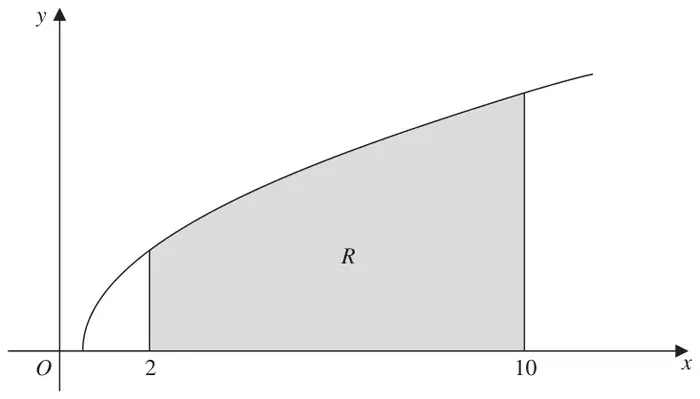
Figure 1 shows a sketch of part of the curve with equation \(y = \sqrt{(2x - 1)}\), \(x \geqslant 0.5\)
The finite region \(R\), shown shaded in Figure 1, is bounded by the curve, the \(x\)-axis and the lines with equations \(x = 2\) and \(x = 10\).
The table below shows corresponding values of \(x\) and \(y\) for \(y = \sqrt{(2x - 1)}\).
| \(x\) | 2 | 4 | 6 | 8 | 10 |
|---|---|---|---|---|---|
| \(y\) | \(\sqrt{3}\) | \(\sqrt{11}\) | \(\sqrt{19}\) |
| Scheme | Marks |
|---|---|
| \(\sqrt{7}\) and \(\sqrt{15}\) | B1 |
| (1) |
Notes
B1: Both \(\sqrt{7}\) and \(\sqrt{15}\). Allow awrt 2.65 and 3.87
| Scheme | Marks |
|---|---|
| Area\((R) \approx \dfrac{1}{2} \times 2; \times \underline{\left\{\sqrt{3} + 2\left(\sqrt{7} + \sqrt{11} + \sqrt{15}\right) + \sqrt{19}\right\}}\) | B1; M1 |
| Note decimal values are \(\dfrac{1}{2} \times 2; \times \underline{\left\{\sqrt{3} + \sqrt{19} + 2\left(\sqrt{7} + \sqrt{11} + \sqrt{15}\right)\right\}} = \dfrac{1}{2} \times 2; \times \underline{\left\{6.0909.. + 19.6707\ldots\right\}}\) | |
| \(= 1 \times 25.76166865\ldots = 25.76166\ldots = \underline{25.76}\) (2dp) | A1 cao |
| (3) |
Notes
B1: Outside brackets \(\tfrac{1}{2} \times 2\) or 1 (may be implied)
M1: For structure of \(\{\ldots\ldots\ldots\ldots\}\)
M1 requires the correct structure for the \(y\) values. It needs to contain first \(y\) value plus last \(y\) value and the second bracket to be multiplied by 2 and to be the summation of the remaining \(y\) values in the table with no additional values. If the only mistake is a copying error or is to omit one value from 2(…..) bracket this may be regarded as a slip and the M mark can be allowed (nb: an extra repeated term, however, forfeits the M mark). M0 if any values used are \(x\) values instead of \(y\) values.
Bracketing mistakes: e.g.
\(\left(\dfrac{1}{2} \times 2\right) \times \left(\sqrt{3} + \sqrt{19}\right) + 2\left(\sqrt{7} + \sqrt{11} + \sqrt{15}\right)\)
\(\left(\dfrac{1}{2} \times 2\right) \times \sqrt{3} + \sqrt{19} + 2\left(\sqrt{7} + \sqrt{11} + \sqrt{15}\right)\)
Both score B1 M1
Alternative
Separate trapezia may be used, and this can be marked equivalently.
\(\left[\dfrac{1}{2} \times 2(\sqrt{3} + \sqrt{7}) + \dfrac{1}{2} \times 2(\sqrt{7} + \sqrt{11}) + \dfrac{1}{2} \times 2(\sqrt{11} + \sqrt{15}) + \dfrac{1}{2} \times 2(\sqrt{15} + \sqrt{19})\right]\)
B1 for \(\dfrac{1}{2} \times 2\), M1 for correct structure
A1 cao: 25.76
| Scheme | Marks |
|---|---|
| underestimate | B1 |
| (1) | |
| Total 5 |
Notes
Accept ‘under’, ‘less than’ etc.