
C4 June 2014 (R) Q4
4.
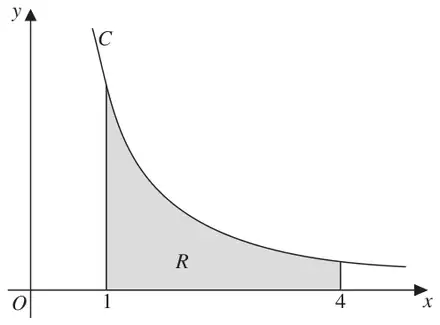
Figure 2 shows a sketch of part of the curve \(C\) with equation \(y = \dfrac{5}{x\sqrt{(2x + 1)}},\ x > 0\)
The finite region \(R\) is bounded by the curve \(C\), the \(x\)-axis, the line with equation \(x = 1\) and the line with equation \(x = 4\)
This region is shown shaded in Figure 2
The region \(R\) is rotated through 360° about the \(x\)-axis.
| Scheme | Marks |
|---|---|
| \(\dfrac{25}{x^2(2x + 1)} \equiv \dfrac{A}{x} + \dfrac{B}{x^2} + \dfrac{C}{(2x + 1)}\) | |
| \(B = 25,\ C = 100\) At least one of “\(B\)” or “\(C\)” correct. Breaks up their partial fraction correctly into three terms and both “\(B\)” \(= 25\) and “\(C\)” \(= 100\). See notes. | B1 B1 cso |
| \(25 \equiv Ax(2x + 1) + B(2x + 1) + Cx^2\) \(x = 0,\quad 25 = B\) \(x = -\dfrac{1}{2},\quad 25 = \dfrac{1}{4}C \Rightarrow C = 100\) \(x^2\) terms: \(0 = 2A + C\) \(\qquad 0 = 2A + 100 \Rightarrow A = -50\) \(x^2:\ 0 = 2A + C,\quad x:\ 0 = A + 2B,\) \(\quad\) constant: \(25 = B\) Writes down a correct identity and attempts to find the value of either one of “\(A\)”, “\(B\)” or “\(C\)”. | M1 |
| leading to \(A = -50\) Correct value for “\(A\)” which is found using a correct identity and follows from their partial fraction decomposition. | A1 |
| \(\left\{\dfrac{25}{x^2(2x + 1)} \equiv -\dfrac{50}{x} + \dfrac{25}{x^2} + \dfrac{100}{(2x + 1)}\right\}\) | |
| (4) |
Notes
BE CAREFUL! Candidates will assign their own “\(A\), \(B\) and \(C\)” for this question.
B1: At least one of “\(B\)” or “\(C\)” are correct.
B1: Breaks up their partial fraction correctly into three terms and both “\(B\)” \(= 25\) and “\(C\)” \(= 100\).
Note: If a candidate does not give partial fraction decomposition then:
- the 2nd B1 mark can follow from a correct identity.
M1: Writes down a correct identity (although this can be implied) and attempts to find the value of either one of “\(A\)” or “\(B\)” or “\(C\)”.
This can be achieved by either substituting values into their identity or comparing coefficients and solving the resulting equations simultaneously.
A1: Correct value for “\(A\)” which is found using a correct identity and follows from their partial fraction decomposition.
Note: If a candidate does not give partial fraction decomposition then the final A1 mark can be awarded for a correct “\(A\)” if a candidate writes out their partial fractions at the end.
Note: The correct partial fraction from no working scores B1B1M1A1.
Note: A number of candidates will start this problem by writing out the correct identity and then attempt to find “\(A\)” or “\(B\)” or “\(C\)”. Therefore the B1 marks can be awarded from this method.
Note: Award SC B1B0M0A0 for \(\dfrac{25}{x^2(2x + 1)} \equiv \dfrac{B}{x^2} + \dfrac{C}{(2x + 1)}\) leading to “\(B\)” \(= 25\) or “\(C\)” \(= 100\)
| Scheme | Marks |
|---|---|
| \(V = \pi\displaystyle\int_1^4 \left(\dfrac{5}{x\sqrt{(2x + 1)}}\right)^2\,\mathrm{d}x\) For \(\pi\displaystyle\int \left(\dfrac{5}{x\sqrt{(2x + 1)}}\right)^2\). Ignore limits and \(\mathrm{d}x\). Can be implied. | B1 |
| For their partial fraction \(\left\{\displaystyle\int \dfrac{25}{x^2(2x + 1)}\,\mathrm{d}x = \displaystyle\int -\dfrac{50}{x} + \dfrac{25}{x^2} + \dfrac{100}{(2x + 1)}\,\mathrm{d}x\right\}\) \(= -50\ln x + \dfrac{25x^{-1}}{(-1)} + \dfrac{100}{2}\ln(2x + 1)\ \{+ c\}\) Either \(\pm\dfrac{A}{x} \to \pm a\ln x\) or \(\pm a\ln kx\) or \(\pm\dfrac{B}{x^2} \to \pm bx^{-1}\) or \(\dfrac{C}{(2x + 1)} \to \pm c\ln(2x + 1)\) At least two terms correctly integrated All three terms correctly integrated. | M1 A1ft A1ft |
| \(\left\{\displaystyle\int_1^4 \dfrac{25}{x^2(2x + 1)}\,\mathrm{d}x = \left[-50\ln x - \dfrac{25}{x} + 50\ln(2x + 1)\right]_1^4\right\}\) \(= \left(-50\ln 4 - \dfrac{25}{4} + 50\ln 9\right) - \left(0 - 25 + 50\ln 3\right)\) Applies limits of 4 and 1 and subtracts the correct way round. | dM1 |
| \(= 50\ln 9 - 50\ln 4 - 50\ln 3 - \dfrac{25}{4} + 25\) \(= 50\ln\left(\dfrac{3}{4}\right) + \dfrac{75}{4}\) | |
| So, \(V = \dfrac{75}{4}\pi + 50\pi\ln\left(\dfrac{3}{4}\right)\) or allow \(\pi\left(\dfrac{75}{4} + 50\ln\left(\dfrac{3}{4}\right)\right)\) | A1 oe |
| (6) | |
| (10 marks) |
Notes
B1: For a correct statement of \(\pi\displaystyle\int \left(\dfrac{5}{x\sqrt{(2x + 1)}}\right)^2\) or \(\pi\displaystyle\int \dfrac{25}{x^2(2x + 1)}\). Ignore limits and \(\mathrm{d}x\). Can be implied.
Note: The \(\pi\) can only be recovered later from a correct expression.
For their partial fraction, (not \(\sqrt{\text{their partial fraction}}\)), where \(A\), \(B\), \(C\) are “their” part (a) constants
M1: Either \(\pm\dfrac{A}{x} \to \pm a\ln x\) or \(\pm\dfrac{B}{x^2} \to \pm bx^{-1}\) or \(\dfrac{C}{(2x + 1)} \to \pm c\ln(2x + 1)\).
Note: \(\sqrt{\dfrac{B}{x^2}} \to \dfrac{\sqrt{B}}{x}\) which integrates to \(\sqrt{B}\ln x\) is not worthy of M1.
A1ft: At least two terms from any of \(\pm\dfrac{A}{x}\) or \(\pm\dfrac{B}{x^2}\) or \(\dfrac{C}{(2x + 1)}\) correctly integrated. Can be un-simplified.
A1ft: All 3 terms from \(\pm\dfrac{A}{x}\), \(\pm\dfrac{B}{x^2}\) and \(\dfrac{C}{(2x + 1)}\) correctly integrated. Can be un-simplified.
Note: The 1st A1 and 2nd A1 marks in part (b) are both follow through accuracy marks.
dM1: Dependent on the previous M mark.
Applies limits of 4 and 1 and subtracts the correct way round.
A1: Final correct exact answer in the form \(a + b\ln c\). i.e. either \(\dfrac{75}{4}\pi + 50\pi\ln\left(\dfrac{3}{4}\right)\) or \(50\pi\ln\left(\dfrac{3}{4}\right) + \dfrac{75}{4}\pi\)
or \(50\pi\ln\left(\dfrac{9}{12}\right) + \dfrac{75}{4}\pi\) or \(\dfrac{75}{4}\pi - 50\pi\ln\left(\dfrac{4}{3}\right)\) or \(\dfrac{75}{4}\pi + 25\pi\ln\left(\dfrac{9}{16}\right)\) etc.
Also allow \(\pi\left(\dfrac{75}{4} + 50\ln\left(\dfrac{3}{4}\right)\right)\) or equivalent.
Note: A candidate who achieves full marks in (a), but then mixes up the correct constants when writing their partial fraction can only achieve a maximum of B1M1A1A0M1A0 in part (b).
Note: The \(\pi\) in the volume formula is only required for the B1 mark and the final A1 mark.
Alternative method of integration
| Scheme | Marks |
|---|---|
| \(V = \pi\displaystyle\int_1^4 \left(\dfrac{5}{x\sqrt{(2x + 1)}}\right)^2\,\mathrm{d}x\) For \(\pi\displaystyle\int \left(\dfrac{5}{x\sqrt{(2x + 1)}}\right)^2\). Ignore limits and \(\mathrm{d}x\). Can be implied. | B1 |
| \(\displaystyle\int \dfrac{25}{x^2(2x + 1)}\,\mathrm{d}x\ ;\ u = \dfrac{1}{x} \Rightarrow \dfrac{\mathrm{d}u}{\mathrm{d}x} = -\dfrac{1}{x^2}\) \(= \displaystyle\int \dfrac{-25}{\left(\frac{2}{u} + 1\right)}\,\mathrm{d}u = \displaystyle\int \dfrac{-25}{\left(\frac{2 + u}{u}\right)}\,\mathrm{d}u = \displaystyle\int \dfrac{-25u}{(2 + u)}\,\mathrm{d}u = -25\displaystyle\int \dfrac{2 + u - 2}{(2 + u)}\,\mathrm{d}u\) | |
| \(= -25\displaystyle\int 1 - \dfrac{2}{(2 + u)}\,\mathrm{d}u = -25\left(u - 2\ln(2 + u)\right)\) Achieves \(\pm\alpha \pm \dfrac{\beta}{(k + u)}\) and integrates to give either \(\pm\alpha u\) or \(\pm\beta\ln(k + u)\) Dependent on the M mark. Either \(-25u\) or \(50\ln(2 + u)\) \(-25\left(u - 2\ln(2 + u)\right)\) | M1 A1 A1 |
| \(\left\{\displaystyle\int_1^4 \dfrac{25}{x^2(2x + 1)}\,\mathrm{d}x = \left[-25u + 50\ln(2 + u)\right]_1^{\frac{1}{4}}\right\}\) \(= \left(-\dfrac{25}{4} + 50\ln\left(\dfrac{9}{4}\right)\right) - \left(-25 + 50\ln 3\right)\) \(= 50\ln\left(\dfrac{9}{4}\right) - 50\ln 3 - \dfrac{25}{4} + 25\) \(= 50\ln\left(\dfrac{3}{4}\right) + \dfrac{75}{4}\) Applies limits of \(\tfrac{1}{4}\) and 1 in \(u\) or 4 and 1 in \(x\) in their integrated function and subtracts the correct way round. | dM1 |
| So, \(V = \dfrac{75}{4}\pi + 50\pi\ln\left(\dfrac{3}{4}\right)\) \(\dfrac{75}{4}\pi + 50\pi\ln\left(\dfrac{3}{4}\right)\) or allow \(\pi\left(\dfrac{75}{4} + 50\ln\left(\dfrac{3}{4}\right)\right)\) | A1 |