
C4 June 2014 Q7
7.
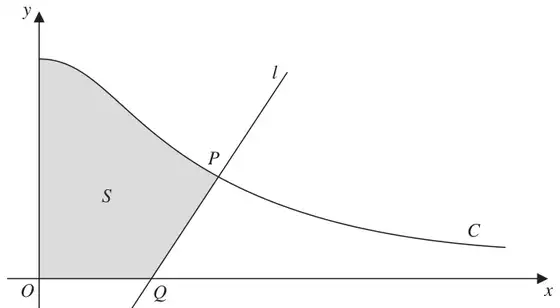
Figure 4 shows a sketch of part of the curve \(C\) with parametric equations \[x = 3\tan\theta, \quad y = 4\cos^2\theta, \qquad 0 \leqslant \theta < \frac{\pi}{2}\]
The point \(P\) lies on \(C\) and has coordinates \((3, 2)\).
The line \(l\) is the normal to \(C\) at \(P\). The normal cuts the \(x\)-axis at the point \(Q\).
The finite region \(S\), shown shaded in Figure 4, is bounded by the curve \(C\), the \(x\)-axis, the \(y\)-axis and the line \(l\). This shaded region is rotated \(2\pi\) radians about the \(x\)-axis to form a solid of revolution.
[You may use the formula \(V = \dfrac{1}{3}\pi r^2 h\) for the volume of a cone.] (9)
| Scheme | Marks |
|---|---|
| \(x = 3\tan\theta, \quad y = 4\cos^2\theta\) or \(y = 2 + 2\cos 2\theta, \quad 0 \leqslant \theta < \dfrac{\pi}{2}\). | |
| \(\dfrac{\mathrm{d}x}{\mathrm{d}\theta} = 3\sec^2\theta, \quad \dfrac{\mathrm{d}y}{\mathrm{d}\theta} = -8\cos\theta\sin\theta\) or \(\dfrac{\mathrm{d}y}{\mathrm{d}\theta} = -4\sin 2\theta\) | |
| \(\dfrac{\mathrm{d}y}{\mathrm{d}x} = \dfrac{-8\cos\theta\sin\theta}{3\sec^2\theta}\ \left\{= -\dfrac{8}{3}\cos^3\theta\sin\theta = -\dfrac{4}{3}\sin 2\theta\cos^2\theta\right\}\) their \(\dfrac{\mathrm{d}y}{\mathrm{d}\theta}\) divided by their \(\dfrac{\mathrm{d}x}{\mathrm{d}\theta}\) Correct \(\dfrac{\mathrm{d}y}{\mathrm{d}x}\) | M1 A1 oe |
| At \(P(3, 2)\), \(\theta = \dfrac{\pi}{4}\), \(\dfrac{\mathrm{d}y}{\mathrm{d}x} = -\dfrac{8}{3}\cos^3\left(\dfrac{\pi}{4}\right)\sin\left(\dfrac{\pi}{4}\right)\ \left\{= -\dfrac{2}{3}\right\}\) Some evidence of substituting \(\theta = \dfrac{\pi}{4}\) into their \(\dfrac{\mathrm{d}y}{\mathrm{d}x}\) | M1 |
| So, \(m(\mathbf{N}) = \dfrac{3}{2}\) applies \(m(\mathbf{N}) = \dfrac{-1}{m(\mathbf{T})}\) | M1 |
| Either \(\mathbf{N}: y - 2 = \text{"}\dfrac{3}{2}\text{"}(x - 3)\) or \(2 = \left(\text{"}\dfrac{3}{2}\text{"}\right)(3) + c\) see notes | M1 |
| {At \(Q\), \(y = 0\), so, \(-2 = \dfrac{3}{2}(x - 3)\)} giving \(\underline{x = \dfrac{5}{3}}\) \(x = \dfrac{5}{3}\) or \(1\dfrac{2}{3}\) or awrt 1.67 | A1 cso |
| (6) |
Notes
1st M1: Applies their \(\dfrac{\mathrm{d}y}{\mathrm{d}\theta}\) divided by their \(\dfrac{\mathrm{d}x}{\mathrm{d}\theta}\) or applies \(\dfrac{\mathrm{d}y}{\mathrm{d}\theta}\) multiplied by their \(\dfrac{\mathrm{d}\theta}{\mathrm{d}x}\)
SC: Award Special Case 1st M1 if both \(\dfrac{\mathrm{d}x}{\mathrm{d}\theta}\) and \(\dfrac{\mathrm{d}y}{\mathrm{d}\theta}\) are both correct.
1st A1: Correct \(\dfrac{\mathrm{d}y}{\mathrm{d}x}\) i.e. \(\dfrac{-8\cos\theta\sin\theta}{3\sec^2\theta}\) or \(-\dfrac{8}{3}\cos^3\theta\sin\theta\) or \(-\dfrac{4}{3}\sin 2\theta\cos^2\theta\) or any equivalent form.
2nd M1: Some evidence of substituting \(\theta = \dfrac{\pi}{4}\) or \(\theta = 45^\circ\) into their \(\dfrac{\mathrm{d}y}{\mathrm{d}x}\)
Note: For 3rd M1 and 4th M1, \(m(\mathbf{T})\) must be found by using \(\dfrac{\mathrm{d}y}{\mathrm{d}x}\).
3rd M1: applies \(m(\mathbf{N}) = \dfrac{-1}{m(\mathbf{T})}\). Numerical value for \(m(\mathbf{N})\) is required here.
4th M1:
- Applies \(y - 2 = (\text{their } m_N)(x - 3)\), where \(\mathrm{m}(\mathbf{N})\) is a numerical value,
- or finds c by solving \(2 = (\text{their } m_N)3 + c\), where \(\mathrm{m}(\mathbf{N})\) is a numerical value,
and \(m_N = -\dfrac{1}{\text{their m}(\mathbf{T})}\) or \(m_N = \dfrac{1}{\text{their m}(\mathbf{T})}\) or \(m_N = -\text{their m}(\mathbf{T})\).
Note: This mark can be implied by subsequent working.
2nd A1: \(x = \dfrac{5}{3}\) or \(1\dfrac{2}{3}\) or awrt 1.67 from a correct solution only.
Working with a Cartesian Equation
A cartesian equation for \(C\) is \(y = \dfrac{36}{x^2 + 9}\)
1st M1: \(\dfrac{\mathrm{d}y}{\mathrm{d}x} = \pm\lambda x\left(\pm\alpha x^2 \pm \beta\right)^{-2}\) or \(\dfrac{\mathrm{d}y}{\mathrm{d}x} = \dfrac{\pm\lambda x}{\left(\pm\alpha x^2 \pm \beta\right)^2}\)
1st A1: \(\dfrac{\mathrm{d}y}{\mathrm{d}x} = -36(x^2 + 9)^{-2}(2x)\) or \(\dfrac{\mathrm{d}y}{\mathrm{d}x} = \dfrac{-72x}{(x^2 + 9)^2}\) un-simplified or simplified.
2nd dM1: Dependent on the 1st M1 mark if a candidate uses this method
For substituting \(x = 3\) into their \(\dfrac{\mathrm{d}y}{\mathrm{d}x}\)
i.e. at \(P(3, 2)\), \(\dfrac{\mathrm{d}y}{\mathrm{d}x} = \dfrac{-72(3)}{(3^2 + 9)^2}\ \left\{= -\dfrac{2}{3}\right\}\)
From this point onwards the original scheme can be applied.
Another cartesian equation for \(C\) is \(x^2 = \dfrac{36}{y} - 9\)
1st M1: \(\pm\alpha x = \pm\dfrac{\beta}{y^2}\dfrac{\mathrm{d}y}{\mathrm{d}x}\) or \(\pm\alpha x\dfrac{\mathrm{d}x}{\mathrm{d}y} = \pm\dfrac{\beta}{y^2}\)
1st A1: \(2x = -\dfrac{36}{y^2}\dfrac{\mathrm{d}y}{\mathrm{d}x}\) or \(2x\dfrac{\mathrm{d}x}{\mathrm{d}y} = -\dfrac{36}{y^2}\)
2nd dM1: Dependent on the 1st M1 mark if a candidate uses this method
For substituting \(x = 3\) to find \(\dfrac{\mathrm{d}y}{\mathrm{d}x}\)
i.e. at \(P(3, 2)\), \(2(3) = -\dfrac{36}{4}\dfrac{\mathrm{d}y}{\mathrm{d}x} \Rightarrow \dfrac{\mathrm{d}y}{\mathrm{d}x} = \ldots\)
From this point onwards the original scheme can be applied.
| Scheme | Marks |
|---|---|
| \(\left\{\displaystyle\int y^2\mathrm{d}x = \displaystyle\int y^2\dfrac{\mathrm{d}x}{\mathrm{d}\theta}\,\mathrm{d}\theta\right\} = \left\{\displaystyle\int\right\}(4\cos^2\theta)^2\,3\sec^2\theta\ \{\mathrm{d}\theta\}\) see notes | M1 |
| So, \(\pi\displaystyle\int y^2\mathrm{d}x = \pi\displaystyle\int (4\cos^2\theta)^2\,3\sec^2\theta\,\{\mathrm{d}\theta\}\) see notes | A1 |
| \(\displaystyle\int y^2\mathrm{d}x = \displaystyle\int 48\cos^2\theta\,\mathrm{d}\theta\) \(\displaystyle\int 48\cos^2\theta\{\mathrm{d}\theta\}\) | A1 |
| \(= \{48\}\displaystyle\int \left(\dfrac{1 + \cos 2\theta}{2}\right)\mathrm{d}\theta\ \left\{= \displaystyle\int \left(24 + 24\cos 2\theta\right)\mathrm{d}\theta\right\}\) Applies \(\cos 2\theta = 2\cos^2\theta - 1\) | M1 |
| \(= \{48\}\left(\dfrac{1}{2}\theta + \dfrac{1}{4}\sin 2\theta\right)\ \{= 24\theta + 12\sin 2\theta\}\) Dependent on the first method mark. For \(\pm\alpha\theta \pm \beta\sin 2\theta\) \(\cos^2\theta \to \left(\dfrac{1}{2}\theta + \dfrac{1}{4}\sin 2\theta\right)\) | dM1 A1 |
| \(\displaystyle\int_0^{\frac{\pi}{4}} y^2\mathrm{d}x\ \left\{= 48\left[\dfrac{1}{2}\theta + \dfrac{1}{4}\sin 2\theta\right]_0^{\frac{\pi}{4}}\right\} = \{48\}\left(\left(\dfrac{\pi}{8} + \dfrac{1}{4}\right) - (0 + 0)\right)\ \{= 6\pi + 12\}\) Dependent on the third method mark. | dM1 |
| \(\left\{\text{So } V = \pi\displaystyle\int_0^{\frac{\pi}{4}} y^2\mathrm{d}x = 6\pi^2 + 12\pi\right\}\) | |
| \(V_{\text{cone}} = \dfrac{1}{3}\pi(2)^2\left(3 - \dfrac{5}{3}\right)\ \left\{= \dfrac{16\pi}{9}\right\}\) \(V_{\text{cone}} = \dfrac{1}{3}\pi(2)^2\left(3 - \text{their (a)}\right)\) | M1 |
| \(\left\{\text{Vol}(S) = 6\pi^2 + 12\pi - \dfrac{16\pi}{9}\right\} \Rightarrow \text{Vol}(S) = \underline{\dfrac{92}{9}\pi + 6\pi^2}\) \(\dfrac{92}{9}\pi + 6\pi^2\) \(\left\{p = \dfrac{92}{9},\ q = 6\right\}\) | A1 |
| (9) | |
| (15 marks) |
Notes
1st M1: Applying \(\displaystyle\int y^2\mathrm{d}x\) as \(y^2\dfrac{\mathrm{d}x}{\mathrm{d}\theta}\) with their \(\dfrac{\mathrm{d}x}{\mathrm{d}\theta}\). Ignore \(\pi\) or \(\dfrac{1}{3}\pi\) outside integral.
Note: You can ignore the omission of an integral sign and/or \(\mathrm{d}\theta\) for the 1st M1.
Note: Allow 1st M1 for \(\displaystyle\int (\cos^2\theta)^2 \times \text{"their } 3\sec^2\theta\text{"}\,\mathrm{d}\theta\) or \(\displaystyle\int 4(\cos^2\theta)^2 \times \text{"their } 3\sec^2\theta\text{"}\,\mathrm{d}\theta\)
1st A1: Correct expression \(\left\{\pi\displaystyle\int y^2\mathrm{d}x\right\} = \pi\displaystyle\int (4\cos^2\theta)^2\,3\sec^2\theta\,\{\mathrm{d}\theta\}\) (Allow the omission of \(\mathrm{d}\theta\))
Note: IMPORTANT: The \(\pi\) can be recovered later, but as a correct statement only.
2nd A1: \(\left\{\displaystyle\int y^2\mathrm{d}x\right\} = \displaystyle\int 48\cos^2\theta\{\mathrm{d}\theta\}\). (Ignore \(\mathrm{d}\theta\)). Note: 48 can be written as 24(2) for example.
2nd M1: Applies \(\cos 2\theta = 2\cos^2\theta - 1\) to their integral. (Seen or implied.)
3rd dM1*: which is dependent on the 1st M1 mark.
Integrating \(\cos^2\theta\) to give \(\pm\alpha\theta \pm \beta\sin 2\theta,\ \alpha \neq 0,\ \beta \neq 0\), un-simplified or simplified.
3rd A1: which is dependent on the 3rd M1 mark and the 1st M1 mark.
Integrating \(\cos^2\theta\) to give \(\dfrac{1}{2}\theta + \dfrac{1}{4}\sin 2\theta\), un-simplified or simplified.
This can be implied by \(k\cos^2\theta\) giving \(\dfrac{k}{2}\theta + \dfrac{k}{4}\sin 2\theta\), un-simplified or simplified.
4th dM1: which is dependent on the 3rd M1 mark and the 1st M1 mark.
Some evidence of applying limits of \(\dfrac{\pi}{4}\) and 0 (0 can be implied) to an integrated function in \(\theta\)
5th M1: Applies \(V_{\text{cone}} = \dfrac{1}{3}\pi(2)^2\left(3 - \text{their part (a) answer}\right)\).
Note: Also allow the 5th M1 for \(V_{\text{cone}} = \pi\displaystyle\int_{\text{their } \frac{5}{3}}^{3} \left(\dfrac{3}{2}x - \dfrac{5}{2}\right)^2\{dx\}\), which includes the correct limits.
4th A1: \(\dfrac{92}{9}\pi + 6\pi^2\) or \(10\dfrac{2}{9}\pi + 6\pi^2\)
Note: A decimal answer of 91.33168464... (without a correct exact answer) is A0.
Note: The \(\pi\) in the volume formula is only needed for the 1st A1 mark and the final accuracy mark.
Working with a Cartesian Equation
1st M1: For \(\displaystyle\int \left(\dfrac{\pm\lambda}{\pm\alpha x^2 \pm \beta}\right)^2\{\mathrm{d}x\}\) (\(\pi\) not required for this mark)
A1: For \(\pi\displaystyle\int \left(\dfrac{36}{x^2 + 9}\right)^2\{\mathrm{d}x\}\) (\(\pi\) required for this mark)
To integrate, a substitution of \(x = 3\tan\theta\) is required which will lead to \(\displaystyle\int 48\cos^2\theta\,\mathrm{d}\theta\) and so from this point onwards the original scheme can be applied.