Further Calculus

Edexcel

A2 June 2025 Q8

EdexcelCurrent spec10 marksFurther Calculus

8.

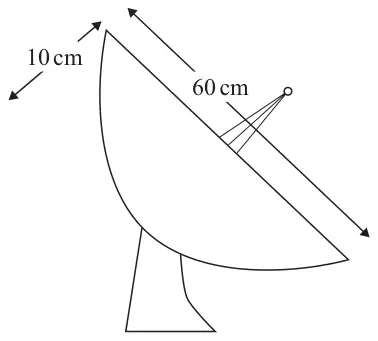
Figure 1: a satellite dish on a stand, with the 60 cm diameter across the rim and the 10 cm depth marked
Figure 1
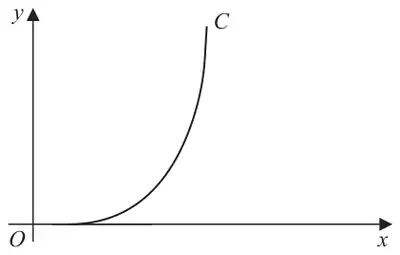
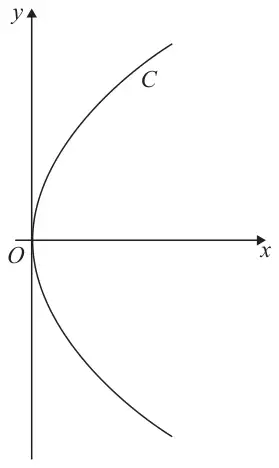
Figure 2: sketch of the curve C, a parabola through the origin O opening in the positive x direction, symmetric about the x-axis
Figure 2

Figure 1 shows a satellite dish.

Figure 2 shows a sketch of the curve \(C\) with equation\[y^2 = Ax \qquad 0 \leqslant x \leqslant 10\]where \(A\) is a positive constant.

The curved inner surface of the satellite dish is modelled by the surface of revolution formed by rotating curve \(C\) through \(\pi\) radians about the \(x\)-axis.

The inner surface of the satellite dish has

  • a largest diameter of 60 cm
  • a depth of 10 cm

as shown in Figure 1.

(a) Determine the value of \(A\). (2)
(b) Using algebraic integration, determine, in cm\(^2\), the area of the curved inner surface of the satellite dish, according to the model. Give your answer to 2 significant figures. (7)
(c) State a limitation of the model. (1)

A2 June 2025 Q6

EdexcelCurrent spec8 marksFurther Calculus

6.

\[I_n = \int_0^2 \left(4 - x^2\right)^n \mathrm{d}x\]
(a) Prove that, for \(n \geqslant 1\)\[I_n = \frac{8n}{2n+1}I_{n-1}\] (4)
(b) Using the result from part (a) and showing all stages of your working, determine the value of \(n\) for which\[I_n = \frac{65536}{315}\]

(Solutions relying entirely on calculator technology are not acceptable.)

(4)

A2 June 2024 Q8

EdexcelCurrent spec13 marksFurther Calculus

8.

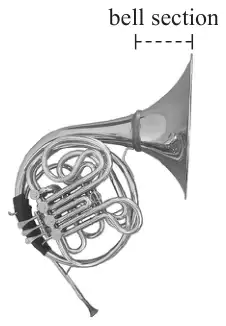
Figure 1: photograph of a French horn with the detachable bell section marked
Figure 1
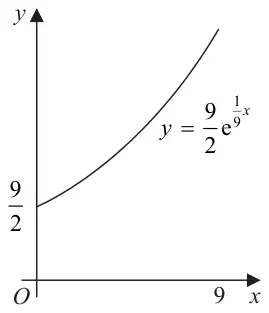
Figure 2: the curve y = 9/2 e^(x/9) from (0, 9/2) to x = 9, increasing
Figure 2

Figure 1 shows a French horn with a detachable bell section.

The shape of the bell section can be modelled by rotating an exponential curve through 360\(^\circ\) about the \(x\)-axis, where units are centimetres.

The model uses the curve shown in Figure 2, with equation\[y = \frac{9}{2}\mathrm{e}^{\frac{1}{9}x} \qquad 0 \leqslant x \leqslant 9\]

(a) Show that, according to this model, the external surface area of the bell section is given by\[K\int_0^9 \mathrm{e}^{\frac{1}{9}x}\sqrt{4 + \mathrm{e}^{\frac{2}{9}x}}\,\mathrm{d}x\]where \(K\) is a real constant to be determined. (3)
(b) Use the substitution \(u = \mathrm{e}^{\frac{1}{9}x}\) to show that\[\int_0^9 \mathrm{e}^{\frac{1}{9}x}\sqrt{4 + \mathrm{e}^{\frac{2}{9}x}}\,\mathrm{d}x = 9\int_a^b \frac{2u + u^3}{\sqrt{4u^2 + u^4}}\,\mathrm{d}u + 18\int_a^b \frac{1}{\sqrt{4 + u^2}}\,\mathrm{d}u\]where \(a\) and \(b\) are constants to be determined. (5)

Hence, using algebraic integration,

(c) determine, according to the model, the external surface area of the bell section of the horn, giving your answer to 3 significant figures. (5)

A2 June 2024 Q6

EdexcelCurrent spec11 marksFurther Calculus

6.

In this question you must show all stages of your working.

Solutions relying entirely on calculator technology are not acceptable.

\[I_n = \int \frac{\cos(nx)}{\sin x}\,\mathrm{d}x \qquad n \geqslant 1\]
(a) Show that, for \(n \geqslant 1\)\[I_{n+2} = \frac{2\cos(n+1)x}{n+1} + I_n\] (6)
(b) Hence determine the exact value of\[\int_{\frac{\pi}{4}}^{\frac{\pi}{3}} \frac{\cos(5x)}{\sin x}\,\mathrm{d}x\]giving the answer in the form \(a + b\ln c\) where \(a\), \(b\) and \(c\) are rational numbers to be found. (5)

A2 June 2023 Q10

EdexcelCurrent spec12 marksFurther Calculus

10.

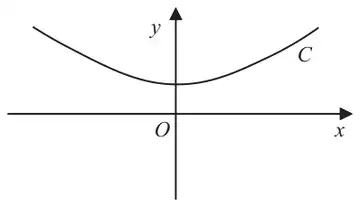
Figure 2: the curve C, a U-shaped curve above the x-axis, symmetric about the y-axis, with its minimum on the positive y-axis
Figure 2

A solid playing piece for a board game is modelled by rotating the curve \(C\), shown in Figure 2, through \(2\pi\) radians about the \(x\)-axis.

The curve \(C\) has equation\[y = \sqrt{1 + \frac{x^2}{9}} \qquad -4 \leqslant x \leqslant 4\]with units as centimetres.

(a) Show that the total surface area, \(S\) cm\(^2\), of the playing piece is given by\[S = p\pi\int_{-4}^{4} \sqrt{81 + 10x^2}\,\mathrm{d}x + q\pi\]where \(p\) and \(q\) are constants to be determined. (6)

Using the substitution \(x = \dfrac{9}{\sqrt{10}}\sinh u\), or another algebraic integration method, and showing all your working,

(b) determine the total surface area of the playing piece, giving your answer to the nearest cm\(^2\) (6)

A2 June 2023 Q8

EdexcelCurrent spec7 marksFurther Calculus

8.

\[I_n = \int_0^2 (x - 2)^n \mathrm{e}^{4x}\,\mathrm{d}x \qquad n \geqslant 0\]
(a) Prove that for \(n \geqslant 1\)\[I_n = -a^{n-2} - \frac{n}{4}I_{n-1}\]where \(a\) is a constant to be determined. (4)
(b) Hence determine the exact value of\[\int_0^2 (x - 2)^2 \mathrm{e}^{4x}\,\mathrm{d}x\] (3)

A2 June 2022 Q10

EdexcelCurrent spec12 marksFurther Calculus

10.

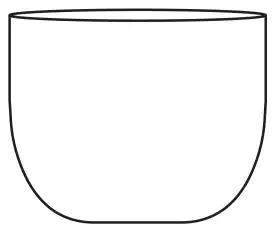
Figure 2: a plant pot with a flat base, sides curving outwards and a circular rim
Figure 2
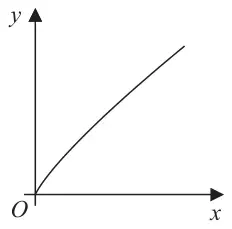
Figure 3: curve C starting on the positive x-axis and rising steeply, axes x and y with origin O
Figure 3

Figure 2 shows a picture of a plant pot.

The plant pot has

  • a flat circular base of radius 10 cm
  • a height of 15 cm

Figure 3 shows a sketch of the curve \(C\) with parametric equations

\[x = 10 + 15t - 5t^3 \qquad y = 15t^2 \qquad 0 \leqslant t \leqslant 1\]

The curved inner surface of the plant pot is modelled by the surface of revolution formed by rotating curve \(C\) through \(2\pi\) radians about the \(y\)-axis.

(a) Show that, according to the model, the area of the curved inner surface of the plant pot is given by\[150\pi\int_0^1 \left(2 + 3t + 2t^2 + 2t^3 - t^5\right)\mathrm{d}t\] (5)
(b) Determine, according to the model, the total area of the inner surface of the plant pot. (4)

Each plant pot will be painted with one coat of paint, both inside and outside.
The paint in one tin will cover an area of 12 m2

(c) Use the answer to part (b) to estimate how many plant pots can be painted using one tin of paint. (2)
(d) Give a reason why the model might not give an accurate answer to part (c). (1)

A2 June 2022 Q9

EdexcelCurrent spec7 marksFurther Calculus

9.

\[I_n = \int_0^{\frac{\pi}{2}} \sin^n 2x \,\mathrm{d}x\]
(a) Prove that for \(n \geqslant 2\)\[I_n = \frac{n-1}{n} I_{n-2}\] (4)
(b) Hence determine the exact value of\[\int_0^{\frac{\pi}{2}} 64\sin^5 x \cos^5 x \,\mathrm{d}x\] (3)

A2 October 2021 Q7

EdexcelCurrent spec15 marksFurther Calculus

7.

In this question you must show all stages of your working.

You must not use the integration facility on your calculator.

\[I_n = \int t^n\sqrt{4 + 5t^2}\,\mathrm{d}t \qquad n \geqslant 0\]
(a) Show that, for \(n \gt 1\)\[I_n = \frac{t^{n-1}}{5(n+2)}\left(4 + 5t^2\right)^{\frac{3}{2}} - \frac{4(n-1)}{5(n+2)}I_{n-2}\] (5)
Figure 1: curve starting at the origin O and rising to the right, concave down, with axes x and y
Figure 1

The curve shown in Figure 1 is defined by the parametric equations

\[x = \frac{1}{\sqrt{5}}t^5 \qquad y = \frac{1}{2}t^4 \qquad 0 \leqslant t \leqslant 1\]

This curve is rotated through \(2\pi\) radians about the \(x\)-axis to form a hollow open shell.

(b) Show that the external surface area of the shell is given by\[\pi\int_0^1 t^7\sqrt{4 + 5t^2}\,\mathrm{d}t\] (5)

Using the results in parts (a) and (b) and making each step of your working clear,

(c) determine the value of the external surface area of the shell, giving your answer to 3 significant figures. (5)

A2 October 2020 Q7

EdexcelCurrent spec8 marksFurther Calculus

7.

\[I_n = \int (4 - x^2)^{-n}\,\mathrm{d}x \qquad n \gt 0\]
(a) Show that, for \(n \gt 0\)\[I_{n+1} = \frac{x}{8n(4 - x^2)^n} + \frac{2n - 1}{8n}I_n\] (5)
(b) Find \(I_2\) (3)

A2 October 2020 Q4

EdexcelCurrent spec10 marksFurther Calculus

4.

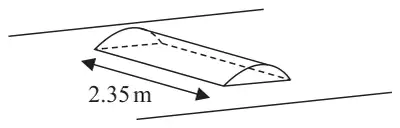
Figure 1: sketch of a speed bump lying across a road, with its width of 2.35 m marked
Figure 1
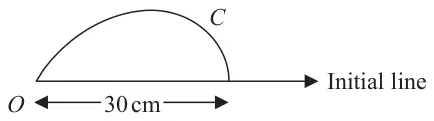
Figure 2: side profile of the speed bump, curve C from O rising and falling to meet the initial line 30 cm from O
Figure 2

Figure 1 shows a sketch of a design for a road speed bump of width 2.35 metres. The speed bump has a uniform cross-section with vertical ends and its length is 30 cm. A side profile of the speed bump is shown in Figure 2.

The curve \(C\) shown in Figure 2 is modelled by the polar equation

\[r = 30(1 - \theta^2) \qquad 0 \leqslant \theta \leqslant 1\]

The units for \(r\) are centimetres and the initial line lies along the road surface, which is assumed to be horizontal.

Once the speed bump has been fixed to the road, the visible surfaces of the speed bump are to be painted.

Determine, in cm2, the area that is to be painted, according to the model.

(10)

A2 June 2019 Q8

EdexcelCurrent spec13 marksFurther Calculus

8.

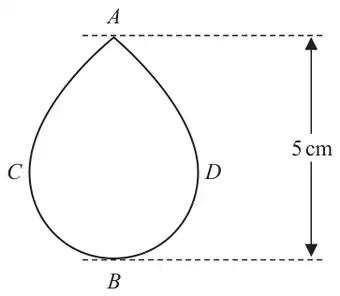
Figure 1: teardrop-shaped cross section with point A at the top, B at the bottom, C and D at the widest points; height AB is 5 cm
Figure 1

Figure 1 shows the vertical cross section of a child’s spinning top. The point \(A\) is vertically above the point \(B\) and the height of the spinning top is 5 cm.

The line \(CD\) is perpendicular to \(AB\) such that \(CD\) is the maximum width of the spinning top.

The spinning top is modelled as the solid of revolution created when part of the curve with polar equation

\[r^2 = 25\cos 2\theta\]

is rotated through \(2\pi\) radians about the initial line.

(a) Show that, according to the model, the surface area of the spinning top is\[k\pi(2 - \sqrt{2})\ \text{cm}^2\]where \(k\) is a constant to be determined. (7)
(b) Show that, according to the model, the length \(CD\) is \(\dfrac{5\sqrt{2}}{2}\) cm. (6)

A2 June 2019 Q5

EdexcelCurrent spec8 marksFurther Calculus

5.

\[I_n = \int \operatorname{cosec}^n x\,\mathrm{d}x \qquad n \in \mathbb{Z}\]
(a) Prove that, for \(n \geqslant 2\)\[I_n = \frac{n - 2}{n - 1}I_{n-2} - \frac{\operatorname{cosec}^{n-2}x\cot x}{n - 1}\] (4)
(b) Hence show that\[\int_{\frac{\pi}{3}}^{\frac{\pi}{2}} \operatorname{cosec}^6 x\,\mathrm{d}x = \frac{56}{135}\sqrt{3}\] (4)