
A2 June 2025 Q8
8.
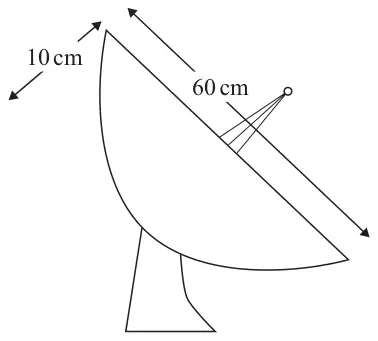
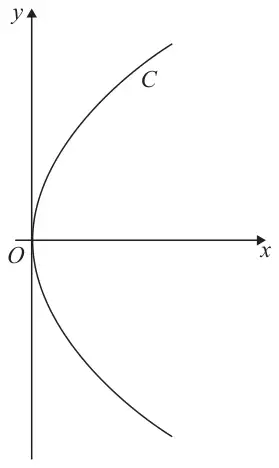
Figure 1 shows a satellite dish.
Figure 2 shows a sketch of the curve \(C\) with equation\[y^2 = Ax \qquad 0 \leqslant x \leqslant 10\]where \(A\) is a positive constant.
The curved inner surface of the satellite dish is modelled by the surface of revolution formed by rotating curve \(C\) through \(\pi\) radians about the \(x\)-axis.
The inner surface of the satellite dish has
- a largest diameter of 60 cm
- a depth of 10 cm
as shown in Figure 1.
| Scheme | Marks | AO |
|---|---|---|
| \(30^2 = A(10) \Rightarrow A = \ldots\) | M1 | 3.3 |
| \(A = 90\) | A1 | 1.1b |
| (2) |
Notes
M1: Uses the model \(x = 10\) and \(y = 30\) to find a value for \(A\)
A1: Correct value for \(A\)
| Scheme | Marks | AO |
|---|---|---|
| \(2y\dfrac{\mathrm{d}y}{\mathrm{d}x} = \text{their } 90\) or \(\dfrac{\mathrm{d}y}{\mathrm{d}x} = \dfrac{\sqrt{90}}{2}x^{-\frac{1}{2}}\) oe | B1ft | 3.4 |
| \(\text{SA} = 2\pi\int y\sqrt{1 + \left(\dfrac{45}{y}\right)^2}\,\mathrm{d}x\) | M1 | 3.4 |
| \(\text{SA} = 2\pi\int y\sqrt{\dfrac{y^2 + 2025}{y^2}}\,\mathrm{d}x = 2\pi\int\sqrt{y^2 + 2025}\,\mathrm{d}x = 2\pi\int\sqrt{90x + 2025}\,\mathrm{d}x\) | M1 | 3.1a |
| \(\int(\alpha x + \beta)^{0.5}\,\mathrm{d}x = K(\alpha x + \beta)^{1.5}\) (NB \(\alpha\) may be 1 if they take the 90 out) | M1 | 1.1b |
| \(\int(90x + 2025)^{0.5}\,\mathrm{d}x = \tfrac{(90x + 2025)^{1.5}}{90 \times 1.5}\) oe e.g. \(\tfrac{3\sqrt{10}(x + 22.5)^{1.5}}{1.5}\) FT is \(\tfrac{\sqrt{A}(4x + A)^{1.5}}{12} = \tfrac{2\sqrt{A}\left(x + \tfrac{A}{4}\right)^{1.5}}{3}\) with their \(A\) | A1ft | 1.1b |
| Use of correct limits \(x = 0\) and \(x = 10\) \(\{2\pi\}\left[\tfrac{(90(10) + 2025)^{1.5}}{135} - \tfrac{(90(0) + 2025)^{1.5}}{135}\right]\) | M1 | 3.4 |
| SA = AWRT 3100 (cm\(^2\)) | A1 | 1.1b |
| (7) |
Notes
B1: Correct derivative.
M1: Uses the model, their \(\dfrac{\mathrm{d}y}{\mathrm{d}x}\) (which must not be a constant) and the surface area of revolution formula \(\text{SA} = 2\pi\int y\sqrt{1 + \left(\dfrac{\mathrm{d}y}{\mathrm{d}x}\right)^2}\,\mathrm{d}x\) to form an expression of the inner surface area. The \(2\pi\) must be present either here or later, but may be missing in between. If never considers this mark and the final A will be lost but the in between marks may be gained. Must be integral with respect to \(x\). Attempting to integrate wrt \(y\) will likely gain no further marks in the question as they will not obtain correct forms.
M1: Uses correct algebra to manipulate their integral into the form \(\int(\alpha x + \beta)^{0.5}\,\mathrm{d}x\ (\alpha, \beta \neq 0)\)
M1: Integrates to the correct form \(\int(\alpha x + \beta)^{0.5}\,\mathrm{d}x = K(\alpha x + \beta)^{1.5}\) (allow \(\beta = 0\) for this mark)
A1ft: Correct integration, follow through on their value of \(A\) – not on incorrect manipulation.
M1: Use of correct limits \(x = 0\) and \(x = 10\) on an attempt at an integral, need not be correct but must have come from an attempt at \(\int y\sqrt{1 + \left(\dfrac{\mathrm{d}y}{\mathrm{d}x}\right)^2}\,\mathrm{d}x\)
A1: Correct answer awrt 3100 (units not required).
| Scheme | Marks | AO |
|---|---|---|
| Score for any reasonable comment about a limitation of the model. Eg the dish will not be smooth, the curve may not be accurate, the measurements might not have been exact. | B1 | 3.5b |
| (1) | ||
| (10 marks) |
Notes
B1: Any appropriate comment referencing the model. E.g. their may be imperfections in the dish, it may not be smooth. The answer must be referring to the model of the curve of the dish for the inner surface, not other features of the satellite.
Do not accept answer such as “there is an antenna” which do not in any way refer to the curve unless the specifically refer to how it might affect the inner surface.
Do not accept answer about the thickness of the dish – the model is specifically referring to the curved inner surface of the dish, so thickness is not relevant to this aspect of the model.