
A2 October 2021 Q7
7.
In this question you must show all stages of your working.
You must not use the integration facility on your calculator.
\[I_n = \int t^n\sqrt{4 + 5t^2}\,\mathrm{d}t \qquad n \geqslant 0\]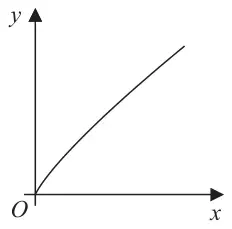
The curve shown in Figure 1 is defined by the parametric equations
\[x = \frac{1}{\sqrt{5}}t^5 \qquad y = \frac{1}{2}t^4 \qquad 0 \leqslant t \leqslant 1\]This curve is rotated through \(2\pi\) radians about the \(x\)-axis to form a hollow open shell.
Using the results in parts (a) and (b) and making each step of your working clear,
| Scheme | Marks | AO |
|---|---|---|
| \(I_n = \int t^{n-1} \times t\sqrt{4 + 5t^2}\,\mathrm{d}t = t^{n-1} \times K\left(4 + 5t^2\right)^{\frac{3}{2}} - \int (n-1)t^{n-2} \times K\left(4 + 5t^2\right)^{\frac{3}{2}}\,\mathrm{d}t\) | M1 | 3.1a |
| \(I_n = t^{n-1} \times \dfrac{2}{3 \times 10}\left(4 + 5t^2\right)^{\frac{3}{2}} - \int (n-1)t^{n-2} \times \dfrac{2}{3 \times 10}\left(4 + 5t^2\right)^{\frac{3}{2}}\,\mathrm{d}t\) | A1 | 1.1b |
| \(= t^{n-1} \times \dfrac{1}{15}\left(4 + 5t^2\right)^{\frac{3}{2}} - \dfrac{(n-1)}{15}\int t^{n-2}\left(4 + 5t^2\right)^{\frac{1}{2}} \times \left(4 + 5t^2\right)\,\mathrm{d}t\) \(= \dfrac{t^{n-1}}{15}\left(4 + 5t^2\right)^{\frac{3}{2}} - \dfrac{4(n-1)}{15}\int t^{n-2}\left(4 + 5t^2\right)^{\frac{1}{2}}\,\mathrm{d}t - \dfrac{5(n-1)}{15}\int t^n\left(4 + 5t^2\right)^{\frac{1}{2}}\,\mathrm{d}t\) | M1 | 3.1a |
| \(\Rightarrow 15I_n = t^{n-1}\left(4 + 5t^2\right)^{\frac{3}{2}} - 4(n-1)I_{n-2} - 5(n-1)I_n \Rightarrow I_n = \ldots\) | M1 | 1.1b |
| \(I_n = \dfrac{t^{n-1}}{5(n+2)}\left(4 + 5t^2\right)^{\frac{3}{2}} - \dfrac{4(n-1)}{5(n+2)}I_{n-2}\) * | A1* | 2.1 |
| (5) |
Notes
M1: Splits the integrand correctly and applies integration by parts in the correct direction to achieve a form as shown in the scheme.
A1: Correct result of applying parts, need not be simplified.
M1: Splits the integrand to identify \(I_n\) and \(I_{n-2}\) (or allow if \(I_{n-1}\) appears due to error for this mark) in the equation.
M1: Rearranges to make \(I_n\) the subject from an equation in \(I_n\) and \(I_{n-2}\)
A1*: Correct completion to the given result.
(corrected from the printed mark scheme: the last integral in the third row is printed as \(\int t^n(4 + 5t)^{\frac{1}{2}}\,\mathrm{d}t\); it is \(\int t^n(4 + 5t^2)^{\frac{1}{2}}\,\mathrm{d}t\))
| Scheme | Marks | AO |
|---|---|---|
| Surface area \(= 2\pi\int_0^1 y\sqrt{\left(\frac{\mathrm{d}y}{\mathrm{d}t}\right)^2 + \left(\frac{\mathrm{d}x}{\mathrm{d}t}\right)^2}\,\mathrm{d}t\) | B1 | 1.1a |
| \(\dfrac{\mathrm{d}x}{\mathrm{d}t} = \dfrac{5}{\sqrt{5}}t^4\) and \(\dfrac{\mathrm{d}y}{\mathrm{d}t} = 2t^3\) | B1 | 1.1b |
| \(\displaystyle\int y\sqrt{\left(\frac{\mathrm{d}x}{\mathrm{d}t}\right)^2 + \left(\frac{\mathrm{d}y}{\mathrm{d}t}\right)^2}\,\mathrm{d}t = \int \frac{1}{2}t^4\sqrt{\left(\frac{5}{\sqrt{5}}t^4\right)^2 + \left(2t^3\right)^2}\,\mathrm{d}t\) | M1 | 1.1b |
| \(\displaystyle = \int \frac{1}{2}t^4\sqrt{5t^8 + 4t^6}\,\mathrm{d}t = \frac{1}{2}\int t^7\sqrt{4 + 5t^2}\,\mathrm{d}t\) | M1 | 2.1 |
| Hence surface area \(\displaystyle = \pi\int_0^1 t^7\sqrt{4 + 5t^2}\,\mathrm{d}t\) * | A1* | 1.1b |
| (5) |
Notes
B1: Correct parametric formula for surface area given. Must include the \(2\pi\) and limits, but these may be added at a later stage and must the \(2\pi\) must be seen before cancelling occurs.
B1: Correct derivatives of \(x\) and \(y\) with respect to \(t\) seen or implied.
M1: Applies their derivatives and \(y\) to \(\int y\sqrt{\left(\frac{\mathrm{d}x}{\mathrm{d}t}\right)^2 + \left(\frac{\mathrm{d}y}{\mathrm{d}t}\right)^2}\,\mathrm{d}t\). May have included the limits and \(2\pi\) here, but they are not needed for this mark.
M1: Squares the derivatives and takes a common factor \(t^3\) from the square root to reach appropriate form for the integral. Limits and \(2\pi\) not needed for this mark.
A1*: Reaches correct answer with no errors seen, limits included (but do not need to be justified) and the \(\mathrm{d}t\) must be present and the \(2\pi\) must have been seen and correctly processed.
| Scheme | Marks | AO |
|---|---|---|
| \(\left[I_{1}\right]_0^1 = \left[\frac{1}{15}\left(4 + 5t^2\right)^{\frac{3}{2}}\right]_0^1 = \dfrac{27}{15} - \dfrac{8}{15} = \dfrac{19}{15} \quad (= 1.266\ldots)\) | B1 | 2.2a |
| \(\displaystyle\int_0^1 t^7\sqrt{4 + 5t^2}\,\mathrm{d}t = \left[\frac{t^6}{5 \times 9}\left(4 + 5t^2\right)^{\frac{3}{2}}\right]_0^1 - \frac{4 \times 6}{5 \times 9}\left[I_{5}\right]_0^1\) | M1 | 1.1b |
| \(\displaystyle = \frac{3}{5} - \frac{8}{15}\left(\left[\frac{t^4}{5 \times 7}\left(4 + 5t^2\right)^{\frac{3}{2}}\right]_0^1 - \frac{4 \times 4}{5 \times 7}\left[I_{3}\right]_0^1\right)\) \(\displaystyle = \frac{3}{5} - \frac{8}{15}\left(\frac{27}{35} - \frac{16}{35}\left(\left[\frac{t^2}{5 \times 5}\left(4 + 5t^2\right)^{\frac{3}{2}}\right]_0^1 - \frac{4 \times 2}{5 \times 5}\left[I_{1}\right]_0^1\right)\right)\) | M1 | 3.1a |
| Total surface area is \((\pi)\left[\dfrac{3}{5} - \dfrac{8}{15}\left(\dfrac{27}{35} - \dfrac{16}{35}\left(\dfrac{27}{25} - \dfrac{8}{25} \times \dfrac{19}{15}\right)\right)\right] = \ldots\) | M1 | 2.1 |
| = awrt 1.11 (3sf) \(\quad \left(= \dfrac{69509\pi}{196875}\right)\) | A1 | 1.1b |
| (5) | ||
| (15 marks) |
Notes
B1: Correct value for \(I_1\) between the limits - need not be simplified and may be seen later in the working.
M1: Applies the reduction formula from (a) in attempt to solve the integral. This may be from \(I_7\) to \(I_5\) or from \(I_1\) to \(I_3\) depending on the direction they are going. Allow for any application relevant to the integral (e.g between two odd values for \(n\)).
M1: Applies the reduction formula two more times to link \(I_1\) and \(I_7\). May have evaluated at each stage or find expression before substituting limits but look for the complete process to link the two intervals.
dM1: Applies the limits to their integral in a complete process to reach an answer. Allow if substitution happens throughout the process of reduction or at the end but it must be a complete process to find reach a value, though allow if the \(\pi\) is not included.
A1: Must have scored all three method marks. Correct answer, awrt 1.11.
(corrected from the printed mark scheme: in the alternative below, the first line is printed with \(\frac{8 \times 19}{25 \times 35}\); it should be \(\frac{8 \times 19}{25 \times 15}\))
For the three method marks if the process is worked the other way:
| Scheme | Marks | AO |
|---|---|---|
| \(\displaystyle \left[I_{3}\right]_0^1 = \left[\frac{t^2}{5 \times 5}\left(4 + 5t^2\right)^{\frac{3}{2}}\right]_0^1 - \frac{4 \times 2}{5 \times 5}\left[I_{1}\right]_0^1\left(= \frac{27}{25} - \frac{8 \times 19}{25 \times 15} = \frac{253}{375} = 0.6746\ldots\right)\) | M1 | 1.1b |
| \(\displaystyle \left[I_{5}\right]_0^1 = \left[\frac{t^4}{5 \times 7}\left(4 + 5t^2\right)^{\frac{3}{2}}\right]_0^1 - \frac{4 \times 4}{5 \times 7}\left[I_{3}\right]_0^1\left(= \frac{27}{35} - \frac{16}{35} \times \frac{253}{375} = \frac{6077}{13125} = 0.4630\ldots\right)\) \(\displaystyle \left[I_{7}\right]_0^1 = \left[\frac{t^6}{5 \times 9}\left(4 + 5t^2\right)^{\frac{3}{2}}\right]_0^1 - \frac{4 \times 6}{5 \times 9}\left[I_{5}\right]_0^1 = \ldots\) | M1 | 3.1a |
| \(\displaystyle = \frac{27}{45} - \frac{24}{45}\left(\frac{6077}{13125}\right) = \ldots\) | M1 | 2.1 |
| = awrt 1.11 | A1 | 1.1b |