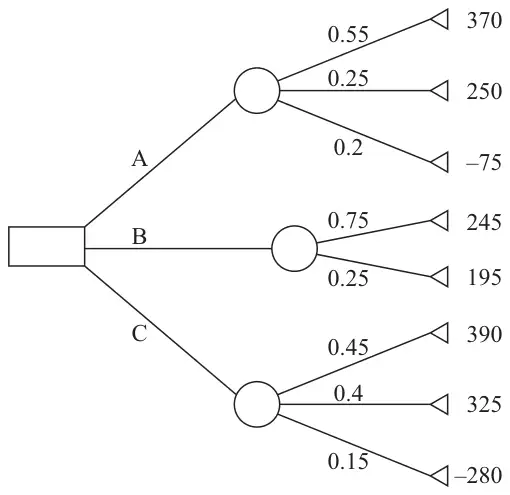
1. Ravi can choose one of three options, A, B or C, when playing a game. The profit, in pounds, associated with each outcome, and the corresponding probabilities, are shown in the decision tree in Figure 1.
Figure 1
Calculate the optimal EMV to determine Ravi’s best course of action. You must make your working clear. (3)
Mark scheme
Scheme
Marks
AO
EMV for A is \(0.55(370) + 0.25(250) + 0.2(-75) = 251\) EMV for B is \(0.75(245) + 0.25(195) = 232.5\) EMV for C is \(0.45(390) + 0.4(325) + 0.15(-280) = 263.5\)
M1
A1
3.4
1.1b
The optimal EMV is £263.50, which makes option C the best choice (using the EMV criterion)
A1
2.2a
(3)
(3 marks)
Notes
Note: Working (or values) may be seen on the diagram as well as on the lined page. If both seen, the answers on the lined page take precedent. Completion of the diagram is not necessary.
M1: Correct method for calculation EMV for either A, B or C
A1: Correct values of EMV for A, B and C
A1: Correct deduction of optimal EMV (dependent on all three correct EMVs) C must be clearly identified in some way, either stated or indicated with e.g. an arrow. If all working is shown on the diagram with 263.50 written in the decision node, they must still indicate C in some way.
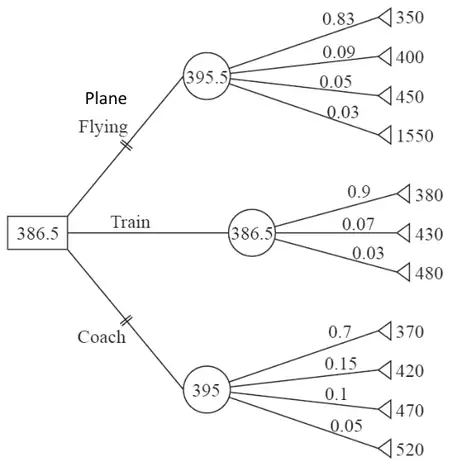
5. Sebastien needs to make a journey. He can choose between travelling by plane, by train or by coach.
Sebastien knows the exact costs of all three travel options, but he also wants to account for his travel time, including any possible delays.
The cost of Sebastien’s time is £50 per hour.
The table below shows the costs, the journey times (without delays), and the corresponding probabilities of delays, for each travel option.
Cost of travel option
Journey time (in hours) without delays
Probability of a 1-hour delay
Probability of a 2-hour delay
Probability of a 3-hour delay
Probability of a 24-hour delay
Plane
£200
3
0.09
0.05
0
0.03
Train
£130
5
0.07
0.03
0
0
Coach
£70
6
0.15
0.1
0.05
0
(a) By drawing a decision tree, evaluate the EMV of the total cost of Sebastien’s journey for each node of your tree. (6)
(b) Hence state the travel option that minimises the EMV of the total cost of Sebastien’s journey. (1)
(c) A cube root utility function is applied to the total costs of each option. Determine the travel option with the best expected utility and state the corresponding value. (3)
Mark scheme (a)
Scheme
Marks
AO
Note arcs must show delay time and probability
M1 A1 M1 A1 M1 A1
3.3 1.1b 3.4 1.1b 3.4 1.1b
(6)
Notes
(a) Condone additional arcs seen with 0 probability (plane 3 hours, train 3 and 24 hours, coach 24 hours)
M1: tree diagram with at least eight end pay-offs, one decision node and three chance nodes (condone missing triangles from end pay offs and incorrect shapes for decision and chance nodes)
A1: correct structure of tree diagram with the non-zero probability 11 arcs labelled correctly (including probabilities)
M1: at least three end-pay offs consistent with their stated probabilities (must include ticket price, cost for travel time and cost for delay – may be implied by correct values); at least eight attempted
A1: all eleven end-pay offs correct including triangles and no incorrect extra (condone if not fully simplified) (values may be negative as costs)
M1: all three chance nodes attempted with their probabilities
A1: CAO for chance and decision nodes including double line through inferior options – must have the correct shapes
Mark scheme (b)
Scheme
Marks
AO
Travel option is Train
dB1
2.2a
(1)
Notes
dB1: deduction of correct travel option (dependent on all method marks earned in (a))
Mark scheme (c)
Scheme
Marks
AO
Utility values are 7.2427…, 7.2820…, 7.3282…
M1 A1
1.1b 1.1b
Therefore, the travel option with the best expected utility is Plane
A1
2.2a
(3)
(10 marks)
Notes
M1: At least one (of the three) utility values correct (FT their end pay offs)
A1: At least two correct
A1: Correct travel option (Plane) together with all three correct values (to at least 3 sf – rounded or truncated)
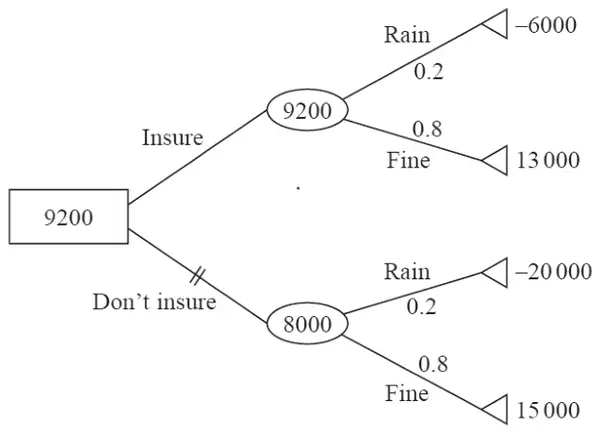
2. An outdoor theatre is holding a summer gala performance. The theatre owner must decide whether to take out insurance against rain for this performance.
The theatre owner estimates that
on a fine day, the total profit will be £15 000
on a wet day, the total loss will be £20 000
Insurance against rain costs £2 000. If the performance must be cancelled due to rain, then the theatre owner will receive £16 000 from the insurer. If the performance is not cancelled due to rain, then the theatre owner will receive nothing from the insurer.
The probability of rain on the day of the gala performance is 0.2
Draw a decision tree and hence determine whether the theatre owner should take out the insurance against rain for this performance. (5)
Mark scheme
Scheme
Marks
AO
M1 A1 A1 M1
3.3 1.1b 3.4 3.4
The theatre owner should take out the insurance
A1
1.1b
(5)
(5 marks)
Notes
M1: tree diagram with at least four end pay-offs, one decision node and two chance nodes used correctly (may not have all shapes drawn e.g. no triangles on end pay-offs)
A1: correct structure of tree diagram with each arc labelled correctly with word and associated probabilities (condone incorrect shapes for decision and chance nodes)
A1: at least three end pay-offs correct including triangles; all four attempted (not dependent on previous A mark so M1 A0 A1 is possible)
M1: both chance nodes completed with at least one value correct. Must be filled in on their diagram.
A1: cao for chance and decision nodes (all three correctly filled in on diagram) + clear conclusion ‘insure’ including double line through the inferior option.
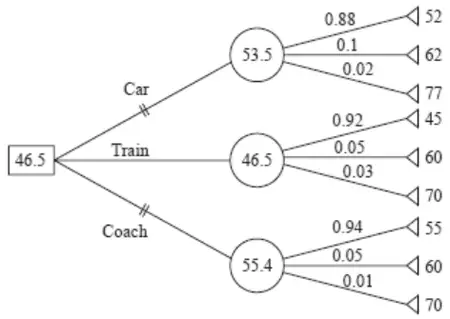
3. The table below shows the transport options, usual travel times, possible delay times and corresponding probabilities of delay for a journey. All times are in minutes.
Transport option
Usual travel time
Possible delay time
Probability of delay
Car
52
10
0.10
25
0.02
Train
45
15
0.05
25
0.03
Coach
55
5
0.05
15
0.01
(a) Draw a decision tree to model the transport options and the possible outcomes. (5)
(b) State the minimum expected travel time and the corresponding transport option indicated by the decision tree. (2)
Mark scheme (a)
Scheme
Marks
AO
M1 A1 M1 M1 A1
3.3 1.1b 3.4 3.4 1.1b
(5)
Notes
M1: tree diagram with at least nine end pay-offs, one decision node and at least three chance nodes used correctly
A1: correct structure of tree diagram with each arc labelled correctly (including probabilities)
M1: at least three end-pay offs consistent with their stated probabilities (eg time 52 with probability 0.88); all nine attempted
M1: chance nodes attempted with their probabilities. Must be filled in on their diagram.
A1: cao for chance and decision nodes completed correctly
Mark scheme (b)
Scheme
Marks
AO
Minimum expected travel time is 46.5 minutes Transport option is Train
B1ft B1
3.4 2.2a
(2)
(7 marks)
Notes
B1ft: correct travel time from their completed tree diagram (dependent on all method marks earned in (a))
B1: deduction of correct transport option (dependent on all method marks earned in (a)) including double line through inferior options in (a) (condone cross or single line here)
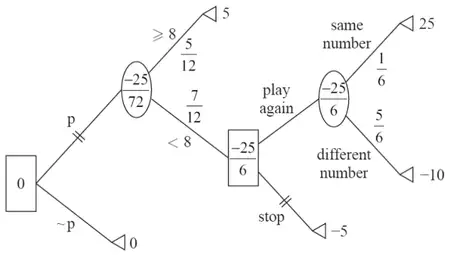
2. Alka is considering paying £5 to play a game. The game involves rolling two fair six-sided dice. If the sum of the numbers on the two dice is at least 8, she receives £10, otherwise she loses and receives nothing.
If Alka loses, she can pay a further £5 to roll the dice again. If both dice show the same number then she receives £35, otherwise she loses and receives nothing.
(i) Draw a decision tree to model Alka’s possible decisions and the possible outcomes.
(ii) Determine Alka’s optimal EMV and state the optimal strategy indicated by the decision tree. (7)
Mark scheme
Scheme
Marks
AO
M1 B1 A1 M1 M1
A1
3.3 1.1b 1.1b 3.4 3.4
1.1b
EMV is £0 and Alka should not play the game
B1
3.2a
(7)
(7 marks)
Notes
M1: Tree diagram with at least five end pay-offs, two decision nodes and two chance nodes
B1: Correct probabilities for rolling an 8 or more and obtaining the same number on both dice
A1: Correct structure for the tree diagram with each arc labelled correctly (including probabilities)
M1: At least three end-pay offs consistent with their stated probabilities; all five attempted
M1: Chance nodes attempted with their probabilities
A1: cao for chance and decision nodes including double line through inferior option
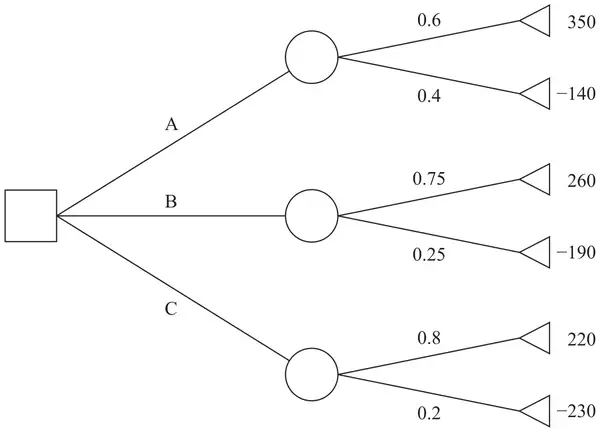
2. Jenny can choose one of three options, A, B or C, when playing a game. The profit, in pounds, associated with each outcome and their corresponding probabilities are shown on the decision tree in Figure 1.
Figure 1
(a) Calculate the optimal EMV to determine Jenny’s best course of action. You must make your working clear. (3)
For a profit of £\(x\), Jenny’s utility is given by \(1 - \mathrm{e}^{-\frac{x}{400}}\)
(b) Using expected utility as the criterion for the best course of action, determine what Jenny should do now to maximise her profit. You must make your working clear. (4)
Mark scheme (a)
Scheme
Marks
AO
EMV for A is \(0.6(350) + 0.4(-140) = 154\) EMV for B is \(0.75(260) + 0.25(-190) = 147.5\) EMV for C is \(0.8(220) + 0.2(-230) = 130\)
M1 A1
3.4 1.1b
The optimal EMV is £154, which makes option A the best choice using the EMV criterion
A1
2.2a
(3)
Notes
M1: Correct method for calculation EMV for either A, B or C
A1: Correct values of EMV for A, B and C
A1: Correct deduction of optimal EMV (dependent on all three correct EMVs)
Calculate all three expected utilities: A is \(0.6(0.583\ldots) + 0.4(-0.419\ldots) = 0.1822557\ldots\) B is \(0.75(0.477\ldots) + 0.25(-0.608\ldots) = 0.2064621\ldots\) C is \(0.8(0.423\ldots) + 0.2(-0.777\ldots) = 0.1830140\ldots\)
DM1 A1
1.1b 1.1b
The optimal expected utility is 0.206 utils, which makes option B the best choice using expected utility as the criterion
A1
2.2a
(4)
(7 marks)
Notes
M1: Uses the correct utility function to replace each pay-off with the corresponding utility
DM1: Calculate all three expected utilities using correct probability values from (a)
A1: At least 2 expected utilities correct (correct to at least 2 decimal places)
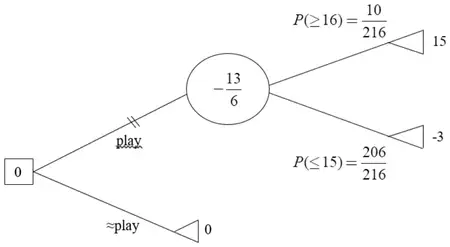
7. Aisha is deciding whether or not to play a game.
The game involves rolling three fair six-sided dice, which have faces numbered from 1 to 6
If the total score on the three dice is 16 or more then she wins a prize. If the total score is 15 or less then she loses and will have to pay the person running the game £3
(a) Given that the prize is £15
(i) draw a decision tree to model Aisha’s possible decisions and the possible outcomes
(ii) determine Aisha’s optimal EMV and state the optimal strategy indicated by the decision tree. (6)
The utility function of the game to Aisha is \(\mathrm{u}(m) = 1 - \mathrm{e}^{-\frac{m}{500}}\) where \(m\) is the amount of money that Aisha has available. Given that Aisha has exactly £3 and that the prize is now £\(x\)
(b) find the expected utility to Aisha of playing the game in the form\[\frac{a}{b}\left(1 - \mathrm{e}^{-\frac{(x+c)}{500}}\right)\]where \(a\), \(b\) and \(c\) are integers to be found. (2)
Aisha decides to use the expected utilities to determine whether she should play the game or not.
(c) Find the minimum prize for which Aisha would consider playing the game. (4)
Mark scheme (a)
Scheme
Marks
AO
(i)
1M1 1B1 1A1 2M1 2A1
3.3 1.1b 1.1b 3.4 1.1b
(ii) Optimum EMV is (£)0 and Aisha should not play the game
1B1ft
3.2a
(6)
Notes
(a)(i) 1M1: tree diagram with at least three end pay-offs, one (rectangular) decision node and one (circular) chance node
1B1: Correct probability for rolling 16 or more (accept equivalent fractions)
1A1: Correct structure of tree diagram with each arc labelled correctly. The following must be seen for this mark:
Probabilities on branches leading from chance node. Probabilities may not be correct but must sum to 1
‘Play’ and ‘Not Play’ (o.e.) labelled correctly. (If one branch is labelled correctly then condone lack of label on the other branch).
Pay offs: 15, –3, 0 placed at tree ends (do not condone ‘3’ for ‘–3’)
2M1: Correct chance node. ft from their probabilities: \(15p - 3(1 - p)\) where \(p\) is their probability for rolling 16 or more. If given as a decimal allow for correct (or truncated) to 2dp
2A1: CAO (must be exact) for chance and decision node including double line through inferior option Note must see 0 at the decision node for this mark.
(ii) 1B1ft: correct optimal EMV (clearly indicated) and analysis in context. So: If their EMV for playing game < 0 then ‘Optimum EMV = 0, together with corresponding conclusion: ‘Aisha should not play’ o.e. would earn B1. Whereas, if their EMV for playing game > 0 then ‘Optimum EMV = their EMV of playing game’ together with corresponding conclusion: ‘Aisha should play’ o.e. would earn B1. (Corrected from the printed mark scheme, which has ‘should play’ and ‘should not play’ the wrong way round in these two sentences.) BUT If their EMV for playing game does not ft from their probabilities then B0.
Mark scheme (b)
Scheme
Marks
AO
Expected utility is \(\dfrac{10}{216}\left(1 - \mathrm{e}^{-\frac{(x+3)}{500}}\right)\)
1M1 1A1
3.4 2.2a
(2)
Notes
1M1: \(p\left(1 - \mathrm{e}^{-\frac{(x+3)}{500}}\right)\) with their \(p\) from (a)
Note: isw after a correct expression for M mark. May see: \(p\left(1 - \mathrm{e}^{-\frac{(x+3)}{500}}\right) + (1 - p)\left(1 - \mathrm{e}^{-\frac{(-3+3)}{500}}\right)\) o.e.
1A1: CAO for expected utility. Must be of the correct form as is specified in the question. So: \(\dfrac{10}{216}\left(1 - \mathrm{e}^{-\frac{(x+3)}{500}}\right)\) but allow fractions equivalent to \(\dfrac{10}{216}\)
Mark scheme (c)
Scheme
Marks
AO
If Aisha doesn’t play she will have \(3 \Rightarrow 1 - \mathrm{e}^{-\frac{3}{500}}\)
1B1
3.1a
For the prize to be worthwhile \(\dfrac{10}{216}\left(1 - \mathrm{e}^{-\frac{(x+3)}{500}}\right) > 1 - \mathrm{e}^{-\frac{3}{500}}\)
1M1
1.1b
Correct order of operations and use of logs to find \(x\)
2dM1
1.1b
\(x > 66.178\ldots\) so (minimum prize amount should be) £66.18
1A1
3.2a
(4)
(12 marks)
Notes
1B1: CAO. May be in decimal form: 0.00598…. May be embedded in inequality/equation.
Note: Look out for missing minus sign in the power if stated exactly.
Note: Do not award this mark if seen in only part (b).
1M1: Sets up an inequality or equation with their expected utility of playing the game (from part b).
2dM1: Solving for \(x\) (dependent on previous M mark). Requires correct order of operations and log work.
For example, May see: \(\mathrm{e}^{-\frac{(x+3)}{500}} \ \square\ 1 - \text{‘}p\text{’}\left(1 - \mathrm{e}^{-\frac{(3)}{500}}\right)\) o.e. [Isolates exponential term] Or \(\mathrm{e}^{-\frac{(x+3)}{500}} \ \square\ 0.870\ldots\) Followed by: \(\dfrac{(x+3)}{500} \ \square\ -\ln\left(1 - \text{‘}p\text{’}\left(1 - \mathrm{e}^{-\frac{(3)}{500}}\right)\right)\) o.e. [Applies logs correctly] Or \(\dfrac{(x+3)}{500} \ \square\ 0.138\ldots\) Where \(\square\) is any inequality or equals sign.
Note: May not get to \(x = \ldots\)
Note: Can be implied by correct answer
1A1: CAO with units
Note: For this mark, condone ‘£66.18’ or ‘\(x =\) £66.18’ or ‘\(x \geqslant\) £66.18’, but not ‘\(x >\) £66.18’.