
A2 October 2020 Q2
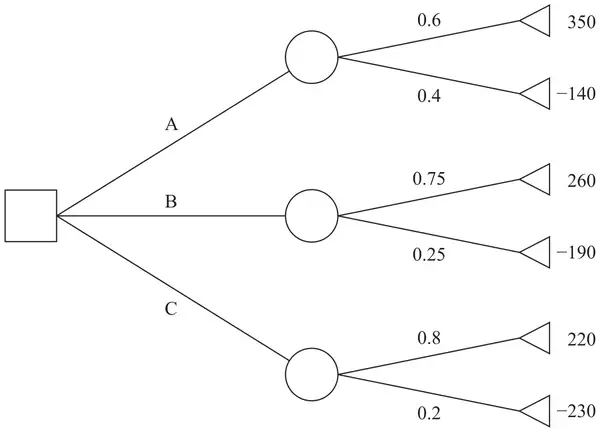
2. Jenny can choose one of three options, A, B or C, when playing a game. The profit, in pounds, associated with each outcome and their corresponding probabilities are shown on the decision tree in Figure 1.
For a profit of £\(x\), Jenny’s utility is given by \(1 - \mathrm{e}^{-\frac{x}{400}}\)
| Scheme | Marks | AO |
|---|---|---|
| EMV for A is \(0.6(350) + 0.4(-140) = 154\) EMV for B is \(0.75(260) + 0.25(-190) = 147.5\) EMV for C is \(0.8(220) + 0.2(-230) = 130\) | M1 A1 | 3.4 1.1b |
| The optimal EMV is £154, which makes option A the best choice using the EMV criterion | A1 | 2.2a |
| (3) |
Notes
M1: Correct method for calculation EMV for either A, B or C
A1: Correct values of EMV for A, B and C
A1: Correct deduction of optimal EMV (dependent on all three correct EMVs)
| Scheme | Marks | AO |
|---|---|---|
| \(u(350) = 0.5831379803\ldots,\ u(-140) = -0.4190675486\ldots\) \(u(260) = 0.4779542232\ldots,\ u(-190) = -0.6080141975\ldots\) \(u(220) = 0.4230501896\ldots,\ u(-230) = -0.7771305269\ldots\) | M1 | 3.4 |
| Calculate all three expected utilities: A is \(0.6(0.583\ldots) + 0.4(-0.419\ldots) = 0.1822557\ldots\) B is \(0.75(0.477\ldots) + 0.25(-0.608\ldots) = 0.2064621\ldots\) C is \(0.8(0.423\ldots) + 0.2(-0.777\ldots) = 0.1830140\ldots\) | DM1 A1 | 1.1b 1.1b |
| The optimal expected utility is 0.206 utils, which makes option B the best choice using expected utility as the criterion | A1 | 2.2a |
| (4) | ||
| (7 marks) |
Notes
M1: Uses the correct utility function to replace each pay-off with the corresponding utility
DM1: Calculate all three expected utilities using correct probability values from (a)
A1: At least 2 expected utilities correct (correct to at least 2 decimal places)
A1: Correct deduction of optimal expected utility